
 | The Bullroarer - Tuesday 12 August 2008 | The Oil Drum: Australia/New Zealand | National Energy Essay Competition |  |
The Hydrogen Economy and Peak Platinum
Posted by Big Gav on August 13, 2008 - 10:05am in The Oil Drum: Australia/New Zealand
One Bullroarer at TOD ANZ a week or two ago featured an article from the ABC on the possibility of mining low grade Australian platinum reserves to supply rising demand for catalytic converters and hydrogen fuel cells - World 'needs Australia's platinum to build cleaner cars'.
An Australian researcher has warned that the drive to put cleaner, hydrogen-fuelled cars on the road will stall unless new reserves of platinum are found. Platinum is one of the key components of catalytic converters, catalysing carbon monoxide from exhaust fumes. It is also a critical component of fuel cells for hydrogen-powered cars. However 80 per cent of the world's reserves come from just three mines.
John Mavrogenes says a team of geochemists from the Australian National University has identified new methods to detect platinum deposits. They are simulating the intense heat and pressure of the Earth's magma to discover whether platinum can be extracted from other minerals. "This work may help geologists find new reserves around the world in places that haven't been searched before," he said. Professor Mavrogenes says if the platinum price remains at its current high, Australia could mine lower-grade deposits. ...
The three major mines that produce platinum are in South Africa, Siberia and the United States. "If we go to more and more uses of platinum we're going to need more than they can produce," Professor Mavrogenes said. "Existing reserves would meet less than 20 per cent of the world's platinum demand if all cars went hydrogen."
The Hydrogen Economy
The dream of the hydrogen economy is one that has been around since the 1970's, and has been heavily hyped by sources ranging from Wired (as a key component to their long boom vision), the European Hydrogen Association and Jeremy Rifkin to George W Bush (who seemed primarily interested in supporting the gas and nuclear industries).
The term was originally coined by chemistry professor John Bockris (also an alchemist, cold fusion researcher and winner of the Ig Nobel prize).
The basic vision is that hydrogen is used to fuel vehicles containing hydrogen fuel cells, rather than internal combustion engines, creating no pollution other than water.
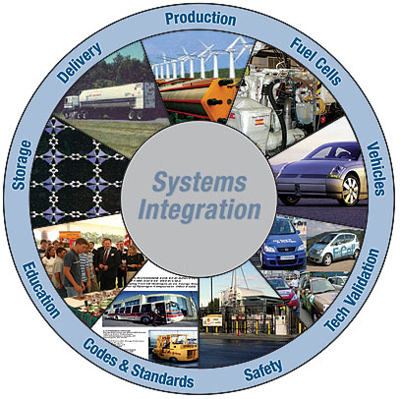
Global hydrogen production is currently derived from natural gas (48%), oil (30%), coal (18%) and electrolysis of water (4%). Given that hydrogen is currently largely derived from fossil fuels, the first obstacle facing the "hydrogen economy" dream is shifting away from these sources to extracting hydrogen from water.
Hydrogen is also used for producing ammonia and cracking heavier grades of oil, which means that peak oil and gas pose a number of problems to the hydrogen dream - the primary sources of present day hydrogen become less plentiful, and demand for hydrogen increases as we resort to heavier grades of oil (and coal to liquids) to keep the habit going.
Criticisms of the hydrogen economy
Critics of the hydrogen economy aren't hard to find, with frequently raised objections including:
* The use of natural gas (both from a global warming point of view and a depletion point of view)
* The inefficiency of electrolysis techniques in converting other forms of energy into hydrogen
* The difficulty of distributing and storing hydrogen
* The cost of setting up a hydrogen based infrastructure to replace the existing oil based infrastructure
* Safety concerns about storing hydrogen on board vehicles
* The cost and complexity of hydrogen fuel cells
* Availability of platinum for large scale use in fuel cells
Amory Lovins' Rocky Mountain Institute (pdf) argues that many of these objections are either myths or can be overcome.
Fuel cell expert Ulf Bossel and energy commentator Joe Romm (author of The Hype About Hydrogen) are probably the most frequently cited critics, arguing that the inefficiency of the hydrogen conversion process is wasteful and compares unfavourably to alternatives - specifically the "electron economy" where electricity is the energy carrier of choice.
Bossel says "In a sustainable energy future, electricity will become the prime energy carrier. We now have to focus our research on electricity storage, electric cars and the modernization of the existing electricity infrastructure".

The diagram above shows that both the efficiency of electrolysis and the efficiency of fuel cells are key factors in making hydrogen as a transport fuel less attractive than the electric transport option.
Peak Platinum
Even if we assumed that hydrogen fuel cells could be made significantly more efficient, and thus more competitive with the electric vehicle option than they are currently, we still have the issue of the scarcity (and thus the cost) of platinum to deal with, as platinum is the material traditionally used as the catalyst in cells.

In 2005, South Africa was the top producer of platinum, accounting for around 80% of world production, followed by Russia and Canada. Significant deposits are also found in Zimbabwe, the United States and, as noted in the introduction, Australia. South Africa has been expanding production rapidly to take advantage of soaring prices - causing some controversy in affected townships.
When discussing rare metals, the subject of peak minerals is usually quick to arise. The idea has been covered at a number of venues in recent years - including The Oil Drum, New Scientist (with some good graphics here and here) and WorldChanging.


The New Scientist article estimated that there are 360 years of platinum reserves available if we continue to extract it at the current rate of production - however this drops to 15 years if predicted growth in demand is taken into account.
One analyst at Resource Investor has predicted that we may have already reached "peak platinum" production, though this seems to be predicated on the belief that production of hybrid and electric vehicles will remove the demand for both fuel cells and catalytic converters in future years, rather than a firm belief in supply constraints.
Another analyst at the UK Department For Transport, looked at the platinum supply situation for fuel cell vehicles and concluded:
The above projections, coupled with the statements from Cawthorn (1999) about accessible platinum reserves in South Africa, suggest that platinum availability should not be a constraint to the introduction of hydrogen fuel cell cars. If South Africa alone can deliver up to 5% per year additional platinum supply between 2000 and 2050, this equates to an additional 13.6 million oz in 2030, 24.8 million oz in 2040 and 42.9 million oz in 2050, which is sufficient to meet demand under any of the scenarios considered.
However there are many important assumptions and uncertainties built into this model. For example, this additional South African platinum supply would be insufficient to meet worldwide platinum demand by 2040 under Scenario 2 (realistic penetration) if any one of the following alternative assumptions is made:
* South African supply can only be increased by 4% per annum instead of 5%.
* Jewellery demand grows at more than 2% per annum - it is currently assumed to remain constant but grew by an average of 6% per annum between 1994 and 2001.
* Fuel cell stacks require more than 0.3 oz of platinum per car in 2040 - it is currently assumed that only 0.2 oz will be required but this is a factor of 10 less than current stack technology.
* The demand for cars grows by more than 55% per decade - it is currently assumed to increase by 45% per decade based on USDOE projections.The platinum loading for fuel cell stacks is an important factor in determining the commercial viability of fuel cell cars as well as determining potential platinum demand constraints. The price of platinum is not likely to be a constraint to the introduction of fuel cell vehicles if the expected reductions in platinum loadings are achieved. At current platinum prices and the target platinum loading of 0.2 oz per car, the platinum required for a single car would cost about $90 or $1.5/kW, compared to a cost target of $50/kW for the whole fuel cell engine.
In the wake of the New Scientist article, the Wall Street Journal noted that if the most dire predictions are true, recycling of rare metals will be the only way to manufacture some types of machinery. Hazel Prichard, a geologist at the University of Cardiff in the UK, is developing ways to extract platinum from the dust and grime of city streets - apparently, urban grit contains 1.5 parts per million of platinum.
Its worth noting the contrarian view of metals depletion, expressed by Herman Kahn in his book "The Next 200 Years", which points out that reserves data for minerals is often very dubious when there is sufficient known supply available to meet hundreds of years of demand - and that recycling can change the picture dramatically in any case.
Either way, the platinum supply concern may not be an insoluble problem, as recent reports from Japan claim Nisshinbo Industries and the Tokyo Institute of Technology have developed a platinum-free, carbon-based catalyst for fuel cells which they hope to commercialise in 2009 (first for home use, later for use in vehicles). Their catalyst is made from nanospheres of carbon. While 10 times as much carbon is required compared to the platinum equivalent, the cost is one 10th of using platinum. Diahatsu also claims to have a platinum free catalyst, using cobalt or nickel.
Another platinum free alternative being pursued is being researched at Monash University, where chemist Bjorn Winther-Jensen is looking at layering an active conducting polymer onto Gore-tex to make a cheap catalyst.
Alternative Methods For Producing Hydrogen
The discussion following the Australian platinum supply article at TOD ANZ noted the recent, highly publicised, research into a new catalyst for electrolysis at room temperature using cobalt and phosphate which MIT modestly described as a
"'Major discovery' from MIT primed to unleash solar revolution". The process also requires platinum, which seems to limit the potential for cheap and universal application of the technique.
The news was covered extensively pretty much everywhere - see Technology Review, Green Car Congress, The Guardian, The Press Association, Wired, Renewable Energy World, EE Times and Scientific American, with much of the coverage being heavy on hype and short on facts and accuracy.
Joules Burn at The Oil Drum was less impressed, cynically commenting on the story in Local Scientist Splits Water, Saves World, Gets On TV. Bruce Sterling didn't see what the big deal was either, and nor did Joe Romm, who was positively scathing about the news.

There are other schemes for generating hydrogen that don't require electrolysis, at various stages of maturity.
A group at the University of Birmingham in England is looking at using microbes to produce "biohydrogen" from waste, and claim their technology has an added bonus - leftover enzymes can be used to scavenge precious metals from spent automotive catalysts that can then be used to make fuel cells.
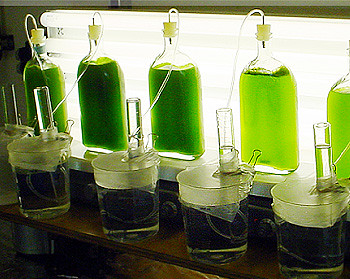
Another biotechnology based approach to hydrogen generation is being pursued at the University of Queensland and Berkeley University, in this case using algae.
So Is Hydrogen Worth Pursuing At All ?
Whether or not the MIT discovery, or any of the other alternatives, really does lead to cheap, abundant hydrogen seems open for debate for the time being.
If we assume for a moment that it is possible to generate hydrogen on a large scale in a reasonably cost effective manner, the issues around distribution, storage and fuel cells still remain - particularly when comparing a hydrogen fueled transport system to one using electric cars.
The car industry, apart from BMW and Honda, seems to have pretty much given up on using hydrogen for vehicles, but enthusiasm remains for using fuel cells in some niche applications where problems are minimised, such as buses, which are refueled at a central location and have fewer concerns about weight and storage size.
Another niche where distributed hydrogen generation may be applicable is cogeneration (CHP) at home, something Jamais Cascio noted in his comment on the MIT announcement. Japan would seem a likely candidate for proving this on a large scale given that they seem to be the most enthusiastic about using hydrogen at home.

The other likely candidate for using hydrogen is energy storage in renewable energy generation - though perhaps not for home scale PV the way Nocera has been suggesting. An Australian company called WHL (previously Wind Hydrogen) has been looking at building wind farms which store excess energy in the form of hydrogen and use it to generate power later, when the wind isn't blowing. The Lolland Hydrogen Community in Denmark has been experimenting with a similar concept, as has a ship called the Hydrogen Challenger.
Melbourne based company Solar Systems is also looking to combine hydrogen energy storage with a solar power plant, using excess heat to improve the efficiency of electrolysis.
Cross posted from Peak Energy.
Contact
- anz at theoildrum dot com
License

This work is licensed under a Creative Commons Attribution-Share Alike 3.0 United States License.
Archives
- November 2010 (2)
- October 2010 (5)
- September 2010 (4)
- August 2010 (8)
- July 2010 (2)
- June 2010 (2)
- May 2010 (6)
- April 2010 (7)
- March 2010 (12)
- February 2010 (11)
- January 2010 (7)
- December 2009 (10)
- November 2009 (6)
- October 2009 (7)
- September 2009 (10)
- August 2009 (10)
- July 2009 (3)
- June 2009 (14)
- May 2009 (10)
- April 2009 (15)
- March 2009 (16)
- February 2009 (16)
- January 2009 (15)
- December 2008 (15)
- November 2008 (23)
- October 2008 (25)
- September 2008 (24)
- August 2008 (30)
- July 2008 (44)
- June 2008 (38)
- May 2008 (48)
- April 2008 (43)
- March 2008 (29)
- February 2008 (32)
- January 2008 (30)
- December 2007 (26)
- November 2007 (32)
- October 2007 (11)
A related article from the SMH today - Platinum shortfall expected to increase
I don't work in PGMs, but it seems to me that significant platinum production comes from Layered Mafic Intrusions(LMIs). LMIs were all emplaced back in the Archean, and Mother Nature "don't make them anymore". Unless you have very old continental shield basement exposed, you just don't have LMI's.
The exploration model for LMI's is pretty advanced and the places available to look for LMI's are pretty limited. I could be wrong, but I think Stillwater in Montana, USA was the last major new LMI platinum deposit discovered/put into production.
There are Alaskan/Ural-type ultramafic intrusive platinum deposits, but again there is a fairly well-understood exploration model. I wonder just how much potential there is to expand platinum production. Arctic Canada and arctic Siberia are tough places to operate mines. Exploration for platinum underway in the arctic of Finland demonstrates some of the difficulties.
So aside from hydrogen's thermodynamic problems, I have doubts about the capacity of the world's platinum miners to maintain production, especially in the face of dramatically higher fuel and equipment costs.
"I don't work in PGMs, but it seems to me that significant platinum production comes from Layered Mafic Intrusions(LMIs). LMIs were all emplaced back in the Archean, and Mother Nature "don't make them anymore"."
They would have that in common with a lot of geological features. I can assure you that they are out there and they are still being discovered and explored. I'm a shareholder in a company (Magma Metals) which is exploring for PGM in Canada. They are finding plenty of platinum but little investor interest due to the falling platinum price. If the market senses low demand then the price drops and resource companies will shelve their projects (and vice versa). Its not a matter of there being an arbitrary limit to discoveries or production its simple economics. If Magna does not prove up a reserve or enter production it will be because the economics aren't good - not because the platinum isn't there.
As with all minerals, higher prices lead to greater supply through:
-increased investment in exploration
-increased investment in production
-production from lower grade sources which may previously have been un-economic.
-recycling of metal (which may have previously been uneconomic)
they also lead to lower demand through:
-substitution (e.g. with palladium)
-technological innovation to reduce platinum requirements(e.g Nissan this week announced it had halved the amount of platinum used in its fuel cell stack).
-technological developments to replace platinum (as several R&D teams have recently announced).
I would add that the same arguments being raised against platinum are also being leveled at lithium and the same economic counter-arguments apply.
Like Bryant, I'm a geologist, and also like him, I don't work in platinum (or platinum group elements, PGE, which include palladium and several similar metals). I'd probably agree with both of you, though. As has been discussed previously on TOD, you can always extract more metals from low grade or small deposits, or from tailings, or (unlike oil) via recycling, given sufficient need and the right price. Ultimately, however, this will probably boil down into an energy cost, and the total amounts are still limited by geology, which is Bryant's point.
As you state, lots of platinum remains, at the proper price, and substitution is possible if the price gets too high. Not mentioned yet is, e.g., the huge Dufek layered mafic intrusion in Antarctica, which LMI is presumed to contain much platinum (e.g. Maarten De Wit's 1985 book "Minerals and Mining in Antarctica"). Far more speculatively, the Moon is presumed to contain abundant platinum in either LMI's or dissolved in the iron of fallen meteorites (e.g., "Moonrush by Dennis Wingo, 2004). Slightly (but not much) more reasonably, metallic asteroids presumably would contain practically infinite amounts of recoverable platinum, if they could be placed in low Earth orbit before mining (see "Mining the Sky" by John S. Lewis, 1997). Of course, these "far out" proposals assume both that demand resulting from a runaway hydrogen economy will keep platinum prices literally "sky-high" and that cheap access to space will some day become possible. I won't defend either assumption.
To summarize, whatever valid (practical and thermodynamic) arguments might be raised against the so-called hydrogen economy, an immediate (or ultimate) shortage of catalytic platinum is probably not one of them. On the other hand, if this cornucopian statement sounds just as silly as stating there are more-than-sufficient amounts of recoverable hydrocarbons in oil shales and tar sands (or on Titan), it probably should.
Hydrocarbon fuels consist of complex molecules that have formed under special conditions over geological time scales. Once consumed they are gone for ever (for our purposes). Platinum (and lithium) are simple elements that exist in varying concentrations in the earth's crust but can't really be destroyed.
The pattern of consumption is very different too. Oil and other fossil fuels are energy sources which are burnt (destroyed) in order to do work. Lithium is more analogous to a fuel tank, and platinum to a filter - they aren't the source of the energy. They are consumed as more vehicles are put on the road, rather than miles traveled or work done - so demand for them follows a very different pattern and isn't infinite (unlike demand for energy). Also unlike oil (and other hydrocarbons) they aren't destroyed in their use so may be recycled (if that is economic).
Minerals of all varieties are important to all aspects of daily life. Just because demand exceeds supply from time to time doesn't make a case for it being "peak".
As a side note I have even heard of "peak water" recently. Sure there are regions where supplies of potable water are endangered, but as for the planet running out of the stuff - not likely. The problems and solutions are of an economic and engineering nature. They aren't caused by basic laws of science and the "p" word is once again being abused.
And we won't ever run out of oil, either. I mean, even when oil fields are "dry", 65% or so of the oil remains in place. It's just too much trouble to get out.
The issue with all resources isn't "running out", but rather having much less than we need for the particular way we like to do things. Demand exceeds supply by a large amount.
For example, if we didn't burn fossil fuels, but still used them for plastics, the chemical industry, fertilisers and so on, then at current rates of use we'd have centuries before peak fossil fuels became a serious issue; but we burn the stuff at stupid rates, so peak fossil fuels are an issue today.
Likewise, with our current rate of use of platinum its peaking in production is not really much of an issue; but if we were to use it in fuel cells in a billion or so cars and homes, then it'd very likely be a serious issue.
I have disagree with almost everything in this article, First, Hydrogen, is a worthless storage device. As for Platinum, There has been a significant rise in the price recently, Rhodium rose by 35% over the last three months, The problem is not a shortage of Platinum but a lack of infrastructure to process it. If we were to mine Platinum in Oz we would have to ship it to South Africa for refining. that would be expensive. The other thing that should be pointed out is that to get platinum you need other rare minerals in the PGM group. The only source of Rhodium I know of is in Zimbabwe.
Like I said...I don't do PGMs, but metal mining is pretty much the same the world over. In the gold mining business, higher metal prices are deceiving. The costs of production are accelerating as fast or faster than the the metal price. Despite record gold prices, new exploration and production is problematic, especially given that today's deposits are usually more technically challenging...that's why they were not discovered/mined before.
If you are expecting new, large, accessible and profitable platinum deposits to "appear" as a result of higher platinum prices/demand...you might as well wish for a pony too.
Rhodium is about 80% from South Africa and this year the 20 tons produced will be worth more than the gold (about 6 billion dollars). Rhodium is in a huge bubble (up 20 fold) that is due to burst (maybe already has).
Thanks for the Rhodium info, and yes it is in a huge bubble, Merril Lynch have to get those 35% profits from somewhere It is worth a lot more than Platinum though because it is rare, I thought that Rhodium was an essential element in the process of refining Platinum, and it is also essential for catalytic converters. I wish my memory was better, but I seem to have the idea that Rhodium and Platinum have some special link, i.e. you cant get platinum without rhodium. and this is why most platinum deposits are not viable.
However you can allways get rhodium from spent nuclear fuel.
Nuclear enthusiasts often throw in the partitioning argument, but partitioning with high efficacy is not easy nor proven to be viable on a full commercial scale.
Something doesn't add up. The figure of 0.2 oz costing $90 was mentioned in the text (UK transport) yet platinum is $1470/oz.
At .2oz X $1470= $300 the device would be a magnet for thieves.
Thanks for your support:
http://www.reddit.com/comments/6vypn/the_hydrogen_economy_and_peak_plati...
Nice article Gav. The animated fuel cell is cute, but oh-so-20th-Century with its Edison-style lightbulb...
:-)
Gee, I bet you didn't expect an argument on the Reddit page as well! It's like one of those combat games that jump between different dimensions of time and space!
In 2004, the National Academy of Engineering identified 4 significant problems with a hydrogen economy in, The Hydrogen Economy:
Opportunities, Costs, Barriers, and R&D Needs:
“There are major hurdles on the path to achieving the vision of the hydrogen economy; the path will not be simple or straightforward. Many of the committee’s observations generalize across the entire hydrogen economy: the hydrogen system must be cost-competitive, it must be safe and appealing to the consumer and it would preferably offer advantages from the perspectives of energy security and CO2 emissions. Specifically for the transportation sector, dramatic progress in the development of fuel cells, storage devices, and distribution systems is especially critical. Widespread success is not certain. The committee believes that for hydrogen-fueled transportation, the four most fundamental technological and economic challenges are these:
1. To develop and introduce cost-effective, durable, safe, and environmentally desirable fuel cell systems and hydrogen storage systems. Current fuel cell lifetimes are much too short and fuel cell costs are at least an order of magnitude too high. An on-board vehicular hydrogen storage system that has an energy density approaching that of gasoline systems has not been developed. Thus, the resulting range of vehicles with existing hydrogen storage systems is much too short.
2. To develop the infrastructure to provide hydrogen for the light-duty-vehicle user. Hydrogen is currently produced in large quantities at reasonable costs for industrial purposes. The committee’s analysis indicates that at a future, mature stage of development, hydrogen (H2) can be produced and used in fuel cell vehicles at reasonable cost. The challenge, with today’s industrial hydrogen as well as tomorrow’s hydrogen, is the high cost of distributing H2 to dispersed locations. This challenge is especially severe during the early years of a transition, when demand is even more dispersed. The costs of a mature hydrogen pipeline system would be spread over many users, as the cost of the natural gas system is today. But the transition is difficult to imagine in detail. It requires many technological innovations related to the development of small-scale production units. Also, nontechnical factors such as financing, siting, security, environmental impact, and the perceived safety of hydrogen pipelines and dispensing systems will play a significant role. All of these hurdles must be overcome before there can be widespread use. An initial stage during which hydrogen is produced at small scale near the small user seems likely. In this case, production costs for small production units must be sharply reduced, which may be possible with expanded research.
3. To reduce sharply the costs of hydrogen production from renewable energy sources, over a time frame of decades. Tremendous progress has been made in reducing the cost of making electricity from renewable energy sources. But making hydrogen from renewable energy through the intermediate step of making electricity, a premium energy source, requires further breakthroughs in order to be competitive. Basically, these technology pathways for hydrogen production make electricity, which is converted to hydrogen, which is later converted by a fuel cell back to electricity. These steps add costs and energy losses that are particularly significant when the hydrogen competes as a commodity transportation fuel—leading the committee to believe that most current approaches—except possibly that of wind energy—need to be redirected. The committee believes that the required cost reductions can be achieved only by targeted fundamental and exploratory research on hydrogen production by photobiological, photochemical, and thin-film solar processes.
4. To capture and store (“sequester”) the carbon dioxide by-product of hydrogen production from coal. Coal is a massive domestic U.S. energy resource that has the potential for producing cost-competitive hydrogen. However, coal processing generates large amounts of CO2. In order to reduce CO2 emissions from coal processing in carbon-constrained future, massive amounts of CO2 would have to be captured and safely and reliably sequestered for hundreds of years. Key to the commercialization of a large-scale, coal-based hydrogen production option (and also for natural-gas-based options) is achieving broad public acceptance, along with additional technical development, for CO2 sequestration.
For a viable hydrogen transportation system to emerge, ALL FOUR of these challenges must be addressed.” (my emphasis added)
Regarding the hydrogen economy, the U.S. Army Corps of Engineers (2005) concluded that
“there are tremendous problems to overcome; once we have solved the PRODUCTION, TRANSMISSION, and RESOURCE issues (my emphasis added,)
then the switch to hydrogen may occur. This is a long term issue and the hydrogen economy is decades away. The tools to make it work, such as safe nuclear reactors, windmills, and fuel cells are still in the development or early adoption phases. To realize the potential benefits of a hydrogen economy – sustainability, increased energy security, a diverse energy supply, and reduced air pollution and greenhouse gas emissions – hydrogen must be produced cleanly, efficiently, and affordably from regionally available, renewable resources.”
In summary, even if we can get lots of hydrogen, the hydrogen economy is not possible.
Hydrogen cannot be transported using the current pipeline net work that is used to transport diesel, gasoline, heating oil, and jet fuel. Thus a whole new vastly more expensive pipeline system would have to be built (very heavy pipeline is required
We would have to construct, transport, and put in place hundreds of thousands of hydrogen filling stations to replace the gasoline/diesel stations, as well as replace hundreds millions of car and truck engines, and train millions of personnel on the repair of hydrogen engines.
On-board hydrogen tanks would be huge and carry less energy than gasoline and diesel, thus necessitating more filling station than we have now. Because hydrogen leaks easily and is explosive, ventilation would have to be installed in all public and home parking garages.
This switch over would require trillions of dollars in investments and would consume enormous quantities of fossil fuels that will soon be dedicated to keeping people warm in their homes.
Did you actually read the post ?
Yes I read the post. I added solid documentation from credible sources explaining why the hydrogen economy is impractical. You did not do this.
One has to wonder why you and TOD editors present so many techno-fix posts and so few posts on contingency planning and risk management regarding the impacts of Peak Oil.
From your two comments it would seem you didn't.
I made it pretty clear the vision of a hydrogen economy, as applied to transportation, was unviable.
You then vigourously "disagreed" and said exactly the same thing.
However, I did say that there are some niches where hydrogen may be useful, primarily as a form of energy storage for power generation.
If you want to disagree with the post, that is the part you should be arguing against.
Comments about distribution problems and large scale infrastructure replacement do not apply in this case.
If you want to read about risk management, here's a post from ANZ on Monday:
http://anz.theoildrum.com/node/4391
Did you read the first part of your post?
"The three major mines that produce platinum are in South Africa, Siberia and the United States. "If we go to more and more uses of platinum we're going to need more than they can produce," Professor Mavrogenes said. "Existing reserves would meet less than 20 per cent of the world's platinum demand if all cars went hydrogen."
I didn't bother reading past that. The last sentence is an absolute joke. "If all cars went hydrogen".........holy crap. this must be the worst post ever on TOD.
Why didn't you read it?
"Existing reserves would meet less than 20 per cent of the world's platinum demand if all cars went hydrogen." was a quote, are you suggesting that quoting somebody accurately is not a good thing?
Because quoting stupidity and then proceeding to elaborate on it is as stupid as the quote.
What part of the quote do you like? Would you like to enlighten me as to what is good about it?
I know I shouldn't feed the trolls but....
then
So did you read it or not? then if that is the case where is your constructive comment?
Troll feeding can be a waste of time but I appreciate your comments anyway.
I kind of like the idea of being awarded "worst TOD post ever" by someone who only read the introductory paragraph - especially when 80% of the words where from a newspaper article. Apparently the content and conclusion of the article are irrelevant (no wonder newspaper editors mainly worry about the headline and the first paragraph or two).
Bandits;
Just saying 'If all cars went to Hydrogen' is a hypothetical, not advocacy. He's just using an extrapolation to show a sense of scale of available Platinum production.
Hyperbolic much?
Hi all,
It is my understanding that H2 and O3 react fiercely. Could chemists out there please explain the the Ozone layer depletion consequences of having H2 as the dominant energy working substance.
cheers
At this time no one knows the long term effect of massive amounts of H2 in the bio-sphere. But if H2 is able to escape the biosphere due to gravity VS weight then yes, H2 will end up reacting with O3.
A link saying 'it will be bad' was posted a few drumbeats ago.
Oh well, the people who won't accept powerdown or population reduction will end up dooming their childern and childerns childern, so eventually there will be price to pay for their actions today.
Geez, are you a pessimist by nature or something?
There's gobs of power available, we don't need to power down jack. We just have to advance our technology enough to be able to convert it and store it.
I suspect you're not so much a pessimist as an elitist attempting to appeal to people who disagree with your view with the "for the children" argument.
We will figure this out, and you will not be moving into your mountain castle with the personal police force to keep out the lowly commoners, since they won't even need your food or fuel.
We don't strictly have to figure out the effects of large amounts of hydrogen emitted into the atmosphere because we will never have a hydrogen economy.
This kind of post, without any quantification, is just arm waving. Most of the objections to the so-called "hydrogen economy" result from a failure to quantify, and to realize what the term "hydrogen economy" really means, as well as to monitor the rate of progress of technology, and therefore most of the objections are essentially invalid. the famous Ulf Bossel is ine of the most guilty. See:
http://www.energypulse.net/centers/article/article_display.cfm?a_id=875 . Murray
If you quantify the entropy equasion of hydrogen energy storage, and link that to macro-economical dynamics, you will know why we will never have a full scale hydrogen economy.
It was by just the means Cyril R. describes that I came to realize, several years ago, that other zero-local-emission combustibles were lighter and safer as car fuels than hydrogen is. [Whips glasses off, nails the camera with naked gaze] G.R.L. Cowan did
and, having incontrovertibly done it, need not do it again. But maybe Cyril R. could concisely but without omission run through his use of ... whips off glasses again, cueing the celestial choir ... the entropy equation ... in this context.
--- G.R.L. Cowan, H2 energy fan 'til ~1996
The fuel-cell-centric hydrogen economy vision is a sham, but hydrogen works well in spark-ignited motors, so if platinum became unobtainable, this would not make the hydrogen economy any less viable.
Cars with liquid hydrogen tankage that looked persuasive to me existed in the mid-1970s. Apparently if I had had the money to buy one, however, I would not have done so; thus, the very rich Governor of California never had any of his vehicles converted to hydrogen, nor did he ever buy a new car that was hydrogen-capable, despite seeming intent on doing so at one time.
--- G.R.L. Cowan, H2 energy fan 'til ~1996
The energy cost to liquefy hydrogen is enormous. If you're burning it in an IC engine, might as well react it with CO gas to make hydrocarbons. Courtesy of mdsolar:
http://mdsolar.blogspot.com/2007_12_01_archive.html
We've been very busy over at PESWiki adding information and links regarding Hydrogen Production, etc. -
http://peswiki.com/index.php/Directory:Hydrogen
Have we saved the cars yet?
Thank God. I thought we might have to walk. Whew.
It shouldn't be a choice between the two.
I have a car and I'd like to think that in 20 years time I still do, albeit an electric one.
However, I prefer to walk or cycle, and cycling is how I get to work - the number of car journeys I do is pretty small - generally less than 5 per week (sometimes none), and most of those are less than 5 kilometres.
It would be preferable if people lived fairly close to their work, and thus could avoid cars for much of their travel - and that urban planners designed walkable suburbs and put decent public transport in place - however cars have their uses and I doubt they are going to disappear.
Gav
The problem with offering the solution of "walkable suburbs and put decent public transport in place" is that public officials are in my opinion, doing the second without the first, I am in fact relatively anti the current crop of public transport solutions. In Auckland we have the ARTA which subsidizes buses, trains and ferrys and 'energy efficiency' is not directly one of their goals.
The outcome of this is (and I assume it will be the similar in Australian cities) that we end up with politically and ideologically justified public transport systems that barely (if at all) reduce our energy consumption that are offered up as the 'environmental' solution. The irony lies in the fact that public transport 'efficiency' (in energy per distance traveled) increases the farther each passenger goes whereas we should be promoting the philosophy of traveling less, ie walkable urban areas, rendering intra urban public transport redundant.
Neven MacEwan B.E. E & E
I was actually surprised to see Gav come out in favour of walking and walkable suburbs as the priority solution over electric cars. I think we will have some form of mechanised road transport for the forseeable future but I doubt it will be fuel cell H2 inspired. NG and biogas maybe, hybrids definitely especially for goods delivery trucks.
Now here is a dumb question which some of the chemists may be able to answer. If supposing we could generate plenty of H2 through renewable powered electrolysis, could we then react that H2 with a carbon source to make CH4 or methane? We already have a distribution system for methane, it can be liquified and even converted to liquids using FT. I am guessing that the efficiency would be lousy but if the initial energy input is virtually limitless, say from solar CSP or wind, who cares?
Thanks in Advance - Termoil
Actually I didn't say that walking and walkable suburbs are the priority solution, I said they are my personal preference (subtle but distinct difference).
Given that we have a lot of unwalkable suburbs and an oil dependent transport infrastructure, the priority solution is switching to electric transport (in its various forms) ASAP - so getting practical and economical electric cars on the market is actually the priority solution (followed closely by making the grid smarter and plugging a lot more renewables into it).
Termoil: Your comment and question could be best answered by a net energy expert at TOD like Nate Hagens but let's go back and look at Big Gav's excellent diagram of the wind turbine spitting out electrons. You have a wind tower generating X quantity of Electricity. The construction and assembly of the tower used a sizable amount of fossil fuels(unknown). Once up and running the diagram says it is running at 93% efficiency. You use that energy in the hydrolysis of water at 70% efficiency. You then compress the H2 at 90% efficiency. Multiplying the various efficiencies and ignoring the energy cost of producing that tower we have .93X.7X.9 you get 58% efficiency.Now with that tank of hydrogen you have just compressed, you can go find a carbon source. CO or carbon monoxide is an obvious choice. Where you will get huge quantities is any body's guess but let's use a coal plant like the Jim Bridger plant in my home state of Wyoming which is generating electrons at 50 to 60% efficiency by the way. It can be combined with the hydrogen from the wind turbine to give you methane CH4 using energy and some catalysts in the plant you just built for the process, which you then can compress and put into the pipeline spur that you just built to your plant. Make sure you tell the guy running the drag shovel and all those titanic dump trucks not to drive over your CNG pipeline by the way. Now you can go back to Big Gav's diagram and see that you can take those electrons and put them into a Li ion battery or into our marvelous grid and use the electricity directly to run your new electric vehicle or electric train at 86 % efficiency. Which option is the best choice? Your question is not a dumb question at all. It does illustrate the EROEI of all energy production and utilization and the thought processes that must be used in formulating some kind of national energy strategy which this country so sorely lacks but that is another subject.
Thanks Hugho. Very detailed response. I'm confused about why there needs to be a direct head to head competition between H2 fuel cell or ICE cars vs electric cars. Both have deficiencies when compared to the current petroleum powered versions so we are going to have to compromise on our transport options somewhere.
My question about converting electrolysed H2 to Ch4 or NH4 as suggested below by Neven, was an attempt to find out if we can overcome some of the difficulties associated with storage and transport of pure H2.
To my way of thinking we already have a hydrogen economy. It is just that the hydrogen is tightly bound up with carbon and it is that chemical bond which gives it the useful properties of stability which pure H2 does not have.
It is all pretty theoretical as I would imagine the EROEI not to mention the FROFI (Financial return on Financial investment) would be very low compared to biogas which is still a long way behind natural gas. But I am interested in knowing if it is theoretically possible to convert H2 to a more stable combustible gas as a large scale storage medium
, mainly for use by the renewable electricity sector.
Termoil
You are probable better to make ammonia with it as a hydrogen carrier. You can run an ICE on ammonia, or reduce it to H2 for use in a fuel cell, also the obvious use as a fertiliser, It would also free up remaining NG (which is currently used for ammonia manufacture).
The idea of using it to make methane, when you look at it, doesn't make sense really, sure it would be carbon neutral but you may as well use it directly (for eff reasons)
Neven
I wondered about NH3 being a better gas as it does not involve carbon. What do you get when it is combusted? Is it NOx and isn't that just as bad? The point about making methane is really to use it as energy storage derived from renewable energy such as solar CSP, wind and tidal where there is an intermittency factor that needs to be smoothed out. I imagine that a large scale industrial plan could handle hydrogen or ammonia mcuh easier if it is contained onsite rather than trying to compress or liquefy it to get it into a car. In that respect, electric cars have it all over H2 as there will be much less leakage of the energy source.
"The car industry, apart from BMW and Honda, seems to have pretty much given up on using hydrogen for vehicles, but enthusiasm remains for using fuel cells in some niche applications where problems are minimised, such as buses, which are refueled at a central location and have fewer concerns about weight and storage size."
Look more closely and I think you'll find almost all are still quietly pursuing hydrogen and mostly in fuel cell for (I know for a fact that Toyota, GM and Nissan are). Hydrogen is obviously further down the track as an energy storage mechanism but electric vehicles are a stepping stone to this goal. Aside from energy storage the vehicle may be otherwise identical.
Platinum is certainly rare but as with most minerals stated reserves are much lower than those that could be discovered if demand led to price increases which led to further exploration. As a holder of a platinum exploration stock I'm currently watching its share price plunge in tandem with the platinum price and wondering if there isn't a lot more platinum around than people have been letting on ;)
The USGS gives 100,000 tons as the world reserve of platinum-palladium, most of it in South Africa.
http://minerals.usgs.gov/minerals/pubs/commodity/platinum/platimcs07.pdf
The amount of platinum required for a PEM fuel cell in a car is 8-10 grams
according to Johnson Matthey. By contrast there is 3-7 grams in the catalytic converter in my IC car.
http://www.azom.com/details.asp?ArticleID=1236
So 10 billion fuel cell cars would take 100,000 tons of platinum.
Palladium-gold has also been used and 'nano iron'(nickle iron or lithium-iron phosphate).
http://en.wikipedia.org/wiki/Fuel_cell
http://www.azonano.com/news.asp?newsID=7021
And there are the researchers in Toyko and other places with promising leads as you indicate above.
I don't see this as a severe limitation of fuel cells (but let's hope cheap nano iron is waiting around the bend anyways).
This is different from lithium ion batteries where lithium is not a catalyst but is in fact the storage medium.
Great stuff.
I think the 'hydrogen economy' is a dangerous myth - it's a technological fix in the distant future, but it allows the car/oil companies and governments to say, "look, we're doing something, we're working on a solution. in the meantime, please continue to consume as normal". (the same goes for carbon capture and sequestration).
the ruthless market is now calling their bluff - hybrid and wholly electric cars retail now and are going great. hydrogen cars are still at the concept stage and look like being that way for a long time.
i also don't rule out niche applications for hydrogen, but the efficiency of the electric cycle has to win in the end for most automotive applications.
Exactly, I don't understand the pursuit of a hydrogen economy save for maybe producing it large scale and storing it for use at a power station...Why waste all the energy in creating mini-power plants in cars when you can produce it en masse and supply it through existing electric lines to plug-in cars? Does that make sense?
For anyone truly deluded enough to think that we're ever going to be using hydrogen to power our cars on any large scale - just look at Ballard's stock price! That should tell you all you need to know about the 'hydrogen economy.' Ballard wouldn't be tanking so badly for so long if there was any chance at all that hydrogen was going to replace gas...
I'm surprised that none of the tech geniuses who post here (really - no sarcasm intended) has so much as mentioned palladium, other than in marjorian's negatively rated comment.
Hydrogen fuel cell catalysis is still an open problem, and it's more than likely that the significant advancements in the development of H2 oxidation catalysts will continue. Like platinum, palladium has a special relationship to H2, and its use in organic hydrogenation reactions is common.
The H2 fuel-cell car that I saw in 1972 used a "Pt-Pd-on-carbon" catalyst that looked like dirt, and contained very little precious metal. Its limitation was lifetime: It needed regular regeneration.
This is not to say that a chemical battery (which is all that H2 fuel cells offer) will make any difference, other than providing yet another straw to clutch at in our collective desperation to preserve some vestige of BAU. The hydrogen fuel cell can't save us, and it may provide a costly distraction from practical mitigation schemes like electrified rail, but it could yet succumb to major technical breakthroughs that reduce its dependence on precious metals.
Maybe worth bearing in mind that there have been advances recently in fuel cell research that may eliminate the need for platinum:-
http://www.physorg.com/news136741749.html
Did you even read Gav's article? Simply changing the fuel cell won't do it.
Ever heard what liquid hydrogen does to metal? How'd you like to drive around with your explosive fuel in a fuel tank turning brittle? How do you feel about a fuel tank taking up half the volume of your vehicle?
Amazing the technobabble people will toss out to avoid even thinking about having to just go for a walk.
Yes, I read the article. He talks about the problem posed by platinum supply and I highlighted the fact that recent research suggests that there are cheaper alternatives that can be developed instead. Why make such a fuss over "peak platinum" as a problem in the first place when solutions to that problem are now clearly becoming available? You have now moved the goalposts by raising another issue entirely. A question you should maybe ponder is why if hydrogen is such an insurmountable problem from a safety standpoint cities like Reykjavik have been using it for municipal buses?
http://ec.europa.eu/research/environment/newsanddoc/article_3894_en.htm
Buses aren't cars, and have different cost, safety and space considerations. That is why, for example, we have (in significant numbers) CNG buses but not CNG cars, or electric trains but not electric cars.
Iceland also has heaps of spare electricity, they've got the highest per capita production and consumption of electricity in the world, over 25,000kWh each - twice that of the US and Australia, three times that of Germany or France...
Iceland gets 81% of its electricity from hydro, 18.9% from geothermal, and 0.1% from fossil fuels.
Iceland has a population of 300,000, 60% of whom live in the capital city. It's one thing to change a few tens of thousands of vehicles over, it's another thing to change hundreds of millions of vehicles over.
When the US or Australia get twice as much electricity per person as now, or France or Germany three times as much, and 99.9% of it all from renewable sources, then and only then will it be viable to use this wasteful fuel... on buses. If we want it to be on private cars, too, then we have to have under a few million cars per country.
And they expect to complete their "hydrogen economy" by 2050. If the conversion of a mere 300,000 people takes half a century, how long should the conversion of 1,000 million Westerners take?
The key thing is the enormous amount of energy wasted when you make hydrogen. If you have all that spare energy you really are better off just putting it in batteries, and then exporting your surplus electricity which would have gone to hydrogen to other countries.
And if you don't have any surplus electricity, then hydrogen is about as practical as getting oil from Titan.
But the batteries aren't too awesome, either. Really what it comes down to is that if when you travel you insist on dragging a tonne of steel with you, it's never going to be very efficient. Considering the weight of stuff dragged along compared to passengers or freight carried, feet are better than bicycles, bicycles better than trains, trains are better than buses, and all are better than cars.
Perhaps worth noting that there are also some hydrogen powered cars on the road in Reykyavik as well including three that can be rented out from Hertz:-
http://www.reuters.com/article/companyNewsAndPR/idUSL28874720071128
http://epaper.ocregister.com/Repository/ml.asp?Ref=T0NXSXJ2aW5lV29ybGROZ...
The 2050 estimate was something that was talked about prior to the recent reports of less expensive alternatives to platinum in fuel cells and the recent rise in oil prices. If the economics can be made to work it could be done much sooner than that not just in Iceland but elsewhere as well.
Is it credible that batteries could ever be used to balance the intermittancy of renewables globally on a terrawatts sort of scale so that wind and solar power do not need to be backed up by fossil fuels to ensure that base load demand can be satisfied 24/7? Tom Nocera's research based on a green chemistry approach to the electrolysis of water is much more credible as a long term solution for that, in my opinion. I suspect even just running the current global level of motorized transportation on Li-ion batteries for a few decades would be pushing it in sustainability terms. Batteries will probably wind up being a stop gap measure.
Hydrogen ?? Someone still talking about this ?
Battery electrics are quickly becoming practical for 95% of the transportation needs, and series hybrids will cover the gaps for the rest, burning whatever fuels far more efficiently than todays car engines.
Just follow the day by day news:
http://www.autobloggreen.com/category/ev-plug-in/
Even electric planes are now flying. With thin film solar cells advancing rapidly who needs hydrogen ?
Excellent overview, Gav (or actually more than just an overview). I wouldn't expect any less from you :)
I've made public promise not to write more lengthy posts about hydrogen at TOD, so I try not to.
I will namely refer people interested in the issues to some posts that I've found useful or have authored myself.
Most of the stuff is already covered in this excellent post by Gav already. One important issue still missing (imho) and covered in the linked posts is the conversion efficiency from hydrogen to electricity. :
Twenty Hydrogen Myths: A physicist’s review - reply to Amory Lovins' paper
The Truth About Hydrogen: Reply to Amory Lovins - as above
Hydrogen vs Electricity - good PPT overview
Royal Society of Chemistry response to Renewable Electricity Generation Technologies - Good points on hydrogen and batteries (pp. 6-12)
Hydrogen fuel cell cars vs chemical battery PHEVs - author's comments
Why Hydrogen storage of electricity has challenges - author's comments
Hydrogen economy storage issues related to GHG and leakage - author's comments
Why Nocera's invention does not remove Hydrogen Economy barriers (yet) - author's comments
I urge people to read Datamunger's replies as well for another perspective.
Happy reading.
I'll get back to the issue myself once scientists and engineers can raise the hydrogen->electricity real world conversion efficiency to near the quantum maximum of 83% (currently at c. 45% avg). Then I'll be really interested in hydrogen and start worrying about platinum. I sincerely hope this breakthrough can be made, but for reasons given in the linked post remain somewhat doubtful.
Thanks for the comments SamuM.
I'm wondering if maybe I wasn't as clear as I could have been in this post, given the wide range of misconceptions evident in the comments (in terms of understanding what I thought I'd written).
As far as the conversion efficiency of hydrogen vs electricity issue goes, I thought the graphic in the section on "criticisms of the hydrogen economy" said it all (see the diagram marked "The diagram above shows that both the efficiency of electrolysis and the efficiency of fuel cells are key factors in making hydrogen as a transport fuel less attractive than the electric transport option").
A glance at the numbers there shows why I don't think hydrogen will be a competitive alternative in the area of transport (especially cars - for buses the choice isn't as clear cut).
The use of hydrogen for storing energy (and later using it, onsite, in fuel cells or simply burning it in a combined cycle type setup) seems like a potentially practical use, particularly for wind power or PV where it may well compete with alternative storage mechanisms - I haven't seen anyone argue against this idea yet, so I'm assuming it is uncontroversial (unlike the transport issue, which seems to have a lot of people wound up, regardless of what I actually said in the post) other than potential issues around storing it.
You were not unclear at all. I personally just wanted to stress the hydrogen->electricity conversion. This is a major bottleneck, imho. As for other posters, I can't vouch for them, but I think some may have jumped the gun without reading properly (shame on them) :)
Reading research papers and books on the subject I get the same idea that on-site power generation electricity storage is where hydrogen might have worthwhile applications in some years to come.
Although even there batteries offer tough competition.
At the end of the day I think the choice falls down to initial purchase price, maintenance, life-cycle costs and reliability. I'm not sure there's long term data on these for hydrogen storage yet. So at least it needs to be tested for this application.
I know my company is looking towards a hydrogen solution for our datacenters vs solar in terms of renewable power source. I can't speak in depth to the details..do you know of anything like this use case?
I certainly know a lot less than you do about this, but here are some tidbits:
Installations of hydrogen storage for data center power use
Fujitsu Sunnyvale campus
http://www.fujitsu.com/us/news/pr/20070817-01.html
Installations of PV solar for data center power use
AISO.net
http://www.aiso.net/solar-powered-network.asp
http://www.itjungle.com/two/two050207-story02.html
Google Mountain View
http://www.eispv.com/customer_stories/eis_google.pdf
http://www.eispv.com/customer_stories/eis_case_study_google.pdf
As for source X + hydrogen vs solar + chem batteries in a situation like that, I'm sorry I can't help you. The decision hangs on so many variables. I do hope that once your company has decided and installed the system, that you could provide an overview here on how you decided.
Big Gav,
Wouldn't it be easier (=cheaper) if we just put pv for electricity and a solar collector for hot water on our roof?
Together with some batteries to keep the alarm clock and the tv going, that should be ok.
For electricity, I feel that accepting a $30k investment and a conservation plan for home appliances would solve all problems. $30k is the price of a new car. so it's not that outrageous.
Before there is a Peak Platinum due to a Hydrogen Economy there will be another Peak: Peak Time & Peak Money.
Maybe all the obstacles that are still obstructing the use and diffusion of hydrogen will be solved eventually. But what we need are solutions to be applied on a worldwide scale now - i.e. not in a few decades but within the coming few YEARS. And if mankind continues to behave as stupid as yeast - refraining from initiatives for a major change - then we will also pretty much run out of money: The money needed for research and production of new technology, building insulation etc. will aready be spent for the last drops of fossil energy resources.
So I rather tend to a more practical and low-tech solutions like batteries, trolleybus cables etc. The new, and certainly fascinating new technoligies may be tried out by the next generation as soon as the vital issues have been overcome.
Seven reasons why hydrogen fuel cell cars will never be a commonly deployed technology:
1. You get hydrogen by cracking hydrocarbons or electrolyzing water. In either case, you are better off cutting out the hydrogen production step. You can burn the hydrocarbons directly (or make liquids from solid ones) and you can use the electricity to drive electric vehicles. Pretty much any time you make hydrogen, you are using up a better fuel.
2. Cooling and compressing hydrogen for storage takes a lot of energy. Even liquid hydrogen has less energy per litre than gasoline.
3. We would need to build an infrastructure of hydrogen liquification stations and pipelines.
4. Storing enough hydrogen to travel a decent distance is difficult.
5. Arguably, storing that quantity of hydrogen in a car is quite dangerous.
6. Fuel cells are very expensive, partly because they require platinum catalysts. They are also relatively fragile.
7. Fuel cells that produce water as a by-product might have trouble in freezing cold conditions.
Granted, a few of these factors might change. We might develop an ideal system for storing hydrogen or develop fuel cells with cheaper catalysts. Even so, the number of objections is large. Forced to bet, my guess for the ground transport of the future is electric vehicles and plug-in hybrids for urban areas and biofuel or coal-to-liquid powered vehicles for long-distance travel.
Quite so, but you're being too dismissive of hydrogen further in the future. It makes an excellent rocket fuel. When the coal runs low we'll need thermochemical hydrogen production to upgrade it. When it runs out we'll need hydrogen to upgrade CO2 into gasoline, diesel, DME or whatever liquid hydrocarbon is the fasion of the day.
But the notion that we'll burn it directly for cars is ridiculous, I agree.
The answer is simple... Produce as much hydrogen as you can and take it to your nearest coal fired power station. Once there collect as much of the CO2 as possible then put both the CO2 and the H2 in a big blender and bingo you have Methanol..... Put the Methanol in your slightly modified car and off you go..
The point is that the last thing we really want to do is to have to spend billions of dollars on completely rebuilding the supply chain to support fuel cell powered vehicles when some smart chemistry will allow us to maintain the existing internal combustion engine supply chain.
Another one of those classic animated GIFs from Big Gav !
Where do you find these things? (a rhetorical question of course, I love these animations)
:-)
I'm (obviously) quite partial to them too.
I don't go out of my way to find them, but when i come across one I can rarely resist using it.
I find even the simplest animation can be pretty effective at explaining how something works - much better than I can do with my frequently tortured sentence structures...