
 | Hansen to Australian PM: stop coal plants now | The Oil Drum: Australia/New Zealand | The Bullroarer - Thursday 3rd April 2008 |  |
Concentrating On The Important Things - Solar Thermal Power
Posted by Big Gav on April 2, 2008 - 6:00pm in The Oil Drum: Australia/New Zealand
While we spend a lot of time talking about traditional energy sources based on depleting resources that are extracted from the ground, I think its important to remember that the fastest growing sources of energy are solar and wind, and that these will never run out. As M King Hubbert put it regarding solar power in particular :
The biggest source of energy on this earth, now or ever, is solar. I used to think it was so diffuse as to be impractical. But I’ve changed my mind. It’s not impractical…This technology exists right now. So if we just convert the technology and research and facilities of the oil and gas industries, the chemical industry and the electrical power industry—we could do it tomorrow. All we’ve got to do is throw our weight into it.
Both Stuart Staniford's recent "Powering Civilization to 2050" post and (to a lesser extent) Scientific American's "Solar Grand Plan" concentrated on using photovoltaic solar cells to provide the bulk of our energy needs. While both thin film and traditional silicon based PV cells seem to set new efficiency records every couple of months (a CIGS cell recently reached 19.9% efficiency in lab tests, and multi-crystalline silicon PV cells recently reached 19.5% efficiency), the most promising mechanism for large scale solar power generation seems to be solar thermal power (often referred to as concentrating solar power, or CSP).

While this subject has been covered previously at TOD (from a slightly UK-centric viewpoint), I thought it was worth revisiting as solar thermal power has received a lot of press attention lately, as experience with generating power in this way grows and the potential becomes clearer to a larger number of parties.
History
Concentrated sunlight has been used to perform useful tasks for many centuries. A legend claims Archimedes used polished shields to concentrate sunlight on a Roman fleet to repel them from Syracuse in 212 BC. Leonardo Da Vinci considered using large scale solar concentrators to weld copper in the 15th century. Auguste Mouchout successfully powered a steam engine with sunlight in 1866 - the first known example of a concentrating solar-powered mechanical device.
Concentrating Solar Power (CSP) systems use lenses or mirrors combined with tracking systems to focus sunlight which is then used to generate electricity. The primary mechanisms for concentrating sunlight are the parabolic trough, the solar power tower (not to be confused with solar updraft towers) and the parabolic dish. The high temperatures produced by CSP systems can also be used to provide heat and steam for a variety of applications (cogeneration). CSP technologies require direct sunlight (insolation) to function and are of limited use in locations with significant cloud cover.
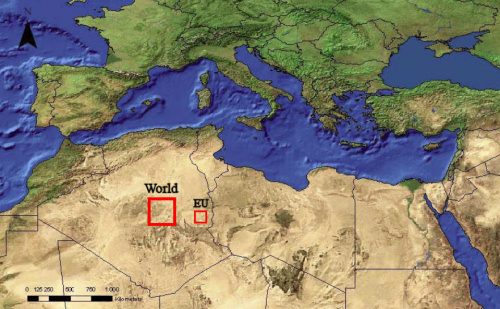
Solar thermal power plants have been in commercial use in southern California since 1985. An area of desert around 250 km by 250 km covered with CSP power generation could supply all the world's current electricity demand.
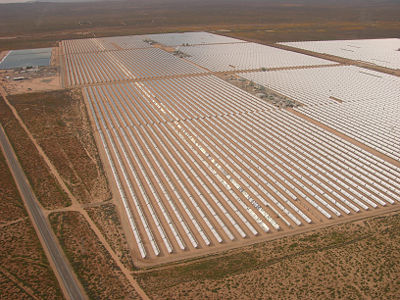
Solar thermal plants can be built in their entirety within a few years - much faster than many conventional power projects. Solar thermal plants are built almost entirely with modular, commodity materials (and thus have short development and construction times) and do not encounter the sort of opposition on environmental grounds that traditional forms of power generation like coal and nuclear face.
Operational plants include :
* US (California) - 354 MW FPL's Solar Energy Generating Systems (SEGS) plant, using parabolic troughs
* US (Arizona) - 1 MW Acciona Energy's Saguaro Solar Generating Station using parabolic troughs
* Spain (Seville) - 11 MW Abengoa's PS10 solar tower
* Australia (NSW) - 35 MW Liddell Power Station using fresnel reflectors
* US (Nevada) - 64 MW Acciona Energy's Nevada Solar One plant (not to be confused with the Solar One / Solar Two experimental plants) using parabolic troughs

Plants currently under construction :
* Spain (Seville) - 20 MW Abengoa's PS20 solar tower
* Spain (Seville) - 20 MW (each) Abengoa's PS20 and AZ20 solar towers
* Spain (Seville) - 50 MW (each) Abengoa's Solnova 1 and 3 using parabolic troughs (5 plants planned in all)
* Spain (Andalusia) - 17 MW Sener's Solar Tres solar tower (molten salt energy storage)
* Spain (Andalusia) - 50 MW (each) Sener's Andasol I, II and III plants (molten salt energy storage)
Solar Thermal Heating Up
There has been a spate of new announcements regarding solar thermal power over the past year - there are over 5,800 MW of solar thermal plants in the planning stages worldwide.
The company receiving the most attention seems to be Ausra, a company set up by Dr David Mills (who pioneered the CSP plant at the Liddell power plant in New South Wales using compact linear Fresnel-reflector technology) with backing from Vinod Khosla and Kleiner, Perkins, Caulfield & Byers (see here for a brief demo of how their technology works). Mills estimates that solar thermal plants could provide more than 90 percent of current U.S. power demand at prices competitive with coal and natural gas. "There's almost no limit to how much you can put into the grid," he says.
Mills presented a paper (pdf) at the IEA SolarPACES conference in Las Vegas recently which revealed some interesting statistics about the construction cost of solar-thermal technologies: US$3,000 per kW of capacity, estimating this will drop to US$1,500 per kW over the next "several" years. The New York Times last year quoted GE Energy executives estimating coal plant construction between US$2,000 and US$3,000 per kW. Ausra says it can generate electricity for 10 cents per kWh (close to the current cost using natural gas), and it expects the price to drop even further.
According to Technology Review:
What distinguishes Ausra's design is its relative simplicity. In conventional solar-thermal plants such as Solel's, a long trough of parabolic mirrors focuses sunlight on a tube filled with a heat-transfer fluid, often some sort of oil or brine. The fluid, in turn, produces steam to drive a turbine and produce electricity. Ausra's solar collectors employ mass-produced and thus cheaper flat mirrors, and they focus light onto tubes filled with water, thus directly producing steam. Ausra's collectors produce less power, but that power costs less to produce.
Ausra is initially planning a 177 MW plant in California, and has committed to supply 1,500 MW of power to Californian utilities PG&E and FPL. They are also rumoured to be moving in to Texas as well.
PG&E have also signed a 25-year deal with Ausra competitor Solel Solar Systems of Israel to buy power from a 553 MW solar thermal plant that Solel is developing in California's Mojave Desert. FPL has also hired Solel to upgrade the SEGS solar-thermal plants it operates in the Mojave.
Another PG&E contract is with BrightSource to supply between 500 MW and 900 MW of power per year from solar tower plants in California, beginning in 2011, with the first of a number of 100 MW facilities being built in Ivanpah.
Other companies active in the US include eSolar (linked to Google's energy initiatives), RocketDyne and SkyFuel.
Abu Dhabi's Masdar Initiative and Spain's Sener are have formed a joint venture to build and operate concentrating solar power plants across the world's sunbelt regions called Torresol Energy.

Independently of Torresol, Masdar is developing its 100 MW "Shams 1" CSP plant in Abu Dhabi.
Algeria and Germany have signed a a joint research agreement for the development of a new generation of large-scale, low-cost solar thermal power plants (which could contribute to the Desert-TREC vision of large scale CSP in North Africa powering Europe, which I once dubbed "Deserts Of Gold").
More new plants are being planned in :
* Algeria - 20 MW Abengoa's plant in Hassi-R'Mel
* Australia - 10 MW Queensland State Government facility in Cloncurry
* Australia - 154 MW Solar Systems and TRUEnergy's plant in Mildura
* Egypt - 70 MW plant in Kuraymat
* Iran - 17 MW plant in Yazd
* Israel - 250 MW plant in Ashalim
* Morocco - 20 MW Abengoa's plant in Ain-Ben-Mathar
* US (Arizona) - 280 MW Abengoa and Arizona Public Service's plant in Gila Bend
* US (California) - 50 MW Inland Energy's plant in Victorville
* US (California) - 250 MW FPL Energy's Beacon Solar Energy Project
Feasibility studies are also being done in Oman, China and Mexico.
Most of the plants in the middle east are combined gas / solar thermal plants, with the numbers above representing the solar component only.
Energy Storage
One of the key differentiating factors between solar thermal power and solar PV is that heat energy is more easily (and efficiently) stored than electricity, with solar thermal plants often combining energy storage into the design to enable around-the-clock, dispatchable electricity generation.
Most solar thermal plants are looking to use molten salt for storing energy - other alternatives being developed are graphite (in the Cloncurry development), heated water / steam (for the Ausra plants) and heat-transfer oil such as therminol (for the Abengoa plant in Arizona).
Cost
The existing plants prove that concentrated solar power is practical, but costs must decrease. Electricity from solar thermal plants currently costs between US$0.13 per kilowatt hour (kWh) and US$0.17 per kWh, depending on the location of the plant and the amount of sunshine it receives. Conventional power plants generate electricity for between US$0.05 and US$0.15 per kilowatt hour (not including any carbon taxes or cap and trade related costs) but in most places it's below US$0.10 (wind power generally costs around US$0.08 per kWh).
An economic analysis released last month by Severin Borenstein (pdf), director of the University of California's Energy Institute, notes that solar thermal power will become cost competitive with other forms of power generation decades before photovoltaics will, even if greenhouse-gas emissions are not taxed aggressively.
In 2006 a report by the Solar Task Force (pdf) of the Western Governors’ Association concluded that CSP could provide electricity at US$0.10 per kWh or less by 2015 if 4 GW of plants were constructed.
According to Bernhard Milow from the German Aerospace Center (DLR) electricity from solar thermal plants could cost as little as €0.04 per kWh [US $0.06/kWh] by 2020, with well sited plants potentially generating power at lower prices than coal.
The US DOE began supporting large scale CSP last year, aiming to reduce the cost of CSP power to 7-10¢/kWh by 2015 and 5-7¢/kWh by 2020. The DOE estimated that reaching these cost targets could lead to installation of up to 35,000 MW of new generating capacity by 2030 in the US. James Fraser at The Energy Blog commented at the time that it was 5 years too late (given recent commercial activity in the area) and that PV solar may beat these price goals before solar thermal does, but that more solar options are good in any case, as both PV and thin film solar manufacturing will be constrained by availability for materials for some time as production continues to accelerate.
Another estimate from Sandia labs showed solar thermal costs (for solar towers) could fall to around 4 cents per kWh by 2030.

Stirling Engines
Another variant on the solar thermal power theme are Stirling engine based power plants, which generate electricity directly rather than first storing the energy as heat.
Stirling Energy Systems seems to be the leader in this field, with some reports talking about agreements with Southern California Edison and San Diego Gas & Electric for up to 1.75 GW of power. The company recently set a new world record of 31.25% for Solar-to-Grid conversion efficiency.
Other companies pursuing stirling engine based solutions are Infinia and SunPower (not to be confused with its larger namesake in the PV industry).

Passive Solar Thermal - Solar Hot Water And Others
Generating power isn't the only way to utilise solar thermal energy of course - solar hot water is a very cheap and efficient way of replacing gas or electricity usage with solar energy. Solar hot water systems are in widespread use in Australia, with state and federal governments encouraging people to upgrade their home hot water systems to solar - almost cost free in some states. The New Zealand government is also encouraging the use of solar hot water systems.
Some larger scale uses of solar thermal hot water are being put in place by Abengoa in Texas and Colorado.
Solar hot water is in wide use in China as well, with the city of Rizhao becoming somewhat famous for achieving widespread takeup of the units.
An unusual variation of the direct capture of solar energy in the form of heat is from a Dutch company that has developed a "Road Energy System" that siphons heat from roads and parking lots to heat offices and homes.
And one final use of solar thermal power - it can keep your house warm, if your windows face the right way, and even better, have insulating glass that doesn't let the heat out again - which could help make your building energy positive.

Cross-posted from Peak Energy
Contact
- anz at theoildrum dot com
License

This work is licensed under a Creative Commons Attribution-Share Alike 3.0 United States License.
Archives
- November 2010 (2)
- October 2010 (5)
- September 2010 (4)
- August 2010 (8)
- July 2010 (2)
- June 2010 (2)
- May 2010 (6)
- April 2010 (7)
- March 2010 (12)
- February 2010 (11)
- January 2010 (7)
- December 2009 (10)
- November 2009 (6)
- October 2009 (7)
- September 2009 (10)
- August 2009 (10)
- July 2009 (3)
- June 2009 (14)
- May 2009 (10)
- April 2009 (15)
- March 2009 (16)
- February 2009 (16)
- January 2009 (15)
- December 2008 (15)
- November 2008 (23)
- October 2008 (25)
- September 2008 (24)
- August 2008 (30)
- July 2008 (44)
- June 2008 (38)
- May 2008 (48)
- April 2008 (43)
- March 2008 (29)
- February 2008 (32)
- January 2008 (30)
- December 2007 (26)
- November 2007 (32)
- October 2007 (11)
Personally I think thin film solar in conjunction with car or house based batteries will go closer to solving the baseload problem. That's if the price can come way down. The levels of storage envisioned for CSP plants seem to be generally less than 24 hours. Maybe that needs to be extended several times.
Also I'd take the 'comparable to gas fired' price suggestions with a pinch of salt. The gas generator can be switched on or off at random (if it has fuel) and the electrical connection usually already exists, not way out in the desert. It appears CSP promoters cite marginal costs, not average costs of a system that includes backup.
Sidenote: during Adelaide's heatwave some rellies went to Yorke Peninsula to catch the sea air. It too was like an oven despite being in effect way offshore. They sent a phone photo of the wind farm not stirring, the same time that every AC in Adelaide was switched on. CSP would have helped more.
California gets power from out of state alot so these might to closer to electrical connections than thought.
Boof - many of the plants mentioned were either combined CSP / gas generation, or had energy storage included (in the case of Ausra in particular).
The desert sites used for these plants get a couple of days a year of cloud cover - they aren't exactly likely to be out of action often. Why do you think 16 hours of storage is insufficient ?
Including storage also means you don't have the on/off problem to deal with.
If you combine a week of cloud cover (a common occurrence) with a natural gas shortage (an increasingly likely occurrence) your power station will be offline for 90% of that week.
A week of cloud cover in the locations that are best suited for solar thermal is unheard of - what are you talking about ?
These things are built in deserts that get (maybe) a few days of cloud cover in a year.
Look at a global solar insolation map - find the best bits. Match against rainfall records.
You'll find vast areas in the south-west US, north africa, middle east, western china, kalahari desert, northern chile and central australia that have great sun and hardly any rain.
Of course, cloud cover isn't the only cause of reduced insolation in desert-like environments:
http://www.mapsofworld.com/referrals/weather/severe-weather-conditions/s...
Good point (and very effectively made).
I was thinking of our local deserts here, which you don't see sandstorms in very often (not sandy enough) - but my one trip into the Sahara ran into one of these things and they are pretty awesome.
Does the Mojave get these things or is it more rocky than sand ?
My sand filled, 6 year old eyes testify to the Mojave having sand storms. Ah, memories...
Two miles, I tell ya! TWO miles!
Cheers
I don't mean to rain on your parade, but a check of the number of clear days for major cities across the US SW returns a lot of cloudy and partly cloudy days. 16 hours of storage only takes you through the night. If the next day is cloudy, your power station isn't generating. You need more storage than that. The following SW US cities have these numbers of clear, partly cloudy, and fully cloudy days, on average. They are in the area which has the highest potential for solar production in the US, according to http://www.energyatlas.org/.
Tucson is clear 53% of the time.
Tucson AZ, clear days: 193, partly cloudy: 91, cloudy: 81
http://www.cityrating.com/cityweather.asp?city=Tucson
Phoenix is clear 58% of the time.
Phoenix AZ, clear days: 211, partly cloudy: 85, cloudy: 70
http://www.cityrating.com/cityweather.asp?city=Phoenix
Flagstaff is clear 44% of the time.
Flagstaff, AZ, clear days: 162, partly cloudy: 102, cloudy: 102
http://www.cityrating.com/cityweather.asp?city=Flagstaff
Albuquerque is clear 46% of the time.
Albuquerque, NM, clear days: 167, partly cloudy: 111, cloudy: 87
http://www.cityrating.com/cityweather.asp?city=Albuquerque
Roswell is also clear 46% of the time.
Roswell, NM, clear days: 168, partly cloudy: 113, cloudy: 84
http://www.cityrating.com/cityweather.asp?city=Roswell
Las Vegas is clear 58% of the time.
Las Vegas, NV, clear days: 210, partly cloudy: 82, cloudy: 73
http://www.cityrating.com/cityweather.asp?city=Las+Vegas
As you can see, it's a lot more than "a few days."
Nice line about raining on my parade - you've brightened up my evening.
However - you seem to be conflating partly cloudy and cloudy with "no sun", which is more than a bit of stretch.
It's still possible to have 12 hours of sunlight on a "partly cloudy" day.
If you look at some of the technical discussions of the solar thermal plants, you'll find they actually have to dump energy in optimal conditions - they aren't expecting to get the absolute best possible solar exposure at all times.
When selecting appropriate locations (using detailed insolation data) they are looking for places which really do get very reliable sun - not somewhere which gets 130 days of sun per year.
16 hours of storage is more than enough except in rare cases (don't forget, plants don't always generate at peak output - and that includes traditional gas and coal fired power too - they get adjusted up and down to match demand - and there is much less demand at night, weekends and days where the weather is mild).
I think the issue of how much solar intensity decreases during winter is probably more important - which points towards locations closer to the equator - and if you do a plot of all the plants being built, you'll see that is where they are heading (as far as is practical - right on the equator is generally too cloudy).
Ausra already used real climatic data (although they arranged them randomly throughout the year) and found >90% correlation with the national load. If the plants are geographically dispersed then the problem of climatic extremes is reduced. But, it makes sense to be prepared for the worst.
Substantially more storage than 12-16 hours to deal with longer climatic irregularities is suboptimal from an economic viewpoint. If CST is to be the main supplier in the national grid, then it will make more sense to install emergence natural gas heaters (relatively cheap). A strategic natural gas reserve, and the existing natural gas networks could be used for this purpose. A month at full load would be more than enough to survive even the longest cloudy periods. In the future, biogas could be used with modest modifications on infrastructure. The quantity required is very low, just for the occasional emergence, not for regular operation, so this should be quite feasible.
Oh, and dealing with the winter load isn't that big a deal. An east-west axis orientation line focus plant, in a good location, has very consistent seasonal output. Most of the parabolic troughs built in the Mojave were north-south oriented to get a high summer bias, which is good for California, but if CST must provide a large chunk of the national generation then most plants would have to be in the east-west orientation.
Thanks for the feedback.
I agree with the natural gas / biogas backup idea - I guess that is why David Mills is only aiming for 90% of the power supply :-)
Thanks. They did say 100% would be possible if required, but that it would increase the cost a bit.
Now, I don't suggest it's a good idea to rely on solar thermal for 100% of electric needs, but in the hypothetical case that it does happen, it's better to use the backup heaters for this last bit as well, as much less energy would have to be dumped from the array and the occasional week or two of bad weather/sandstorms could be dealt with as well. And most of the existing infrastructure could be used, which is great.
With enough biogas in strategic reserve (use existing/depleted natural gas fields), this is one renewable energy scheme that is actually full proof at a plausibly reasonable cost. And that's rare.
Thank you, this is very interesting information. Unless it is certain that solar produced energy will be effective, then we must not get to enthusiastic about it. I must admit however that if it is realistic , it should be seriosuly considered.I believe, however, that with a few selected locations , this proposal could be successful. Even if solar power only works to take over even 5% of fossil fuel production, it is still better than nothing; considering that it remains feasible. The fact mentioned in the article that solar thermal plants could provide more than 90 percent of current U.S. power demand at prices competitive with coal and natural gas is very interesting. This illustrates that there is potential; espescially considering The fact that other nations are investing in solar energy research as well. Costs are apparently an issue. I believe it is essential for government funding to play a role.This woudl facilitate testing otu whether the proposed solar producing sites would be productive.
I must conclude however that we should give solar energy a try because it has many positives.It can be converted to thermal energy and be used to heat homes, and buildings, relieving stress from other non renewable energy sources. After all, soalr energy is a natural "free" resource that never technically runs out. It is essential to at least try other alternatives in order to elminate this dependence on fossil fuels.
As Prof Goose would say, thanks for your support :
http://reddit.com/info/6edxp/comments/
Because of the recent EROEI discussion, I'd give this link for a CSP estimate: http://www.ases.org/divisions/electric/newsletters/2006-04.html#roi
27 with storage and 44 without with Eout in electricity, not thermal.
By combining CSP district water heating with PV I get a cost estimate for electricity at under a penny per kWh here: http://mdsolar.blogspot.com/2008/03/lux-lucis-tepida.html
The water cools the silicon allowing a much higher concentration of sunlight. Also, the water shields the silicon from cosmic ray induced defects so that it lasts much longer. There may be immediate potential for 3 GW average electric power in the US by this method.
There is a lot of potential for CSP.
Chris
Hey read this: http://www.abc.net.au/science/articles/2008/01/16/2139711.htm
Imagine 99.95% of the light energy absorbed as heat through a coat of these nano-tubes on the inner tubes of these CSP stations. I imagine with use of vacuums and Stirling engines that it would essentially be 50 % + efficient solar power. A revolution in nano-tube production is needed to bring down cost though, they can run more than 250,000$ a ton. I can't see how coal or nuclear could compete with a system like this, plus the only emissions are from the materials manufacture which could be converted over too renewable sources essentially, emission free power.
I'm gonna stop before I start to sound like a techno-phile, ewww
Regards,
Crews
The standard coatings on domestic vacuum tube solar thermal water heaters using multilayers of materials like nickel sulphide and oxide and aluminium nitride already achieve absorptances in the visible of 94% while having emittances in the long infra-red (to stop re-radiation) of 8%. The gain from going from 94% to 99.95% is very little and the cost of going from a relatively low technology of such multilayer films to carbon nanotubes is at present huge. It will have to fall a long way to make it worth such a small gain
The article does not quote the infra-red emittance of the carbon nanotubes but this is a vital parameter. Since by Stefan's law, radiated energy rises as the fourth power of the absolute temperature and these utility sized solar thermal units operate with their absorbers at a much higher temperature than domestic units the re-radiation losses will be much higher. A small increase in infra-red emittance will easily wipe out the gain from a slightly higher visible absorptance.
I think that reducing reflectivity helps quite a bit, that was one of the main effects in improving efficiency in BigGav's second PV link on multicrystalline silicon. But, the main limit for this type of PV is the electronic bandgap which ends up only being responsive to a portion of the solar spectrum. Usually, PV is used with concentrators when it is multijunction so that there is more than one bandgap. That material is expensive because it is complex to manufacture and it is optimized to run hot, though not as hot as concentrated solar thermal. It is sometimes worth it though because you need less of it. What I have in mind is to use regular silicon and run it cold, but then use the low grade heat from the cooling water to save some energy in home water heating thoughout a small town. Because there is no need for really high tempertures and because existing infrastructure is reused, the cost comes in pretty low. Lower reflectivity in the panels means that much more heat for the water.
Chris
Chris;
In response to your blog entry, am I clear that the PV is in the water, facing UP (clear tank-roof), or is it attached to the underside, facing heliostats?
In either case, it sounds like an interesting synthesis.
-If immersed, do you have a sense of the Visible Light transmissivity through that much water, and it's effect on PV absorbtion?
-Second, did you find a good source of info for how much light a water-cooled PV panel can be subjected to, and how this affects it's potential output and lifespan? You touch on these, but I'd love to see some documents on test-results for such setups.. I would hope that it's possible to toss maybe 3 to 6 'Suns' at a panel that is aggressively cooled to boost it's yields, without compromising on its durability. Your proposal to shield the PV from cosmic rays with water sounds good up front, so has it been tried out to any degree that you are aware of?
Best,
Bob Fiske
Hi Bob,
The idea is to hang the panels from the bottom of the tower and cool them with running water on the unilluminated side. There is a program in New Mexico that just got funded to do this kind of plumbing. I mentioned it here:
http://mdsolar.blogspot.com/2007/07/new-mexicans-conspire.html
Sunlight does not harm silicon though it can have an effect on epoxies and such in the rest of the panel structure. Heat cycling can cause delamination of electrical contacts. On the cosmic rays, this has been an issue in the semiconductor industry for a while, and is quite well known for space applications. Water is used as a cosmic ray shower detector in the Auger Observatory and it would not see them if it could not stop them. Basically, at those energies it is mass that makes a difference though some metals can produce a secondary X-ray flux which can be a problem for shielding humans. Since ground radioactivity is lower energy, 50 meters of air should be a help. It seems to me that all you would need to do to check would be to put a scintillation counter in place and hang a second off a boom or put it up on a pole nearby. You should have enough data in a week or less. If you have a tower in mind, I can try to do a more detailed calculation of the relative flux just below and out away from the tower. I know of one proposed experiment to put some panels in the Goldstakes mine for a long time to check their degradation. Don't know if it went forward. It is easier to look at data from space or take a panel to an accelerator to understand the degradation mechanism.
Other degradation mechanisms owing to water getting into the panel frame might be avoided in this enviroment as well. It should not be too difficult to keep the panels warmer than the ambient environment at night since the warmed water is available so that even with a small leak, condensation within the panel might be avoided. This would tend to protect anti-reflection coatings and electrical contacts.
Chris
There are at least 2 typos in the table. The sum of the listed embodied energies (without storage) totals to 175.2GWh, not 174.2GWh. The EROEI calculates to 34, not 44. Still good, but not 44.
I agree. Thanks for catching that. I notice also that no estimate is made for running the heliostats or pumping the salts. I'd like to see more thorough work on CSP if you know of any.
Chris
I would like to see an EROI estimate of Ausra's CLFR. Considering the compactness and lower structural (mirrors close to the ground) and material requirements (low temperatures and pressures) it should do pretty good.
Very nice! I was wondering when someone would innovate a combined PV/CSP array.
Thanks Big Gav - this is the best summary I have seen on Solar Thermal.
Excellent Article;
Thanks a lot.
An excellent guide to solar thermal power - thanks.
A couple of points, firstly the estimates I have seen are perhaps a bit more conservative on present costs, with figures of around 20-30cents/kwh hour mentioned:
http://www.renewableenergyworld.com/rea/news/story?id=51889
As against that though, you don't really need to compete initially with base-load costs, as in most of the most suitable areas power use tracks very well with solar incidence as it is mainly used for cooling.
There is a lot more flexibility in costing when it is for peak power, so you don't need to hit baseload costs. Increasing costs for natural gas which is the fuel of choice for peaking power should rapidly mean that solar thermal is the preferred option.
Many of the hot areas are also short of water, which makes it easier to use solar thermal than coal or nuclear power with their large cooling requirements. It should be noted though that water use in solar thermal is not negligible, as you need to clean the mirrors.
There is also no free lunch on environmental concerns, as you are using substantial areas of land and affecting the ecology. This would seem to me to be very manageable in most areas though.
There are also possibilities for using solar thermal power in some fuel cycles to replace oil use, for instance in a zinc cycle where the heart for a solar tower directly transforms zinc oxide into zinc, for use in batteries which are very dense in energy terms as they can use air as one of the inputs.
http://www.meridian-int-res.com/Projects/The_Zinc_Air_Solution.pdf
The_Zinc_Air_Solution.pdf
Many areas of Australia would appear to have the needed sunlight and access to forestry resources - ideally you would not want to transport the timber far.
This is a very advantageous process, as you are not transforming the energy form one form to another, which is always done at a cost.
There is also the possibility of using boron in a fuel cycle, as this fascinating site details:
http://www.eagle.ca/~gcowan/boron_blast.html#TOC
A car running on boron could have cross-continent range!
In either case the chance to turn out a useful portable fuel would seem to mean that perhaps even if solar thermal were around 20c/kwh, then perhaps it would be cost effective.
Dunno about sunlight and forests but I live near to zinc mines http://www.zinifex.com/ and forests. The sunlight bit is unreliable. The zinc concentrate is shipped by coast (ie skirting around the central forests) to an electrolytic smelter that allegedly pays 3c/kwh 24/7. Their hydropower is runoff from the same forests. Just don't eat the fish downriver of the smelter. Zinc oxide + charcoal is not on their radar yet they would seem to have the head start.
Sometimes I just hate being years ahead.
Three things not mentioned above:
Sometimes I just hate being years ahead.
And without returning the micro-nutrients in the charcoal back to the soil, years wrong.
It should be noted though that water use in solar thermal is not negligible, as you need to clean the mirrors.
True, but it's not a big problem either (water for wet cooling would be in most arid areas). The water use is much lower than most agricultural practices. Although, in the areas best suited for CST, most agriculture wouldn't work very well!
Chemical heat storage is interesting, but so far only demonstrated on small scale and it was very expensive. Perhaps scale-up would reduce the cost enough.
Could you please clarify whether or not the costs cited for solar thermal includes distribution and all other costs associated with actually transmitting the electricity to the retail customer. I assume this varies, but is there some sort of agreed upon range for comparison purposes.
Or perhaps we only need to be concerned with the marginal distribution costs of producing from the mojave desert.
A project recently in the news is Southern California Edison installing 250 mw on commercial rooftops in Los Angeles. The advantage of this approach is that it can feed into the existing local greed and not require additional transmission lines, etc. to make it all work. Might this approach reduce some of the advantage that solar thermal may have other PV?
No - the costs don't include transmission costs - they would vary wildly depending on where the plant is located and how far it is to the grid.
A plant in the middle of the Sahara or Simpson desert would have much higher additional costs than the Mojave, which is close to the Californian grid (and has interconnects to elsewhere going across it I suspect).
One of the articles I linked to for a southern Californian CSP plant also discussed the 250 MW "distributed" PV power plant in LA. I think this is a great idea - putting PV on commercial buildings makes excellent sense, though I'm not sure it will be quite as cheap as CSP in the long run.
Nevertheless, I don't see PV and CSP as competitors - CSP fits the centralised generation model well (especially when storage is included) but I'm very keen on distributed generation, which means lots of PV and thin film.
We'll see how the relative economics work out in a decade or so.
Thanks for your response.
I have been successful in getting my local utility to provide net metering. Next step is to convince them to provide a rebate for installation of solar panels on customer's homes. But here's the rub. Since it is clearly cheaper to use a centralized approach to solar power, whether using panels or CSP, the utility may take the position that it does not make any sense to encourage distributed generation.
From a utility's perspective, why would distributed generation be a good thing if the costs are not advantageous.
Net metering is a good first step - ideally your regional government will legislate for feed-in tariffs as well.
Utility companies are unlikely to see much benefit in encouraging distributed generation (especially if they don't own the generation equipment), so encouraging this is more in the domain of government - especially if the government owns the transmission infrastructure - in which case it can build a business case for subsidising solar panels and avoiding building more transmission capacity (ditto for smart meters to a certain extent).
Thanks Gav,
Your work and references fill an important gap in the post-carbon toolkit. Now to get it into the hands of those who do the heavy lifting (and jaw-dropping piano-smashing!) in the capital markets. Try cleantech.com and others. Is it not time for solar bonds? Maybe Aussies can configure them if too much of a departure from US energy values/norms.
I like the SciAm piece because it locates its central project in the heart of the US electrical demand beast, across 32,000 km2 of bare-earth right next to the backyards of the most innovative souls on earth, at least per their own self-image! Economic with relatively tiny rate subsidy (under certain potentially reasonable assumptions of course).
Beats bashing bitumen and other innocent tarbabies. We didn't ask to be born near the oilsands or heavy oil and sour gas fairways. From one sick and tired native Albertan...
Just do it.
Big Gav
Thanks for the excellent summary of the status of this technology. A couple of comments about the economics:
- Australian power generators, up until a year ago, were selling in to the grid at average prices of between $25 and $30 per MWhr(2.5c - 3.0c /kWhr). The power stations were still turning a profit at this price level. There has been a bit of a change in the pricing structure over the past year. The reasons are a bit too complex to deal with here. The point is that any competing technology needs to either be subsidised or taxed into competition with coal at these price levels.
- Through my work I have done extensive study into costing of Solar Thermal. My company built one of the only full scale solar troughs in the country. The figures quoted for the construction of a large scale solar thermal facility are pretty accurate. We have estimated it at around A$3100/kW.
- A solar thermal plant utilises the same technology as a coal fired plant for the bulk of the facility i.e. the solar collectors only replace the boiler component of a conventional plant. The boiler constitutes only 40% of the plant costs. You can therefore consider A$1900/kw of the cost fixed and not subject to either volume or technology induced improvement. The claim that the build costs can be reduced to US$1500 is simply wrong. It won't happen.
- Utilising the build cost of $3100/kW and feeding it into a financial model with a few other inputs for operations and maintenance results in a electricity sale price of around $230/MWhr.
I sincerely wish otherwise but the above are the plain economic facts. Either through tax or subsidies the electricity generation price would need to increase 7 fold to make solar thermal viable for stand alone base load operation. On the positive side the retail price of power will "only" have to increase around 150%.
Either Solar thermal or large scale PV will happen, but there will be a lot of screaming and nashing of teeth before it gets there.
Hi Phoenix,
If 60% of the cost is fixed and is common between coal and solar thermal plants, how did the they turn out power at 2.5-3cents/kwh if they have $1900 of fixed costs in common with solar thermal?
The coal-fired plants would not only have build costs, but also the cost of the actual coal.
Presumably a lot of the difference is due to utilisation rates, as the solar plant only operates at around 25% of capacity, and a lot less in winter, even in latitudes as southerly as the Mohave.
Do your calculations take into account the proposals for storage which are an integral part of why Ausra, for instance, say that they can actually reduce costs whilst building storage.
I wonder if you would comment on the costs of maintenance? And the water use for cleaning? It is no trivial matter to maintain a set-up which covers vast areas.
Davemart
There are a number of reasons for the differential:
- Higher efficiencies achieved by the coal plant due to higher operating temperatures
- Lower cost of the equipment because the optimal size for the coal plant is 1000MW while the solar plant size will be less than 100MW.
- Equipment utilisation, the coal plant runs for 8100 hr/year while the solar plant will only operate effectively for 2100 hr/year.
That being said, I realise I did in fact make a mistake in my post. The "common" equipment constitutes around 60% of the cost of the coal plant but only 25% of the cost of the solar plant. The cost reduction required for the solar portion of the plant (to get to US$1500 /kW) would be from a current level of A$2300/kW down to $850 /kW. I still don't think this is credible.
*********
I have used in my model a cost for operations and maintenance of around $25 /kW/year. This is a very agressive number and takes into account a good deal of the learning curve that will be experienced in the initial developemnt of large scale plants.
*********
For the most part water usage will be similar to coal fired plant. Mirror cleaning is trivial. The water will be used for cooling. In this respect the solar plant suffers from the same problem as a nuclear plant in that the lower efficiency means that more heat has to be removed from the cycle. It will therefore, if anything be a higher water user than a coal fired plant.
Hence the plants proposed for Morocco and Algeria are co-gens with natural gas, and in about those ratios, ie 75% of the power is natural gas, with the balance solar thermal.
Contrary to what some here think, that I am totally for nuclear energy only, I have looked hard to try to find renewables that will work at any reasonable cost, and about the only two which can generate any substantial amounts of power so far are residential solar thermal and on-shore wind, and neither will really power our society
Geothermal might have some potential, but it is very early days, and PV has it all to do, although certainly in off-grid situations it is about the most promising.
Otherwise, if you don't want greenhouse gasses and don't want to go bankrupt, every time it comes back to nuclear power.
Oh please (rolls eyes). If you add together all the possible unexplored efficiencies + smaller societal energy footprint + willingness to pay more for power and you have loads of potential for CSP, PV, wind, tidal, geothermal and more. It's only those who lack imagination who insist we need a monolithic, known, centralised solution (like nuclear energy) to keep powering us along in the luxurious lifestyle to which we've become accustomed.
If you extrapolate anything far enough, then you can come up with something that sounds as though it can work.
The problem is we need it now, not at some unspecified point in the future.
Tidal generation, for instance, is hopeful, but suffers from being, well, tidal, so it peaks twice a day without reference to when you need it, so you not only have to cost for equipment in difficult environments but build buffering facilities.
I find it difficult to understand how so many work without reference to cost - most folk are going to have to tighten their belts anyway, and there just will not be the money available for all of these 'cunning plans', and the higher costs some are so keen on will mean real suffering to real people.
Particularly when we have perfectly adequate possibilities open to us which will do the job just fine at reasonable cost and do not involve giving up a decent standard of living.
The uncharitable response to your comment would be that it is only those who can't face reality who would advocate that we should go for solutions that we don't know how to engineer.
At the moment billions are being made based on totally unrealistic prospectuses.
Want to buy the Brooklyn bridge? Projections show it will be a money maker real soon.
If you use cost as the only measure (ignoring externalities as per usual), the cheapest approach in the short-medium term is increasing efficiency (or negawatts, as Amory Lovins dubs this 'resource").
Mandatory fuel efficiency levels for vehicles, mandatory low energy lighting, better insulated buildings, mandatory gas or solar hot water, shifting more freight to rail and sea, urban planning that encourages walking, cycling and public transport etc etc etc
Every study I've seen shows this - even the pro-nuclear "The Economist" has pointed it out.
If you were concerned about cost above all then you'd be pushing efficiency first at every chance you got...
Most studies incorporate several scenarios - the optimistic, business as usual, and pessimistic. Those in the optimistic camp typically assume a degree (fairly mild to very aggressive) of efficiency and conservation programme implementation. But energy bulk demand increases in nearly all cases due to population growth and development (such as more people getting air-conditioning or that second TV for the bedroom).
Also, one worry I have is an unstated assumption that efficiency improvements and conservation are something new and are not already being aggressively pursued.
If you look at this chart from the IPCC, you will note that during the 1970's energy crisis, the emissions and GDP lines begin to diverge. This is due to efforts that were commenced at that time (and continue) to conserve energy and improve efficiency as well as programmes to introduce nuclear power.
Efficiency and conservation are good initiatives that will help, but - in total and considering the broader perspective of population projections and ongoing development - there is risk in presuming they will bear significant fruit with respect to real emissions cuts.
Here is a link to an old web page of mine, Gav, where it is very clear that as far as I am concerned it is less use and more efficiency every single time:
http://energy-futures.blogspot.com/2008/02/conservationour-best-route-to...
Please note also that my comments about the roles of different power sources are particular to the UK, and in Australia for instance solar, thermal and PV, can help a great deal towards peak load capacity - the problem is being too hot, not too cold as is the case in the UK.
However, it seems perfectly clear from the expert comments of Phoenix that the idea of running base load from solar thermal even in Australia is a non-starter - you have to buy too much equipment which stands idle most of the time due to solar intermittency.
I think I recollect that you were also fairly critical of the heat output to water from nuclear power - apologies if I am mistaken - it is clear from phoenix's comments that that is at least as severe for solar thermal, - water usage in desert areas along kills it.
But we must also note the following characteristics of solar thermal:
Hot, cloudy regions are unsuitable, as concentrated solar power needs clear skies.
So you are left with cloudless skies - which are precisely the regions under most water stress.
If you actually take critiques on board, how do you propose to provide enough water for these solar thermal plants?
I may have sound negative - but that is precisely because I also had high hopes for it, until I saw the actual numbers from phoenix.
In contrast, you can site nuclear plants anywhere you have access to sea water - ie where most of the population of Australia live.
It is not that I am mad-keen on nuclear, but when I put the numbers in for alternatives that is what I come up with - but conservation and residential solar thermal ( in Australia - the criticism I had on my site was specific to cold areas like the UK - in Australia it will be an unmitigated benefit ) lead the pack.
Renawables if done right can help a lot, but I have not seen any convincing numbers yet for running society on them - and prior to this thread I thought that in hot climates solar thermal might do the trick.
Water usage alone rules it out.
Second killer is utilisation of boilers and other equipment due to solar intermittency.
That gets much worse in winter- you don't get near so much sunlight, at anywhere which is not really close to the equator, which is most of the desert areas you need to use, again means vast overbuild and huge costs if you want to use it for base-load,
If you want to carry on to make your case, you really have to address both issues.
Personally I hope you can.
Phoenix has done the numbers again and changed his mind (offline conversation - hopefully he'll respond again here).
Read the Ausra technical docs - they are using dry cooling - there isn't any sense in proposing solar thermal in the deserts and then requiring the amounts of water coal and nuclear plants need.
http://www.ausra.com/technology/
Some of our existing coal fired power down here is already struggling to get the necessary amounts of water.
(edited to add)
The Western Governor's Association report I link to in the main article says :
I will follow with bated breath! - I was very hopeful on solar thermal, especially in areas like the Indian Thar desert, where I hoped it might be a low-cost option.
Plant utilisation reflected in costs still sounds tricky though - any thoughts?
I have now had a chance to look through the Ausra technical documents, and could not see the subject treated, certainly not at any length.
Have you got a link to the discussion you are referring to?
Perhaps though it is possible to make the following comments, subject to later correction when we can look at the documents you are talking about.
You have to get rid of the heat some way, usually open circuit water, as it is by far the cheapest way.
Alternatives include closed circuit water and air cooling.
Neither is used much in coal and nuclear plants as they are just too expensive.
In addition solar thermal plants would be located in the very most difficult areas for cooling,so I find it difficult to imagine that it would be other than very expensive indeed.
I like the Ausra approach, but some of their projections seem far too optimistic - many of the other solar thermal companies are much more conservative in their projections.
Dry cooling would mean that they would have yet another area where the technology would really have to go far beyond current practise to work in those locations, to add to their projections for storage costs and so on.
I can't see their projections coming off personally, although I hope I am wrong.
No details, just David Mills saying that they are breaking new ground in dry cooling technology (see some of the interviews he has done) and the diagram on the web site showing a closed cycle for water circulating through the plant.
We'll see how it turns out - luckily these things are getting built pretty rapidly, so we won't have to wait too long to see the outcome.
Well, Gav, this is simply not a engineered proposition at the moment.
Here is the quote you link to in a later post:
http://beyondzeroemissions.org/2008/03/23/david-mills-ausra-describes-fr...
IOW there is no current engineering which can do what is proposed.
Incidentally, should such an improvement in dry cooling take place, then it would presumably be equally applicable to coal or nuclear plants, and so solar thermal would have no economic competitive advantage.
I am sorry, Gav, this is not a weak case regarding the practicality of solar thermal to provide substantial power, it is non-existent, and simply relies on some guy saying it will be alright on the night.
Without massive costs or fundamental technological breakthroughs this is saying it is impractical in the dry regions it is suited for.
They have to make these statements that it will be overcome to get funding.
Prior to this thread I was a lot more optimistic about solar thermal than I now am.
For peak load in hot areas it would seem a better bet to hope for large decreases in solar PV cost, as that does not use so much water resource.
"Dry cooling" is no mystery, it's just like an automotive radiator. GE even has air-to-air intercooling as an option for one of their newest gas-turbine generators. They take more material and cost more, but in water-short areas this makes good sense.
One problem with dry condensers for steam is they would have to operate under vacuum, which would tend to collapse tubes. If the system working fluid was an ammonia-water mixture (as has been suggested to improve the thermal efficiency of some conventional thermal plants) it could be run at positive pressure even at condenser temperatures well under 100°C.
Absolutely - but Ausra seem to be claiming large cost reductions.
There is also the issue that solar thermal plants by their nature will operate in areas with high temperature, making cooling more difficult than, for instance, a coal plant, which can equally be sited in a more temperate region.
How do the costs for the Ausra system sound to you?
The freznel lens collectors, reversible in storms, sounds great, but the storage of steam sounds more doubtful, with molten salt being the established technology.
I simply had not realised that there were such large cooling issues.
Perhaps storage of PV energy will be easier.
My expertise is not in cost estimation for large engineering projects, so I won't venture an opinion about the scheme as a whole.
However, storage of energy in hot water is a very simple thing; all it takes is a pressure vessel which doesn't lose heat very fast. Water is an extremely cheap medium, and it eliminates issues with heat exchange to and from salts (which may have low thermal conductivity while freezing, and may corrode the heat exchangers). All you have to do to get energy out of a tank of really hot water is reduce the pressure a bit, and it gives you saturated steam. If Ausra says their scheme is cheaper, I'm inclined to give them the benefit of the doubt for now.
They say it's supposed to be underground, in a metal lined cavern. That could considerably lower the storage costs, as there would no longer be a need for expensive pressure vessels aboveground. Excavating should be quite a bit cheaper per volume than big metal pressure vessels.
Hot water storage can be done of course, however again the isssue is cost. As Engineer-Poet says you can store the energy in the water and obtain saturated steam by simply lowering the pressure. Sounds simple, so let's have a look at the engineering and costs. The system temperature is already low (around 300 deg C)thus making the solar thermal low in efficiency. You really don't want to lower this too much more in order to facilitate the storage. If we assume a loss of a further 20 deg C. Let's take a unit size of 100 MW. Assume that we want to extend the operation for an additional 4 hours. With a system efficiency of 25%. The stored energy will be 5,760,000 MJ. This will equate to 68,000 T of water stored at 63 bar. Thats one hell of a pressure vessel. we recently purchased a similar pressure vessel with a capacity of around 70 T. It cost $500,000.
Anything can be done, it just costs money.
If they can do it underground, volume nor pressure should be a big problem. That's what they talk about in the reports, although if you hear David Mills it sounds like they're trying various thermal storage approaches.
In your example, you use about 400 MWh(e), if that 70T tank can store about that amount worth of net electrical energy, then it's only $ 1.25 per kWh(e) stored.
A buck twenty five per kWh sound very cheap to me. If the vessel lasts a thousand cycles, it's just 0.125 cent per kWh(e) delivered to pay for the vessel. With discounting, maybe 0.2 - 0.3 cents per kWh delivered.
Also, steam accumulators are very efficient, you'll only lose a few percent of the initial energy. So that shouldn't incur much extra costs either.
I think the steam control equipment and separator would cost quite a bit though, so these would have to be included. I'm not sure if maintenance is a big cost, suppose not for a large system.
In one of the reports, they mention a total estimated storage cost for an underground steam accumulator concept of $ 3 per kWh(th) which should be about $ 10 per kWh(e). Their system efficiency is higher, because very large saturated steam turbines can have decent efficiencies, in the order of 30-35% for most systems and it could be higher with multiple reheat stages, but cost is important of course.
But I disagree that steam accumulators are very expensive, you have to put this in perspective: a 100 MW(e) solar thermal plant would cost hundreds of millions of dollars. An extra half a million won't change that picture a lot.
Besides, adding storage means less power block and balance of plant per kWh delivered, so as long as the storage system is cheaper then the specific cost of the power block and balance of plant, the levelized cost will actually be lower.
Dry cooling is not a fantasy, or for that matter cost prohibitive. The two most recently built coal fired power stations in Australia are utilising dry cooling. It make the station build more expensive but only marginally, in the order of 5% depending on a number of environmental factors. It also shaves a little off the plant efficiency particularly in hot weather. Unfortunately both of these drawbacks will be magnified in a solar thermal plant because of the reduced operating temperature and higher heat rejection. By the way, dry cooling could also be used in a nuclear plant with the same drawbacks.
There is an alternative and that is the use of salt water cooling. However this would severely limit the potential sites for the solar thermal plant. Still it will make sense in some circumstances, North Africa, North West Australia possibly Southern california.
Thanks for supplying the extra details.
Do you think Ausra's plan to put the tanks underground will have an impact on costs (ie. can the tanks be cheaper if they are buried, with the tradeoff being additional construction costs ?).
Big Gav
I am sure the concept of underground storage will be a lot cheaper than the pressure vessel costs I quoted above. No doubt you are aware of the underground facilities used for the pressurised storage of LPG that can contain very large volumes. I just don't understand the implications of both high pressure containment and the possible heat loss. Another issue is the effects of contamination of the water, unless they intend to have the cavern lined. Either way all of this will not come cheaply. And as I pointed out the solar collector representing 75% of the cost will mean the ultimate cost per MW will not go down unless they can lower the cost of collectors. This will happen as they get into mass production. I just have doubts over the extent of cost reduction they are promising.
Some bloke named Tanner investigated the cost of a cavern storage system and found that it costs less than $ 100 per kWe. That's cheaper than any power block especially with the balance of plant included, which indicates that adding storage will lower the delivered per kWh cost.
But, I couldn't find the reference. Tanner 2003. Where is it?
Heat loss. Well a couple hundred meters of sediment/rock has pretty good insulating value I would say!
Geology would be important. The harder volcanic layers shouldn't have much difficulties with the temperatures and pressures, but sandstone sediments etc. would probably be unsuitable.
They probably want to line the cavern, as sand and rock are things you don't want in the steam accumulator! Imagine that, directly flashing the dirty water into the turbine... ouch.
I think scale is crucial. Storage, power block, and array all benefit substantially from that.
Their first plant will be situated on the Carrizzo plain. That's not too good a place, doesn't get the 7-8 kWh per day that many parts of the Mojave get. With really large plants, the extra costs of grid connection could be lower than the gain from high direct nominal insolation, so I'd expect more cost advantages there.
Thanks to both of you for the additional commentary.
I was imagining the "caverns" to be relatively shallow excavations that then had fairly basic (albeit large) containers buried in them - with the containing layers of sand / rock providing the additional strength required>
If this isn't practical then I'm not sure what you would line an underground cavern with to avoid contamination.
We'll see (hopefully) how low they can get manufacturing costs for the reflectors once economies of scale are realised.
I'd really like to get my hands on that Tanner reference, to glare over the details.
It seems more practical to first dig out the cavern and line it after that rather than to bring the entire tanks down there. The Ausra reports mention 200 meters and 400 meters dept. I assume one is for the cold water and the other for the hot pressurized water, but can't be sure of it.
The shape isn't mentioned. Maybe large tunnels, or just one big underground orb for compactness?
It's possible to use metal tiles as lining as well, but they would have to be very well lined up and callibrated, packed together like a jigsaw.
If the rock itself can take the strains, then maybe some heat and pressure resistant polymer could be sprayed on the walls of the cavern to keep the sand and rock out of the accumulator. Such polymers exist, and it might be cheaper and faster to do, but I'm not sure how well it would hold up structurally over time. Low maintenance would be important.
Any people in the mining biz that care to comment? Or maybe some Ausra insiders that know on what concept they're working?
Dave - solar thermal plants exist right now, and the build out is rapid.
You can complain all you like that you don't think they are practical (as you do with all forms of alternative energy before you head back to your favourite source of power, ignoring all its drawbacks), but I have many reservations about your objectivity and thus discount your analysis heavily.
I'm not sure if you have ever worked for a startup, but they don't tend to publish detailed technical blueprints for the systems they are working on - so in every case you will always find skeptics pointing the finger and saying "it has never been done before, and is therefore impossible".
I long ago learned to ignore that sort of attitude as we'd still be in the stone age if everyone adopted that viewpoint.
When I read Mills' statement he is saying "we can do this now, but not as efficiently as we would like to, and we are doing research to improve this".
You then leap forward to your usual "doesn't work, requires tremendous breakthroughs" palaver.
It seems to me that you have a mission to try and cast FUD upon every clean alternative to your desired nuclear option.
Meanwhile those nuts on the TOD E thread about nuclear today are babbling away about spallation and subsidiary reactors to burn all the exotic radioactive isotopes produced by the main reactor to try and escape from one of the primary reasons why nuclear power is unacceptable at any price - you can't solve the waste issue, and people don't want these things anywhere near where they live, or their water sources. Nuclear is what really needs a huge range of breakthroughs for it to be a sustainable option - and all of these are just theoretical at this point in time.
Cue the Naaah-nah-nah-Naaah-nah I'm not listening post in 3...2...1....
Ooops, Big Gav is staff so got to suck up....
I can't tell if you're making fun of me or Dave, but in any case you don't need to suck up to staff.
And I haven't noticed a great deal of it in the past I might add - just a whole lot of attitude :-)
Poking fun at David there. Where we are at is that I found him doctoring a quote from New Scientist to insinuate uncertainty about a climate issue a while back. So, he's on my s-list. You've correctly identified another aspect of his MO I think.
Chris
Are we in the playground?
There is really nothing to debate about your fantasies. nor do you attempt anything other than polemic.
David,
It is not possible to debate with you because you deliberately lie. Debates are conducted in good faith and that is what you lack.
Chris
Would you care to substantiate that?
David,
In this post you quote without a link New Scientist: http://www.theoildrum.com/node/3610#comment-307534
I did not find that quote on the New Scientist site but I did find a very similar quote that expressed more certainty with regard to the effects of orbital forcing on climate change: http://www.theoildrum.com/node/3610#comment-307816
You have had numerous opportunities to demonstrate that the quote you gave is verbatim, but you have not done so. Thus, I conclude that you knowingly doctored the quote in order to introduce the uncetainty on which the gist of your post relied. Doctoring quotes and presenting them as verbatim is dishonest rather than just an error or ignorance. For this reason, what you do is not debate.
Chris
You do realise how incredibly weak this is?
Because I forgot to give a link and rarely read your posts you make an accusation of lying?
Here is the link:
http://environment.newscientist.com/article/dn11659
And here is the post:
You will note it is exactly as I gave it. word for word, which is not surprising as I copied and pasted it.
I look forward to your immediate retraction and apology.
And don't bother searching desperately for some other minor glich that you can falsely present as a lie - I have not got all day to google for you, as you seem to find it difficult, and so until you retract your present entirely ill-founded and conceived accusation in respect of this instance, will refuse to mess around further.
Most of us make sure we are on rock solid grounds before making the sort of accusation you have done.
This is a further instance of your lack of judgement.
David,
So, there it is, taken out of context to make a false point. If an apology is required, it is from you since you did not address my question when your replied to it. Thank you for finally answering my query. I suggest you review TOD ground rules and be more promt in the future.
Chris
Once again , you are changing your ground - you were incapable of finding the quote, so your accusation was that I distorted it - aside from your incompetence at using google, you wish to pass over the fact that your accusation was that I misquoted and distorted the source.
So, you have accused me of lying on that basis.
Were you correct, or did I fairly quote?
Out of context is a very different argument to that which you were trying to make.
Was this word for word what was said, or did I edit it as you accused me?
Be a man, and back up your specific accusations which were that I took a passage and misquoted it, according to you editing it - was this correct or not?
Dave - cut out the insults - your constant resort to ad-hominem attacks is what causes flame wars in every thread you decide to try and dominate.
You have been warned repeatedly - cut it out.
Aw, but you promised you wouldn't reply to mdsolar any more. Then you promised again about 18 hours later. Then eight hours later you abused some poor guy, in a much nastier way than when I swore at someone last week.
Mind you, all the climate change denialists in there, I'd've been swearing, that's for sure. That's why I avoided Rapier's article, as soon as I saw, "We Won't Stop Global Warming" I knew I'd find (a) doombats and (2) denialists. And then the profanity would just gush forth like the Larsen B ice shelf collapsing.
But anyway, you should keep your promises, DaveMart.
Whatever
Once again - presented with the facts you have no real counter.
I'm glad to see you didn't start spitting out abuse for a change - a small improvement in your behaviour.
Seconded.
I've seen Dave being accused of doing PR work in other threads and thought it was a bit unfair to make the accusation without any proof, but he does seem to closely follow the PR line the nuclear power industry outlined a few years back to try and glom onto the peak oil and global warming issues.
http://www.energybulletin.net/6427.html
Unfortunately for Dave, most of the claims he makes don't stand up to close scrutiny.
It seems that most of your polemic would be well-suited to the playground.
I've had enough of correcting your endless stream of disinformation about every energy source that isn't aligned with the nuclear option that you advocate at every opportunity, relevant or not.
You constantly cause flame wars with other users (a number of which I've had to intervene in to bring some sanity back), and have numerous incorrect statements in this thread alone that people need to spend time correcting lest casual readers form the mistaken impression that you know what you are talking about.
You've accused me of having "fantasies" several times now - if you persist in insulting me you will be banned - this is your 3rd and final warning.
Would you provide an example of the alleged disinformation?
Like most of us, I am at times in error, but always withdraw if that is the case.
You have several times accused me of providing disinformation, without specifying what that information is that you feel to be incorrect.
I use the term 'fantasies' not as an insult, but I am unable to know how to characterise a position which you are unable to substantiate in any way.
Your own characterisation of myself as being solely in favour of nuclear is in itself wholly inaccurate, as I have on many occasions highlighted renewable resources which are presently viable, those being residential solar thermal, with potential energy savings of at least 6% of electricity, biogas, which might substitute much of the NG burn, wind turbines in suitable locations and even at this moment in time solar PV in off grid locations and in hot climates, with major future potential - I fell that in hot areas it will probably provide most of the power for most people, but we are not there yet and I prefer to base present plans on what we know how to do, and at the moment we know that we can run most of the base-load electricity requirements by nuclear means as France already does it.
When the technology changes, so will my preferred options.
In the case of hot areas of the world, this would seem to me likely or at least possible within the next few years in favour of solar - but I don't know that, and in fact no-one does.
As for the issue at hand, utility scale solar thermal cooling, here is an excellent post which actually addresses the concerns rather than playing the man:
http://anz.theoildrum.com/node/3791#comment-326756
It is surely fairer to characterise your own position as being partisan, as you are wholly in favour of renewables, and wish to exclude nuclear.
This makes it more difficult for you to moderate, as your own position is clearly laid out.
As for banning and so on, thank you for addressing Chris on the accusations of lying, but perhaps you would also be specific in your own accusations of misrepresentation rather than continually making blanket accusations.
My own critique of your position is clear and precise.
It seems to me that you present possibilities as though they could certainly be done - maybe they can, and maybe they can't.
It is difficult to referee when you are playing at the same time.
If I see commenters like yourself making incorrect accusations and causing flame wars I call them out.
Someone has to.
I have yet to see you acknowledge when you are incorrect on any previous thread, so I see little hope of you doing so now.
Be specific.
What comment is inaccurate.
FYI I have several times where I have been mistaken withdrawn immediately.
I have also never knowingly misled.
It appears by misinformation you mean having a different opinion to yourself, if you are unable to provide references.
Why don't you be specific ? Where have you corrected yourself or admitted you were wrong previously ?
In this thread you have been wrong about (at a minimum) :
- solar thermal construction costs
- winter sun
- dry cooling
Would you like me to spend all my available time correcting your nonsense ?
As you will note in a later post in the thread, when Cyril pointed me to other figures on winter sun, I immediately retracted:
http://anz.theoildrum.com/node/3791#comment-327120
I had not realised that the figures I used were configuration-dependent - a mistake, but hardly evidence of your much graver accusation of 'misrepresentation', which implies knowingly misleading.
It also exposes as entirely false your accusation that I never retract - I do so whenever I find I have made an error, as some of us do from time to time.
A further instance of this was my having mislaid a decimal place in a thread some time ago about incidence of winter sunshine in Germany - Chris kindly corrected the figure for me, which I immediately acknowledged and thanked him for.
So you are entirely incorrect on this point.
As for your comments on dry cooling and solar thermal constructions costs, if you want to give me the link and state exactly what figures you disagree with, then I will respond.
I have not got all day to correct your entirely false allegations.
Personally, if I wanted to accuse anyone of misrepresentation, I would make sure I knew what I was talking about first.
Mistaken, fine, but you are seeking to make the case that I have knowingly misled.
Dave - there is a very consistent pattern in your commenting behaviour that leads me to conclude that you are intending to mislead.
I'm not the only one to point this out.
I advise you to be very wary in future in your commenting - as I've noted before, I've had enough of your tricks - you aren't fooling anyone.
I'm glad to see you have at last acknowledged 2 of your primary objections to this entirely practical technology were, in fact, completely wrong - after a 30 comment argument.
I view this as just covering your tracks now you have been exposed.
Hopefully you'll eventually concede you were wrong about dry cooling being impractical, regardless of any future improvements.
That's all pretty ad hominem, Gav.
You seem to discount the possibility that try as I might I can't make most of the various propositions for alternative energy add up.
I except residential solar thermal, and am pretty confident that in many circumstances in the next few years solar PV will be practical in hot areas, although it is not economical at the present time.
You seem to get offended when you are asked, OK, how?
Having finally tracked down the tiny reference to dry cooling you were referring to, it provides no details at all.
Just like the South Sea bubble, it appears to be 'an advantageous project, of which no details can be released'
Other people are addressing concerns about cooling, and it may be possible to work around it - I don't know.
Do try to think about issues sometimes. They matter more than all your prejudices.
As for 'discounting comments heavily', you have already discounted your own, as you quite openly rule out nuclear and say that renewables can do the whole job, presumably everywhere and at all times, without having the slightest clue how when asked about it.
That is prejudice, as far as I am concerned.
It is interesting to see that you make little pretence at any editorial impartiality - you have made comments previously indicating that you take your role as and adjudicator seriously, but seem to have no idea of the responsibility that entails.
If you don't like having your pet projects and prejudices examined and it miffs you, then don't publish on the web.
Dave,
Once again you are trotting out a long list of diversions and red herrings - no references, no context and baseless accusations.
I can see why so many threads that you "contribute" to end up in flame wars, as you ceaselessly bait people with groundless claims and misinformation.
You've made numerous claims upthread that simply don't stand up to scrutiny, yet you persist with your claims that this technology is not practical and somehow more costly than your nuclear option (even though the decommission costs alone for nuclear, as discussed by Cyril and Engineer Poet, are more than the very pessimistic costs assigned to completely constructing parabolic solar trough plants by Phoenix, whose one comment here - which is incorrect for a number of reasons - you now treat as holy gospel).
Your presence here is unwelcome - the small positive role you provide in querying some aspects of various claims made is more than compensated for by the bad feeling you generate and the incorrect data you feed into the discussion.
As mdsolar noted, whenever you are questioned about this you blow your fuse and start hurling accusations around.
I've had enough of your behaviour.
The discussion that follows below corrects your continual repetition of a number of incorrect criticisms you've made as part of your FUD campaign - I suggest readers pay attention to the comments from Cyril R in particular, such as this one correcting you on winter insolation and on water use :
http://anz.theoildrum.com/node/3791#comment-327215
Please see my reply above.
So to summarise, you have no real argument, just insults and accusations.
Consider Sudan/Darfur.
There is an underground lake which is about 1000 km long and contains 150.000 cubic kilometers of water.
Could this water be the real reason for the troubles over there???
Maybe you're cash-strapped up in Debt-Land, aka USA, but here Down Under we're spending big. We already spend a billion bucks each on submarines that can't be quiet and have no torpedoes, spend $2.5 billion on 45km of roads, spend $10 billion annually subsidising the very profitable fossil fuel industry, $1 billion on a public transport ticketing system to replace the last ticketing system was finally working well, have a $17 billion federal surplus and the same again in state surpluses, and despite feeling so desperate for water that there are six major desalination projects planned in the country at a total cost of no less than $2 billion each, we're still able to give - that is, give, for no money at all - aquifer water to mining companies in amounts that could satisfy entire cities.
So really money is not a problem for us. There's plenty about, it's just a matter of diverting it from useless projects that don't work and provide zero net benefit to projects that will very probably work and provide lots of benefits.
In the choice between billions spent for certain failure and billions spent for probable success, I see no contest.
So when someone says, "oh no! these renewable energy projects are so expensive!" I really can't get excited, sorry. Everything's expensive. So what?
Agreed.
There is so much waste embedded in most government spending that giving big renewables projects a boost and cutting some of the other boondoggles to pay for it doesn't seem all that difficult (starting with subsidies to the fossil fuel industry).
geothermal is going to be huge.
stick a pipe in the yellowstone caldera. You could run the whole US electricity for a long time...but they won't do it pre-collapse.
Look at the Ausra technology page - they are saying they are using a cooling process that uses very little water (in some interviews David Mills calls this "dry cooling"). As they will be operating in deserts, this seems to be a fairly important design consideration.
Very important post, Gav - sorry I missed it in my earlier response - I will check out more details later.
Presumably it is air-cooled though, which in hot desert areas ain't too efficient.
This is the first I've seen read regarding the water issue. One of the arguments for solar and against coal and nuclear is the water issue. This seems to knock out that argument for CSP but not for PV. Reduced costs in PV production still seem to have a fair way to go with thin film eventually getting below $1. PV may win out after all.
I've said this a few times - these things are being built to keep water use very low - they are different to your average coal or nuclear plant.
http://beyondzeroemissions.org/2008/03/23/david-mills-ausra-describes-fr...
http://www.ausra.com/technology/
I sincerely believe the best approach to all this is distributed networks. I.e., VERY distributed, as in perosnal in size and scope, but tied to the grid.
I, for example, have built a solar oven out of cardboard boxes that got to around 300F. Water boils at 212. How hard can it be to encase water, attach a presure valve connected to a turbine wired to a battery pack?
What am I missing?
cheers
Phoenix - thanks for your comments - I'd like to address a few points :
Up until recently there was a large oversupply of coal fired power in the NEM - a situation which has rapidly reversed over the past 2-3 years.
Selling at $25 per MWhr was barely profitable for many generators - coal coasts in NSW were (4 years ago) around $15 per MWhr, with total costs in the $20 - $30 range depending on the plant and its utilisation rate.
It's worth noting that coal prices have increased steadily (or even rapidly) since then, as have some other costs. Water supply has also been an issue for several generators, with desalination units having to be built for some inland plants.
Is this for one of the small South Australian plants that are about to be constructed (Wizard or Acquasol) ? Are these really representative of the economies of scale that the 100 MW - 500 MW plants will get once economies of scale in manufacturing components have been reached ?
Ausra is claiming their technology is much cheaper than parabolic troughs in any case (its their main selling point) - see both of these articles and note the constant emphasis on low cost :
http://beyondzeroemissions.org/2008/03/23/david-mills-ausra-describes-fr...
http://www.businessweek.com/magazine/content/07_42/b4054053.htm?chan=top...
On the other hand, in the Beyond Zero Emissions interview, David Mills does say the first 177 MW plant would cost around $700 million, which would appear to be about $4000/kW. He also says the turbines used by Ausra are completely different to those in a coal fired plant.
Ausra are saying that 15% of their cost relates to the steam turbine/power block (http://www.ausra.com/technology/reports.html) - most of the cost is in building out all the collectors and associated infrastructure. David Mills also said in one interview (http://www.technologyreview.com/Energy/19440/page2/) that they can use "cheaper turbines" than conventional power stations because of the hot water storage scheme used (why this is so I don't know - I'm not a power plant engineer).
Heat storage is more efficient than electricity storage: just 2 to 7
percent of the energy is lost when heat is banked in a storage system,
compared with losses of at least 15 percent when energy is stored in a
battery. More important, says Mills, is the fact that storage enables
thermal plants to use cheaper turbines.
The bottom line is that Mills vows that adding storage plus savings
from economies of scale and lower cost of capital (as banks become
familiar with solar-thermal technology) will cut Ausra's current 10 to
11 cents per kilowatt-hour cost of power in half. By 2010, he expects
solar thermal to provide California with baseline power cheaper than
natural gas, currently set by the state at 9.2 cents per
kilowatt-hour.
Care to explain the calculations the model does ?
(I'd like to understand the reasoning here)
Big Gav,
My guess is that the lower cost for turbines is relative to the number of heliostats. If you store some of the power before conversion then you don't have to take the full brunt of the maximum power production and can get away with smaller turbines than you would otherwise.
Chris
Yes - I'm slowly understanding this - the Ausra system somehow stores two thirds of the heat and converts the rest to electricity - thus evening out power production over a full day.
But to me that still means if the plant is generating 177 MW continuously over the whole day, it would use the same equipment as an equivalently sized gas plant - or alternatively that it should really be viewed as a 59 MW plant (if you compare apples to apples).
But maybe I'm still failing to understand something here.
Well, one more detail, a gas plant needs two turbines to do combined cycle but whatever the constant output, that is the comparison you want, basically on turbine cost. I think steam turbines might need less fancy material than gas turbines. It is interesting that they can get a lower kWh cost with storage than without. Everybody wants their turbines running all the time if possible because the equipment pays for itself more quickly in time and interest is time is money. I wonder how big a part of the calculation that is?
Chris
Ausra's design uses a saturated steam cycle, which are cheaper (for example they don't need a superheating stage and have lower material requirements in general because of lower temperatures and pressures used compared to a supercritical steam cycle). These saturated cycles must be big to be efficient, and that nicely fits into Ausra's low cost, economy of scale concept.
Comparing CCGT with solar thermal plants? Equipment costs of CCGT are very low, yes, but natural gas is expensive. The levelized equipment cost of a CCGT is less than 1 cent per kWh, then there's the cost of doing business, and all of the rest is fuel and fuel-related costs.
They get a lower kWh cost with storage because the marginal cost of turbine is higher than the marginal cost of storage (granted that their cost estimate for storage is really as low as they claim). It's a nice bonus, but not a huge difference in levelized cost. However, it's very important to note another relevant factor: that adding storage can increase revenues per kWh because of the time of day pricing models the utilities employ. A flexible, dispatchable load following plant will sell it's kWh's for more than a baseload plant and this allows higher internal return on investment, even though the baseload plant has better payback on the turbine. The reason that run-of-the-mill pulverized coal plants are often not employed in the lucrative load following is simply because they are not flexible enough by design.
That is a good point about the time of delivery. Gas plants could make more if they were payed at peak 24/7 but they aren't so you balance interest costs against what you can get paid. Hopefully, carbon pricing makes it worthwhile anytime.
Chris
Big Gav
The calculation goes roughly as follows:
- 100 MW plant give a capital cost of $310M (neglecting the construction finance)
- Debt of 70% at an interest rate of 8% pa
- Equity of 30% at a return rate of 20% pa
- Depreciation straight line at 3.3 % pa assumes a plant life of 30 years (this is high)
Capital recovery must be 14.9% of $310M or $46.2 pa
Assume a very optimistic cost for Operations and Maintenance of $2.5 M pa.
Total cost recovery = $48.7M
Power generation 100 MW x 2100 hrs = 210,000 MWhrs
Cost per MW = $48,700,000 / 210,000 = $232/MWhr
You can see I have taken some fairly generous assumptions concerning the costs and still it ends up with this level to recover costs.
By the way I agree with the Ausra statement concerning the value of the turbine block. 15% sounds reasonable with another 10% for the costs of the infrastructure, leaving the solar collectors at around 75% of the capex. So what effect will it have to store heat as Ausra are proposing.
Well for a start the solar collector cost will increase directly proportional to the proportion of stored heat. So 75% of you costs will identical to the above. You will save all of the turbine block and infrastructure costs. But you will need to pay for the heat storage. This will be a trade off between extreme capital costs for the storage vessel and a significant loss of cycle efficiency as the storage necessitates a reduction in system temperature (see previous post). I have not optimised this, but as an example I estimated the volume of storage required if they limit the temperature reduction to 20deg C. This requires a storage vessel of 68,000T operating at 63 bar . This will not be cheap. It will cost at least the same as the gain from extra utilisation of the turbine and infrastructure. And then you will have increased costs coming from the drop in efficiency. The net effect will be no gain. You will still be talking power costs of over $200/MW.
On the brighter side, the matching of solar thermal to system peak load requirements is the biggest advantage I see. Current Australian peak load costs are up around $90/MW hr. Add to this a carbon tax of $70 and some pretty hefty increases to gas prices and you will not be too far away for this application. The public on the other hand had better get used to paying a whole lot more for their electricity.
The Lidell project array has been installed at about 1000 per kWe. This is without any further array cost reductions resulting from large volume production and less overhead in larger plants.
I'm having a hard time imagining why your cost estimate is so high. Big saturated steam power blocks cost maybe US 300-500 installed, including BOP.
It looks like your capital costs are too high by a factor 2.
The average PV and ST capacity factor, without storage, is around 21% for the United States. It rises to about 33% in the southwest. The cost of PV power still does not tell us how much electricity is going to cost us the other 79% to 67% of the time. I would take cost estimates from a ST manufacturer with a grin of salt until they install a few facilities, and we get a real world picture of costs.
A real world picture of costs?
You mean, like that $ 7000 per kW nuclear project by FPL?
Or perhaps that $ 12000 per kW costing for the decommissioning of the UK nuclear fleet?
I'll bet now you're going to talk about how amazing and cheap the LFR would be, of which we have 0 Watts of capacity installed.
I would take cost estimates of new nuclear plants from manufacturers of LFRs with a grin of salt. Oh no wait, no one is manufacturing the darn things!
You fail to understand what a "load factor" means. For an individual site it means that the total delivered energy is equal to its supplying energy for (say) 21% of the time. But it does not actually supply 100% power for 21% of the time and 0% power for 79% of the time.
So for example a fixed solar PV system will on a sunny day supply 5% at dawn, 40% in mid-morning, 70% in mid-afternoon, 10% at sunset, and then 0% at night. Why does this matter? Well, mid-afternoon is the peak demand time in sunny countries; if it's an overcast day it'll be less sunny giving us less supply, but it'll also be cooler, so that demand is lower, too - less airconditioning and the like.
Thus a fixed PV system without storage can provide follow the fluctuating demand to a large degree.
Now, add in the fact that this entire article and thread is about solar with storage, and the low load factor becomes less important still. This thread is saying, "solar with thermal storage works well." You're replying, "if you take the thermal storage away it doesn't work so well." That's wilfully obtuse.
You also fail to understand that nobody seriously suggests that we rely on One Single Big Renewable Facility somewhere to power a whole continent; rather we have many facilities spread about. Already our electricity generation system relies on many facilities placed a great distance apart; our grid means that if one facility is down, planned or unplanned, other facilities kick in to make up the difference.
So that if it's overcast at one site, it will not be overcast at another. Adding in wind, and we get energy on overcast and stormy days, too.
It is extraordinarily unlikely that it'll be simultaneously overcast and with still air across the entire country at once.
Good points. I've been trying to explain the correlation with the load idea, but some people do appear quite obtuse.
When I look at what the US consumes vs what the installed capacity is, I see an average aggregate capacity factor of less than 50%. That's the demand, and that's what we have to compare to. Not to baseload, baseload is not a good standard to compare to. Demand is not baseload.
The Nevada Solar One has reasonable amount of thermal storage, and it's feeding kWh's into the grid right now, real kWh's that real people are buying right now. So thermal storage is proven as such.
What's great is, a load following dipatchable, flexible power plant can often get more than 50% more revenues per kWh, as the utilities place great value on this type of powerplant. Which is nice for investors, especially if the storage system is cheaper than the powerblock and balance of plant (which is often the case) because the cost per kWh can be lowered.
Excellent overview of the status of solar thermal power generation projects. There's a bit more to passive solar design, though that could be an article all of it's own.
Enertia homes.
http://enertia.com/
The passive solar homes need to get much simpler to make a difference .
"If it is not economically viable it is not sustainable"
Like how to build a Simple Passive Solar South Wall for a shelter that stays cool in summer ?
http://flickr.com/photos/10162336@N06/2384476092/sizes/l/
Are you building this now jmygann? Got some details or an overview for us?
(The pic pointed to the beginnings of a metal frame, is that what you intended?)
We built a passive-solar year round post-beam home in the Maine woods 28 yrs ago, with a strong southern exposure (North Hemisphere).. framed with lumber from the site, milled in exchange for more of the same wood, and so it was a simple design with local materials, and the current owners say it costs them less to heat this home than the one they used to live in, far south in New Jersey.
Bob Fiske
Just got started ... 800 sq ft ... same as the solar decathlon structures http://www.solardecathlon.org/
goal is low cost ... earth floor ... windows only on south wall as in earthships ....
cooling more an issue than heating
south wall to use Nick Pine solar closet http://www.ece.villanova.edu/~nick/solar/solar.html
the enertia homes seem pretty simple to me.
Really? Have you checked the prices on the site? You're going to spend 200,000 on their cheapest iteration. Now, that's affordable for the world!
These homes rely on massiveness. In this case, thickness. These are not framed, they are solid walls of wood. That's a lot of wood, and hardly cheap. Further, it requires **two** walls at the front and back and a basement.
For chrissake man, can't you just argue the issues instead of always pushing your ideology or being flippant? Do you think being a zealot in the anti camp is being any less a zealot?
Now, if you had responded that this basic design might be adapted to a low-cost option I might take you more seriously. For example, what if this was done with straw bales?
Cheers
He didn't say "cheap", he said "simple".
Reading comprehension--
And the design is simple, and can obviously be trivially adapted to low-cost alternatives.
Around my neck of the woods, wood is one of those low cost materials. Elsewhere it may be straw, dirt, or even stone.
Build whatever kind of house you like, but build it with thick walls and appropriate windows for your climate and it will be energy efficient. Pay somebody to do it for you and go broke trying to save money. Isn't that always the way it's been?
The post he was referring to oviously, if somewhat unspecifically, was including costs.
I am an English teacher, friend. Best not to call me on that score. While I'm not perfect, it will usually not go well for you. FYI.
Cheers
True - but I thought I'd mention it lest I once again get accused of ignoring solutions like passive solar.
One day I'll do an in-depth post on the topic...
Here is an interesting concept for solar space heating which works even in climates with extensive cloud cover in the winter time.
Great job on this piece.
I just interviewed at Stirling Energy Systems last week, I have a whole packet about the company that they gave me.
I think they have a good chance of dominating the market.
They have signed a 860MW deal with Southern California Edison, and a 900 MW deal with San Diego Gas & Electric, these two projects will require about 70,000 dish units in total. I applied for a High Volume manufacturing engineering position, as they are now ramping up production and hope to have dishes in place by aug of 2010.
A couple key advantages that stiling has is the dishes are modular, and they can track the sun much more effectively.
Modular is big because as they start building the plant as soon as one dish is in, they are putting power to the grid. This is huge for reliability, simplicity and lower startup costs. No cogen unit/boiler/chillers ect. Each dish outputs 3 phase 460 vac.
Tracking: Th tower of power and trough designs have a parabolic efficiency curve, meaning not all mirrors are reaching optimal sun exposure throughout the day, the Stirling dishes can track the sun in both rotation and arc, increasing their efficiency.
Also, they showed me the record received from the from the US Dept of Energy/Sandia National Labs stating an efficiency of 31.25%(sun exposure surface area X radiant energy of sun that day in W/energy output to grid in W)
SES engine is a crank type.They do not have the life of the free piston kind of stirling used by Infinia and Sunpower. Free pistons can do all cranks can do, and last far longer.
http://www.sunpower.com/index.php is a better reference for Sunpower-note spelling- not to be confused with the west coast PV people who have a similar but not same name.
Yawn. Once again, finally some proper news on solar thermal, and then lots and lots of comment on PV! Hey, solar thermal is a lot easier to understand, as well as cheaper. So why is everybody harping on PV all the time??
And yet again- solution to energy problem= solar thermal in deserts, HVDC transmission to population centers, pumped hydro storage both ends of transmission line. Solved.
Next problem-Population- root of all evil.
Are they staring series production? I realy hope a few stirling engines start being produced in serious volumes since they would be good for miniature CHP plants.
I see Dean Kamen is getting some very mainstream media attention for his Stirling engine generator (and his water purifier) - though I'm not sure how much influence the Daily Show audience has...
http://peakenergy.blogspot.com/2008/04/solving-worlds-water-problems.html
Hello all,
Great post. I love CSP. I think it will be the solution for large scale power generation. The question is when.
So, I'm wondering when it will be cost competitive? If $3000-3100/kW remains fixed for CSP then how long will it be before electricity from FF is more expensive? Excluding any taxes, subsidies, carbon credits, or legislation, how long before depletion pushes up the cost of coal and gas to make CSP competitive?
Thanks in advance,
Tim
PS for bonus points give TheOilDrum.com a Defcon rating
This begs the question of if the homebuilders start giving land away in the desert is that land basically a speculation on solar power in the future?
Stirling Engines
I had a similar idea to the Infinia engine and drew up plans in January. Mine may be better... Any engineers want to take a look and get it to a workable stage? Mine is quite crude.
Hmmm... if TOD community were to develop my idea (assuming it's practicable), we could call it the TOD engine and use it to fund a whole new world!
;)
Cheers
Quite Crude, huh?
You know, sometimes a piston is just a piston. It's always sex with you people.
But seriously.. I'd love to hear more about it. I'd love to hear about Wimbi's, too, when he's ready to get those t's crossed and i's dotted and send out some news. Otherwise, I'll just have to keep singing my Hosannas for PV while he grumbles in the upcountry.
Bob
Wa'al, Bob, things is a-changin' real fast in these-here hills. In a few months you will see something that will surprise all a' you guys. I'll let you know where to look.
And it won't be PV, that's for sure.
"And it won't be PV, that's for sure."
Fine with me, I want both. PV is ideal for it's portability and it's low-latency/agility (Immediate starts).. very useful traits. But it's all BB's.
Look forward to the news. If you need any video support, let me know. I'm a director/cameraman with gear.
Bob
If you're an engineer - I am anything but - I've got the plans saved as an .html file (made them in Visio).
Cheers
At this site I couldn't make the claim to be an engineer.. just a very accomplished tinkerer, which makes me perennially interested in 'conceptual designs'.
Some folks do crosswords.. I do gadgets.
Bob
Double-E here, though I don't have the time I'd like to have to go over things.
To both: Thanks for your interest. I'd saved the dic as .html and uploaded, but when I look at it it doesn't display. I get an error message. Perhaps by e-mail?
ccpo
I like this idea.
http://www.news.com/2300-11392_3-6207903-1.html
http://www.news.com/2300-11392_3-6207903-2.html?tag=ne.gall.pg
Eventually I predict we'll have a DIY local way of dealing with peak oil problems.
Sixty Six Bottles of Beer on the Wall Provide Hot Water
http://www.treehugger.com/files/2007/06/sixty_six_bottl.php
Soda Can Solar Panel
http://www.treehugger.com/files/2007/04/pop_can_solar_p.php
I completely agree. In fact, I posit there really is no othe workable response if we assume any of the more dire scenarios. It doesn't really matter what the rationale is (distributed networks, national energy independence, individual energy independence/freedom from governmental control, etc.)
Mechanically inclined people are everywhere, if not engineers. If a 14 year old African boy can build a windmill from a picture in a magazine to provide energy for his family, what can entire communities do with far, far more material sitting in their homes and junkyards?
Let me repeat my query from above: if I can build a solar oven that gets to 280-300 degrees, why not the sort of system under discussion here?
Also, the systems being discussed here rely on good access to sunlight. What happens if there is some freak weather that covers an extensive period of time or a major volcanic eruption, etc.? Distributed networks solve virtually every problem we can think of by spreading the burden among multiple energy forms and multiple locations on a massive network, but a network that is robust due in part to it's simplicity.
Let's say there's a huge installation in Arizona providing power to the Southwest. Great! Then the Mammoth Lakes caldera blows, spreading ashe over the entire Southwest for days or weeks. What then? (Extreme, I know, but the KISS principle exists for this sort of eventuality.)
Cheers
I've probably linked this one before, but for any of you Solder-fume junkies out there, here is a site with a string of great circuits for simple Tracker-Motor Controllers, one and two axis verions, variable hysteresis, etc.. You don't need a computer to keep your dish or trough trained accurately on the sun.
http://www.redrok.com/electron.htm
Keep that tinfoil polished, and you can do that Brass smelting that DaVinci was gunning for!
and here's his page on Stirlings and such..
"Heat Engine Projects"
http://www.redrok.com/engine.htm
Geeks!
Bob
Thank you very much. I used to have a site url where you could buy a simple circuit for that. I want to build another solar oven and add a tracker with a small motor to it. I imagine I could over 300F with accurate tracking and well-oriented reflectors.
Cheers
That 5,800 MW number is old (relatively)--Novemeber 2007. It's really exploded since then, even though before then it was picking up speed, so it should be significantly higher than that. I consider myself very up to date on nearly all things regarding alternative energy, but solar has really come out of left field and hit the seen big in basically less than a year. It seems like every week they announce another >100 MW plant is put into the works somewhere. I read recently that one company is building a 700 MW/year fabrication plant in (I think) Nevada--and that's just one company, and 1 MW of solar thermal produces more than the 1 MW PV on average because utilities only really put solar thermal plants in prime locations, while PV is more often than not used in sub-optimal areas (like Germany, who installed something like 1/2 the world's PV last year).
If they can really get the prices down to what they say they can (<$.15/kwh), this will be absolutely huge. Since the demand profile of the places that it is best used in (unlike wind), and the electricity profile isn't unmanageably variable (unlike PV, especially distributed PV), this is really manageable from an infrastructure standpoint.
Also, this tech isn't only aplicable to the US. This shows promise in high power demand areas with population centers reasonably close to open desert, including China, Australia, and the Middle East. Could you imagine what this could do in Dubai--I would imagine their peak-load natural gas consumption is nothing short of horriffic (I've read stories that Dubaians think nothing of having their homes wide open while cranking the A/C).
Great post! The advantage of CSP over PV is that it takes less fossil fuel energy to produce the materials and doesn't require expensive materials like silicon. Nevertheless, the same rules apply: no power at night, very little in the morning & evening, very little in Autumn & Winter. So even in the Mojave Desert, this is no silver bullet. And even the molten-salt storage won't work in the winter, so it is incorrect to call it base-load, since it isn't year round. Nevertheless, this is a promising technology. But when they say they're installing 5,800 MW, we won't actually get that much most of the time. We'll only get close to that around 20% of the time, even in the desert.
I beg to differ on at least one count (not necessarily the silver bullet, but the why): My brother, God rest his soul, kept a full tan year round sitting in a protected lee of our house in that same Mojave Desert. I thought he was nuts (you get snow there once every few years; I.e., winters are cold and windy) till I tried sitting in that same spot.
Cheers
In the region of the Mohave desert solar incidence in winter is around 25% of that in the summer due to shorter days and lower angles of sunlight.
Where this technology should work is for peak load as natural gas gets more expensive, but for the foreseeable future it's use as base load is off the horizon - plants that do so are burning natural gas and just using solar to supplement.
I'm having a hard imagining eight hours of sunlight being too little. Sometimes you more eggheaded types forget to think outside the box. If my solar oven could get there, I can spin a turbine, too. And, once again, distributed systems. A small home system just might be more practical.
Also, anyone thinking only one form of power generation is going to be in use is just being argumentative or stupid. It's not that way now, it certainly won't be in the future. You need to think of a more distributed system. Perhaps your love of nuclear leads you to repeat the same tired misconceptions over and over. I.e., just because the subject here is about concentrators, that doesn't mean it's intended to indicate no other type of power will be generating.
I'm willing to bet these systems in the desert regions and wind in the Texas to Canada corridor will cover a whole bunch of the power needs of the nation... if not all of them. Better yet, have a few tens of millions build their own home brewed systems using water, wind, sun... or coke/beer cans.
Cheers
I am totally on board for using solar thermal for peaking power - it has an excellent fit with maximum use in hot areas - in fact I was pretty disappointed when I read Phoenix's critique of solar thermal, as it bought out a lot of problems I was not aware of.
The problem happens when you start trying to use the peaking power as baseload - you already have to build a lot more than you would for coal, for instance, as it isn't sunny at night, but if you take into account lower winter solar incidence than the numbers get crazy - you have to multiply all the kit many-fold.
That is why I completely agree with you - it is daft to go for one power source alone, and I have always argued that we need all the options which emit little carbon - and first amongst those is conservation - I have linked earlier in the thread to my ideas on that (completely pinched, mainly from German practise!)
Personally I have great hopes for solar PV, and think that it is likely to make the difference between society and the more doomerish predictions around here, but I don't count on it - I am confident though that we can provide all the energy we need from nuclear energy, but I by no means think that we will or should do that - we should be going for a lot of options.
Alan from Big Easy recently posted some encouraging information on the costs of electric transmission lines, and it seems that a grid such as you suggest would be basically 'cheap'.
I am for anything which will provide power to enable people (6.5 billion of them) to live.
It appears that we are not that far apart, for me it is :
First: conservation
Second: Residential solar thermal and heat pumps
Third: Everything else
I just don't rule out nuclear , which some here wish to.
Cheers!
25% in winter? Dave, you got that figure from Steve (from Solel) but it's actually not true if the plant is in an excellent solar radiation location, reasonably close to the equator (e.g. Mojave) and:
* A dual axis tracker is used (they follow the sun quite well even in winter)
* A single axis tracker in the east-west position is used. (I think this is why Steve mentioned that 25% - he works with troughs, and troughs in the Mojave are in north-south orientation which gives high summer bias, great for California. Not so with the east-west axis orientation though, which is better for the national load.)
* The array is in a tilted position (this option is only for small arrays).
Ausra is building plants in the east-west axis orientation. That's quite a difference from the north-south troughs such as those at Kramer Junction.
As you know, I don't rule out nuclear, but you're being overly pessimistic with your figures on solar thermal, and probably a bit too optimistic on the real costs of nuclear fission. You do realize that the Nuclear Decommissioning Authority budgets the decommssioning costs of your entire nuclear fleet to be $ 12,000 per kW do you? That's for the entire fleet mind you, so can be taken as a systems cost.
It will cost less than $6000/kW to decommission Big Rock Point, and the costs do not scale as fast as size. If we consider the decommissioning as a steady-state process paid for out of current revenues, even at $12000/kW a fleet operating at 80% capacity factor for 50 years would have to pay 3.4¢/kWh. If you allow interest on a decommissioning fund, it's much smaller.
Yes, I mentioned Big Rock Point on the Energy Blog recently. Big Rock Point ran for 35 years, the longest of any reactor in the US. It would be fairly optimistic to take that 35 year lifetime, 50 years is stretching things a bit. Of course, new plants may be built to last longer, but that is very much unproven. While it may be possible for at least some plants, there may be quite a few that don't last that long, lowering the average reactor lifetime in the fleet. Also, running the plants longer would probably increase O&M significantly, and, quite plausibly, will increase the decommissioning cost even more. Technical lifetime isn't the same as economical lifetime.
In the case of the British fleet, they will almost certainly not have a mean economic lifetime of 50 years.
Also, the Nuclear Decommissioning Authority has increased the estimate a couple of times already, so another increase in the budget is possible.
And we haven't even discussed the overnight capital costs just yet. The FPL plants cost more than $ 7000 per kW. The argument that these costs were caused by increases in commodity prices and labor doesn't hold up to scrutiny - it's not nearly a sufficient explanation for these high cost estimates. The nukes wouldn't even get built if it wasn't for the huge gov't support.
Yep, you are correct, my figures for solar incidence in winter as based on Steve's comments - although I would add that he did not put them forward as a precise figure.
Any idea of the correct figure in the configuration Ausra choose?
I was pretty hopeful for solar thermal, but phoenix's post on water use rather set me back - I understand dry cooling is pretty expensive, and difficult in very hot areas? Any idea of how bad the hit is?
Dunno what figures you think I am using for nuclear, but I usually base things on what seems to be happening in Finland, which is an Areva reactor, but the work force is inexperienced and it is a one-off build, so hopefully it is a high estimate.
They currently estimate around $4bn for a 1.65GW nameplate reactor, I believe, so I allow another $2bn can call it $6bn to be on the safe side! - so at least I am not being wilfully over-optimistic.
You are absolutely correct though that interest and so on means that the overall costs of nuclear rise a lot from that build figure compared to, say, wind, and levelised costs take this into account.
I am a bit suspicious of levelised costs though, as so much depends on you assumptions - I have seen 'projected' wonderful levelised costs per kwh for jsut about every industry - according to the industry, that is! ;-)
At least you can grab hold of build costs a bit better, but just the same they need to be taken with a pinch of salt, as the long lead times and so on of, for instance, nuclear power raise costs relative to other sources.
Actually, the source I am most enthusiastic about is high altitude wind power, it is a pretty universal power source and should be cheap - the obstacles to it's development seem relatively slight.
I just don't count my chickens, and nuclear is my fall back position, together with solar in many areas - solar is already making a huge difference in many areas of Africa, for instance, where connection to the grid is difficult.
Any idea of the correct figure in the configuration Ausra choose?
It strongly depends on:
* How close the array is to the equator. Closer = more consistent yield. Well in theory, because most locations close to the equator have lower direct beam insolation (cloudy much of the time) which brings up the next point:
* How good the direct beam insolation is. The best locations tend to have a more consistent yield as well, but it does vary a lot between locations.
* Array configuration. The east-west line focus has more consistent yield, and so does a point focus system.
I think the Ausra figures, which show very consistent seasonal yield, are actually in the right ballpark, if the above is considered. But, they don't consider a week or two of bad weather, so they'll want some biogas backup for that just to be safe. And the winter output seems high, but it looks like their system might have less shading problems than troughs so it's somewhat plausible.
For the Kramer Junction plants, a north south orientation was chosen, precisely because the Californian solar peaking market demanded it. So 20-25% of maximum in winter would be typical. But east-west tracks the sun much better during the seasons. 50-60% is not a problem for an east-west trough in a good location in the southern Mojave. Northern Mexico should do even better. I'm not sure about the specific figure, that's my point, it depends on a couple of factors.
For some general information and graphs, see this site.
You can see why solar in high lattitudes isn't a good idea:
Here's a paper on solar power in Algeria to illustrate what a difference the right location makes. As you can see in the maps at the end of the paper, there are large areas in Algeria that get very consistent DNI throughout the year.
Of course, it really depends on how you feel towards importing solar from the Sahara to the UK. And you're right, solar in the UK itself is not the best bet. I'm worried though, that if nuclear is pushed harder that it will turn out much more expensive. Getting rid of coal is looking very expensive right now!
I understand dry cooling is pretty expensive, and difficult in very hot areas? Any idea of how bad the hit is?
It's not difficult, for example there's the Heller dry cooling system that's very succesful with dozens of GW installed. It's just that the parasitic load increases a bunch with higher ambient temperatures. However, the water saved is worth a lot, especially in the arid areas the plants would be, so the economic penalty is lower than what you'd expect. Also, in desert areas, the late evening/nighttime/early morning temperature is actually a lot lower, in fact it can be darn cold! So then, with power coming from the thermal storage, the dry cooling system would be a plus, and there's quite a bit of electric demand during those times (although afternoon demand still tends to be biggest in the southwest).
It's also important to point out that there have been interesting developments lately that could be used for dry cooling as well. Historically, water use was not a serious consideration, but now there's more interest and there's more development work going on to improve the efficiency. For example, there's the carbon foam radiator invention for high performance cars, which has much better thermal conductivity so there's less power needed which improves efficiency.
Dunno what figures you think I am using for nuclear, but I usually base things on what seems to be happening in Finland, which is an Areva reactor, but the work force is inexperienced and it is a one-off build, so hopefully it is a high estimate.
You know decommissioning your reactor fleet has been costed at about $ 12000 per kW. That's expensive even with discounting, although to be fair, a large part of that cost has to do with military nuclear tech.
In the US, there's been some serious cost overruns in projects. Here are the new figures that I found:
Moody's estimated $5000 - $6000 per kWe.
The FPL 2200 MWe project has been revised to $5780 - $8071 per kWe.
The FPL 3040 MWe variant has been revised to $ 6256 - $ 8005 per kWe
The NRG project, based on FPL ABWR, but for 2700 MWe is estimated at $ 5062 - $ 6488 but they include some transmission costs, so substract a couple hundred.
Progress Energy: $ 6300 per kWe. (I think it was 7000 with 10% transmission costs)
You're right about levelized cost though, the manufacturers can't be trusted! And the national labs tend to be a bit overly optimistic as well. We'll just have to wait and see, I'm afraid.
Is there any information on the resources needed for CSP, including any new infrastructure? How much steel, concrete, glass, etc, per MW, or whatever? Any exotic minerals needed? What are the ongoing resources needed? I'd just like to get an idea of whether the scales mentioned are actually doable or if something else needs to make way for it. Also, is there much research on the environmental consequences, if any, of producing the resources needed and of the setup itself?
The CLFR array completed at the Liddell site was about 5 MWe peak. It used:
Steel: 220 tonnes ( 44 tonnes per MWe peak)
Glass: 27 tonnes ( 5 or 6 tonnes per MWe peak)
Concrete: 320 cubic meters ( 64 cubic meters per MWe peak)
A coal plant uses more materials. Except glass, but the quantity is not huge so it wouldn't make that much of a difference.
However, the coal plant can be run at much higher capacity factor, and the coal plant already includes the power block and balance of plant materials, whereas the above materials include only the array. Turbines, generators, cooling system and thermal storage would have to included for a stand-alone solar thermal system.
Of course, Ausra probably made some design improvements since the Liddell trial project, so maybe it's less.
Rare materials? Well the absorber coatings maybe. It's a tiny quantity so unlikely to be a constraint for large scale adoption.
GIven that you get sunburned worse if you swim in water, rather than simply tan by a pool, is there a way to harness all that reflected sunlight??
Thanks for synthesizing all this info!
(And yes, what is right/fair/sensible is not usually the chosen path.)
I think the stronger sunburn when you are out on the water is due to your skin receiving both its usual dose of sun from above as well as reflected rays from the water (its not being immersed in water that does it).
You get the same effect skiing with reflected light off the snow...
There are passive solar design guidelines that call for taking advantage of reflected sunlight, though not necessarily just from a water surface;
THE FUTURE RECIPE: SUN, AND A SMALL DASH OF GAS
Excellent article Big Gav! This article now joins the great previous article on the subject on TOD Europe.
http://europe.theoildrum.com/node/2583
This article and the previous one linked above give an excellent comprehensive overview of the state of the CSP (Concentrating Solar Power) art.
The TOD Europe article also gave us a link to what an integrated CSP system could look like in combination with wind and biomass:
http://www.trecers.net/
It has been fascinating to watch the great minds of the TOD group, Stuart Staniford and Robert Rapier come over to the solar alternative. They now join an earlier generation of great minds, such as M. King Hubbert, R. Buckminster Fuller, and Thomas Edison, among others.
One of the earlier posts I placed on TOD in reply to the anti-hydrogen camp described my own growing belief that solar was the route to take, and now, not later.
I had in prior years considered both solar and hydrogen as somewhat “pie in the sky”, but the more I studied, the more I came to believe that the myriad other alternative energy schemes (ethanol, coal to liquid, coal to gas, gas to liquid, tar sands to liquid, shale oil, etc.) were basically what I called “death by 1000 conversions. Basically, they required the creation of multiple new industries layered one upon the other to do one job: Extract hydrogen, and then get rid of the carbon. The hydrogen was of course bound by nature in the form of fossil fuels. The depletion treadmill never ended, the procedure was basically a “fuel swapping” operation, and the carbon problem would not go away.
At some point, it became apparent that only solar could provide the high intensity heat and energy needed without the carbon cargo. The appeal of solar is that it “cuts out the middleman” of multiple conversions, and releases one of the constant carbon burden.
Now for the first time, solar is being seen as not just a fringe marginal player in future energy production. For the first time, people are beginning to understand that if your stated goal is to reduce carbon release, you simply have to find an energy source that does not contain carbon. For the first time, we are seeing the outline forming of a sustainable and clean energy future.
Solar energy is fascinating in another respect: The more you learn about it, the more reasonable it becomes. This is the opposite of coal to liquids or ethanol, wherein the more it is studied, the less appealing it becomes. Solar and it’s kindred brother wind are the energy sources with the Midas touch: the more they are developed and cultivated the cheaper they get. No matter how much is extracted, the supply never diminishes.
I would make the argument that if the cost of carbon release were factored in, solar has been cheaper than fossil energy for some time.
Above, I mentioned hydrogen. Use of hydrogen as energy storage and transport method is still very unpopular to discuss here at TOD, so I won’t discuss it except to say that application of hydrogen from solar would still pose many challenges. The development of very high quality batteries, or other chemical options such as boron may make hydrogen economically non-viable in all but only a few special cases. As is often pointed out, hydrogen is only a carrier of energy and not a source. Of course in the greater scheme of things this is true of oil, natural gas and coal,in fact any fossil hydrocarbon fuel. It has simply taken us a while to realize that only the sun is a source (laying aside the atom for the moment, because even there the suitable fuel depletes with current generation nuclear power).
I would propose something very similar in arrangement to the TVA (Tennessee Valley Authority) to be established in the U.S. Southwest to organize and finance a large scale CSP system. This could be chartered by a consortium of Western states who need clean non carbon fuel, or by the federal government. Bonds could be underwritten that would pay for initial development, and then paid by outlying years of power sales. In a world of market generated paper based wealth or "fiat" wealth based on nothing, could there be a safer bond? Anyone who TRULY believes in "peak oil" and "peak gas" should be willing to buy all of them they could get!
In combination with Texas and Midwest wind resources, the Western CSP Authority could provide clean grid power to all citizens west of the Mississippi. Efficient electrified rail for cargo transport and modern comfortable rail complete with telecommunications services for inter-city passenger transportation, one can seen a continental energy/transportation system of astonishing efficiency and cleanliness. Private vehicles would consist of grid based plug hybrids, for those who still needed, or felt they needed a private vehicle. Given the economics, many people would probably rent those only for special occasions, however. This system could offer the “spine” baseline energy system in combination with currently existing nuclear plants, so that baseline energy would never be a concern. Smaller private PV solar systems and Distributed Generation systems could feed into and extract from this system, using methane recapture from sewers, landfills and agriculture byproduct. Of course natural gas, propane, and coal bed methane would be available for many decades in some quantity (albeit perhaps small amounts and expensive) and used sparingly and efficiently where it is most economic to do so (the Rockies or areas that still have areas of large stranded gas reserves for example)
Burt Rutan of Voyager aircraft fame once said the weakness of hybrid cars of the Toyota Prius type was that they are mostly heat engine cars with a little bit of electric thrown in. Rutan maintained that the viable hybrid option was a mostly electric car, with a little bit of heat engine thrown in.
This is exactly the case with current thinking on renewable energy. Everyone pictures a basically fossil fuel energy system with a small dash of renewable thrown in. That is not viable if we accept a true post peak fossil fuel scenario. The only viable option would be a mostly renewable energy system with a small dash of remaining fossil fuel and methane thrown in.
Thank you.
Roger Conner Jr.
Yes.
This is definitely one of the ways forward.
On a personal scale, it is fairly inexpensive to cut down on your heating bill by building solar air heaters and likewise solar hot water heating.
Also: since there is effectively a free tank of sunlight every morning, we don't need to worry about declining EROEI. The more we build, the more energy we have.
Whilst not totally on-topic, Gav put the cost of wind at 8 cents/kWh. NREL, that makes a serious effort to track wind power economics, in its 2007 report said that for turbines put into service in 2006 the selling price per kWh was 49 cents. (Production tax credits, double declining 200% depreciation for wind, and sundry other goodies add up to almost 8 cents.) The price of wind-generated power - that showed a decline during the late 1990s into the early part of this century as turbines got more efficient, put on higher towers that capture more wind, etc. - has been moving up in recent years because of materials and labor inflation. Some recent EU numbers for wind put installed cost per nameplate kW at $1,800 that sounds pretty cheap, but if availability is 33% (about twice Germany's 17%)the real-world cost is $5,400/kW which is more than nuclear. Although wind's O&M costs are less per kWh than nuclear, a turbine may have a life of 25 years, a nuke 60. Although I have not run the numbers, my hunch is that on a NPV basis O&M costs would be pretty close. Sorry for the divergence from solar thermal that sounds better than PV: CIGS may be getting close to 20% conversion, but how much Indium is there on the planet?
Perhaps we are talking about entirely different things, but every number I've seen regarding wind power is in the 5 cents per kWh to 11 cents per kWh range. Even the anti-wind power people at wind watch quote numbers like 10 cents per kWh - here's just one example (its the most biased source I could think of) :
http://www.wind-watch.org/news/2007/10/03/new-wind-power-would-cost-more/
It's probably because he's confusing kW with kWh.
You can get almost any numbers you fancy from levelised costs, depending on the assumptions.
I prefer build costs, then take into account capacity factor, as a lot of wind turbines are being erected due to subsidies where it ain't very windy, then I give wind a pretty substantial discount as it is quick to build and is more readily financed than nuclear - I really, really, do not want to build coal plants.
If you take a build like Boone-Pickens in Texas, you have $10bn for 4GW nameplate capacity, perhaps if you allow for the great wind resource of Texas you might get around 33% capacity, so it costs you over $8bn per GW for actual average hourly annual output.
If you allow sod all for interest and amortise the investment over 10 years that comes out to around 8 cents a kwh ACTUAL OUTPUT - most of the figures you see are for nameplate capacity, and take no account of the fact that the wind does not blow all of the time (Commercial investments are normally amortised, with interest, in 7-8 years)
I have rounded down where in doubt, and most places don't have the wind resources and hence capacity factors of Texas.
It should be noted though that in Texas wind power drops when you most need it - in the case of Texas, in mid-summer, when it is hot, whereas in areas like the UK wind power maximises when it is most needed, in winter.
This is an important point. In my Ecotechnia series I was looking at what, globally-speaking, sort of load factor we could expect for each way of generating electricity.
And for wind it seems that when the first few turbines are put in, you get up to 40% as the good spots are used first. After the first one or two you get 30%. Then as time goes on and you've installed a lot of them, and the best sites have been used or other factors like local politics stop them being used, it trends down pretty low. So I made a pessimistic assumption of a 20% load factor.
Engineer-poet gives 30%, but he seems to be looking more at individual wind farms than the sort of numbers you'd get if there were hundreds or thousands of gigawatts installed worldwide.
Again I'm not that worried about cost. But it's important to know what we can expect, globally, in how these different generation methods will perform. We can't expect that they'll always be put in the best place or operated and maintained well.
30% is probably a good figure for the US, as they have many excellent sites, but in Europe it is too high on average.
Wind maps of China, for instance, indicate it's fine potential in many areas, and severe limitations in others:
http://www.ewea.org/fileadmin/ewea_documents/documents/publications/stat...
070129_Wind_map_2006.pdf (application/pdf Object)
Perhaps you would prefer to think of it in engineering terms if you don't like costs, as you don't try to exploit a resource which isn't available much of the time - you waste too many resources that way, and conservation should be bout reducing waste, not making it.
Personally I think that costs are a good indicator of when our thinking gets out of line.
That is not to say that the cheapest solution should always be chosen, as for a start many costs are not properly accounted for, but we should keep an eye on them just as much as we do when going shopping - we are, after all, effectively proposing shopping for the nation, and that includes many people for whom cost is very important.
It's not that I don't "like" costs, but rather that (as I said above), we in Australia spend literally billions in very waseful ways for no or dubious benefit, and so money isn't really the main issue; and that costs vary across the world much more than does the physics of the thing.
Ultimately, I think we as consumers will pay almost any price for electricity, if the price gets too high we just cut consumption, and since there's so much waste there's a lot of room to cut. But basically electricity's so vital to our lifestyles that we'll pay almost anything for it.
And you can make all sorts of assumptions and guesses about the future, what our income and expenses are likely to be for this or that. It's just really too difficult to guesss.
But physical things remain, and are likely to be the greater limit. I mean, if money were all that mattered we'd have a cure for cancer by now, and our fossil fuels really would be infinite in supply. There are physical limits.
So I prefer to focus on the physical limits. And those, combined with the vagaries of local politics, general human imperfection, suggest that a fair figure for worldwide wind turbine load factors is 20%.
Of course another point is that when I'm speaking of changing to renewables, I'm also imagining other changes which would lead to an overall lower energy use - more mass transit, etc - so while some costs like electricity would rise, other costs like transport would drop.
I can't really imagine a plausible scenario in which we fill our countries with renewably generated electricity - or even nuclear - because we're worried that fossil fuels are running short, and at the same time we keep burning as much fossil fuels in transport, etc. It's just contradictory.
To me, that's the thing to keep in mind. What we're talking about isn't simply "Business As Usual, But With Windmills." If the production of energy changes, its consumption changes, too.
Perhaps a maxim to post at the top of TOD ANZ?
Technology Review is talking about offshore wind becoming cost competitive with onshore wind, which would change this situation dramatically - Wind Power That Floats
If we could get this working with "fun bag" (TM) energy storage (which does sound like a bit of a long shot) we'd be able to make a huge leap forward with wind.
One issue I can see with an effort detailed in the TR article; downwind turbines may be easier to control, but the cyclic stresses from blades flying through the tower wake are bound to teach some costly lessons about history!
Yes - I'm sure the experiments will have some interesting outcomes - but I'm glad to see people are trying to solve this particular problem as it would open up a lot of very "stranded wind".
(and by the way, for those who don't check dates, the "fun bags" were an April Fools joke - no need to debunk them...)
Solar thermal district heating:
Drake's seasonal solar storage is ground breaking but is really first gen (in North America) of Borehole Thermal Energy Storage (BTES). Since Drake there have been more advanced versions of BTES systems created in Canada. I along with the Canadian engineers (trained in Norway on this tech) put a BTES system in Halifax, Nova Scotia for 4 town houses. The sumer colling of the houses (big westerly facing windows) charged the boreholes. Winter heat was drawn off the seasonally stored thermal energy. Looking at the system as being %80 more efficient than tranditional oil or nat gas fired heating systems. Since then the engineers have started a BTES cooling system project (first of its kind in the world) to store winter cold thermal energy for an urban office building cooling system. Cooling takes many times the energy compared to heating a building so the energy savings are enormous with seasonal thermal energy storage. We have to remember that thermal energy, not just electric energy, is part of the equation here.
Hi Guys,
No question that Solar is one of the solutions. We have been talking about it for more than 30 years now. We keep finding "cost" excuses. Cost is a false indicator. I think it has always had a slightly positive long term EROI, even in the old days, because it has no moving parts.
The 'Olduvai Theory" absolutely defines our energy problem, which in turn defines the only possible solution.
The Problem is defined as: Per Capita Energy Consumption. (At just over 6 billion people)the graph has gone negative. The solution is a No-brainer. In the absence of Plague, SARS, Bird Flu, Ebola, and a declining AIDS, we had better get real.
We all have pet theories for solutions, but we all conveniently avoid the reality of the Human Condition. "The dilemma of the Commons" is what we are fighting. Who wins, who loses, and who voluntarily steps back so another can take his/her place.
Most of us who read this column are at least middle aged and educated. Most live in a few thousand square foot house, drive at least a 3 liter engined car (probably more than one) We have pets, gardens, and we commute hundreds of miles a month.
Not one of us is going to live within the limits, required by Sanity, to save mankind. The truth is that we have structured our lives so that it would be impossible.
In the 1960's I had a little Morris 8, (8HP) and thought I was a king.
My children now drive nothing less than a Chevy Truck with the 400 series cubic inch engines. (They are still single and earn good money)
We are doubly trapped. We keep talking about the "Self Correcting" Free market system. the North American Free Market System has made the world insane. The Free market system absolutely insures that we always remain psychologically and emotionally trapped in a totally controlled and un-free system. With National Pressures, Social Pressures, Peer Pressures and Advertising, "They" manipulate us in profound and subtle ways, all our waking lives. Was it Kunstler who coined the term "Sheeple"?
My point is that we could actually really solve some of our problems right now, instead of playing for time. We really could at this point still save our Oil, Coal, and Gas supplies for another 1000 years if we had not taught the Chinese, Indians, and other Asians to aspire to the North American Insanity.
They have taken Per Capita Energy Consumption out of our hands and we are still acting like Prima Donna's with our heads in the sand by thinking we still have some say in the matter.
This Very week Ford, GM, and Toyota are crying in their beer because they were not able to find sufficient Idiots to buy their humanity destroying vehicles.
This very year the Fed is trying to get even bigger Idiots to keep buying houses which need massive Heating and Air conditioning energy inputs, and are miles from anywhere.
Our Free Market system will make sure that not one of us ever succeeds in changing our Profligate Energy lifestyle.
The "Real Patriot Act" tells us that we consumers are a National Treasure. It is "we" who have to save the US by blindly consuming more and more (and Energy) all the time.
This is not about me but I mention in passing, My total monthly energy bill is less than $50.00 per month.I again have an 800cc car, I spend only $20.00 per month on gasoline. My total electric bill is less than $25.00. My two bedroom house cost me less than $3000. (built it myself)I am 80% self sufficient with a few sheep, pigs and chickens and lots of fruit trees.
I retired on a small pension, so it was survival. I live better now than I ever have, and am I happier now than I have ever been in my entire life.
We still keep "Talking" about solutions. Maybe its time to get serious.
Just a correction, this has been posted on TOD, and it shows Olduvai's theory "revisited".
Check out the tick up since 2000. It refutes that we are descending the Olduvai cliff. And if you consider this to be a zero sum game, then the US are doing fine, compared with the third world.
Cliff event? Not yet.
While the concern has been primarily about oil, other energy sources can be a concern also. However, simply because the world has been using more energy per capita does not mean there is not a global oil production plateau occurring at this time.
We think of solar as a diffuse power source and electricity as dense power power. The following quote from Edison shows that at the time electricity was being engineered into useful form, it was viewed as a diffused source.
Once we work the engineering, we will find that sunshine is quite adequate. We are planning to power JPods transportation networks with solar. The distributed nature of the transportation network can be used to harvest the energy needed to power it.
Transporting a pallet of cargo or up to 4 people requires about 200 watt-hours a mile. Solar collectors mounted over that mile of rail gathers about 2.5 million watt-hours in a typical day, 12,500 vehicle-miles of power. The following image shows PV panels. It is likely Sterling Engines will also prove very effective. Solar is very potent when used where it is gathered.
Thanks Bill - that is a great quote from Edison.
Big Gav - Thanks for a nice article on solar thermal. A couple of thoughts on it that I didn't see: The problem of theft in the future is hardly ever mentioned. With solar thermal your possible theft vulnerability is small. Only pieces of the operation could be taken and then only sold for scrap. You couldn't take the turbine portion of the plant, nor the solar storage. If molten salts were the heat medium just dismantling the CSP panels would be extremely dangerous for the thief. Other thermal system designs have similar built-in theft deterrents. This theft for scrap problem could be a significant problem in its own right, but would be much less then the theft potential of PV panels. The panels could be stolen and then sold as complete working units to other users. Their market would be large and their value much higher than solar thermal scrap. Dismantling would be much easier, the main threat being electrocution. The copper wiring would also be a real target for thieves. It is already becoming a problem for our society, and our current electric distribution network is built right into our neighborhoods where we can watch it all the time. Square miles of PV panels and wires out in the desert will be prime pickings for organized crime or the fly-by-night thief.
Also not mentioned was the use of personal solar thermal systems. I have used a batch water heater since 1999 and, being located in Florida, enjoy free hot water year-round. No maintenance has been required, as the system has no moving parts. The life expectancy of the unit is a least 25 years, with the unit paying for itself after about 7 years. Being a point-of-use system with no moving parts, it just doesn't get any better. Maybe TODers could spend their tax rebates on purchasing a system like this, or something solar or insulation related. That would be better than a flat panel TV for the kids.
I looked at that 250 km X 250 km desert example and thought about how far from a cooling water source can a CSP plant be built. We are talking about 62,500 sq km. How long is the Mediterranean coast of Africa? The coast of Baja California? Could CSP be built in such a way as to not need water for cooling? Would an open loop Brayton cycle be cost effective? The Stirling and PV systems don't need water but quit working when the sun goes down. Storing energy in batteries is much more expensive than a big tank of hot salt or oil.
As for the cost of solar electricity just consider what the percentage of household income would 20c per kwh be? Here in Iowa it wouldn't be much of a financial burden but for folks in Pheonix it might be a budget buster.
It isn't very hard at all to build thermal solar plant that doesn't require any water, it's just a little bit more expensive. In all the trough and power tower systems that I know of the water that is boiled to run the turbine is in a closed loop and is run through a condenser where it condenses and is reused. The condenser is usually cooled by another water loop which typically uses a cooling tower where there are some water loses, but if you needed to, you could replace this with a big radiator which transfers heat to the air without any loses. Also, I should note that the best existing solar plants generate electricity at under $0.10/kwh and the newer ones are less expensive.
Nicely put - you should have chipped in to respond to DaveMart's litany of complaint that "this is impossible" earlier.
Regarding energy storage, its great if this is done on site (and solar thermal plants are variously using molten salt, water, graphite and various types of oil to store heat over extended periods of time), but for the Stirling engines and PV plants, you still have the other traditional storage options - pumped hydro, flow batteries, compressed air, flywheels etc.
These are all more lossy than the heat based storage mechanisms, but they are still perfectly workable if you put the infrastructure in place.
You really, really do not like your pet project being scrutinised, do you?
If by 'litany of complaints' you mean checking to see if it is feasible, fine - that's what most people do, or at least those with any sense at all.
The problem is that you're inconsistent. You share this inconsistency with many enthusiasts, both those in favour of renewables and those in favour of nuclear, and even those in favour of fossil fuel use.
When we come across some wonderful new technology nobody's managed to actually make work yet, if it's the favoured type, "wonderful!" if it's not, "oh when they get it to work let me know, but they'll probably never get it to work."
For example,
That is, the biased person applies a lower standard of proof of usefulness, safety and cheapness to their favoured technology than they do to the stuff they don't like.
Pro-nukers like yourself aren't alone in this, greenish types do it with renewables all the time. But in either case it's a block to useful discussion.
You're holding all this renewable stuff to much stronger criticism than you'd ever do with nuclear. That's what annoys people.
Now, I'm not in favour of nuclear, and I don't think anyone's without bias, but there are degrees of bias - for example, just as I dimiss thorium reactors as unproven and unsustainable, so too do I dismiss wave power and biomass. And just as I dismiss fusion power as "let me know when you make it work" so too do I dismiss wind turbines as kites in the air, ocean temperature differentials, etc etc. So I do try to approach things without bias, applying similar standards to each technology I look at: (1) is it commercially proven? and (2) does it use a depleting resource, or a renewable resource in a depleting way? If the answer to either of those is "no" then I dismiss it.
Now, your reflexive response will be to defend nuclear; but you won't respond to defend wave power, biomass, or any fancy new other renewable designs. This shows the inconsistency.
And that's what brasses Gav off.
Assumptions seem to be made by many about my attitude to renewables. I do think there are a lot of scams out there, and what brasses me off is airy waves of the hand when considering solar PV in Germany etc.
To be perfectly clear, there are several renewables tehnologies which I feel are already reasonably economic and should be introduced as soon as possible.
The first is residential solar thermal, which can do a good job even in northerly latitudes, for instance in the UK we use around 40% of our electricity residentially, and we might save around 15% of that with solar thermal panels.
That is 6% of total electricity use (rough figures, as a lot of heating in the UK is by means of gas) - and that is not to be sneezed at.
It would do an even better job in hot areas like Australia, as it would track peak load.
Secondly there is biogas, which it is almost criminal is not more used more, as it often involves utilising landfill and so on.
Germany and other continental countries are leaders in this respect, and in fact think that most of Europe's NG imports could be replaced in this way.
Care would have to be taken that too much agricultural land is not used up, but the potential is clear.
Thirdly, solar PV is already vital in many hot areas off the grid - for instance in Africa very modest amounts of power, and it is clear that it will be useful in more and more areas.
Wind turbines can give a substantial contribution, always supposing they are put up where it is windy, which is not always the case in Europe!
As for nuclear power, to be perfectly clear I do not see this as the sole means of power generation, but just like the renewables I have mentioned it is up and running.
In the case of France it provides most of the electric for the whole country, so it is obviously practical engineering.
I base my case on present reactors.
The only time future reactors come into things is when people raise future difficulties, like wee will run out of fuel in 50 years or we won't be able to deal with waste in the future.
In those circumstances it seems reasonable to look to slightly improved technology to deal with those issues, just as solar PV expansion relies on doing it rather better.
If you ask me how I see the future of energy supply, I think that in many areas of the world where most of the people live solar power is likely to provide most of the juice, and that storage at least in the developed world will largely be provided by batteries residential and in cars.
I do not think that transporting it via huge cables to northerly areas will be the way to go though, and I would see most base power there as being supplied by nuclear perhaps supplemented by geothermal energy where it is relatively easy to access.
The one which would knock everything else into a cocked hat is high altitude wind power, as it is cheap and available almost everywhere.
That is my own best guess, but I don't count on things until we know most of how to do it, and my guesses may be wrong, just like everyone else's.
So at present I would base my choices on the options I have given, with wind turbines in suitable locations and a heavy dose of conservation, but if other technologies get a wee bit more proven will happily discard other options including nuclear if better alternatives come along.
The only bits of nuclear I would not discard would be the development of more advanced reactors to deal with waste already generated, largely by the weapons program, and power for space travel.
To be clear though I feel that we will probably have and need a nuclear program on approximately the same scale as solar on a world-wide basis.
I just base serious present day proposals on what we know how to do, and change the mix as and when other options prove themselves.
For instance, to my relief it looks as though cooling issues for utility scale solar thermal may be possible to cope with - we will all know more in a couple of years as the early plants come online.
That sounds good - any idea of what the percentage cost increment would be for dry cooling, in ball-park figures?
Have you got a source for your 10c/kwh figure? All I have seen to date are projections to reach that kind of cost, with current practise being at least 20c/kwh, but it is a fast moving field and someone might have got there.
The author should be congratulated for his excellent summary article about solar thermal power systems. As an aside, using the nomenclature CSP instead of concentrating solar thermal power (CSTP) leads to confusion with concentrating PV designs, which are a totally different concept.
It would seem that the AUSRA approach to large volume cavern storage of hot water/saturated steam in a single closed loop system would eliminate the need to cool or condense the steam after it passes through the turbine. After all, the purpose of the collector system is to capture heat and use it to drive a steam turbine. The remaining heat in the steam after it drives the turbine can simply be re-introduced into the storage tanks if they are of sufficient volume, thus increasing overall efficiency.
A second approach is the bianary turbine system being used by Raser Technologies (http://www.rasertech.com/) in their geothermal plants. Both of these approaches are or can be completely closed loop systems with little or no need for make-up water, no cooling towers, and no emission of steam.
I'm currently working on an article comparing the total life cycle costs of generating electricity from coal in a carbon-taxed environment to generating it with solar thermal. My conclusion is that over the life of a new power plant, CSTP will cost less than half as much per gigawatt as coal over the next thirty years when you factor in the increasing cost of transportation, water usage, and carbon capture or taxation. Evidently the financial institutions that control the purse strings for new utility scale power plants have reached the same conclusion, judging by the 50+ proposed coal fired generating plants on hold or canceled in the US as of 2008.
The turbine exhaust must flow through some sort of heat sink and the cooler the heat sink the more efficient the system is. What you are suggesting is the equivalent of running the exhaust directly back to the boiler. An intermediate working fluid can be routed through the boiler and directly back to the storage tank but the working fluid cannot.
I quoted this because it illustrates the type of misinformation which is rampant among the general public.
The reason that steam is condensed before sending it through the cycle again is because it is impossible to run a heat engine any other way. Saturated steam at 40°C and 90% quality (10% liquid water by mass) is in no way equivalent to superheated steam at 600°C, or even hot water at 350°C. To pump the turbine outlet steam back up to the saturation pressure of the 350° water would take more energy than was extracted in the turbine which bled it down from there. If you have any familiarity with steam tables, all you have to do is look at the entropy values. Entropy increases through the system. You have to get rid of this entropy to return the water to its original state, and entropy cannot be destroyed; it can only be taken out of the system. That's what happens in the condenser: enormous amounts of entropy are removed as the disordered steam becomes liquid water, and it is carried away with the coolant (and the waste heat implicit in that entropy).
But not one US citizen is twenty is at all familiar with steam tables, or can even define Carnot efficiency. Perhaps it is not even one in a hundred. And in the ignorance of the most basic principles of thermodynamics, nonsense can breed and financial scams can be brought to fruition.
Ignorance is painful; it's just that the ignorant can't see where the hurt is coming from, or even realize soon enough that they're being hurt.
If it was 1 in 100 I'd be pretty surprised. I'd suspect its not even 1 in 100 people with University degrees.
The place to go for heliostats (as that is what this post is all about):
http://www.redrok.com You can find him every year at the Midwest Renewable Energy Fair hawk'n his wares
From my info page here.
Use of a large heliostat for cooking:
http://www.dfg-vk.de/SolareBruecke/info_e.htm
http://www.geocities.com/%7Edmdelaney/scheffler-precis/scheffler-precis....
THE UNQUANTIFIABLE
On the dictionary.com website, unquantifiable is defined as
"unable to be counted or to have a value assigned: impossible to determine the quantity of."
In discussing solar energy and it's potential to reduce natural gas and coal consumption, many of the advantages of solar energy are hard to quantify. We have seen this in the string of discussion above, in which costs for construction of CSP plants and solar towers are compared to wind, to conventional fossil fuels, to competing forms of solar such as PV and to nuclear. The math can become overwhelming.
And exactly how do you compare the advantage of solar to fossil energy in terms of carbon release? If the darkest of scenarios depicting the outcome of climate change (ala Hansen) are to be believed, the cost of solar would be worth it at any price. However, if one is a climate change skeptic, the cost of solar may be considered very high, perhaps making it non-viable.
If peak oil is to be accepted as valid, we likewise see that the cost of solar may be worth it because it can be viewed as the only viable long term renewable that has any chance of helping us maintain a modern society. If that scenario is accepted, then solar will have to be built in large scale no matter the cost.
One other aspect of solar not often discussed is the geo-political aspect. We know that the United States, Japan and Europe consume great quantities of natural gas, even though these areas have marginal amounts of natural gas reserves in comparison to total worldwide reserves. This must mean that those with large volumes of natural gas reserves would have a geo-political advantage. Solar would be a huge national security tool in attempting to blunt that advantage.
I would like to offer for your observation the type of "argument" being put forth by those engaged in the ongoing effort to persuade the American investor that they MUST invest in commodities, especially natural gas, precious and strategic minerals commodities.
The nations with natural gas and strategic minerals reserves are now being posited as major threats to our national securtiy and future.
I could not provide a web link to the text below that would show only the sales pitch, as it comes to the prospective customer in the form of an e-mail, so I posted the text of the e-mail in it's entirity below.
My point is that if we accept as factual the content of what is being said here, then the strategic advantage of solar energy becomes great, almost impossible to quantify. One in fact would quanitify it on this basis based purely on the percieved reality of the threat. If the reality of the threat below is seen as small, the quantifiable advantage would be seen as small on a geo-political basis. However if one accepts the percieved threat to be as grave as that depicted below, the geo-political advantage of solar energy produced in volume and inside the borders of an nation would be huge, so huge as to be unquantifiable:
----------------------------------
The World’s Most Dangerous Man
Putin Plunges Red Dagger Into America's Financial Heart!
As Russia plays a deadly game of "Resource Roulette," you can now safeguard your money with a little-known investment plan that could return 493% in the next 12 months…
Dear Reader,
I’ve just returned from an extensive fact-finding mission throughout Russia with some shocking news.
At this very moment, the country’s ruthless, power-hungry president, Vladimir Putin, is taking bold steps toward becoming a very real, very dangerous threat to your well-being -- financial or otherwise.
Do a little digging, and you’ll find that word has already begun to spread…
The New York Times has reported that U.S. officials "have growing doubts about the nature of [Putin’s] leadership."
USA Today confirms and says that Putin "is now showing his true - and very Soviet - colors."
Inside Russia, The Moscow Times states,"Russia is full of fear. Businessmen and politicians are afraid of Vladimir Putin. [Putin] relishes the fear. The greater the fear, the stronger his power."
And the U.K.'s oldest and most-respected newspaper, The Daily Mail, goes so far as to call Putin a "brutal despot who is dragging the West into a new Cold War."
Bottom line: Vladimir Putin is not the friend to the U.S. that we once thought he was.
And, as much as I wish these reports were sensationalizing the situation, they're not!
In fact, it's actually much worse.
You see, Putin is already in the early stages of a strategic strike on the United States economy, the likes of which could cripple our nation for decades.
That’s right, even as you read this, the attack is underway; and, sadly, most won’t realize it until it’s too late.
Putin’s playing it smart and hitting our weak spots -- taking aim at our struggling dollar, our growing energy crisis and our crumbling healthcare industry.
And with his warhorses racing toward us at full speed, all of these things are going to get a lot worse, real fast.
Now, when I say Putin has begun an "attack," it’s important to realize that we’re not talking about cruise missiles or machine guns.
No, instead this fight is being led with commodities such as nickel, oil and liquid natural gas. The very commodities Americans use to fuel their cars, heat their homes, maintain their health and more.
That’s right. Russia’s abundant natural resources are also its absolute deadliest secret weapons.
That’s why now it’s more important than ever for you to protect yourself from the dangerous game Putin is playing with the rest of the world.
And that’s what I’ve spent the past 17 days throughout Eastern Europe working on for you.
My name is Andrew Mickey, and I’ve created what I believe to be an ironclad protection plan for you and your portfolio against Putin’s upcoming attack.
But this isn’t just about preserving your assets.
No, in fact, this protection plan I’ve devised actually utilizes several little-known investments that could actually hand you up to 493% in gains over the next year.
These are stocks that have managed to either fly under Putin’s radar or have figured out exactly how to hit the Russian czar where it hurts the most -- his wallet.
And in the process, they’re raking up healthy gains that any investor would be thrilled to have maximizing his or her portfolio.
I can tell you with 100% confidence that this could be your one and only chance to immunize yourself from this insidious threat and actually BUILD your wealth, to boot!
Believe me, I’ve seen what’s taking place over in Russia firsthand, and I can safely say that we haven’t seen a threat like this since the darkest days of the Cold War.
Now is the time to make your move. If you wait even a few short weeks, it could already be too late.
All I ask is that you take the next few moments to read through this urgent report. Inside, I’ll spell out in precise detail how Vladimir Putin - the most dangerous man alive - is working to destroy your wealth and well-being.
Not only that, but I’ll show you exactly what you need to do to protect your portfolio from this threat, plus how you could rack up 493% in gains in the next 12 months in the process.
So, let’s not waste another second.
Read on to learn more...
http://www1.youreletters.com/t/1463227/15647857/845745/5824/
____________________________________________________________
So is this a "boogy man" put forth simply to sell commodities futures, or is the threat real? You be the judge, but in relation to our discussion, it adds a very real national security or strategic aspect to the discussion of large scale solar power. In a nation that spends trillions of dollars on national security, this aspect could be interesting to attempt to quantify. If it is quantifiable at all.
RC
Moscow Times is not read inside Russia, it is an English language newspaper read by foreigners and owned by crazies.
And if Daily Mail is the most respected UK newspaper then there is indeed no such thing as Peak Oil.
I don't think there is any way The Daily Mail could be considered the most respcted newspaper in the UK - its not even in the top tier (Independent, Times, Guardian, Daily Telegraph).
The history of the paper is pretty sordid - it backed the fascists during the 1930's and has been nicknamed "the daily hate". see this article for some scathing commentary :
http://commentisfree.guardian.co.uk/nick_angel/2007/08/my_daily_hell.html?1
Greetings to all,
This is my first post. Just to introduce myself, I am an expatriate, non-land-owning, automotive engineer. Also a previously diagnosed depressive. :-) You can probably imagine my state of mind as peak oil awareness really kicked in over Christmas. Laugh and a half.
But I'd like to mention a crazy idea and hopefully get some comments back from what seems to be one of the most intelligent sites on the subject.
I read the post about solar thermal, and had also thought it to be the best renewable option. But when I see the enormous amount of it we'd need to build and started looking up raw materials production rates for metals and glass, it's pretty shocking.
So (and I'm not saying this is a new idea, but I didn't yet come across it around any peak oil debates), why not place solar collection on reflective balloons in the stratosphere, somewhere around 80,000ft where winds are low?
The advantages are
1. Far cheaper than a space-based solution
2. Guaranteed solar power in all weathers/locations
3. Low usage of resources (reflective balloons - yes, oil derived, are much less energy intensive than all that glass etc.).
4. Scaleability
5. EFFICIENCY - The possible efficiency of any mechanism would improve with a -50C heat sink instead of ground temperature.
Regarding the mechanism of capture it needs to be massively scaleable and very simple, some kind of seebeck effect device?
The scaleability would work as follows - you need to put up one "base station", probably a very large helium/hydrogen balloon. Following this, solar concentrating balloons are "floated up" and tethered to the base station, at any rate desired by "the market". Floating balloons up also provides transport of personnel and other equipment to the base station.
So here are what I consider to be the main problems :
1. Tethering the station
2. Returning the power to terra firma
These problems can be linked, in that 25000m of power cable would certainly weigh something more than any feasible balloon could carry, which suggests to me that we'd have to leave the station untethered to float around, and ship the energy back by dropping lumps of hydrogen from the base station, or a microwave power transfer system to ground. The hydrogen scheme would mean that the raw materials for buoyancy control would also be available in-situ.
So, lots of problems with it and I would prefer to float the idea incomplete, and maybe someone will point out more fatal flaws, or come up with helpful suggestions. Incidentally, a company in California is already producing such balloons as low cost solar collectors, though it's a concentrated PV system at the moment.
So let me know, cheers.
I've never heard of this idea before, though I've posted about high altitude wind turbines in the past.
The tethering and power return problems are quite large - the wind turbines may be able to do it, but they are much lower than 80,000 feet.