


A Sustainable Futures Fund for a Fuel and Climate Emergency
Posted by Phil Hart on March 8, 2008 - 11:00am in The Oil Drum: Australia/New Zealand
This is a guest post by Garry Glazebrook, who is an urban transport consultant and urban planning lecturer at the University of Technology, Sydney. The Sustainable Futures Fund is described in the Australian context, but with our population of 21 million and a local currency approaching 1:1 with the US dollar, the figures suggested here could be considered comparable with those required in a moderate size state in the USA.
Readers of TOD are well aware of the oil supply threat and its implications for society. Recent reports such as “Crude Oil – The Supply Outlook” by Energy Watch Group suggest global oil production could fall 50% by 2030, while research by Jeff Rubin at CIBC suggests OECD countries will experience an 8% fall in supply by 2012 due to delays in Megaprojects, declining production from existing fields and strong oil demand growth in OPEC, Russia and China.
Similarly, more and more people are aware of the potential for dramatic climate change, though few are perhaps fully across the critical nature of our current circumstance. In Australia, Professor Ross Garnaut’s interim report has frightened some State Premiers, with quotes such as these:
“Only urgent, large, and effective global policy change leaves any hope of holding atmospheric concentrations (CO2e) at the 450 ppm or even the 550ppm levels” (p19) or “The review does not consider 'business as usual' a likely outcome” (p24).
However the Climate Code Red report by David Sprat and Philip Sutton makes for even scarier reading. Drawing on 250 references, many of them recent scientific papers, the authors call for recognition of a “sustainability emergency”, noting that global average temperatures have already risen 0.8 degrees C above per-industrial levels, that there is a further 0.6 degrees 'locked in' from past emissions, and that melting of the sea ice in the Arctic (which could happen in the next few years) would add 0.3 degrees due to albedo feedback. This would take us perilously close to the 2 degree “safe” limit assumed by many European Governments, but which scientists like James Hansen believe is already above the threshold for dangerous climate change.
How these two major threats develop and interact is the 64 million dollar question, but it is already clear that a dramatic change of course from current “business as usual” is required. Either governments foresee what will happen and act urgently, or we face a series of rolling recessions from the rising oil prices and the impact of significant carbon pricing. 2010 is perhaps shaping as a crunch year, with a new US government settling into its second year and the economy struggling out of a sub-prime mortgage-induced recession. In addition, we are approaching a demographic turning point, when large numbers of baby boomers begin to retire, and start drawing on savings rather than contributing to them.
How to avoid this coming crunch?
My suggestion is to move immediately to declare a “Climate and Fuel Emergency”; to institute carbon taxing on coal, oil and gas at point of production or import, as a prelude to carbon trading, and to establish a “Sustainable Futures Fund”.
This Sustainable Futures Fund would receive the revenue from the carbon taxes (later carbon trading) and allocate it to three key areas:
- Rapid deployment of renewable energy generation and support for new renewable energy technologies
- Rapid development of mass transit; networks of “greenways” for bicycles and small electric vehicles, and other sustainable transit initiatives
- Introduction of transitional assistance, targeted at those most at risk from the sudden shift in priorities.
Assistance would include electricity and gas subsidies for low income families, petrol subsidies for low income outer suburban and non-metropolitan families, and regional and industry adjustment assistance – for example for the Hunter Valley, Central Queensland and the Latrobe alley which are all tied to the coal industry, or to the current car manufacturing sector. Such assistance would be aimed at strengthening the capacity of the regions and firms to develop new industries or products which will contribute to rather than detract from sustainability.
Currently Australia produces some 320 million tones pa of CO2 from electricity generation and transport. A carbon tax of A$40/tonne CO2 would equate to around $120 per tonne of coal or 30c per litre of petrol. These price signals would drive expansion of existing renewable energy options such as wind and solar and accelerate the move to walking, cycling and public transport which has emerged in the last two years in Australia. For example, rail patronage grew 3.7% in Sydney last year, 20% in Melbourne in the last two years, and a staggering 41% in Perth following the opening of the new line to Mandurah last year and purchase of additional rollingstock.
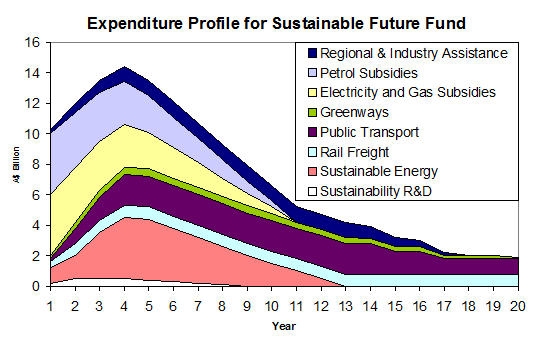
The Sustainable Futures Fund would generate some $13 billion in year one. This would allow electricity / gas subsidies of $1000 on average for four million families, and a petrol subsidy of $1000 for a further 4 million families. These subsidies would be wound down gradually over ten years to give people time to insulate their homes, install solar power, buy smaller vehicles and alter their travel behaviour. It would also enable an initial $2.3 billion to be invested in renewable energy, sustainable transport and transitional industry and regional assistance.
By year four, the peak spending year, annual spending on these investments would total $8.8 billion. This is designed to allow time to gear up major programs, and to avoid adding to current inflationary pressures or labour shortages caused by the current resources boom. It can be expected that the resources boom will be levelling off or declining in 4-5 years as Chinese and Indian growth rates slow, in part from the impact of peak oil and climate change mitigation efforts, and efforts to accelerate investment in renewable energy, rail and public transport will therefore provide counter-cyclical expenditure at that time.
Over time the renewable energy fund revenues would gradually wind down as CO2 emissions taper out, as fossil fuel consumption should eventually be largely eliminated (unless carbon capture and storage can be proved effective on a wide scale). A profile of expenditure for the Sustainable Futures Fund is shown, with transitional family subsidies largely wound down within 10 years, although regional and industry assistance programs would continue up to 20 years.
A program of planned retirement of older coal fired power stations would be introduced. By 2030, virtually all our existing coal fired plants will be 45 – 50 years old in any event. The existing car fleet would also be almost entirely retired by 2030 – policies would be needed to phase out production or import of current generation cars within 7 years. Our electric rail systems could be converted to 100% greenpower within the next two years as large scale wind plants (as just proposed near Broken Hill) and solar (like the concentrated solar PV plant announced by Senator Wong on 25th February) rapidly gear up.
What could this achieve over the 20 year life of the fund?
- $27.5 billion assistance to accelerate renewable energy, plus a further $2.5 billion in R&D. In this context, the rise in general electricity prices and the fall in costs for renewable energies from scale economies should allow this assistance to be phased out within about twelve years.
- $15.6 billion to upgrade our main interstate rail freight system, enabling a significant shift of long distance to rail, which is three times more energy efficient than road freight. This will also reduce congestion and maintenance costs on major highways
- $31.7 billion to significantly revamp our urban public transport systems. This would allow such projects as electrification and expansion of Adelaide’s rail system, major new mass transit systems for growing areas such as the Gold and Sunshine Coasts, Perth and Western Sydney, expansion of bus priority and cross regional bus services, and bringing Sydney’s rail system into the 21st century.
- $7.4 billion to create a comprehensive network of “greenways”, “greenlinks” and “green lanes” to allow safe, energy-efficient and healthy personal mobility in our cities and towns, using bicycles, electric bicycles, electric scooters and electric gophers. These will be needed even in the absence of climate change and peak oil to cater for the mobility needs of our rapidly ageing society.
- $13.7 billion of regional and industry assistance to assist transition to a more sustainable future.
Without such a comprehensive approach, it is highly likely Australia will fail to make the necessary transition away from oil and fossil fuels in time to avoid massive social and economic damage.
Contact
- anz at theoildrum dot com
License

This work is licensed under a Creative Commons Attribution-Share Alike 3.0 United States License.
Archives
- November 2010 (2)
- October 2010 (5)
- September 2010 (4)
- August 2010 (8)
- July 2010 (2)
- June 2010 (2)
- May 2010 (6)
- April 2010 (7)
- March 2010 (12)
- February 2010 (11)
- January 2010 (7)
- December 2009 (10)
- November 2009 (6)
- October 2009 (7)
- September 2009 (10)
- August 2009 (10)
- July 2009 (3)
- June 2009 (14)
- May 2009 (10)
- April 2009 (15)
- March 2009 (16)
- February 2009 (16)
- January 2009 (15)
- December 2008 (15)
- November 2008 (23)
- October 2008 (25)
- September 2008 (24)
- August 2008 (30)
- July 2008 (44)
- June 2008 (38)
- May 2008 (48)
- April 2008 (43)
- March 2008 (29)
- February 2008 (32)
- January 2008 (30)
- December 2007 (26)
- November 2007 (32)
- October 2007 (11)
Excellent plan, sir. I hope it gets the required support.
One query. Is it really true that "Our electric rail systems could be converted to 100% greenpower within the next two years"? I can imagine trains slowly grinding to a halt like be-calmed wind-jammers at sea.
Can diesel-electric locos be dual fuel? Would be useful in a transition phase.
Electrified rail transport uses relatively little electricity compared to total electricity consumption. So what he probably means is, rather than sticking a solar panel on top of a train, instead of the train companies buying electricity from coal-fired stations, they buy them from wind, etc.
Alernately, he might mean that the train companies could invest in renewable energy power plants to match the energy they use.
Either way, costs for them would go up a bit. But they get enormous public subsidies as it is. The Victorian government is spending $1 billion over ten years just for the stupid Myki "smartcard" ticketing system... after which there'll no doubt be another change anyway.
Currently wind, solar, coal and gas are all together in a national grid. If I tell my power company I want to buy wind they don't hook a line from my house to a turbine. They just charge me for it. And I'm charged the same whether the wind turbines are turning or humming along like mad. So if on a particular day only 1% of our power comes from wind, and 50% on another day, that wind customers make up only 10% of consumers makes no difference. It just all goes into a national pool of electricity generated.
Edit: I think Hart's got a decent plan, by the way. I've had an article like this fermenting on my hard drive for some time, but I was looking for more data to see where the subsidies would go.
Actually the article is by Garry Glazebrook.
Me stupid.
You'd think a guest poster would recognise other guest posts :-)
I hope this plan gets up. The infrastructure spend that we need to make in the next 15 years is frightening. The fact that most of this spend will occur at a time of declining oil and increasing costs takes the cost from "frightening" to "Nightmare".
Starting a fund now is a step in the right direction.
The spending's not that frightening.
For example, what was last year's federal budget surplus? $17 billion? Well, best figures I can get, taking averages from around the world,
Not perfect, but gives us an "order of magnitude" sort of figure for the costs per delivered watt. Note that I've been pessimistic; load factors decline once there's a lot of the stuff built, as the plum spots get taken, the manufacturing and maintenance quality often declines, etc. I've not taken into account economies of scale. It's best to be pessimistic about these things.
In 2005 Australia produced about 240 billion kWh. This is 240x109 x 3.6x106 = 864x1015J over the year, or effectively 27GW.
For $17 billion we could, ignoring geography and "where to buy from" issues, get ourselves,
8.5GWdel geothermal, or
3.8GWdel hydroelectric
0.9GWdel solar PV
2.1GWdel solar thermal
1.9GWdel tidal
2.3GWdel wind turbines
We may not have 8.5GW geothermal capacity, I don't know. They reckon there's only 100GW unused capacity in the world (that's for power generation - for water heating and the like there's oodles). We're too dry and flat for that much hydroelectric. But it's reasonable to suppose that between all the rest, for an amount equal to our federal budget surplus we could add a couple of gigawatts a year. This is 2/27 = 7.4% of present delivered power. Well, probably we need to factor in increased population, and turning off some of the old fossil fuel generation.
So we might get 2-5% - call it 3% - conversion to renewable annually. That'd be 100% renewable by 2040. Emissions due to electricity generation would be about a quarter to a third what they are today, assuming no positive feedback; for example now a lot of the emissions associated with building renewables come about because they're built using fossil fuel driven vehicles, and in factories with electricity from fossil fuels. As the economy became increasingly renewable-dependent, we could expect that to decline, so that the emissions due to electricity would be lower than that 1/4-1/3. They'd never decline to zero, though, if only because of all the concrete they use...
Of course we're unlikely to spend the whole federal surplus on any one thing, but there are state surpluses, too, and possibilities of a carbon tax to raise funds, as noted in this article.
In an Australia where we're happy to spend a billion bucks each for submarines that don't work, to hand $300 million in bribes over to Saddam Hussein, to spend $500 million on locking up a few reffos, $250 million each for some fighter jets, a cool $1 billion for a "smartcard" ticketing system for the trains - I really don't find this sort of infrastucture spending frightening at all. It's bloody expensive, but at least we'd see a result.
Great post Phil.
I hope you submit it to Rudds Australia 2020 Summit planning meeting.
Here is a submission I prepared. I would be very grateteful for some review and comment:
Sail Dog,
Great to see some activity for mthe 2020 summit. I think your submission is great but remeber it should be limited to 500 words or less ( I counted 818).
I think you should drop the climate change reference as I think that the delegates will get plenty of that anyway and just concentrate on the Peak Oil issue. Also I think that your response number 3 a-d may be just be a lttle too long winded. I suggest shortening it as follows
1. Immediate Public Debate on risks of Peak Oil led by governemnt
2. Establishment of National Oil Vulnerbaility Task Force from Federal, State and Local governments
3. Reassessment of taxation in shifiting from high to low oil consumption
Fine post- thanks.
I am a bit confused though as to where the oil is going to come from for the people you want to subsidise - the assumption seems to be that if the price is right oil will be readily obtainable, but I am not sure that that will be the case.
Perhaps it might be necessary to convert substantial numbers of cars to natural gas, too.
Have you got your assumed costs for solar and wind, and perhaps geothermal over the time period?
Converting cars to natural gas has been something both the major parties have pushed in recent years, with substantial subsidies available for conversion.
How wise this is long term, given that most of our gas seems destined to be exported, is a matter for debate (one I hope to have a post on in the near future).
Using biogas for CNG in rural areas might be a good idea long term though.
Not sure what costs Garry was using for solar and wind (at this point large scale geothermal would just be a guess until the GeoDynamics experiment is complete), but solar CSP is currently estimated to cost between 13 and 17 cents per kwh and expected to drop to around 8 cents per kwh - the same as wind costs today.
http://www.insnet.org/ins_headlines.rxml?id=6303&photo=
http://www.technologyreview.com/Biztech/20356/
Solar should track your needs much better than wind in many parts of Australia, so the cost difference may not count for that much.
If you used a solar thermal plant and simply sent the power to an air heat pump then you should be able to cool a well-designed house sufficiently to last the night - perhaps by chilling water.
Hopefully they have a massive program for residential solar thermal panels too, or at least are putting one in place.
Household solar panels and (thermal) hot water systems are both subsidised by the government (up to a point).
Feed in tariffs have just been introduced in South Australia - hopefully they will be elsewhere as well in the not too distant future, especially with the new government talking about a 20% renewable energy target for 2020.
I know it is incredibly politically incorrect in Australia but if we really want to make substantial cut in CO2 emissions by 2025 we need nuclear power. The only addition this plan needs to enable it is to remove the current policy impediments and the market will drive it. Nuclear comes in cheaper than coal at $120 per tonne and is much cheaper than wind + storage.
Not really.
We can't get nuclear going without uranium mining and refining, which is not exactly carbon neutral. And you can't just chuck yellowcake into reactors, you have to enrich the stuff. Enrichment is very energy-intensive, for example with gas centrifuges. If we wanted to have a nuclear reactor, we'd have to have an enrichment facility and power for it - 1,000MW or so. So we'd have to build a fossil fuel-fired generator to be able to enrich fuel for the nuclear one. Basically it takes one power station to be able fuel each two or three others, depending on how you do things.
Then as time goes on and the rich uranium ores get tapped out, the less rich ones are mined, and eventually you spend more energy getting the stuff from the Earth than you'll get out of it.
I'm constantly puzzled that on a website dedicated to the idea that fossil fuels will deplete, people can't grasp that other resources deplete, too. All mineral resources are finite and will deplete. Uranium's no different from coal, oil and natural gas in that respect. You can fiddle the numbers a bit with efficiencies and so on, but you're just delaying the inevitable. Mineral resources run out if you burn them.
We need to rely on stuff that doesn't deplete as you use it.
The "market" is nothing but the decisions of people. My own indecent proposal is that each area vote on what, if anything, they'd like to get their power from. That's democracy, and it's also a free market. When it has to be in their backyards, I'd be interested to see if wind turbines still look so hideously ugly to them, and whether nuclear seems prettier to them.
This is really not on. if you seriously believe that your comments on the energy costs of nuclear power and the availability of fuel is as you say then you are grossly misinformed, and are misinforming others
Your figures for the energy costs of mining and enrichment are complete nonsense.
http://www.world-nuclear.org/info/inf100.html
Energy Balances and CO2: WNA
The audited lifetime costs are around 1.35% of the energy generated is consumed in the production, including construction, mining, ENRICHMENT and all lifecycle costs.
As for not being able to understand why people who are concerned about peak oil should not always feel that we are in trouble on all minerals, that is because they have taken the trouble to inform themselves on the actual situation in different resources.
Oil and fossil fuels are produced only in very limited and specialised circumstances, other materials like uranium are a substantial proportion of the earth's crust.
We already know how to produce uranium by getting it from seawater:
http://npc.sarov.ru/english/digest/132004/appendix8.html
Fuel costs are such a small part of total nuclear generation costs that even at that price it would not greatly affect price per Kwh.
Of course, no one is going to bother whilst it is far cheaper to mine it, and when we need it costs can be vastly reduced anyway by a variety of strategies, as indicated in my quote.
How Australia chooses to power itself is entirely up to them, and the low population and good resources of the country probably mean that they could power themselves without nuclear power if they so choose - but at a cost.
It would be far, far cheaper to build the 20 or so nuclear plants that Australia would need, and contrary to your assertion you would certainly not need one coal plant for every two or three nuclear plants - that is quite absurd.
It seems a shame as your comparisons of renewable costs were pretty good, if some of them were perhaps a touch on the low side, maybe due to old data, and I can only imagine that you have some sort of blockage in looking at nuclear power.
The choices Australians need to make should be set out fairly to them, if those who advocate an all renewables future wish to argue their case it should be done from an accurate assessment of costs, not an entirely specious prospectus such as that given.
Maybe Australians will be happy to pay multiples of the price of alternatives - check out the price per Kwh of 75% nuclear France.
Ask them, but ask them fairly.
I might add that at virtually every step of the fuel process for nuclear...it can be energized by *nuclear* power. You don't have to build *fossil* powered production facilities, you can build *nuclear* ones.
So...in a country like france...80% of the energy to create and process nuclear fuel and waste is by carbon-free nuclear power.
DWalters
How much carbon is produced - note I didn't say could or would - by the construction of nuclear power plants and their total support/supply chain? Please include any carbon sinks destroyed by site selection.
Cheers
It's hard to say. The nuclear industry itself hasn't published any greenhouse gas emissions studies of construction, let alone complete lifecycle, of nuclear reactors and their fuel. Nor is there any independent official board or group entrusted with all the data to study things like lifecycle emissions.
So we're left with the estimates from various groups, from the political to the academic. And those give widely varying conclusions, from 50% to 0.1% the emissions of a similarly-sized coal-fired plant. Often though they have glaring omissions, like not considering different ore richnesses and so on, or assuming the lowest richness or the highest, or assuming the oldest and most inefficient uranium enrichment technology, or the newest and untried enrichment technology, and so on. But more often the conclusions are published without mentioning the methods and assumptions behind them.
What's clear is that it's not carbon zero, though like the wind and solar industries they often claim or at least strongly imply they are. If nothing else, the concrete used in the things causes emissions, since concrete is made with cement, which is made by roasting limestone and driving off the CO2 in the limestone; so even if your roasting oven were powered by entirely carbon free energy, that chemical process gives us CO2.
So basically all electricity generation technologies around produce some greenhouse gas emissions. The question is how much they produce relative to each-other.
But to me that's not the killing argument against nuclear. Rather, it's that uranium, like coal, oil and natural gas, is a depletable resource. The stuff's going to run short, and then after that run out. So we'd just be delaying the problem of how to get energy without depleting resources.
When you confront nuclear advocates with that they tend to start talking about getting it from seawater, breeder reactors and so on. The similarities between those arguments and "but what about tar sands? and also enhanced recover technology, and better efficiency for cars, and biodiesel, and -" are quite striking.
The timescales may or may not be different. Depending on whether you're talking about the same number of reactors as today but with as yet unproven technology and with breeders and fuel recovery and unconventional uranium, or the whole world current reactors and no breeders, you get anywhere between 7 and 1,000 years for how long the nuclear reactors would power the world - or part of it.
But in the end, the stuff runs short and later runs out. At that point we're again faced with the problem of running our civilisation without using stuff that runs out. I don't really see why we should be putting off dealing with this fundamental problem, handing it to future generations.
I mean, we have the technology now. If nobody had invented photovoltaic cells, solar thermal, geothermal, wind, water and tidal turbines, then fair enough, one depletable resource runs short so we change to another. But we have invented these things, and they have been proven to work, and be commercially successful - at least as commercially successful as nuclear, anyway. So why fuck about?
There is no such similarity, the analogy is entirely false.
Oil from tar sands involves removing an immense overburden of soil, or heating the area significantly, both of which are extremely energy intensive and very dirty processes.
To extract uranium form sea water you manufacture plastic membranes and suspend them in a cage in seawater where there is a current to pass water through the membrane, so most of the energy is provided by the current.
Apart from manufacture of the cages and membranes the only other energy involved is to lower the cages into position before use and to raise them 200 or so days later after they have absorbed the uranium.
When we need to we will build the cages out of plastic to give them a specific density similar to water and minimise the cables and support structure.
You are seeking to equate a very clean, energy efficient technology with a very energy expensive, dirty one.
You also have very significant mining operations involved in windpower, you know, as they are very materials intensive.
As is often the case Dave, you respond with your head up yer arse. You really need to start communicating without an agenda overlaying everything you say.
His analogy had nothing to do with the carbon footprint or energy intensity. It was a comparison of pie-in-the-sky hopes and dreams vs. current realities.
But thanks for playing.
Cheers
Please - cut out the insults guys - you can argue without being rude...
You really area an ill-mannered chap, aren't you?
Thanks for showing so clearly the level you are on.
Rational debate is plainly too difficult for you, and that explains the prejudiced standpoint you so often show.
Do grow up.
Both of you - stop it.
I had thought my response was mild and in no way abusive - perhaps your comments would be better directed at those who wish to use gross abuse and offensive language.
I've directed my comments to everyone who deserved them.
Your "grow up" comment is just inflammatory - if you can't keep yourself under control, I will - got it ?
'Leave him! He's not worth it!' :-)
The analogy's not false at all.
With oil beyond the conventional, the EROEI drops as time goes on; with uranium ores beyond the conventional, the same holds.
With oil beyond the conventional, the promise is of dramatically increasing the recoverable reserves at a high energy cost, requiring unproven technology, and at a low rate of production. This is the same with uranium.
If these things were so technically simple, then they'd have been done regularly already. Less than 1kg of uranium has ever been extracted from seawater. There exist no public plans for commercial operations. It's lab stuff.
"Oh but the price of uranium today is too low, and -" - ah, much the same as gets said about oil. This or that unconventional oil extraction technique is always deemed to be economical at whatever today's price is plus 40% or so.
You cannot say that any electricity generation complete lifecycle is "very clean" or "very energy efficient." You can only give absolute figures for the emissions and efficiency, and/or say that relative to some other technology it's clean/dirty and in/efficient.
Wind turbines certainly require material to be mined for them, as do nuclear reactors. Both require maintenance which uses material. Let's suppose that wind turbines delivering X electrical energy used just as much material and energy as a nuclear reactor delivering X electrical energy - they actually use less, but let's be kind to nuclear and suppose it's the same. There remains the fuelling of the things; wind turbines require no fuel, nuclear reactors do. They thus require more resources and energy to keep fuelled than do wind turbines.
Thus, wind turbines produce less emissions and require less mineral resources in their complete lifecycle compared to nuclear; wind is clean and energy efficient relative to nuclear.
Of course nuclear and wind each have other advantages and disadvantages both, which must be considered along with their emissions and resource use.
In the end, this must be a decision of the public. If the public don't want nuclear reactors, they shouldn't have them. Likewise, if they don't want wind turbines ruining their view, they shouldn't have them, either. Each region should be given the choice:
I'd be interested to see if people worried so much about wind turbines ruining their pretty view when coal or nuclear steam towers were their alternative :D
Yes you're not even wrong, but it helps to actually have some numbers detailing where the truth lies.
Conveniently they've been posted numerous times. Consider the Rossing mine data, where the uranium mined in these mining operations yields 500 times the energy in light water reactors in the once through fuel cycle than is consumed in these mining operations. We wont bother with seawater extracting simply because conventional resources are so vast that we could run our current civilization for thousands of years before exploiting seawater becomes a reasonable thing to consider.
An incomplete analysis which is glaringly wrong on some points; Quoting some numbers:
Nuclear power plants built in the 1970’s used 40 metric tons of steel, and 190 cubic meters of concrete, for each megawatt of average capacity.
Modern wind energy systems, with good wind conditions, take 460 metric tons of steel and 870 cubic meters of concrete per megawatt.
Nuclear power uses 1/5th the concrete and 1/10th the steel as modern wind turbines before dispatchable energy systems are brought into play. Wind certainly has its advantages (financing, licensing, grid integration on small scales) but to portray it as universally inferior to nuclear is to be willfully ignorant.
Thanks for the response.
This combined with safety issues is my problem, too. While the operation of plants is relatively safe, it is not safe enough given the long term storage issue. When we have Hiroshima, Nagasaki, Chernobyl and depleted uranium shells being used in Iraq, how can anyone claim it is safe to keep this stuff lying around? How purely lucky have we been that none of the FSU warheads has gotten away?
It's like climate change: the risk is so great, why continue letting that genie out of the bottle? It's a no-brainer to me.
Let's add in that autonomy and change requires the people not be beholden to a small group of powerful interests and advocating nuclear becomes but a bizarre obsession to me. As I've said, the cost of the government supplying every home in America with solar power is less than the cost of one nuclear power station. The government is putting 20x that amount into yet another economic package.
3 billion to reduce US energy consumption by, what? 50%? 80%?, or 200,000,000,000 in welfare to bankers.
How much more simple do people need this to be before they get it?
Cheers
I prefer not to argue the safety issues, it just goes round and round. You point out Chernobyl, they pull out some stupid official figure of 25 deaths from it or something, you mention nuclear weapons, they say, "oh but modern designs don't allow nukes to be made from the spent fuel, and anyway nobody's used a nuke since 1945", etc. It's pointless.
The other thing is that they're pretty well-practiced at arguing about safety. That's why it goes round and round. I mean, say "nuclear reactor" to anyone and the first thing they think of is deadly radiation. The pro-nuke guys know this, so they prepare their arguments.
But they're less well-practiced at defending nuclear on the basis of emissions, and they're extremely weak on its using a depleting resource. "Oh but the latest reactor designs... fast breeders... extraction technologies..."
"Okay, then, the latest solar PV designs using inkjet printers to make them -"
"But that's not a commercially-proven technology."
"Neither are the latest reactor designs, fast breeders, or extraction technologies."
"No, you don't understand. The latest technology and science works perfectly and can be trusted when it's my favoured technology, and is imperfect and can't be trusted when it's not."
If you argue safety you go round and round. If you argue emissions and the depleting resource, they get a bit lost.
And let's face it, in principle nuclear could be made entirely safe. In practice, of course bloody not, we're human after all. But in principle, sure. But even in principle nuclear will always be relatively high emissions (compared to geothermal, wind and solar, at least - though not compared to hydroelectric), and will always use a depleting resource.
Just don't argue the safety issue. It goes round and round, it's pointless.
The figures I gave are audited figures authorised by the Swedish government of 1.35% of the total energy yield of a reactor being required as all the energy inputs including construction.
From that you can estimate the carbon input.
Since they are much more extensive and use much more materials wind-turbines also have significant carbon inputs.
The issue isn't wind, it's statements by nuclear nuts that nuclear is zero carbon. It ain't.
A little honesty would be appreciated. As would less defensiveness.
What's the carbon input of a home-built windmill, eh? Quit being argumentative. Look for solutions.
Cheers
No one is suggesting that nuclear, or for that matter any other energy source, is zero carbon.
The debate is about how much carbon is released, so this is a strawman argument.
Nuclear is anything but clean. It's not just about carbon. But even then, very clean? Maybe you should define your terms if you don't want them taken "wrong."
Cheers
I'd be interested to see the source of the 1.35% figure - I hope in English! If nothing else, I want to keep my household carbon emissions excel updated - I have a breakdown of the emissions per kWh by difference generation method.
Actually John Howard asked us repeatedly in recent years - and we just threw him out and replaced him with a government that says "no" to nuclear power.
Most states here don't even allow uranium mining...
Notably, the state with the largest uranium mine (Olympic Dam in South Australia) doesn't allow uranium to be shipped from its ports. The stuff has to go north and ship from Darwin in the Northern Territory. The NT govt has a couple of times said it might ban the use of its ports, too - but the Commonwealth government said they'd use their powers to override that legislation if they did.
Hey - I see today that even the coalition are giving up on nuclear power - the sun is shining in Canberra it seems and even they can see where the wind is blowing ...
http://www.theage.com.au/news/environment/coalition-cools-on-nuclear-pla...
THE Federal Opposition has quietly ditched its support for a nuclear power industry in Australia.
Environment spokesman Greg Hunt has told The Age: "In the next 40 years, I think there is a zero chance of a nuclear power industry in Australia."
Mr Hunt said the Coalition's policy was changed at a shadow cabinet meeting in December, although no statement was issued at the time.
The new policy does not explicitly oppose nuclear-generated electricity, but goes close. The Coalition will no longer advocate nuclear power, recognising that its introduction would only be possible with bipartisan political support and widespread community support.
Well, they want some hope of attaining government in the next decade or so...
Strange since it was the good Dr Nelson who started the ball rolling leading to Howard commissioning the Switkowski Report. Hunt and Rudd might lose face if the wind shifts. Never say never. Word is from my Adelaide moles that Rann is a closet nuclearist but is reluctant to come out.
We've created one global well being crisis with fossil fuel and there are people like you that want to create another one. If left up to nukers the planet will die a green death, you know that eerie glowing Dr Who/X file green.
Your a very intelligent person for someone with brain-death Dave.
I notice that you don't try to defend the completely crap figures I was criticising - I have google earth, and I can't find the 15-25 coal plants specified in the original fantasy post for France's needs for enriching uranium - so what is your problem - you want to rely on total lies to support your case?
Guys - no personal insults - keep the debate civil please.
I don't agree with Dave on the nuclear topic but he is allowed to have his say.
I feel it is entirely up to the people of Australia what option they wish to pursue, and there is a stronger case there than in most countries for supplying their energy be renewables, and indeed expenditure by the Australians if they choose that option may help a lot of other people in poorer parts of the world by paying to develop, for instance, solar thermal energy.
My sole concern is that the options should be laid out to the people in Australia and elsewhere as fairly as we possibly can, and without distortion.
It is false according to reports that the Swedish government has accepted that nuclear energy uses anything like the amounts of energy indicated, ie needing one coal plant for every two to three nuclear reactors, and arguments should not be based upon such a demonstrably erroneous prospectus.
Having said that, I have no desire to turn this thread into a renewables vs nuclear debate, and was quite happy prior to this to deal with it on it's own terms, that is to look at how and with what cost Australia could be run on renewables alone, but am unwilling to allow what appear to me to be entirely misleading statements to stand unchallenged.
I would also like to clarify that I do not regard the poster who brought up the supposedly vast energy costs of nuclear as someone who is telling lies, as it appears he is under a great but genuine misapprehension, and I have provided authoritative figures to counter that, my remark was directed at the poster who thought it was inappropriate to challenge information on the grounds that it is false, and seemed happy to allow even inaccurate data to be disseminated as long as it supported his thesis.
Knowingly to provide false information however noble one thinks the cause to which it is in service is to lie.
I do hope we can get this thread back on track.
And yet somehow all renewable energy related threads on TOD ANZ (and maybe the rest, I haven't been keeping track) get redirected to this topic.
I'm getting fed up with this - I know you didn't start it this time Dave but I'm tired of people constantly rehashing the pro / anti nuclear argument on unrelated threads.
At some point in the (near) future I'm going to start pruning off topic chatter - move it to the daily Drumbeat or Bullroarer posts if you most go over this time and again - or, even better, put it into a post somehow related to nuclear energy.
It seems the industry PR campaign has been more than a little successful...
http://peakenergy.blogspot.com/2005/06/when-pr-goes-nuclear.html
I gave no figures for nuclear energy, so they can't be wrong. You're not responding to what I said, you're doing the old internet thing of just spurting out a pre-made mix of arguments you've had with a thousand other people.
All I said was that when you're beginning the nuclear industry in your country, then you'd need to build a power plant to power the enrichment to fuel the nuclear plants. And that's true. Our grid doesn't have a spare 1GW to chuck into gas centrifuges. Of course, you can lower the power requirement if you're happy to wait longer for the fuel, but I was assuming we were talking about powering Australia substantially with nuclear within say 20 years, rather than say one reactor in 30 years.
If you import enriched fuel and so on, then sure, you can get your reactor going a lot quicker. But that wasn't how it was presented in the last couple of years, it was presented as an ore to power at the point complete cycle all happening domestically. Which means we'd have to build another power station before we could fuel the nuclear one.
Further, I said that the stuff is going to run out some day. The more reactors there are in the world, the quicker it'll run out. An imaginary thousand year supply becomes a fifty year supply if everyone goes nuclear; and if we're talking about nuclear as a way to avoid global warming, then having everyone - or close to everyone - go nuclear is what we're talking about, a few dozen reactors in Western countries will make bugger all difference to emissions.
Yes, we have technology for extracting uranium from seawater. We also have technology for making photovoltaic cells with inkjet printers. I'm only interested in current technology, who knows what the fuck will end up working in the future - I'm still waiting for the flying cars I was promised in the 1970s. Let's focus on what we know works today, prudent public policy focuses on what works. Britain invented the jet engine before WWII, but they still fought and won the war with propeller-driven craft. The Germans buggerised about with jets, and lost. In a task involving the fate of nations, we must put the bulk of our resources into technology we know works well. Of course at the same time we should put some resources into research, because you never know. But the bulk should be in proven stuff.
My costs for renewables were averaged over the costs in many countries around the world, and these are surprisingly low. On the other hand, I also gave the lowest reasonable estimates for load factors, so even if you think I was being optimistic about cost, the pessimism about load factors should balance it out.
Centrifuges could be outdated if this Australian developed technology succeeds
http://www.silex.com.au/
I believe they started in Sydney got taken over by Westinghouse now Toshiba (?). I'm not sure why progress has slowed. I believe Australia should get into waste disposal, nuclear electricity then enrichment in that order.
I wonder why this topic never goes away?
"I wonder why this topic never goes away?"
"Energy too cheap to meter!" maybe? I dunno, I blame the faith in Science!
Stuff like "take the train!" - it's too simple for some people. They want complex solutions to simple problems. "Oh if we get this new expensive insulation, then when we use our brand new quantum heat pump, the heat won't leak in, awesome!"
"Why not just turn the AC off, close the blinds, turn the fan on and have a cold drink?"
"But that's not very high tech, I dunno... Anyway how are we going to feed ourselves?"
"Well you could grow some spuds in your backyard, you're always complaining about mowing the lawn."
"Hey I heard about this new hydroponics system which uses nano membranes to dynamically separate the..."
Life's too simple for some people. They need Science! to make it more complicated for them, and save them from having to actually do anything.
Its interesting, but ultimately probably rather dangerous to pump prior to simply replacing diffusion plants with centrifuges. The promise of laser isotope seperation delayed this infrastructure upgrade 20 years ago in the US and France before, and the countries with the largest installed nuclear consumption of SWU's have the least efficient enrichment techniques. Funny that.
I suspect silex isn't vaporware, but isn't mature enough to replace centrifuge enrichment either. Build centrifuges now.
Get active.
Stop the words.
cheers from us activists.
Just some more socialist drivel that will result in increased human suffering.
Perhaps the ethanol boondoggle was not a sufficient misallocation of resources to satisfy the the mindset of those needing to be taken care of by the incompetence of government planning.
Have you even noticed how politicians are ever so happy to point to enemies as a means to take more control so as to "protect the people"? In the USA we now have the Islamic terrorist as justification for government to further increase its nasty presence, and fast behind is the enemy of global warming, as justification to continue the plunder and control that masquerades as freedom in the minds of the indoctrinated.
There is just as much scientific evidence for solar cycles modulating the earth's temperature as there is for the CO2 cause and effect argument. Many respectable researchers say global warming is junk science; unless there is proof this is just hypothesis, not fact.
As far as peak oil, yes it is real as supported by real evidence. Yes, the industrial age will likely end, and yes likely many will die, and soon, as a result of a dramatic contraction in the economic pie without oil to fuel it. If you want the pie to shrink more rapidly, and to be directed disproportionately into the hands of the privileged few at the expense of the many, then you probably want government to oversee the economy as is suggested by the author. If you want to minimize the suffering and let nature give us a more fit population coming out the other end of the hourglass through which we are about to pass, then freedom is much preferable to the slave system of fascism or socialism.
There seems to be no end to what people will propose when driven by fear rather than by an understanding of the history of freedom and slavery and the known results of each.
Henry, So the data supporting Global Warming is bunk in your opinion, and just a veiled attempt to control the masses with fear for socialist or fascist reasons, yet at the same time the data for Peak Oil is sound, yet we should have no Plan B so the the fittest survive, instead of the richest and most politically powerful. Is that correct? A sort of post peak oil Darwinism.
Any thoughts on wave energy? The potential in the Bight and Down to Tasmania must be immense. I have often thought about large scale deployment of pelemis in this region.
I don't think politicians invented the global warming theory as a means to gain power and control; they are not that creative; I think it was invented by less than stellar scientist, and then the politicians around the world saw their opportunity. I don't subscribe to a conspiracy theory, but am just observing human nature.
I do think we should recognize the reality of peak oil and have plan B, and that should be individual plans developed by each of us for our own survival. I do not think that imposed collectivist solutions are sound, and if implemented will result in far greater human suffering than freedom driven individual and voluntary group plans. Socialist and fascist solutions have a history of serious failure, so why in the world if you want to survive, would you opt for something designed to fail for most except for the politically powerful? If we have what the author and seemingly you suggest, then the richest and most politically powerful will be more likely to survive than the fittest, since under socialist and fascist systems it is they who live of the sweat of the average man under any economic conditions, both favorable and dismal.
I do think that the human species will, in the long run, benefit by letting nature take her course, as you describe, "a sort of post peak oil Darwinism". Given the human population and its fast approaching confrontation with the limited capacity of earth to support us, there will be a massive reduction in our numbers. Do you want the laws of nature or an Adolph Hitler to do the pruning?
Bullshit. Stop the propaganda.
I find it intriguing someone decrying big government swallows the gov't/big business-sponsored bullshit about climate change.
http://www.climatecodered.net/
Read it.
We've already blasted this crap about the sun causing the problem all to hell on these forums... repeatedly. Stop spreading lies and propaganda.
Cheers
I'm right there with you on that one, but you know how denial is; They will scramble around for any scrap of evidence, no matter how obscure to support their failed position, and like the current US Admin. 'stay on message' thinking that by continuing to remain steadfast with a false message it will act as a form of brainwashing so people see things their way. Trouble is lying won't change the course of climate change.
The evidence that human produced greenhouse gas is affecting the climate is overwhelming. The scientific consensus is vast. It would take a massive solar event -- a new long period solar minimum like the Dalton Minimum -- to reverse current warming trends. Unfortunately, real research on solar variability has become politicized in an attack against the vast and mounting evidence supporting human caused global warming.
First they say the sun is the problem, now they're saying we're going into an Ice Age because of a solar minimum...
Criminy....
FYI, denialist, brainwashed, buddies of Exxon and BuCheney - who, ironically, coined the term Climate Change to be a less descriptive and less emotional description of Global Warming - the anthropological climate change problem will probably prevent the next glaciation of Earth from even happening. That's right. If present trends continue, we will be preventing the natural cycle of the planet.
Anyone care to guess at the long term changes that will cause? We only in recent years figured out letting forests burn was a good thing. The balance of the entire planet? Sheesh...
Cheers
I interviewed one of the Code Red authors twice, trying to cover the breadth of the report:
http://globalpublicmedia.com/sustainability_emergency_part_ii
The link to part 1 is included in the above url.
Anthropogenic Global Warming (AGW) is a scam of unprecedented scale. The data does not support the hypothesis. A dissection of the IPCC wibble here ->
http://heartland.temp.siteexecutive.com/pdf/22835.pdf
(Warning: Large PDF)
For all you angst-riven earnest hippies who get weepy eyed over the plight of f**king polar bears, baby seals, and seagulls ( supposedly ) caught in plastic bags; have a shave and examine the Data.
To lose focus from the very real threat of increasing fuel prices linked to peak oil is a mistake. Money will be much better spent on remedial action to mitigate the effects of a petroleum shortage, or to empower those who wish take personal action, than on such junk as more AGW research, carbon sequestration (plant a tree!) and b4st4rd biofuels.
There is little enough attention paid to PO as it is, and to partner up with AGW will negate the warnings when AGW is shown to be nothing more than an expensive social diversion.
People need the facts, conclusions based on available data, so they know how plan ahead for their own survival in their own way.
It's sad to see TOD, a valuable resource of expert PO related data, information and guidance, increasingly used as a forum for AGW and associated Junk Science.
And before I get accused of being an AGW 'Denier', an AGW Atheist? Both AGW and PO are still Hypothesis. AGW has made predictions which been proven to be false ( inc temp per inc altitude, inc sea level, inc hurricane frequency etc etc ), the basic data is also false. Peak Oil is still an hypothesis because it is based on admittedly unproven data, the trends on the available data allow us to speculate on the future, and it is future data which may yet prove PO false ( continued plateau due to severe demand destruction, yet the economic damage is done ).
You sound more like a person who hates hippies and therefore can't look at climate change objectively. You probably just cling to any data not to refute the science behind global warming but because you have a grudge against hippies and environmentalists.
Heartland Institute is a proven front organization for large corporations. Their last project was defending big tobacco. This is the quality of your Heartland Institute, which has never, once, ever submitted a scientific paper for peer review in an established scientific journal. Con men, all of them.
Furthermore, peak oil is not a theory unless you believe in infinite oil. Certain predictions made by peak oil may be wrong due to incomplete or inaccurate data but ANY finite resource can theoretically be exhausted. Some resource bases are so large as to be absurd but oil is not one of those.
Didn't we get our fill of global warming denialism in the recent thread, "We Won't Stop Global Warming"?
I don't know why we're expected to discuss things with them. Should we have to defend against those who don't believe in the Big Bang theory, evolution, a spherical Earth, or who think black helicopters from the UN are coming to take over the country? How nutty and stupid do they have to be before we just tell them to fuck off? Would we calmly discuss things with the Time Cube guy?
You are absolutely correct. The only non-biased look at the literature breakdown for and against AGW went 1000/0 for AGW. Nothing has changed since. Not one peer-reviewed paper that has withstood the challenge of peer review. Not one. Exxon and BuCheney have done their smoky magic well, I'll admit.
I'd endorse the site admins keeping all AGW posts limited to the aforementioned thread. If they had any merit whatsoever, I would not say this. That is not the case.
Cheers
AGW is bunk?
Well, I'm rather afraid it might all be true.
Hey, lets place a Wager:
* If you're RIGHT, we all go home
* if you're WRONG, 90% of species die, terran biosphere possibly permanently eradicated.
Now; all we need are appropriate odds, to assess the risk/reward ration.
j
Blog of Record for the International Climate Conference
http://tinyurl.com/36jxp2
Ah... Is/Was it anything like this one? http://www.realclimate.org/index.php/archives/2008/01/what-if-you-held-a...
Cheers
Power to the sun ! ;-)
Why don't you downunders consider solar thermal large scale (CSP) in your deserts ? Excellent EROI all things considered...
Some good wrap up found here:
www.mareinitiative.com
That would be bold and innovative. Australia doesn't do that, we'd much rather sell our patents overseas then import the stuff, while wandering around after some imperial master.
The biggest planned CSP plant currently on the drawing board is a 6 GW plant in California, using Australian technology from Ausra - now backed by Vinod Khosla's firm.
Demonstrating once again the foresight of our combined venture capital industry and government.
Are heating and cooling not an issue in Australia? (Not a facetious question.) This plan needs to include transitions in homes and businesses, too, no? Also, I think asking governments and the private sector (big business) to handle Climate Change and PO is a major, major error. Solutions will be best with a very strong dose of community involvement. This is especially true since our current systems of gov't and economy are based on endless, exponential growth - inherently unsustainable.
Cheers
In most of Australia, certainly in all of urban Australia, heating isn't much of an issue, it very rarely drops below OC as a minimum, but usually reaches 10C during the day. Wearing jumpers and having hot drinks will deal with that for anyone who isn't an infant or elderly and infirm.
Cooling's a bigger issue, as the north gets temperatures of 30-45C with high humidity, and the south similar temperatures but dry. Traditionally Aussies deal with that by using 2.5kW AC units. The boxlike concrete fibro board McMansions simply aren't designed to deal with that sort of heat, any more than are the concrete and glass office towers.
We need better designs. The McMansions at least because they're so shoddily-built will need refits and repairs anyway, so they can be given insulation and so on.
But really what's needed is a change of attitude. Turn off your 2,500W AC unit and turn on your 50W fan. Yes, it doesn't cool the whole house, but usually you don't need that, either you're in one place for hours (bed, TV or computer) or you're moving around cooking and the like and would get hot anyway.
I absolutely agree that we can't rely on government. They're followers, not leaders, that's the nature of democracy. They'll resist change, and when it becomes irresistable, help it out then claim it was their idea all along. That's why I suggest things like the one tonne CO2 lifestyle, it's something almost any Aussie could do today, and doesn't need any help from the government, new infrastructure, etc. If enough Aussies do things like that, the government will wake up and follow along.
Another serious question as I've not looked at the actual numbers and would be hard-pressed to do so if I tried - what do we get with the one ton lifestyle when multiplied by 7 - 10 billion? Would it allow a drop in CO2 globally?
Cheers
No, a one-tonne CO2 lifestyle if adopted globally would not give us a drop in atmospheric CO2. But it would probably prevent more than 2-2.4C warming, above which is the level the scenarios reckon will really screw us.
It's not often discussed in this way, but logically just as if I want to avoid getting drunk I should not consume more alcohol than my liver can process (one standard drink per hour), so too if I want to avoid raising atmospheric CO2, I should not put more into it than it can absorb. How much is that? We're not told directly.
You can get the IPCC reports on their site. Their summary reports at least don't mention carbon sinks at all. Let's take a look at a nice picture of it,
Their figures are in billions of tonnes of carbon, not carbon dioxide. 1 tonne of carbon is 3.67 tonnes of carbon dioxide.
Existing forests are basically carbon neutral; they breathe in CO2 and turn it into wood, sugars and so on, but they also breathe some CO2 out at night, and when they die they rot and produce more CO2 and methane (CH4) as well. If you cut down forests then more CO2 is released, if you plant more forests then more is absorbed as the forest grows, until it stabilises in total mass a few decades later.
There's some argument that the forests may not be carbon neutral, that as there's more CO2 they grow more, or that as they warm they rot more, the science is unclear. The fact that it's unclear whether they add to or subtract show that their contribution can't be very large either way.
The ocean absorbs some CO2, between 1.6 and 2.4Gt carbon each year. There are some signs this may be declining, there are limits to how much it can soak up, it's like when you put sugar into a glass of water, at some point it stops dissolving. In addition, when water is warmed it lets its dissolved gases out bit by bit; boil lemonade or beer and it'll be flat afterwards. So global warming actually reduces the ability of the ocean to take up carbon.
So if our forestation and deforestation are exactly balanced, then basically the ocean is it for our carbon sink. This gives us 1.6 and 2.4Gt carbon we can pump out and hope it's absorbed. That's 5.9Gt and 8.8Gt of CO2. Divide that into today's world population of 6.6 billion, or 2050's likely population of 9 billion, and you get 0.6-1.3t CO2 - call it a tonne each.
However, that's only half a tonne for individuals, since the stuff we can control individually - our transport, what we eat, how we get electricity, etc - makes up about half of each country's emissions. The other half comes from industry, commerce, and a whole swag of other stuff you and I can't control. But of course a general reduction by individuals would have knock-on effects, if homes won't buy coal-generated electricity, the stations won't be economically, viable, and then industry and commerce won't be able to buy it either.
Now, even this scenario doesn't give us the world stabilising at current atmospheric CO2 emissions immediately. That's because there's a bit of inertia in the system, between all the stuff we've pumped into the atmosphere and the changes already under way, even if all human carbon emissions stopped tomorrow we'd still get more climate change.
The IPCC Nov 2007 summary report looked at six groups of scenarios for emissions reduction or increase. None of them gave an eventual temperature increase of less than 2C, the lowest was emissions peaking somewhere between 2000 and 2015, and a 50-85% reduction in total emissions by 2050, giving eventual temperature rise of 2-2.4C.
Thus the following graph,

The roman numerals are the six different scenario groups, according to whether we reduce or stabilise emissions by 2050 (groups I, II and III) or increase them (groups IV, V and VI). The consensus is pretty much that we want to stabilise it at or below 450ppm, 2C increase. Above that we're in this shit.
Our current carbon emissions from fossil fuel burning are about 8Gt. Methane from livestock, rice paddy farming, mining and so on add another Gt or two, as does deforestation. It all added up to about 49Gt CO2 equivalent in 2004. That was 8t CO2e per person then.
Okay, note that no studies have been done of what happens if we all stop causing emissions tomorrow. Scientists tend to only spend years of their lives studying likely scenarios. So the biggest reductions studied are 50-85% of total emissions. That takes emissions to 7.4Gt to 24.5Gt CO2 by 2050.
Divide that by 9 billion people, and we get 0.8-2.7t CO2e per person. Again, remember that only about half of emissions are things we control in our daily lives. So you're looking at 0.4-1.4t CO2e per person.
I looked at that, and said to myself - well, if we're aiming at gradually approaching 0.4-1.4t CO2e each by 2050, then if I'm doing it tomorrow, I'll get something on the higher end of that. Reducing our carbon emissions is like paying off a loan with compound interest - if you can do more earlier, that's good. 1.4t CO2e each today is better than going from 8 to 0.4t CO2e each over 42 years.
Then I dropped it down a bit, because ideally we won't just avoid totally screwing the planet, but will give it some breathing space and emit less than we safely could, give it a chance to recover. Also I made it lower because it's good to be ambitious with such things, then if you fall a bit short you're still better off than if you'd aimed low. Thus, one tonne of carbon dioxide each as individuals, or two tonnes total for each person in the world.
This still gives us an eventual 2-2.4C warming. The one-tonne CO2 lifestyle does not prevent climate change, it just gives us a fair shot at preventing catastrophic climate change.
What it seems to be is that our car is going down a one-way street and we've left it too late to hit the brakes and avoid the climate change brick wall at the end - the best we can do is make sure the collision isn't hard enough to kill all the passengers.
You can see more of this sort of thing on my blog, if it interests you, or email me if you enjoy lots of numbers and discussion.
Thanks! I like your site too.
Just wondering if you have digested Climate Code Red yet and if so does it change anything you have laid out above?
No, I haven't, I've just read reviews of it. My understanding is that they're saying, "oh no! Things will turn to shit! Someone hit the alarm bell and let's get moving!" Which is probably a fair assessment of the situation, but really that sort of thing requires government action.
I don't have much interest in that. Once a month I sit down and write letters to my federal and state MPs, and to the newspaper, about whatever issues have come up recently. That's about all I'm willing to do politically. Ever read Thoreau's Walden? He says something like, it's not my duty, as such, to eliminate even the greatest wrongs in the world; but it is my duty to at least wash my hands of them and have nothing more to do with them. So for example Thoreau would say that a person doesn't have to run around trying to free all the slaves, but they do at least have to free their own slaves, and if they come across one running away, shelter him then send him on his way to a safer place.
I'm like that with my impact on the environment. I can't change the world, I can just change me. Along the way I talk about things so that when others make their own choices they can be informed choices.
I understand your perspective and have personally gone back and forth on this issue. If I may, I recommend either reading Code Red or my interviews with the author. It may shift some of your numbers and strategies a bit.
Government action is required indeed! And ain't that trouble given the state we are in and how little trust we have in institutions. This is all well understood by the authors and is discussed in my interviews.
I would be interested to see your response. It is worth the time. I generally follow your lines of thought closely.
I'll have a look over the next few days (I see that it's 101 pages!) and post any thoughts up on my blog.
I think our governments and institutions are generally good. It's just that we think the wrong way about them; we expect them to be leaders, when in a democracy they're actually followers. They don't come up with their own ideas or policies, they just do what they believe the people want. Of course they're often wrong about what the people want, but that's why they lose the next election ;)
If we want them to act, we have to act so they can follow us.
Climate Code Red is based, essentially, on the work last year of Hansen, et al. Their work finds the climate sensitivity is so great that a doubling of CO2 = a 6c rise. That ends up putting us already too far along the road and in need of going backwards a few decades to 320 - 350 ppm.
The 1 ton carbon lifestyle, then, is too little, too late.
Cheers
Dunno about that, mate. Remember that I'm not saying such a change by itself is enough, but that with flow-on effects to the rest of the economy, coupled with actual legislation and such to enforce and encourage change, it could work. It might not, but it is in any case more ambitious than any plan I've seen proposed by any country or state anywhere.
In the IPCC's 2005 report, they said that,
- to get eventual stabilisation at 450ppm CO2, cumulative 21st century emissions must not more than about 490GtC, or 1,800Gt CO2
- stabilising at 1,000ppm takes about 1,100GtC, or 4,030Gt CO2.
At 1,000ppm the world is basically toast so we won't aim for that.
Our current emissions are about 49Gt CO2e annually, no change would give us 4,900Gt CO2e by 2100 - not only toast, but "bugger the stupid smoke alarm went off no don't put the knife in the toaster you idiot - shit."
So let's aim at or below the 1,800Gt CO2e figure. That's an average of 18Gt CO2e throughout the 20th century. Unfortunately we've already knocked about 315 into the atmosphere from 2001-2007, so we're left with just 1,485Gt CO2e for the other 92 years, or an average of 16Gt CO2e annually.
Okay, on the basis of "individuals reduce to 1t CO2e each over ten years, the rest of the economy holds steady over that time, then drops by X% annually," we get as below. I put in a 0.75% annual population growth to 2050 to get the middle range of population estimated by the UN, stabilising at 9 billion then - stays steady after that.
The tables would be too long, so I'll just describe it from my spreadsheet.
Okay, so individual emissions drop from 24.6Gt CO2e to 7.2Gt CO2e by 2019, then rise with population one-for-one. From 2008-2019 they add 176Gt CO2e to the system, compared to the 308 they'd have added by staying being frozen at their current per capita level and just going up with population.
Now, what happens from here depends on X, the rate of decline of general emissions after 2018.
If X=2%, then danger level (1,800Gt CO2e) is reached by 2062, and it's at 2,400 by the end of the century.
If X=3%, danger level is hit 2070. 4%, 2079 - you get the picture.
To have 1,800Gt CO2e total emissions through the whole century requires a 6% annual decline in general emissions from 2019-2100, coupled with that "one tonne in a decade" for individuals.
Is this achievable? I think so, yes. More likely, if individual emissions were declining 10% a year for a decade, we'd see at least a 5% annual decline in general emissions during that time and afterwards, too.
They'd then reach parity about 2030, at a total of 1t CO2e per person general and individual both, or 7.9 + 7.9 = 15.8Gt CO2e annually, rising to 18Gt CO2e by 2050 then levelling off. This has us hit danger zone in 2080.
But we could after 2030 take time to reduce further, to 0.5/0.5 rather than 1/1. This'd be a harder task, I think, so I'd allow 10 years to think about it, then 60 years for the changes, a simple 1% drop on the previous year each time. In this scenario we reach 1,800Gt CO2e bang on 2100.
In sum, the plan would be,
- 2008, freeze totalgeneral emissions, individuals reduce their emissions 10% annually
- 2009-2030, as a result of individual emissions drops, general emissions drop half as fast (5%)
- 2030, individual/general emissions reach parity at 1t CO2e each
- 2031-2040, idle time and planning
- 2041-2100, both general and individual emissions drop at 1% each year compared to previous, until by 2100 they've reach 0.5t CO2e each, or 9Gt CO2e total.
- this gives eventual stabilisation at 450ppm for CO2, and 2-2.4C temperature rise.
Note that natural carbon sinks are at this time estimated to be 5.9-8.8Gt CO2e. So after 2100 if we wanted to bring the Earth back into some balance, lowering CO2, we'd want the population to decline to 5.9-8.8 billion. Continuing improvements in HDI are likely to achieve this past 2100, but I think really we can only be expected to plan 100 years ahead anyway.
For my part, I would support more drastic action than the scenario I outlined above; my own personal annual emissions are about 1.5t CO2e today, not accounting for any tree-planting I do. But I think this one is about the most drastic that has any chance of being accepted globally.
The scenario I offer is, then, going on the IPCC reports, very likely not "too little, too late." I reject such comments entirely as giving excuses to continue eating burgers and driving SUVs, or foolish doomerism.
Hi Folks,
I hate to be the one to tell you, but you are all deluding yourselves that "Help is on the way"
I am now in a Third world country where we know the cost of oil.
We load up to seven people on a 150cc motorcycle. I personally only limit myself to four at a time.
150cc divided by 7 = 21cc/person
We use "Easy-rides" for people-transport. It is a 900cc, twelve valve, five speed Suzuki Multi-Cab. We load at least 12 people before the engine is started. More may jump "On" as it goes.
900cc divided by 12 = 75cc/person.
I understand that the "safety" arrangements are a bit lacking
We have 95 million people sharing limited resources and we have found a way to make it work. We lose some through lack of "Safety" but nowhere near the 4 Billion that the Olduvai Theory says will be lost if we keep doing things the "Safe way"
With GM, Ford, and etc, etc, still putting out 7 litre engines and still measuring the time from 0-60 MPH, I do not believe any one of you who read this, can honestly think anything will change until the bottom falls out.
Not even the less intelligent believe that this modern Industrial/military complex of Consumerism can be diverted.
China and India are going to get their share no matter what.
The tragedy is that (Modern American)Culture has exploited all the Homo Sapien innate weaknesses. There is no voluntary escape from what our pleasure centers tell us is so rewarding.
I have enjoyed 66 years of wasting and squandering. I had tremendous fun and reward, mostly at the expense of the Future. The Dilemma of my Commons was very simple. Starting at the Apex of the Pyramid, when "they" get the conviction of "Actually doing something that matters" I will hold their hand. However, as long as they are fooling the system I am going to do it better and quicker than they can. I am sure "God" will take care of things.
Sorry, but this how I see reality.
If you have to copy and paste your post that many times, it comes across to readers that you really didn't think the post had much impact in the first place, that is without being copied numerous times. Either the information in the post makes sense and has impact, or it doesn't. Multiple copies only reduces impact. Follow, or should I copy this post numerous times to drive home the point?
I am guessing that's not what happened CS. It looks like the server was slow when posted it, so he likely hit the button four more times. I have deleted the other four. :)
I would guess that you are based in the Philippines?
When I lived there for 9 months during 1979/80, there was the previous oil-crisis going on. I know how inventive the people there are when it comes to cramming people into jeepneys and suchlike. However, when I was there, the population was around 47 million - versus around 92 million today. How on earth can any country support that sort of growth?
I mean, mentioning birth-control there is a faux-pas. It is taboo.
Personally, I think that controlled population-reduction is a prerequisite for having a sustainable society.
I agree with all your comments about the wastefulness of the West. However, at least people here, in the UK, practice birth-control.
That's a bit like saying, "I only manufactured the gun and bullets, gave it to the lad as a Christmas present, then asked him why he let that guy take his girl. I couldn't tell you what happened after that."
Blaming developing nations for Climate Change and Peak oil is absurd. The cause is squarely on the developed nations. The blame for future contributions may be apportioned differently, but current conditions are ours and ours alone. Hell, even then, leading the way then crying, "Do as I say, not as I do!" rarely works.
Cheers
It's cool to hear from regular folks here, especially from our 3rd world freinds:). Keep enjoying life till it's gone. We could probably do an ELM calculation for food imports and the philippines and how much rice it takes per person to survive compared with the poopulation doubling rate and guess a massive dieoff date but that would be too cruel and just all too TOD. Happy motoring dude!!!
http://oryza.com/Asia-Pacific/Philippines-Market/7301.html
http://oryza.com/Asia-Pacific/Philippines-Market/5972.html
So a 10% rice import level of total consumption. If you get say population growth and have to be self sufficient due to the same in Vietnam, etc. then the 16 MT of local rice will have to feed twice as many mouths in say twenty years. If there is increasing drought like in 2007 then the crop yields will fall. I would guess then that a continual population growth is unlikely given that it depends on cheap grain imports and higher yields which will not likely continue indefinitely. Dieoff or just deniuded landscape and high population densities? Who knows. 200-300 million philippinos would be pretty hard going.
How much rice per person per year to survive? 16 MT/100 million people is how many calories?
Many times I have read about how the developing world has the potential to continue on the development path, giving it's citizens a better life filled with all the amenities of modern living. When one lives in a developing world it becomes quickly obvious how difficult and resource exhausting this trip to development would be. In addition to the increased consumption of raw material, the fast track development quite often overlooks the more expensive environmental protection regulation and enforcement of any regulations which maybe in place. I have actually been told by state officials that private taxies which belch out copious amounts of diesel soot from their worn out engines are not forced to rebuild the engines because of concern for economic hardship on the owner. These vehicles drive non-stop all day and night long in the city I live in, and they are often the worst polluters.
Another example we have seen recently is that in order to help offset the rising oil prices several taxes have been lowered or suspended.
So, where one would believe that increases to public transportation infrastructure development would be the desired direction, in fact the opposite is the case as the government attempts to reduce the pain of higher fuel costs and the subsequent rise in consumer good prices.
Later in the same article production of palm oil for bodies was addressed
It appears that the plan to produce biodiesel mix blends and pure biodiesel is falling behind on anticipated output.
When computing how much money it would cost for this or that, it is common to assume that:
1) This expenditure is borne wholly by governments, ie taxpayers.
2) This expenditure is on top of all other expenditures.
First of all, even if governments paid the whole thing, the money could come from some other source, such as a reduction in roadbuilding expenditures, or a reduction in military spending. We're starting to hear estimates that our little venture in Iraq is going to end up costing the US government something like $3-$5 trillion all told, just to kill people and blow stuff up in the desert.
Most any transport or energy scheme has potential cashflow, such as rider tolls or revenue from energy sales. Any project with reliable cashflow can be at least partially debt financed.
Of course, the first Age of Trains in the US and UK was mostly privately built. That is more difficult today, due to rather large subsidies for driving that make it hard for unsubsidized alternatives to compete. Second, most any project could involve substantial rights-of-way or eminent domain issues, which the government excels at. Third, there is often concern about private, for-profit ownership of "basic utilities" like transport systems. Rail monopolies were a big concern a hundred years ago.
Actually, even most privately-built projects have heavy debt financing, due to the nature of such projects (high capex, stable cashflow). Thus, whether organized by the government or private sources (ie who holds the "equity"), much of the financing could come through the private debt markets in either case. Many toll roads, subway systems etc. are not really the regular government, but a public corporation such as a "transport authority." These enjoy advantages such as being able to issue tax-free debt at very low interest rates, and are often conceived to be "non-profit" entities, and thus not required to maximize profitability but rather the general good, although they may actually make a profit.
Where there's a will there's a way.
Who cares how they finance it. Once they get the bug that it's urgent they will haul ass, shift money around from one group to another in debt or tax and get it moving.
OK - Phil and Gary - congratulations on your new banner - I still think a silhouette of a surfing Sheilah would have been better - but hey the stars ain't bad.
Its Saturday night and I'm bored.
So if Australia is so concerned about GW - why not ban coal mining? Many states banned U mining, so why not coal? Where do the real risks to the global environment and global economy lie?
I propose that coal exports be included with a domestic carbon cap if the Rudd govt ever gets serious about reductions. In other words if the domestic cap shrinks say 2% in 2012 then coal and LNG export customers have to cut 2% as well. However with coal prices increasing 50+% a year the demand reduction may be a bigger than that anyway.
The uranium connection is that I think extra yellowcake could be sold to some coal customers who take bigger cuts and don't get the coal from somewhere else. Currently I believe China takes less coal than several countries in east Asia and Europe but that seems likely to change. All of this will be an integrity test for the new Federal government who promised decisive action, so far not seen.
Good point about coal though. Including exports Australian coal produces (if I recall) 6% of world GHGs yet with only 0.3% of world population.
The logical thing to do would be to tax fossil fuels the moment they come into contact with the Australian economy, whether that be when we dig them up, import their derivatives, or whatever.
If we just tax the fossil fuels, the flow-on costs will do a lot. If the tax has no effect on consumption, raise it. That's what they did with smokes, those buggers are ten or twelve bucks a packet now, ridiculous. But it's very effectively squashed smoking, or at least contributed to squashing it.
Or they could reduce exports enough to meet the reduction in the carbon cap without having to cut domestic use at all. Call it a win-win :-)
We win and Japan and Korea get shafted. Aussie dollar gets hammered and before you know it we are economically in the same toilet the US currently finds itself swimming.
Aussie dollar gets hammered
I doubt that, Australia is responsible for more than half the worlds coal exports, any significant export cuts they made would push up the price more than enough to make up for the reduced volume.
Euan
Tim Flannery proposed to limit coal exports over a year ago and the polictians went apoplectic.
http://www.abc.net.au/lateline/content/2007/s1849051.htm
Australia is currently running a trade deficit of greater than AU$2 billion a month mainly due to our declining oil production and importation of oil and refined products. Its getting worse.
Fuels and lubricants imports ;
Seasonally Adjusted
FLOW
Month $ Millions AUD
Oct-2007 -2,285
Nov-2007 -2,229
Dec-2007 -2,313
Jan -2008 -2,685
This shows part of the reason why our trade deficit is so shocking. Despite highest terms of trade and record export volumes of commodities.
The overall result for these months were
Month $ Millions AUD
Oct-07 - 2,824
Nov-07 - 2,173
Dec-07 - 1,937
Jan 08 was - 2,723 (great result!!!)
To keep happy motoring going Australia must export coal and even more coal each year. We cannot export enough coal or LNG to keep up with declining domestic oil production and increasing domestic consumption.
That is the sick predicament we are in.
It is totally unsustainable.
That is why Garry's proposal for public transport is so important.
Yeah - I was browsing through the BP stat review looking at coal production data and noticed that Indonesia had also an upsurge in coal production to compensate for declining oil.
I really wonder if we will open new deep coal mines in the UK also - it must be on the cards cos the UK will be up there competing for basket case economy of the year.
I'm amazed to hear that Oz is running such a large deficit - what with all the resources being mined and high prices. You guys must be on a consumptive binge.
But what you say confirms what we already know - economy first, climate second.
We are (and have been for decades) on a consumptive binge - but oil oil and refined products deficit is doing a good job of outweighing our other commodity exports.
The drought (and resulting fall in rural exports) hasn't helped matters...
Euan
Like Gav said we are on long binge, but its really our oil consumption and land use planning that drives it.
The last time we ran a trade surplus was when our oil production peaked back in 2000.
Most freight between on East coast goes by truck. This needs to seriously change.
Our rail system has steam age alignments and as such rail is very slow.
Nor is building more motorways helpful investment to reducing Co2 emissions and oil consumption.
BBoy,
Where did the data come from. I have often wondere dabout the corelation between BOP and oil imports.
Actually Chris Vernon did the work - thanks Chris !
Euan
In answer to your question:
The same reason that Britain doesn't ban North Sea oil - money!
The new Rudd governemnt is a pretty polished outfit and is showing how well it can control spin - a trick I think they have learned very well from the British Labour comrades.
Ratifying Kyoto was the opening dramatic scene, followed up by a flourish at the Bali confernece at which Australia happily accepted a "leadership" role in negotiating an acceptable announcement while refusing to commit to targets until they had "the right advice". Said right advice was furnished recently by Professor Ross Garnaut ( Australias answer to Stern) however his advice appears to have been too right when he suggested that 90% reductions would be required. Apparently that didin't quite fit the Goverenments pre-election committment so they have have aleready signalled their intention to ignore the advice.
Meanwhile, we can't export coal fast enough because our ports have not been built to handle the volume demanded. This is effectively a restriction of supply, which increases the price! That just won't do, we have a duty to export cheap coal to our Japanese and Korean customers. The supply of cars and plasma televisons depends on it and if there is one thing that Australians love more than their cars it's their televisions.
Of course most Australian coal is burned overseas so it doesn't really count as Australia's contribution does it?
Fifteen minutes ago, I watched my wife try and pick up a stubborn clump of dog hair from the carpet with the 4000watt Dyson. Yesterday, I noticed 2000watt foot-heaters on sale for $12 at Bunnings. The point seems obvious: If, as a society, we don't have a mindset to try and check so-called Climate Change, how on Earth are we going to move "voluntarily" from fossil fuel to solar (or whatever)?
As an Average Joe - married, three kids, mortgage - ALL I care about these days is my children's future. And frankly, after what I've read these past few months (including, more importantly, what I HAVEN'T READ in mainstream media), if the notions of CC and/or PO turn out to be FACT, from where I sit it all looks pretty bleak.
We didn't used to have a mindset to try to check running out of water. But a combination of some pretty slack-arsed regulations in Victoria, progressive consumption pricing in Queensland, and adverts in both places along the lines of "every drop counts", these reduced water use a lot.
If it worked for water, it can work for electricity, natural gas, petrol, etc.
Kiashu
The travelsmart program in Brisbane suburbs has been a sucess in reducing travel demand. But more needs to be done to bring it into Sydney and possibly melbourne
http://www.travelsmart.gov.au/
Looks good, BeaconBoy - and I'd never heard of it, so it definitely needs to be promoted more in Melbourne.
I just have the guideline that if it's 0-5km, walk, if it's 5-15km, cycle, and over that take public transport. Well to be honest I don't cycle much because I have freeways near my home and I'm a coward. I've already said why I hate cars. Fuck 'em.
Does
mean that peak natural gas may be recognized by PNM in 2009?
We'll ask if a 10 year projection is availble.
We don't know. Not our expertise.
But may so?
Note the declining reserve margins 526/483 = 1.09, 541/492 = 1.10, 516/500 = 1.03, and 516/509 = 1.01.
View energy intensive High Desert.
Guys
Thanks for not deleting my posts.
My link to Australia is my computer science phd student, friend, legal advisor [his father was lawyer], and salmon fishing buddy Dr John Sobolewski.
Sobolewski received BSEE and MSEE degrees from U. Adelaide.
When we aren't catching salmon, Sobolewski lectures me on lots of things. I listen.
Sobolewski is very smart.
And speaks four languages.
Polish [born in Krakow, 1939], German [He lived 10 km from Dresden when it was bombed], French, and AUSTRALIAN.
AUSTRALIAN accent draws lots of attention.
:-)
This idea is real good, hope it's ok to rip it and give a copy to my local member of parliament.
Average Joes n Janes needs to pay a friendly visit to their local members.
Really, let's lean on them in the nicest possible way.
My local MP is old Pete Costello. The bloke's not even going to see out his term, he's just idling while he looks for a cushy post-politics job. But since he spent 11 years as Treasurer abusing companies for overpaying their CEOs, Directors and consultants, he's finding it a bit difficult to find the traditional post-politics well-paid consultancy :)
So he's doing nothing. Not much use my writing to him.
That is a special case.
Get on Garret's case then, been very quite hasn't he,that in itself is scary.
Even so, There is no harm in trying, got to be in it to win it.
I fail to see how this would actually encourage people to do anything be they poor or not. The whole idea of taxing carbon is to reduce consumption but subsidising consumers negates this. Whats the point. Even reducing these subsidies over time will fail to achieve a net reduction in energy consumption, people will just adjust to the new prices and carry on with business as usual. There needs to be rationing of electricity by way of price increments which punish high use, similar in the way that two tiered water pricing in NSW now operates.
This scheme would make an allowance of say 600 KWh per dwelling which would be charged at a commercial rate i.e the cost involved in delivering the power witha margin for the generators/distributor. After this threshold is exceeded, the cost should rise quite steeply so that wastrels are punished financially but not prevented from accessing the power. The frugal pensioner living in a modest unit will use well below the threshold so won't be any worse off. The fast living McMansion owner with sixty downlights blazing all day and night and the subsequent air conditioning required to then cool the home would pay dearly. Market forces will soon work out waht type of housing to build in the future.
The other consideration of course is how to equalise the access to both reticulated natural gas and electricity across all consumers. Household energy thresholds delivered by the grid may need to be considered. There should also be no trading of unused allowance
A rationing system like this means that the bureacracy involved in administering it is reduced and the political risks are minimised making it it much more palatable for politicians to actually implement. The extra revenue (if there is any) could be directed into providing renewable energy or confiscated by the government if it was not and then pooled inot a bigger investemnt fund.
This takes care of the domestic consumption of energy but not commerical and industrial users which must be treated differently.
Tiered pricing could be a way of 'selling' carbon cuts. Even though people may be miffed about overall energy cuts the guilt trip is a very powerful psychological weapon..I use it all the time.
A problem though with ageing population and extended heatwaves (eg Adelaide currently) is that seniors may need air conditioning. Maybe that needs to handled differently to a baseline electricity quota. It seems to me that gas and electricity retailers are best placed to enforce demand management. They could help ensure that the vulnerable have simple ways of avoiding excessive heat or cold.
Here's my $0.10 worth of critique:
I think it would be better to be replaced by transport subsidies for the poor -- we already do this to some extent with the school bus pass system. This could be expanded. However, in a lot of areas, there isn't an existing public transport infrastructure which such communities could use, so day one of carbon taxing would also have to have a large bus / minibus deployment launched as well. That's lots of extra jobs created, which is not exactly what Australia needs right now. Bus driving doesn't require a lot of hard-to-acquire skills, so perhaps that extra employment would be coming from the long-term unemployed. Still, it would have a further inflationary effect.
Oh dear -- launch now with subsidies that might give us trouble further down the track, or launch now with a plan which will give us trouble almost immediately. Not a good set of options, really.
For example, it should be squarely in the fund's remit to fund drive-on, rest, drive-off trucking capability. i.e. a truckie can meet the train line in Melbourne, drive their truck on to the train, sit or sleep on the train until it gets to Brisbane, and then drive off. This model has worked well in Switzerland (the point there was to get Italian drivers off the Swiss roads for safety rather than for surviving in a peak-oil world). It will work here in Australia even with current rail track and engines -- it's OK for a point-to-point journey to be a bit slower and longer if the truckie gets a rest in the middle.
This could be launched pretty cheaply in the short term, and with the carbon taxing suggested could be made immediately cost-effective. There would be less resistance from the trucking industry if there were some sweetener for them, and drive-on/rest/drive-off facilities would go down pretty well, I would expect.
Of course, if we had a 140km/h-capable railway line all the way down the east coast, or a 400km/h maglev line... that's a nice thought; think of the carbon and fuel savings... which I guess is the point of the sustainability future fund.
For example, the fund should also be subsidising the cost of R&D and deployment of "demand management" receivers in air-conditioners, dishwashers, washing machines, dryers and other "time-shiftable" electricity users. Then the grid would be able to send a signal "we are close to maximum generating capacity; shut yourself down for a random 2/3/4/5 minutes out of the next fifteen minutes" and scale back demand whenever renewable energies are maxed out.
This is useful work - such a Sustainable Futures Fund would sit perfectly within the TEQs (Tradable Energy Quotas) framework advocated for Australia by Ian Dunlop (see e.g. his Prime Ministerial Task Group submission)
Having the money raised for the fund generated by the TEQs system, rather than via taxation would have a number of benefits, most notably guaranteeing that agreed GHG emissions targets are actually achieved, and thus providing more stimulus for the work of the Fund itself. Also, whereas tax would raise energy prices still higher at a time when they are liable to be climbing rapidly, TEQs would soften the impacts of energy price shocks and provide a system for the fair distribution of available supplies. This allows the Government to be seen as helping with a crisis ("we're all in this together"), rather than taxing an already strained population.
Chris Vernon has posted on TEQs over on the Oil Drum Europe. His article can be found here.
Since you make no comment good or bad about the underlying structure of private finance capitalism, I presume that you are envisioning business as usual (i.e. continuous economic growth) at the end of the twenty year period mentioned. Decarbonization of the economy and sustainability are not the same thing. In the long run a sustainable economy is one which seeks to maintain material wealth rather than to continuously increase it. If maintaining wealth becomes the goal of economic activity then money seeking to make money can no longer be the force which drives manufacturing infrastructure investments. Many people deny this fact and claim that even in a steady state or declining economy, the stock market will still be an effective and efficient allocator of production resources. If the renewable energy sector is growing even as the overall economy stagnates then why cannot private investors make money in that particular sector of the economy? The answer that they can if someone else gets poorer. If you do not understand the truth of this statement you do not understand what zero growth means. Investment as a zero sum competitive game does not strike me as an effective way of preserving infrastructure in a resource limited world.
The problem is that not all investments are wealth producing. For example our transportation infrastructure needs to be maintained. Roads need to be resurfaced. Bridges need to be reinforced or, in some cases, rebuilt. Such investments do not make us richer. They prevent wealth from decaying way. If other aspects of the economy are improving in productivity so that we can transport more total value with the same transportation infrastructure then such investments allow an increase in wealth, but do not themselves produce that increase. This is the reason why such investments are not popular in a world focused on constantly increasing short term wealth. As fossil fuel prices increase, investing in renewable energy production may keep our wealth from decaying away faster than it would otherwise, but that does not mean that we can afford to pay private investors large chunks of money for the privilege of creating this new infrastructure.
A wealth maintaining system of investment must be a system of community investment, the goal of which is to produce the goods and services that we really need. Just as you 'invest' in a new roof for your house in order to give your self a safe dry place to live and not to increase you total purchasing power, so in a system of sustainable economic production we will invest in manufacturing infrastructure in order to produce goods and services we really need rather than to allow people who already have more money than they need for their immediate material necessities to gain more purchasing power without doing anything constructive to earn it. I like to call such an economic system community investment capitalism rather than socialism. However, I know that I will be accused of playing semantic games, so I guess that I should just accept the label of socialist. If by socialism is meant the recognition of the objective fact that our personal wealth is dependent on the existence of a healthy economic and ecological community and that the primary concern of economic activity should be to preserve the health of that community rather than to accumulate personal wealth, then, yes, I am promoting socialism.
Of course, if you believe that the true limits to growth are far way, and that after a bad decade or so (due to our poor planning with respect to fossil fuel depletion) energy will become cheap and vigorous economic growth will persist to the end of the century, then the concerns I have raised are irrelevant to the next several human generations, and the sustainability fund proposed may be part of a reasonable strategy to negotiate the rough patch in front of us. If, however, you believe that economic growth in the OECD countries will come to an end in the next several decades if not sooner, then any proposed solution to our problems which does not propose reforms to the basic institutions of private finance capitalism does not have the slightest chance of success.
Some people argue that as long as it cannot be proved that economic growth has a short term limit we should to continue to pursue it. I do not understand the force of this argument. For a long time now we have taken a similar attitude with respect to fossil fuel consumption: It will be time enough to worry about the finite nature of this resource when economic necessity forces us to do so. Most people who read TOD on a regular basis would agree that, in hindsight, this strategy was not particularly intelligent. So why should we believe that the same strategy is intelligent with respect to economic growth? I am not opposed to all economic growth. Clearly moderate levels of economic growth are desirable any many poor communities in today's world. Furthermore changes in technology and in human population over time may make increases in per capital global wealth at some future date a reasonable option even after medium term economic contraction. But to continue to cling to an economic system which creates anxiety about our personal security the moment growth even starts to slow down seems like an incredibly poor strategy in a resource limited world
Comrade Roger,
Your socialist system is eminently achievable but we shall need a dictator of the proletariat to implement it and make all the decisions. Comrade Rudd has shown his penchant for being a control freak and as he is already in a position of high power perhaps we need do no more than let nature take its course.
Capitalist Running Dog Termoil,
What is your plan for organizing economic production when growth comes to an end? Cooperative economic production does not require a dictatorship; It requires intelligence and common sense. If you doubt that any plan of social organization that requires substantial amounts of these qualities to be discovered within the human species can ever be implemented, you are not alone.
From Garry Glazebrook
Thanks for the comments on the original piece. Just a few comments in return:
Space limitations precluded in depth discussion of climate change or peak oil - some people raised the issue of natural vaiations in the earth's climate etc - this is covered in some of James Hansen's material (google him) and this suggests that we are currently at the low point of the 11 year solar cycle, which means the warming we have experienced over the last five years would have been even more were it not mitigated to some extent by the natural cycle. It also means it is possible that nature will not be on our side for the next five years, and global warming may accelerate further. The data from the Arctic this year should be watched closely ( see http://nsidc.org/news/press/20050928_trendscontinue.html)
Kiashu made some very pertinent comments - thank you for that. You are of course correct in that I intended that rail operators purchase greenpower commercially. I have estimated that it would cost Cityrail only around $28m pa extra to run all its suburban and interurban electric trains on 100% greenpower - only a little more than 1% of its total budget in 2005/6 (including both capital and operating costs), and have done proposals to various PT operators on this - as I see it, they could get substantial marketing benefits.
With regard to subsidies and prices, once again space limitations meant I couldnt specify exactly what I had in mind. This is as follows:
- prices for electricity, gas and coal (and products derived from them) would go up as soon as the carbon tax was applied. This will automatically provide incentives for fossil fuel energy efficiency and energy saving measures across the board - for residential, commercial and industrial users alike. Exemptions would be sought from the Reserve Bank in relation to any impact on inflation being an excuse for further raising interest rates, as this is a one-off effect designed as a deliberate policy to deal with climate change and peak oil.
- At the same time, some revenues from the tax would be used to stimulate construction of renewable energy generation. On this score I am technology neutral - wind, solar PV, solar thermal, geothermal, waverpower, even hydro where suitable. The market can decide which makes most sense in given situations. A standard subsidy (measured in $ / delivered KW-Hr) could be applied by the government. This will help bring down the cost of all forms of greenpower. I would expect however that it would not be enough to bring it down to the current low cost in Australia as black or brown coal fired power.
- Some of the revenue from the tax would be needed to reduce the cost of electrcity, gas and petrol for low income households and others adversely affected. But the subsidies would not be paid as direct energy subsidies - rather as lump sum payments - for example every month to pensioners as a cash amount. This means that while the electricty bill for a pensioner might go up, they would be getting cash injections in. This means that the incentive to reduce electricity consumption from the higher prices still exists.
- these lump sum payments would be phased out steadily over ten years. People would know that they were transitional, giving people time to adjust. How they adjust is their business - whether fitting solar hot water, buying a more fuel efficient car, installing insulation, using the bicycle or public transport etc - depending on their specific circumstances. But if they make no adjustments the likelihood is that they will be paying more in total dollars for electricity, gas and petrol in ten years time than now.
The reason for these subsidies is not only to make the plan politically more palatable - the reality is many people are likely to be hurt financially and it will take time for people to make adjustments. We need to think about lower incme people or people who at present live in outer suburbs and may have few alternatives to driving cars.
There is every likelihod that without such transitional subsidies, those least able to adapt and most on the lowest incomes will suffer the most. By contrast our richer cousins can probably afford a solar collector or hybrid car and increasingly live in inner suburbs where there are more public transport transport alternatives. So it would be very inequitable not to have transitional subsidies.
With regard to the general point about the end of capitalism, I would argue that we do need to substantially reduce our eco footprints, and quickly. Whether that will involve major change to our current economic systems remains to be seen. I suspect time for a smooth transition is rapidly running out and may already have done so. But at least if the Government were to declare a Climate and Fuel emergency, we have a chance to confront this as a total society, rather than descending into an unseemly scramble for the last crumbs on the table.
Some great ideas Garry, well thought out.
I am still not convinced about subsidising low income earners as I beleive that this will create the boiled frog syndrome where behaviour doesn't change. Giving petrol subsidies for people who live in outer areas is also questionable as many people choose to live out of town as a lifestyle choice. Others are forced to live in far flung sprawl suburbs who really do need help, but not by subsidising an unsustainable practice of long commutes by single driver cars. The proposed subsidies would be better spent creating urban town centres of sustainable cities than just pissing it away. People will cahnge there behaviour and attitudes far more rapidly in the face of an urgent emergency rather than a softly softly approach.
We have also become accustomed to imagining the federal budget surplus as a permananet fixture and every year, one group or another trys to justify spending it. This is a misreading of what the budget surplus actually achieves finacially in the economy.
The surplus provides a counterbalance to the profligate spending of the consuming public who save nothing. Without this forced saving, the value of our dollar would collapse in much the same way the USD is now failing.
We cannot assume that in a desperate economic situtaion that budget surpluses will be around let alone will be invested in renewable energy.
PLEASE--MORE ARTICLES LIKE THIS and I would like to see this sort of article linked to a practical political lobbying or action effort. I want to join with others to DEMAND action be taken. Perhaps a conference could proceed the hammering-out of a specific plan, not unlike this one, one agreed to by the conference, and then PUSH, PUSH, PUSH it by various means, giving it a catchy name. We are behind, we need to get out in front and LEAD. I've attended the Peak Oil conference in Ohio, and that is great, but we need something like this to develop out of such a conference that puts forward a 'marshall plan' for addressing the dual crisis of peak oil and global warming. Putting out videos, press releases, etc. etc. Ruthless lobbying--ramping up to address the emergency we face....