
 | The Bullroarer - Tuesday 18 March 2008 | The Oil Drum: Australia/New Zealand | The Bullroarer - Friday 21 March 2008 |  |
Banana Methane Powered Cars, Pig Poo Power And Other Uses For Biogas
Posted by Big Gav on March 19, 2008 - 8:13pm in The Oil Drum: Australia/New Zealand
 Powering transport using liquid petroleum gas, compressed natural gas or fuel produced by gas-to-liquids processes are options that have received varying amounts of attention in recent years as the oil price climbs ever higher. While shifting dependence from one fossil fuel to another doesn't make a great deal of sense when you take peak oil and gas into account, there is a renewable option for producing gas - biogas.
One recent example of biogas use in Australia is a pilot project by horticulture company Growcom to convert banana waste into biomethane, which will then be used as fuel by cars converted to use compressed natural gas and by a generator for electricity production.
The processing plant uses an anaerobic digester - in trials, the banana waste produced maximum yields of 398 litres of methane per kg of dry banana. With this yield, 1 ton of bananas per day can generate around 7.5 kW of electricity - enough to supply six to eight modern households.
Growcom board member Keith Noble says, "An over-riding principle of the project has been to use locally available materials and expertise wherever possible. The system must also integrate with existing farm practices. If on-farm digesters are to have a commercial future they must add to farm efficiency and be simple to operate."
Given the volume of bananas required to produce the gas, banana power will only ever be a niche solution (something the people involved readily admit), but it is an example of how waste streams can be used to produce biogas - which has the important benefit of not diverting food (or arable land) to fuel production - one of the major criticisms of present day biofuels.
An important additional benefit is that methane is a potent greenhouse gas, and thus capturing it and burning it helps from a global warming point of view.
Of course, Banana waste is just one type of agricultural byproduct that can be diverted to produce biogas - there are a wide variety of other byproducts from farming and the food industry that can be captured and digested in a similar way (wood chips being another example).
Pig Poo Power
Another niche source of biogas that has considered in Australia is from animal manure - specifically pig poo. This seems to be part of a worldwide trend, with countries as far afield as Thailand and South Korea also harnessing the foul odours and putting them to good use.
Famed Kleiner Perkins Caufield and Byers venture capitalist John Doerr is also getting in on the act, looking at pig farms in California's Central Valley for opportunities.
Pig's aren't the only animals producing large amounts of ordure that could be used for biogas production - other animals producing copious quantities of potential feedstock include cows (which could help solve another problem - burning mountains of cattle manure), dogs, chickens, turkeys (whose output is being burnt directly in biomass power generation facilities in the US, which has received criticism for both pollution and for burning material that would be of use for fertiliser) and zoo animals.

It isn't just the animal world that is capable of providing fuel of course, people can too. A Rwandan prison uses waste from the inmates to help power the prison.
 An Indian company called Sintex is even marketing an at-home biogas digester, with hopes of solving India's energy and sanitation problems in one hit. These plans have the enthusiastic backing of the WTO (World Toilet Organisation). A one-cubic-meter digester (initially filled with cow dung to provide the bacteria required) can convert the waste from a four-person family into enough gas to cook all its meals and provide sludge for fertilizer for around $425 - paying for itself in energy savings in less than two years.
Similar schemes are in use in many other developing nations (an Energy Blog commenter once referred to the developing world as "one large zone of 'stranded biogas'").
Landfill Gas
Another widespread use of biogas is capturing the gas produced in landfills for power generation - Australia already has a number of plants in use, and a large number of developments are underway in the US capable of generating hundreds of megawatts of power, with an estimated 700 sites capable of being used for this purpose.
One heavy user of landfill gas is General Motors, which has reduced its consumption of natural gas by around 25% since 2000 by replacing it with gas from landfills. The University of New Hampshire is getting over 8% of its energy from landfill gas. The city of Sao Paulo in Brazil has a 23 MW landfill gas plant in operation.

Biogas In Europe
Europe seems to be the leader in the production and use of biogas.
UK studies have shown that biogas is much cleaner and more efficient than biofuels for use in transport - and also allows farmers to become energy generators rather than just commodity producers.
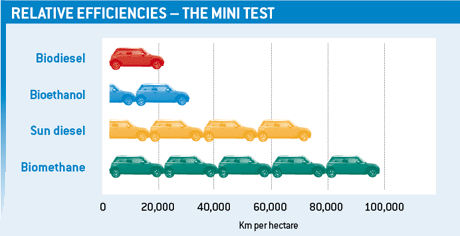
According to an EU well-to-wheel study of more than 70 different (fossil and renewable) fuels and energy paths, biogas is the cleanest and most climate-neutral transport fuel of all.

Some examples of biogas use in Europe include:
* Austrian drivers can fill up their CNG cars using biogas made from grass.
* Denmark has more than 50 biogas plants in operation.
* The Netherlands is generating biogas from sewage treatment plants and feeding it into the gas grid and to fuel cars.
* Sweden is producing biogas from wastewater treatment plants and and using it to generate power and to fuel buses and trains.
* Germany is producing biogas from maize and using it in combined-heat-and-power plants (the French have developed a giant maize variety specifically for biogas production).
The German government is considering feeding biogas into the country's natural gas network (ironically, the main obstacle to this has been that biogas is too good for the network - exceeding Germany's upper limit on gas heating value, something the German Greens and farming lobby are trying to have fixed).
According to the government, locally produced biogas could supply up to 10 percent of Germany's total gas consumption by 2030. Germany is the largest producer of biogas in Europe, and biogas is Germany's fastest growing renewable energy sector.
One controversial study last year claimed that the EU could produce enough biogas to replace all natural gas imports from Russia by 2020, which would change Europe's energy security outlook considerably if it proves to be correct. The main findings of the study were:
* Europe's potential for the sustainable production of biomethane is 500 billion cubic meters of natural gas equivalent (17.7 trillion cubic feet) per year. This is roughly the total amount of natural gas currently consumed by the entire European Union.
* The entire EU's natural gas needs for the the medium-term future (2020) can be met by biogas; all imports from Russia can be replaced, while the excess can substitute petroleum and coal.
* The production of 500 billion cubic meters of biogas, fed into the grid, will result in a reduction of 15% of Europe's CO2 emissions. The Kyoto protocol demands a reduction of 10%.
* An efficient biogas-feed-in strategy will be build around the concept of 'biogas corridors': such corridors consist of biomass plantations established alongside the pipelines, so that the green gas can be fed into Europe's main natural gas grid without the need for new pipelines and infrastructures.
* A Europe-wide biogas-feed-in strategy will result in the creation of 2.7 million new jobs within the EU. Employment will be generated mainly in agriculture, in the manufacture, construction and management of biogas plants and biogas purification plants.
These sorts of plans will raise the usual questions about the wisdom of "fermenting the food supply" and the like, so at this point it is worth taking the claims in this report with a grain of salt.
One company leading the way in Germany is Schmack Biogas, who are piloting feeding biogas into the grid and claim their super maize crop "reduces the land needed to grow feedstock by up to a third" and "restore degraded land and increase its fertility" - all of which sounds very nice, if true.
A related venture is the Combined power Plant idea being promoted by the University of Kassel, Enercon, SolarWorld and Schmack. This proposed plant "links and controls 36 wind, solar, biomass and hydropower installations spread throughout German", making it the distributed equivalent of a large conventional power plant. The plant uses biogas and hydro power to even out supply when the wind and solar components are generating at reduced capacity.

Contact
- anz at theoildrum dot com
License

This work is licensed under a Creative Commons Attribution-Share Alike 3.0 United States License.
Archives
- November 2010 (2)
- October 2010 (5)
- September 2010 (4)
- August 2010 (8)
- July 2010 (2)
- June 2010 (2)
- May 2010 (6)
- April 2010 (7)
- March 2010 (12)
- February 2010 (11)
- January 2010 (7)
- December 2009 (10)
- November 2009 (6)
- October 2009 (7)
- September 2009 (10)
- August 2009 (10)
- July 2009 (3)
- June 2009 (14)
- May 2009 (10)
- April 2009 (15)
- March 2009 (16)
- February 2009 (16)
- January 2009 (15)
- December 2008 (15)
- November 2008 (23)
- October 2008 (25)
- September 2008 (24)
- August 2008 (30)
- July 2008 (44)
- June 2008 (38)
- May 2008 (48)
- April 2008 (43)
- March 2008 (29)
- February 2008 (32)
- January 2008 (30)
- December 2007 (26)
- November 2007 (32)
- October 2007 (11)
This is yet another TOD post on a useless techno-fix. I have been thinking that TOD should be renamed TSP, The Solar Panel, but maybe TPP is better, The Poo Power. When is TOD going to face up to Peak Oil and examine contingency planning and how to save lives in the Peak Oil crisis that is coming soon? Banana Power and Poo Power are not going to save lives. How much oil, natural gas, and coal is going to be used in mining metals, developing, manufacturing, transporting, and maintaining these bio-technic fixes, and what food will NOT be grown in wasting good natural fertilizer (bananas and poo)? Everyone who works in the thousands of jobs in mining metals, developing, manufacturing, transporting, and maintaining these bio-technic fixes will be use gasoline to drive to work, and all of the factories will use electricity and many will use oil or natural gas for heating. And pipelines (which consume oil, natural gas, or oil in their manufacture and transportation) or diesel consuming trucks will be used to transport the gas made from bananas and poo.
Hmmm - you didn't seem to read the post.
If you do believe collapse is inevitable, aren't those Indian single-home biodigesters kind of useful things ? No oil or anything else required.
How about banana farms that can power their vehicles using the gas they produce - and the local town ?
With the same applying for pig farms, and cattle farms etc ?
How about the Swedes powering their public transport systems using biogas from wastewater and sewage plants ?
How about German's supplying some (or maybe all) of their natural gas needs with biogas ?
I would have thought these were positive developments worth considering.
Oil isn't the only energy source - there are a myriad of other options.
I think its worthwhile considering all of them.
The German's have done much that is not worth emulating, and this is one of them. You have not responded to my questions concerning how much energy is used in developing this gas infrastructure (how many millions of Indian houses for the biodigesters and how much piping and energy that goes into it)? Nor did you respond to the questions regarding the trade off between gas production and fertilizer; this is not only important in nations like India and China, but in the so-called developed world, where soil depletion means that when we run out of chemical fertilizer, we are in a world of starvation. Gas production from agricultural "waste" means reduced food production. Moreover, the farm animal economy is wasteful of grain. Raising animals for food wastes much grain, as animals expel much energy in body heat and the elimination of methane gases. In the last few days I have been talking with an old man who was about to sell me his 100 acre/40 hectare little ranch in the state of Veracruz, Mexico. He and few people working with him have never had electricity or telephone. They do everything by hand, and all of the animal waste goes back into agricultural production. I realized, that farm and home life is possible without electricity. I have never seen a happier person in all my life! The quest for more energy is the problem, not the solution. Some gas production methods may make sense, like using the gas from land waste fills and probably sewage for heating. In that case, I'm sure that in that case the gas obtained was not taken from agriculture and the EROEI is positive.
The sooner you stop using Electricity, the sooner you'll be happily rid of TOD, and this silly insistence on there being SOME forms of energy generation out there.. you seem to think that None At All is the best amount, in which case, walk your talk already.
If you object to this imagined mass of wasted production energy used to build a reasonably simple system, then bring some numbers or articles and make a CASE. Gav doesn't have to support your argument for you.
In the article I linked below as well, http://journeytoforever.org/biofuel_library/methane_pain.html the author and Mssr Pain explained that the used slurry was then applied as mulching to their soil, which had previously been poor for growing.. so it hardly seems like they're compromising their growing capacity by producing cooking, lighting and driving gas beforehand.
" Once fermentation ends, the big, magic cake produces no more energy, but it will still render 50 tons of natural fertilizer. By spreading a layer of this humus on the poor, stony soil around the house, Jean Pain has created a luxurious farm garden where even tropical vegetables grow. I admire tomato plants two-and-a-half metres high, lift a six-kilo watermelon and inspect a chayote (a kind of sweet Zucchini -- hitherto found only in the West Indies and in Africa), What surprises me most is that these giant vegetables need no watering; all the water they require, Pain tells me, is synthesized in the compost."
Bob
If one is peddling poo as a viable energy solution, he or she must bring the figures to show that is environmentally sound and provides more energy than it uses.
Shit is a renewable resource. People and animals continue to create a lot of shit whether we put it in biogas digesters or not.
I'm not sure why you imagine that shit put into a biogas digester takes more energy to produce than shit which is flushed down the loo. Do you feel an energy deficit after going to the toilet?
The stuff is going to decay and produce some methane anyway, whether we bury it, put it through a sewage settling system, chuck it in the sea, or whatever.
In nature animals eat plants, the digested plants are turned into manure and urine which gets dropped onto the soil, the manure and urine break down and gives nutrients to the plants, it's a cycle. Humans currently break this cycle by removing their manure from the system and putting it through machines, because we're paranoid about disease.
The machines we put our excrement through already produce a lot of methane. The only question is whether we bother using that methane or we just discharge it into the atmosphere. Since it's 23 times as strong a greenhouse gas as the carbon dioxide it'd turn into if we burned it, it seems better to use it.
Of course, ideally we keep the sludge afterwards to be fertiliser. As this paper notes,
In fact the faeces and urine per person varies according to diet. Urine is about 500lt annually on average, and faeces 36-100kg annually; vegetarian diets give higher volume. The faeces are useful as a soil conditioner, and the urine for its nutrients (the traditional nitrogen, phosphorous and potassium of artificial fertilisers).
Maybe we could just hook cj up to a bio-gas digestor. Hes seems to be full of it. ;)
This says more about you, than me. Personal attacks rather dealing with the issues.
Thanks - that was one of my main points - this methane is getting produced and we might as well make use of it - in some cases we'll actually be cleaning up festering and polluting eyesores (aka the burning poo mountains).
The fact that we end up producing less total greenhouse gas (in terms of effect) is just another bonus.
On a semi-related note, given the scatological bent of this thread, here's a post from WorldChanging which includes a DIY home fertiliser manufacturing kit - you pass your urine through it and voila - happy house plants...
http://www.worldchanging.com/archives/007883.html
It is important to reduce the volume poo generated in the world, as it wastes the energy in food (from body heat and methane generation), and much of food comes from natural gas/fertilizer, so poo wastes natural gas and also oil that was used to plant and harvest. In short, animals are very wasteful of energy in comparison to growing vegetables and grain. When there is poo, get it into the ground as fast as possible to reduce the generation of methane, or dry it as fast as possible to reduce the generation of methane. And don't give others a lot of #$%@.
CJ, very few on this board would argue that industrialized meat industry isn't oversized and way out of balance, not the least because of the degrading quality of food that we end up with, as well as the inputs, the pharma Hormone and Antibiotic components, as well as the mountainous wastes at the other end. It doesn't change the fact that we raise all sorts of animals, and will continue to do so. We raise chickens, pigs, cows, horses, oxen, rabbits, Bison, Ostriches, Sheep, Goats, Turkeys etc, etc. Even if the industrial scaling of these operations is brought back into balance, the fact will remain that we have all sorts of waste matter from both humans and animals, and we can use it BOTH as Fertilizer and for Digesting the Methane for other energy needs. Beyond that is the use of probably much MORE scrap material from plant sources, and which again, is NOT pulled from the growing cycle, as it is returned to the fields as compost later on.
Bob
Having fairly large operations such as 500 dairy cows gives a rational biogas plant and a small cluster of such would be good for an economical gas treatment plant to get the biogas up to wehicle gas specification.
A central purpose of TOD should be to advise people to do wise things regarding food and energy, like reducing the use of animals for food and dairy products. So, I suggest we do that, rather than advise people to keep on wasting energy by raising animals and then implement another techno-fix that wastes energy and fertilizer.
I would rather eat more mostly grass fed beef that during the summer grazed land that has been grazed for more then a thousand years.
CJ!!!
You are not wasting the fertilizer! Just take the 'Jean Pain' example, if you still want to ignore ALL the other ones posted here, and show me how the fertilizer was wasted. If you cannot, then stop saying that. Are you seven? what is up with you?
You are capturing energy that is OTHERWISE wasted!
Alright, other readers are probably fed up with my trying to communicate with you.
You have nothing to say.
Well - I'd like to commend you for your persistence - sometimes when people dogmatically insist on something, no matter how wrong, it does end up influencing those reading.
But hopefully your point has been made now.
.. and hopefully the point was right, too.
I'm happy to get rebuttals, that's how I can learn here.
Thanks,
Bob
Your comments indicate a negative bias toward me. If you can't comport yourself in a more professional fashion you should resign your position at TOD.
Mate, you're on the internet. Complete stranger, words on a screen. Get up from your chair, walk around outside for a bit, have a cup of coffee, relax. Return refreshed and with perspective. Or you could just remember to take your Hard Pills (TM) in the morning.
If you are talking to me then I would like to point out that you have been completely disrespectful to me (and TOD) since this thread started and you have made one incorrect statement after another.
If your accuracy and your manners improve I may start to show you some respect in return.
This isn't "bias" - its a simple case of being treated the way you treat others. Get over it.
Also, after crap has gone through a digester the sludge that remains is pretty mineral rich. In some cases it makes a good fertilizer (although you have to watch the salt level as you do with manure) on its own or is easy to process into a good fertilizer.
On the contrary, I have much to say. Please stop your personal attacks in saying "You have nothing to say." I have not ignored ALL of the other biogas projects, as you say. I was a professor of political science at the University of New Hampshire (UNH) until January 2008, and I am well informed about the use of natural gas from a not-so-local land fill, and I commented so on this post today. Even in this case I have doubts about what was accomplished. A pipe line was constructed from Rochester, NH to Durham, NH. That is laying some 20 miles of pipe. The natural gas, oil, and coal used to make 20 miles of pipe and transport it many miles from where it was made is significant, and the diesel used in digging and the gasoline in transportation is significant. Add to that all of the people who were employed in making the pipe, transporting it, making the equipment that dug deep trenches and channeled the pipe under the Cocheco River -- all of those employees who make a salary and will spend it and thus use more oil. The companies where the stuff is manufactured use oil and natural gas to heat factories and offices, and they all use electricity. Imagine how many hundreds of people are involved in the companies that make pipe and dig and move land -- land moving trucks, pick up trucks, back loaders, back hoes, etc. Think of all of the people commuting to all of these jobs. Think of all of the administrative and clerical personnel in all of these companies, and all of the profits that will go to stockholders. And the salaries and profits will go on car or air travel vacations, trips to the mall or whatever. The digging, welding, architectural firms, etc. And all of the time spent on this means time is not spent on other projects that could save energy. When I was chair of the Energy Policy Committee at UNH, the head of the energy office and I estimated that we could save a million dollars per year just by implementing a program to get students and faculty to shut windows in classrooms at the end of night classes. It is common to walk by big classroom buildings with most of the windows open ALL NIGHT LONG when it is 10 degrees outside -- just pouring out the heat from #6 fuel oil into the air. The administration ignored our plans, they probably were not sexy enough and they would have to work at it on a regular basis. The million dollars a year in 1985 is probably 5 million today. That is a lot of #6 oil over 22 years ... that is a lot of oil. So now they have a natural gas project that is very sexy (and their careers will be advanced), but will it save much energy, I doubt it. No one knows how many years the land fill will generate gas, I doubt many years. They could save a lot more energy by educating students, faculty and administrators about the need to close windows, but that wouldn't be sexy. Good grief!
It is best to quit fooling around with trying to control nature. We've can't win that battle. Most of these techno-fixes are wasting energy, not conserving it. The problem is the continued quest to use more energy from fossil fuels (most farm waste gets its energy originally from fertilizer/natural gas). Quit using a lot of energy in making pipe and equipment and quit wasting energy on farm waste and instead put it into the ground where it will do some good, but it isn't very sexy.
Well Clif, you've finally said something new. I'm sorry I said you had nothing to say, but from the last several DOZEN posts, that was the only conclusion I could come to. And with your final conclusion to this one, I probably won't take this much further. How many times have people said that the effluent FROM many of these systems went back INTO THE GROUND as fertilizer?! If you can say it's not good fertilizer, then say it. But giving jobs to people laying pipe, making pipe, mining metals for pipe? If it's a durable system to carry a completely renewable energy supply, then why is that not a healthy investment?
The above was a Good story, and I'm sorry to hear that UNH was unwilling to work on some of the most basic efficiency measures. Their loss and ours. I'm going over to USM (Southern Maine) This morning for a symposium "Preparing Our Region for a Sustainable Energy Future".. they have an Energy Efficiency and Renewables/Sustainability program led by Dudley Greeley which has made a lot of noise and impact in the College Community there. They do use PV and Solar Hot Water Collectors, but this is not the beginning or the end of their effort. Basic, personal habits, reduction of waste everywhere Dudley could find it has made him respected and frequently just barely tolerated in his zealousness there, but he has managed to get the program going very well, and has served USM in many ways.
Your objections still aren't making your point. This pipeline in NH might have been a huge waste, who knows? Make that the story and show us how.. but to lump it together with the whole category, where example after example have shown modest infrastructure and clear benefits .. you come off as a crank, unwilling to hear the idea that there is a balancing point, and ways to apply this with reasonable inputs and get useful returns.
Bob
That's right, the central purpose of TOD is to promote vegetarianism, rather than energy solutions.
Yes indeed, and as cjwirth has just shown, people can of course *talk* this valuable substance as well ...
You requested figures. I'll supply them.
Please stop peddling your pig poo here. It is very stinky stuff. It is important to reduce the volume poo generated in the world, as it wastes the energy in food (from body heat and methane generation), and much of food comes from using natural gas/fertilizer, so poo wastes natural gas and also oil that was used to plant and harvest. In short, animals are very wasteful of energy in comparison to growing vegetables and grain. When there is poo, get it into the ground as fast as possible to reduce the generation of methane, or dry it as fast as possible to reduce the generation of methane.
Request denied. You stated that people should be produce figures to back up their argument and when someone does (and there are people here that have far more expertise than you profess to have in your bio), you further dig yourself into a hole. So, you just made a bunch of claims inyour reply...let's see you back them up with data.
Otherwise,
Stop peddling YOUR poo here.
It is important to reduce the volume of YOUR poo generated in the world, as it wastes the energy in food, and much of food comes from using natural gas/fertilizer, so YOUR poo wastes natural gas and also oil that was used to plant and harvest. In short, YOU are very wasteful of energy.
Unless you are able to demonstrate that you physically and personally produced more of the following either singly or in combination in equivalent energy production, you have an EROEI of less than 1 and by your metrics are deemed wasteful:
3,222 gallons of distillate oil (#2 ULSD),or
3,687 gallons of gasoline, or
3,349 gallons of kerosene, or
598 cubic feet of pure methane, or
14.63 tons of bituminous coal w/ HHV of 12,010 BTU/lb, or
19.41 tons of subbituminous coal w/ HHV of 8,735 BTU/lb, or
a nominal 34,500 kWh net electrical energy ouput
If you cannot meet these minimum standards for an EROEI you should, therfore, apply the appropriate remedy to yourself.
Thanks for providing the numbers earlier - I'll give CJ one thing - his constant insistence that all energy sources are bad does prompt people to come forward with additional information - which is what I love about TOD.
Makes me wonder how he powers his computer, or why he's online at all.
Just as I suggest that the people who think population is a problem should prove the strength of their convictions by topping themselves, so too do I think those who are against modern civilisation should get offline.
I don't insist that all energy sources are bad, rather I promote conserving fossil energy, rather than wasting them. And, as you well know, I have regularly commented on the utility of passive solar and have asked for more posts on passive solar, but you continue to post techno-fixes. Your comments indicate a negative bias toward me. If you can't comport yourself in a more professional fashion you should resign your position at TOD.
@cjwirth
One of the great things about TOD is that if you have something to say, they will post it for you. If you want more posts on passive solar, why dont you write it and I'm sure they'll put it up.
Passive solar is also a technolgy issue. You have to build something to catch the energy which is to a degree a techno fix. The best passive solar uses modern building material of concrete, glass steel, and insulation materials.
I get quite frustrated by Luddite purists who lump all technolgy together as unsustainable. We are not going to lose the all the knowledge gained from the oil fossil fuel age and much of what we have learned will find new applications in the post peak future.
Securing and preserving that knowledge is essential for the future as we will not be able to dedicate spare resources for pure research in any area.
If you want to dismiss all knowledge of technology just because it won't scale to power BAU, then you miss the point of why we here - to learn from eachother, prepare ourselves and hopefully be able to emerge from the post peak turmoil relatively unscathed.
I see you a re political scientist so I would like to see you post on your area of expertise. My challenge is for you to write a post about what action we need to take to prevent World War in the not too distant futre as the oil supply declines.
You are welcome. This is an operating system.
It's intersting that my senior ChE project was anaerobic digestion of swine waste using solar power as the energy source to maintain and operate the digester in the desired temperature range. never thought that something I did more than 30 years ago would be relevant to what I work on today.
So you'd like us all to hold it in?
I think Freud would have something to say about your ideas.
First remove the beam that is in your own eye.
I'm with Starship Trooper here; I found his response sufficiently valuable to bookmark it as a reference. On the other hand you've contributed nothing to this but nay-saying, and while it's good for you to damage your credibility this way, you're getting very tiresome.
I have never seen a happier person in all my life!
Could it have been because he finally found a crazy gringo to buy that worthless, non-electrified farm of his? :)
Sorry, I couldn't resist. BUT, he was moving, wasn't he?
CJ, you can make nitrogen fertilizer using natural gas, OR bio-methane. And, the dry mass that is left is Excellent Organic Fertilizer.
Yesterday Cristi and I drove the one lane dirt and rocky road 25 minutes to tell the old man, Sr. Melicio, that we wouldn’t’ buy his little ranch. He wasn’t there so we left a note saying we would come back to talk to him today at 2:00. When we arrived today it was cold and misty and the hills and mountains were shrouded in a light fog. It is so beautiful and peaceful there. There was no noise except for the sound of the little river and the birds. Just 3 days before, we had promised him we would buy his ranch and care for it, his people, and his animals, and we shook hands and hugged him. What a nice old man, what a smile and look in his eyes. He has found peace. Arriving today was the saddest moment for us. We walked across the little foot bridge to his house. He came out to greet us and said he wasn’t home the day before, as his son came from Mexico City to see him and they went to town. Then he said he had something new to show us. The night before his horse gave birth to a colt. What a beauty she is. Cristi is crying and I am very sad, seeing the colt and knowing this paradise can’t be ours and we will soon disappoint the old man by telling him we won’t buy his ranch. The beauty of the valley is overwhelming, it is so overwhelming that we agreed that we can’t change our minds when we are there talking with him, we have to say no. We went into his home and explained to him about the land invasions and our fears and that we won’t buy his ranch. After some discussion he explained that he would sell it to us if we wanted it, because he gave his word, but that if we didn’t buy the ranch he wasn’t going to sell it. The day before his son came from Mexico City to say “Pa, don’t sell your ranch, Mexico City is a terrible place to live and it is getting worse everyday.” And that night, last night, his horse gave birth to the colt. What a beautiful animal. I love horses, they are such wonderful animals, and I see how much he loves his horses and the little colt. He said he wants to watch the colt grow up. He won’t sell his ranch and we know he will be happy. His sons live in Mexico City. I explained to him what will happen to Mexico City soon and then he sees that soon his sons will come to live with him. This is something he has always wanted. I explained to him the amount of research I undertook to find the town and his ranch. He is amazed and the look in his eyes and face are peace, joy, and relief that he didn’t sell his ranch. I have never seen a happier person. He has lived there for some 30 years without electricity, telephone, radio, and TV. He has his people, dogs, horses, valley, chapel, and God. We said good-bye and he invited us to visit him often, and we will. The valley can’t be ours, but we will return to see the old man, his people, his dogs, the colt, and the valley. Hey, come visit us and we can all go visit Sr. Melicio and his beautiful little valley.
Leasing a few acres from him would seem a viable option, wouldn't it? That would, presumably, eliminate the problem of land invasion? If you set up a corporation in Mexico, you will need a Mexican National, if memory serves. Just add a Mexico office and have Sr. Melicio on your papers. Awaken the people of that town who know Mr. Melicio and are trustworthy to the issues and you've got your little bit of heaven all sown up, perhaps?
Cheers
What happens when Peak Oil impacts and I have no money to lease land? And planting macadamia trees on leased land would not be wise. The town is far away, and few care about Sr. Melecio. As it is, the land invaders respect him and leave him alone, it would not be so with me and is from Mexico City. I can buy land here with no problem, but my land is somewhere else.
I don't see the problem. The Indian company isn't the only source for biodigesters.
BIOGAS DIGESTERS
Overview
http://www.energyfarms.net/biogasdigesters
Where there's muck, there's megawatts
http://www.new-agri.co.uk/02-4/develop/dev02.html
Further, they look like a pretty simple contraption. It is obvious they can be made locally out of salvaged materials or materials made from other uses. I see this as a perfect solution to the small/subsistence farm: toss in garbage and get out fuel and fertilizer. What's not to like?
Cheers
You didn't answer the question about how much piping, and how much oil, natural gas, and coal energy goes into manufacturing, transporting, and installing this equipment and piping. And is this good use of all of this instead of fertilizer?
I did answer it. I said D-I-Y. Fertilizer is one of the products from the unit. This way, you get power and fertilizer. I've nothing against going back to no power, per se, but the world has never just stopped. It eventually moves forward again after a collapse. I'm all for stabilizing the ecosystem AND maintaining those scientific advances that help us advance as a species. I see no contradiction in a hi-tech/lo-tech world. I.e, I envision an off-grid home with internet access. Why should knowledge die with a crappy culture/socio-economic system?
Cheers
Many words, but little about pipe and energy used.
I have to agree with cjwirth on this one. It's clearly unwise to see biogas in isolation.
Mamba and cjwirth
Your comments are typical of many that I see on this site: anything less than an absolute global replacement for all FF energy gets rubbished.
There is no ONE replacement for FF.
Not Globally.
Not Continentally.
Not Nationally.
Not Regionally.
Not Personally.
There will need to be a vast range of partial solutions implemented over a long time frame to enable the (hopefully at least) 1 billion survivors of the forthcoming crash to maintain some form of technologically enhanced society.
Peak oil does not mean that there will be no FF based industry over the next few decades to enable the construction of worthwhile future energy projects. We are only now at the very start of the Great Decline that will probably continue for at least the next century.
The solutions that will be developed will vary greatly from place to place. Banana biogas might be good for Queensland and Fiji but is obviously impractical for UK or Alaska. Just because it can't be used globally does not mean that it should not be considered in appropriate localities.
Replacing all metropolitan sewage processing of human bodily waste and landfill/incineration of other household organic waste with biogas plants that take it all in and produce gas, electricity, heat, agricultural fertiliser etc. is an absolute win-win-win situation. Reduce polution, produce usable energy, return nutrients to the land.
Obviously the scale of the project for London, New York, Tokyo, or Sydney, etc will require a totally different infrastructure from that needed in a 100 house village near Ekatahuna. In the former case, pipes, pumps and major civil engineering works will obviously be needed, but for the latter a return to the "Honey Bucket" and "Night Cart" taking the products to a batch processing facility on the downwind side of town could work very well.
This is just one of a myriad of probable developments that will occur over the next few decades to try to maintain an energy-enhanced lifestyle. Most people rely at present on a small number of energy sources. In developed nations this is largely supplied by vast anonymous corporations utilising huge infrastructure to provide electricity, petrol and diesel, gas, transportation etc. At the other extreme dried dung and dead branches that can be gleaned from the countryside form the only additional energy source for many nomadic and subsistance farming peoples.
The energy sources of the future will be much more diversified, and I suspect, far more localised than at present in developed nations. I believe that the "Bundaberg Banana Biogas" option has a far greater chance of success than the Sahara to Spitzbergen CSP/HVDC link. This does not mean that the latter should not be tried, but the smaller options should not be disregarded to support only mega-projects.
My personal belief is that the low-tech solutions will greatly exceed the high-tech ones, even thought this will result in a far lower energy available per capita. The solar hot water panel, flow of stream microhydro, backyard or village biogas digestor, solar oven, etc will be far more likely to succeed than the fusion reactor, mag-lev spiderweb, jpod, etc scenario.
My ancestors emigrated from Cornwall, UK in 1839. They came to NZ by sailing ship and once here travelled by foot or by horse. They mostly remained within 100 miles of their landing point for the first generation, and lived within walking distance of their jobs. While I don't expect travel to drop back to that level any time soon, I do believe that the present long-commute, globe trotting lifestyle will soon greatly diminish in developed nations.
There is no ONE solution, so denigrating partial solutions is not helpful. Everything from harnessing the katabatic winds from the Greenland Icecap to charging your cellphone from a generator attached to a hamster wheel should be considered on its own merits IN ITS OWN CONTEXT.
Cheers
Merv
"Massive metal structures, long metal pipelines, machinery everywhere — all mined, extracted, smelted, transported, assembled and maintained with fossil fuels. Biogas evangelists will have to account for this or be scorned."
big deal. in the us we use 40% of our oil just getting to work. compared to what we use in manufacturing at 2.2% it will take very little energy to get this started. the supply chain is constantly being greened right now. just what until the cars, the mining machinery, the smelters and etc are all using electricity and NOT fossil fuels. and of course once the plants are up they can use electricity to power the smelters and the electric cars and the cycle just goes on and on.
we need to use a little bit of the oil left for renewable energy which will be used to build renewable energy and so on.
You propose to use oil build gadgets to get electric power that we don't need. How you going to use electric power to produce and transport food? Renewable energy is an oxymoron. In reality, so-called alternative energies will accelerate oil depletion.
Are you committed to being hostile to every comment in this thread regardless of context? Or is it just me?
Ever heard of electrified trains? Ever heard of batteries? Ever heard of the Haber-Bosch process?
I propose that we're not going to lose all manufacturing capability FOR alternate energy solutions with a mere 5-10% decline rate. There is a lot of reason around here to be doom-and-gloom, to be scared about what the future holds, and I embrace much of it. Without turning into a cynical asshole who deprecates the things that do hold promise.
"How you going to use electric power to produce and transport food?"
With electric vehicles
Then you woke up.
"When I built our first electric tractor, I had NO EXPERIENCE working with electric motors, and only limited exerience working on gasoline engines. That first tractor is well into it's third year now, and still working beautifully on a full-time basis, with NO tune-ups or adjustments necessary (unlike it's earlier gasoline incarnation!)"
http://www.flyingbeet.com/electricg/
Clif, this is a conversion of a 2-generation old gas tractor, done by an amateur. Give it a rest.
"The Allis Chalmers "G" Cultivating and Seeding tractor was built in the late 1940's and 50's.":
I think your fear and anger has you blinded. I hope you can find some of the kind of happiness that your farmer friend has, but electricity doesn't either guarantee nor does it preclude happiness. It is a tool. No More, no less. I have heard one description of Happiness as the 'Overcoming of obstacles on the path to a goal of one's own choosing.' Not a bad start..
Bob
"..for yesterday is a dream, and tomorrow only a vision, but today well-lived makes every yesterday a dream of Happiness, and every tomorrow a vision of Hope. Look well, therefore to This day!" -Exhortation to the Dawn, Sanskrit
http://www.phoenixmotorcars.com/index.php
http://peakoildebunked.blogspot.com/2007/12/317-electric-agricultural-ma...
http://www.treehugger.com/files/2008/03/mitsubishi-i-miev-electric-car-n...
http://peakoildebunked.blogspot.com/2007/12/320-electric-trucks.html
http://peakoildebunked.blogspot.com/2008/03/339-cargo-scooters-and-bicyc...
Adapting the nation's freight rail system to electric power is more complex than the example of passenger train shown, as the rail system traverses a vast area, needing changes of engines and cars, sidings, tunnels, bridges, and vast areas of rail yards. And, the power grid couldn't handle the load. The change over to electric trains would take an incredible capital investment (the nation is broke, as everyone knows) and some 20 years of manufacture and construction. We don't have that amount of time. The same goes for the new truck fleet with thousands of units and thousands of substations for recharging.
The constant recharging of batteries for huge agricultural tractors and combines presents major obstacles. Many combines are running at 400hp for 24 hours a day, and they will require a lot of recharges (like every few kilometers) and you need a way to recharge combines and tractors out in the fields. Again, time and capital are lacking.
The amount of oil, natural gas, and coal that would go into the development, manufacture, and transportation of all of this electric power transportation equipment and infrastructure is mind boggling, and we are out of time.
Much of the electric power needed for the electric transportation concept will have to come from coal, natural gas, and oil, thus defeating the purpose for the changes. Electric motors are more efficient than internal combustion engines, but their is much energy loss in electric power generation (like 30%), and some loss in power lines, and much energy loss in batteries. The infrastructure and investment needed to generate electric power from wind and solar is not available.
Physicist Howard C. Hayden concludes that solar and wind power are limited for several reasons. (1) Solar and wind energy are dispersed. For example, to provide the equivalent of one 1,000 megawatt power plant in California would require a wind farm one mile wide from Los Angeles to San Francisco (or a 127 square mile area of solar mirrors to generate the heat needed for a turbine). (2) Areas with ample sun light or wind are limited (for example, sunlight is weak in winter months in northern states). (3) Extensive solar and wind mill operations would have negative ecological impacts. (4) Much energy is consumed in the construction and maintenance of solar panels, wind turbines, and power line infrastructure that extends to far away cities uses.
The inflation generated by the development of an electric transportation system will stop Congress and the president from proposing such changes. In a democracy, politicians generally heed public preferences, especially on economic matters. Politicians are not going to propose major changes that will cause inflation and eat into health care, education, and welfare.
The costs for developing an electric transportation system will increase as the price of oil increases. Matthew Simmons indicates that the price will continue to increase and increase, and so too will the cost of manufacturing and developing an electric transportation system.
You're just as wrong about the electrification of rail; it would require a small fraction of the energy needed to electrify cars and trucks, which is only about 40% of current generation. No wonder you're so off-base, you've been suckered.
Where does the 2.2% come from? Oil is actually the great enabler for many manufaturing operations, even if it is not used directly. Transporting other raw materials, transforming it and distribution and selling the end product will all rely on oil. I don't see how you can isolate the 40% of oil consumed in geting people to their jobs from an actual input to the process of making and distributing goods and services. Also electricity does not just spontaneously appear out of thin air to un all the cars etc that you are wishing for. It is generated by coupling a generator to a physical force to turn it and that mostly measn using steam turbines which are powered by burning mainly fossil fuel. Replacing all this with renewables is quite a challenge. If it was easy to do we would have already done it. Humans take the path of least resistance so we will use up all the best resources first before we turn out attention to the secondary and tertiary resources.
Anaerobic digetion is a variation on composting. The fertilizer value is not affected. That blows one leg off your argument.
The article seems to imply that the main route to biogas is via fermentation. Like babies bottoms dry is often better than wet so there is also thermochemical bio-syngas (small pdf)
http://www.biosng.com/fileadmin/biosng/user/documents/reports/rx05183.pdf
This can be made to minimise dust, nitrogen and CO2 and tie in with agri-char.
Wind and solar could occupy mountains, coasts and deserts while biogas could reside in farm areas and cities. However we should have started on a linked system 20 years ago.
Wonderful Report;
We're swimming in a Sea of Energy, and the Doomers want to commit suicide because the ugly, black, gooey stuff is getting harder to get. Worse yet, they want the rest of us to commit suicide with them. Ain't gonna happen.
a)just so you know, that sea of energy we are swimming in has a cost to transmute it into the type of energy that currently runs our system, or alternatively, societal infrastructure has a cost to turn it into being able to use said sea. This cost, in energy terms or dollar terms may be more than we have to spare.
b)no ones talking suicide. I actually expect after some major dislocations (and I won't rule out population shrinking via deaths) the rest of world can be happier and healthier than we are in aggregate now.
c)there are no universal answers to a precipitous decline of the black gooey stuff. Many portfolios of responses will work at varying scales in various regions. Biogas has its place, but isn't something that everyone has access to. In Wisconsin we don't have bananas but have cows for dairy. I know from my own research at UVM that we can create 'manure butter' from the cows manure lagoons and then throw it into a biodigester to create burnable methane. But if energy (nat gas) is our goal, we'd be better off throwing the cows and the grass they eat directly into the biodigester. Its only societies desire for milk products that reduces our optimal biogas in this instance.
d)what specifically did you like about the post, other than it resonated your existing belief system? Did you learn anything from it?
a) Come on, Nate; everything has a cost. Middle East Oil is costing us about $165 Billion/Yr in Iraq, right now (not to mention the devastation on the dollar from a Billion + Dollars a Day in Balance of Trade Deficit.) I reckon the "War to protect the Oil," alone, would build an anaerobic digester for every town/city in America.
b) No one has to die. Most of the World's impoverished, right now, are subsistence farmers who can't afford the ever-increasing price of oil/gasoline. Many of us think those people will do considerably better in a bio economy than they're doing on the "Petrol Plan."
c) It's True; there IS NO one "Magic Bullet" in the battle to replace petroleum, BUT, when someone mentions a "Silver BB" he's hooted down in derision with the Curse, "THAT won't REPLACE OIL!" I've, honestly, never seen so many people wailing, and gnashing their teeth, and bemoaning a Problem, and, at the same time, Utterly Rejecting any, and all, possible solutions to the dilemma. It's Freaky.
d) I've been reading about Anaerobic Digestion for a few years (my son is thinking of going into the business,) so I was familiar with a lot of it. It was an impressive compendium of International projects, though. I thought the little units in India were kind of cool.
Kdolliso, when you think what kind of economic traumas would accompany the downturn in oil supplies post peak, it becomes difficult to imagine how millions of "distributed, local" biogas plants could get built. Post peak we'll almost certainly see a massive economic depression, with no spare trillions for this kind of paradigm-changing effort. So like other solutions dreamed up by the Dr Panglosses of TOD, this one will almost certainly be a day late and a dollar short.
Farm biogas plant in Southwest Scotland
Mamba,
during the "Great" Depression we built a courthouse in every county in United States. We, also, built levees, drained swamps, built dams, and a lot of other projects to "Put people to work." Remember, we didn't truly come out of the depression until we embarked on the most expensive project (in constant dollars) in our history, WWII.
That said, though, we have an advantage this time. We see it coming, which means we have a Few years to start adjusting. I think any country that could do the Manhattan Project, and the Apollo Program can figure, and work, their way out of this one. We just need to "Recognize" the Problem.
Don't forget that we had plentiful supplies of domestic oil during the Great Depression. The Depression was strictly a financial crisis and had nothing to do with physical limits to production. I am not a physical doomer in that I believe, like you, that there are options for adjusting economic production to decreasing supplies of fossil fuels. However, if the the goal of making these adjustments is to emerge into a new period of constant economic growth, then probability of success will be extremely low.
Well, there was that Dustbowl thing... it's worth mentioning that in the actual financial collapse, most farmers were able to keep their land, the banks were sane then and preferred to have some income rather than none. It was the environmental disaster that drove the farmers from their land.
So the lesson here is that a single cause, whether financial, environmental, social, etc - is not enough for a great crisis. You need a couple of them together to really fuck things up.
If there is a big enough why then the how will reveal itself. Edison was able to build his first commercial scale electric generator without hug amounts of electric power to begin with. I think most bio-gas plants will probably be very small crude affairs, built in backyard workshops with largely recycled materials. There is after all, plenty of it out there. At the "high tech - high energy end" creating polyethylene tanks from recycled materials could be done with CSP if we really had to. I would be surprised if you can't already buy small bio-gas digestor tanks made from this stuff.
Having a sustainable source of methane, albeit at hugely diminished volumes, will be the difference between breakdown of civiliazation and a safe transition to a sustainable population in the future.
If there is a big enough why then the how will reveal itself. Edison was able to build his first commercial scale electric generator without huge amounts of electric power to begin with. I think most bio-gas plants will probably be very small crude affairs, built in backyard workshops with largely recycled materials. There is after all, plenty of it out there. At the "high tech - high energy end" creating polyethylene tanks from recycled materials could be done with CSP if we really had to. I would be surprised if you can't already buy small bio-gas digestor tanks made from this stuff.
Having a sustainable source of methane, albeit at hugely diminished volumes, will be the difference between breakdown of civiliazation and a safe transition to a sustainable population in the future.
If you want systems, then build enough only for that. Every home should be off-grid,imho. Homes don't need to be tied to a greater system. Use it for the internet, manufacturing, transport... but a lot of energy goes into running the home. Reduce that amount of energy from the grid load and you've made your job a lot easier.
Passive solar homes(etc.) homes, wind, solar and biodigesters (or some mix of energy sources) in every home and you've solved a lot of the problems. And all with no great grid build-up. Heck, have a little neighborhood-owned bus/carpool... life is good.
People are thinking too damned BIG. Everything need not be BIG.
Any of you eggheads want to take a shot at analyzing ccpo's Every-Home-Off-Grid-Localized-community-based-build-out plan and see how much energy we would need? You have to use a high percentage of recycled, local products for the build-out. Let's keep it to the US: @105,000,000 households at $30,000 each to do whatever they deem appropriate in terms of retrofitting homes, building new homes, adding in wind, solar, biogas, etc....
Stuart?
Cheers
And if energy (food) is our goal, we'd be better off keeping the cows.
Humans can derive proteins and fats from animals, but not from grass.
Man does not live by natural gas alone.
"We are swimming in a sea of energy," yes, but it takes energy to get energy. Unfortunately the EROEI for solar and wind is negative when ALL of the energy inputs are counted. AND, we could have all of the electric power we wanted and it will not solve our food production and transportation problems.
Bullshit. The energy breakeven for wind is supposed to be on the order of a month or so. For traditional thick-silicon photovoltaic, it was a good number of years, but it came eventually, and they lasted forever. For newer thin-film CIGS photovoltaic, it's supposed to be very short.
CSP will also have a short ayback period and it will be able to be scaled out to huge proportions - I like PV and thin-film, but I suspect CSP will race ahead in terms of installed capacity over the next decade.
Ausra are talking about building a 6 GW plant now...
CSP is very interesting because it looks like you need a lot less complicated process to manufacture these things. they are also more powerful and would take up a whole lot of space.
Its certainly less complex than PV, but you probably can't build them by hand :-)
They do take up a bit of space, but thankfully the best locations for them are in the desert, where no one cares (well - a few lizards do - but maybe they'll appreciate the shade.
CJ - yes - this does require an electrical grid.
Does this apply to a home-built windmill made from stuff around the home or picked up from scrap yards, etc?
I'm thinking not.
Cheers
"However we should have started on a linked system 20 years ago."
not all is lost. if you mitigating too early you might have missed out on the advances in whatever technology you are using like solar or wind.
You state that one ton of biomass can generate 7.5 kw. I thought you were more knowledgeable of energy and power terms to not conflate them. Can one ton generate 7.5 kwh of electricity or 7.5 kw for some other time period. Obviously one ton of bananas cannot put out 7.5 kw forever. If it could then you've solved the worlds energy problems forever. Get you terms right if you want us to respect your opinion.
Generally when time is left off on watts its and hour.
This irritating shorthand is common.
Obviously irritating enough to detract from all of Gavs effort pulling together the info on biogas.
I have plenty of other ways of being irritating without using poor quality shorthand (in this case I'll blame this Biopact article that I got the numbers from - http://biopact.com/2008/01/growcom-trials-commerical-biogas.html).
I'm not sure why some commenters are so convinced that biogas can't / won't be substituted for oil (no doubt there will be limits to how far it scales, but it certainly seems feasible to generate some reasonably large amount of energy using processed waste, which must be one of the lowest impact way we have of powering our activities).
CNG can be used to fuel vehicles - it is a direct substitute for oil in that sense (once the vehicle has been converted) - if you think we need oil to make metallic objects (which isn't entirely true anyway), then you can do the same thing using CNG instead. End of story.
The more interesting question is how much CNG can you sustainably produce in this way and what impact does that have on the various depletion models out there...
Big Gav;
Thanks for the Article.
As far as converting vehicles to run on NG, consider this one:
" As Ida drives off in their truck, I see on the roof two gas bottles shaped like long cannon shells. These have a capacity of five cubic metres of compressed gas, allowing her to drive 100 kilometres. Jean says that ten kilos of brush-wood supply the gas equivalent of a litre of high-test petrol. All that is needed to use it as motor fuel is a slight carburettor adjustment."
'Jean Pain; France's King of Green Gold'
http://journeytoforever.org/biofuel_library/methane_pain.html
"... "we use it to cook our food, produce our electricity and fuel our truck." He says that it takes about 90 days to produce 500 cubic metres of gas -- enough to keep Ida's two ovens and a three-burner stove going for a year. .."
alternate article,
http://www.daenvis.org/technology/Jeanpan.htm
I've linked this Jean Pain story before, but it seems germane. He used chipped brushwood in a part of France where he had very poor soils, and so after the 18month 'batch' was used up for fermenting, it became topsoil mulch, which would tend to answer CJ's challenge that this biomass is just getting diverted away from Agro purposes. It seems, as well, that Pain's equipment could be wrangled together from any number of scraps and various materials.
Hardly a story of raging technophilia. Just a bit of tinkering and wise use of simple materials..
Bob
Thanks Bob - its very encouraging seeing people building their own gear and being able to improve the soil quality as well as getting the energy they need.
I'm surprised that there isn't more enthusiasm from the more collapse minded amongst us - I would have thought that small-scale biogas digesters are a great solution from a relocalisation or survivalist point of view (even if the larger scale applications may not appeal).
And as a bonus, you can rig them to blow if your bunker is about to be overrun by cannibal mutant hordes from the cities.
...
Have I said too much?
Hmmm - being cheeky are we ?
I sentence you to read Cormac McCarthy's book "The Road" - that will teach you.
Send it to me, I'll read it. I'm saving my money for spam.
Don't be surprised. Amongst many of the 'collapse-minded', doom is quite literally an article of faith, in the same way that the Rapture is for some Christians. Such people need the prospect of doom, psychologically, because the world they see is so f***ed up they would prefer it to be destroyed. Hence, if you propose something that actually threatens the eventual coming of doom, you are bound to get a hostile or dismissive response.
I understand this because I was one of these people myself. In fact, I still am ... but I'm not betting on something as pissweak as Peak Oil to take out a world I can't stand. And no one else with half a brain ought to either.
Big Gav,
Thanks for putting that together. I like the whole idea. Coordinating 3 dif. forms of renewables is a good start in the right direction, imo. They cover each others inherant drawbacks. Sure it'll take some ff to kick it off, but the initial ff investment should taper off (shouldn't it?) once the system is up and running. My Gawd, it's worth the try isn't it?
Jeff
The combined power plant idea is part of the long term solution (obviously you need to move to a primarily electric transport system, do a large number of things around efficiency, switch to bioplastics, etc etc etc as well).
Once we've made all the necessary changes fossil fuels will be obsolete - I'm sure one day in the future there will still be some coal and oil left in the ground, but it will be basically worthless.
http://en.wikipedia.org/wiki/Watt#Confusion_of_watts_and_watt-hours
I'm pretty sure he meant energy and thus watt hours.
It's not shorthand, it's the correct usage.
"1 ton of bananas per day can generate around 7.5 kW of electricity - enough to supply six to eight modern households."
He took a rate of mass per time, and gave you a rate of energy per time supplied in electricity (=power).
If it's one ton per day can generate 7.5 kw for 24 hours then it comes to 180 kwh.
Kw is not shorthand for kwh!
He just quoted an article written by an English major and not somebody who knows the difference between energy and power. I see this absurdity all the time in popular media which makes establishing sound public policy all the more difficult.
Whatsa matter w/you? The guy said real clear - one ton a day= 7.5 kW, or did my eyes go out on me? watts=energy/time. ton/day= energy/time. AOK.
Back to the solar thermal. Really having fun! But I like poo-power just fine. Gotta try it.
How about all the Middle School kids on earth bending over and lighting their farts with a Zippo!
It's gotta have a pretty good EROEI.
A few links on BioGas:
A Hutterite hog farm in Alberta installed an anaerobic digester by BioGem, in 2001. It uses pig manure in an anaerobic digestion system with the biogas powering a modified gasoline engine generator. This paper on Anaerobic Digestion in Canada also mentions the system. As far as I know, it has been operating successfully since 2001.
SHEC labs is building a pilot plant in Regina to utilize landfill gas in their solar thermal assisted hydrogen system. This plant is a few miles from my home.
Enerkem is building a commercial demonstration plant to gasify old creosote treated power poles and use the syngas for a liquid fuel. They have labeled the output Cellulosic Ethanol which is a bit of a marketing slant, but they are building a commercial plant.
Several California cities/water districts are going the "Anaerobic Digestion/Fuel Cell/Electricity from waste" route.
http://ww.pennnet.com/Articles/Article_Display.cfm?Section=ARTCL&PUBLICA...
Also several California dairies are now in the natural gas business in a big way:
Here's an article on one of them.
http://www.telegraph.co.uk/earth/main.jhtml?xml=/earth/2008/03/05/eadung...
What the article doesn't mention is that large dairies in California already have to collect their wast in pools similar to the ones shown in this article to prevent water pollution and all these plants consist of is installing a cover over the pool to collect the gas and adding a scrubber to remove corrosive chemicals from the gas before its injected into an existing gas pipeline. In fact, one of the reasons this is attractive to dairies is that they're already under pressure to do this to reduce smog-forming emissions from their pools which lead to unhealthy air quality in parts of the Central Valley. I read somewhere that the waste from a typical dairy cow when fermented and burned in a power plant produces about 100W (yes that's 2.4kWh/day) so there's a lot of potential here. Also you might want to not the high percentage (14%) of California's electricity that comes from renewables and note that this percentage does not include large hydropower projects which provide roughly another 20%.
It is time to invoke "Wirth's Law": Solar power, wind power, oil from French fries and soybeans, hydrogen, and cow shit are not going to power but a few of the millions of cars, 18 wheelers, tractors, combines, ships, and airplanes. It will never happen. There is no way to convert the sun's energy into liquid fuels in the quantities needed.
I consider "Wirth's Law" worthless.
We do not NEED all those transport fuels; we NEED a sensibly arranged society.
The DESIRE for Mega-SUV owners to commute vast distances from their McMansion Mega-mortgages to their "service sector" jobs is not a NEED.
Stopping this inane activity now, before we use up the last of the easily available FF would be the single greatest step that Homo-semisapiens could take.
Cheers
Merv
@cjwirth
This is not a law. It's a rant. Nobody needs liquid fuels. Humanity survived hundreds of thousands of years without them and we'll survive after they are gone. Bio-gas won't scale up to the current fossil fuel consumption. We know that. But bio-gas may just be the only sustainable form of hydrocarbons we can rely on to continue with the project of civilization.
All manufacturing will need to be massively scaled down Post Peak OG&C and we will have to make choices about what is and isn't worth producing in the future. I'm pretty sure food, clothing and shelter will be on the top of everyones list and I'd include clean water in that too. Beyond that, who knows. The market will sort that out. Bio-gas and all the bio fuels may end up being entirely devoted to agriculture and the distribution of food. Manufacturing anything that does not contribute to food or other forms of energy harvesting will either be too expensive to profitably produce or will tap into an otherwise stranded energy form.
Contrary to some opinions here, civilization doesn't revolve around cars. Our current culture does however but that is as disposable as everytihng else we've created in the FF age. Bio-gas won't be about powering cars or SUV's for soccer Mums in the burbs. It is and will be all about having enough controllable energy to grow, harvest, process and distribute enough food to prevent the sort of catastrophic die-off that some doomers want to see happen.
A few million people world-wide survived without liquid fuels, not 6 or 7 billion.
Actually, the world population in 1800, when coal was just starting up in Europe, was about a billion.
In 1900, when automobiles were starting to spread, but most ships were still sail-powered and only some were coal-powered, the world population was about 1.6 billion.
They also didn't have widespread electrification, which we do. And there are lots of ways to get electricity.
So the equation "liquid fuels = high population" doesn't really hold.
Your data prove my point.
No - his data shows that your point was out by a couple of orders of magnitude.
Not that that seems to stop you...
A billion or two is a heap more than "a few million." It's one thing to be unsure whether the world, with or without oil, can support (say) 6 billion people or 10 billion. It's another to be unsure whether it's 3 million or 1,500 million.
Around half the food the world produces is produced outside the industrialised agriculture system. Coincidentally, we produce about twice the food we actually need. So industrialised agriculture could stop tomorrow and the world would produce exactly as much food as it needs.
Industrialisation doesn't help us have a higher population, it just helps us have a materially rich - or wasteful - population.
Artificial fertilisers and the like mean that instead of one person being able to feed three or four others, one can feed fifty. It doesn't actually increase the food-growing potential of soil that much, it just reduces the labour involved.
Which frees up labour to make tvs and cds and burgers and all the other stuff we have.
Industrialised agriculture doesn't let us have a high population, it lets us have a rich and wasteful population.
The liquid fuels are going to decline over time, not suddenly stop. We didn' t go from zero to 85 mmbl/d in overnight and I doubt that we will reverse that quickly either. We will have to adapt to diminishing oil and gas supplies and bio-gas will be one of the fuel sources which will become more valuable. I expect that we will treat this energy source with far more respect than we treated fossil fuels becasue the work required to produce it will be be far more local and far more personal. It won't be wasted on driving to the shops to grab a pack of smokes.
"not going to power but a few of the millions of cars..."
Not a problem; we can run everything else with your hot air.
Meanwhile back in the real world, last year's 5.2 GW of new wind generation installed in the US was sufficient to power over a fifth of that year's vehicle fleet at reasonable usage and relatively high per-mile consumption [1].
That's fine, because there is no need for liquid fuels in the quanitities used today anyway. Your error is in assuming that the way things are done now is the only way they can be done; others do not have your limited imagination (or your innumeracy).
[1] 5.2 GW * 0.30 capacity factor * 8670 hr/yr / (12000 mi/vehicle/yr * 300 Wh/mi) = 3.8 million vehicles, or about 22% of annual US production.
Nice article Big Gav. So we are finally going to become a banana republic. Well as they say Queensland B.B.B,Banana's there the nicest nana's in the world. I think it is interesting to note that it does require a substantial amount of phisical labour to harvest Bananas and they are highly susceptible to disease. They also require huge amounts of Nitrogen and Potassium to produce. Bananas are in fact a primitive type of grass, like Kikuyu. Whats next ? biodiesel made from Cane Toad fat ? I have to wonder about the logistics involved in transporting this from FNQ, surely we would need a pipeline.
Thanks.
Bananas won't fuel the rest of the country - if you converted all our waste bananas to gas and used it for power generation, you could run a small city of 25000 homes for the year. So its more of a local solution for FNQ.
Of course, you also have sugar cane and other crops up there, so they may end up exporting some power and/or CNG - especially if they build out a reasonable amount of solar. But they won't be piping banana gas south to keep our stovetops and hot water systems on forevermore.
However - the point is that there are *lots* of possible sources of biogas - and if we start trying to harness them as a matter of course, then we can make a significant contribution to our energy needs - just by processing waste streams to extract more value from them.
To your point about nitrogen and potassium - these sorts pf minerals remain in the mash that comes out of the digester and can be put back on the fields - reducing the amount of fertiliser needed from outside.
And I'm not so sure about cane toad fat, but fat to fuel processes have been proposed more than a few times...
http://peakenergy.blogspot.com/2008/03/fat-power.html
this is what the next 5-10 years is going to look like- turning waste into something usable, particularly to create food, water and energy.
As soon as I saw this item, I thought of Barter Town and its Pig Poo power system. Since the aim is to provide a minimal baseline of power generation, not fuel BAU, the idea gets my seal of approval. It will become a vital part of any Post-carbon localization project's energy production suite. And as usual, it appears the non-Americans are on the leading edge. Your work in gathering this info is most welcome, Big Gav; naysayers be damned.
Fun with a reference to the biogas train from my home town Linköping. I were negative to the idea since the cost for a one off biogas train would have paid for about five additional biogas busses. But that were not the point, the biogas train were a PR stunt to draw attention to biogas and it worked brilliantly. And in addition it helps to keep a marginal railway line alive and waiting for new traffic. In hindsight it feels a lot better to do something new rather then try to buy attention with advertising etc.
Here is a brochure with a correct picture of the biogas train:
http://www.svenskbiogas.se/sb/docs/english/Biogastrain_produktblad_2005.pdf
The linked article had a picture of the tilting X2 high speed train for higher speed services on old curvy tracks. It were overbuilt enough to handle 95 % of traditional US requirements for train safety and got 95% of a deal and that meant no tilting high speed trains for USA in the 1990:s. This tilting train is no longer manufactured but we still have train component manufacturing in Sweden. The X2 project were probably a response to the oil crisis in the 70:s and is now the overbooked backbone of the passenger traffic.
More then 5% of the total fuel sales in my home town are biogas and that is old data from 2005. All the in-town busses run on biogas and all the busses in the region will soon run on renewable fuels, probably biogas and perhaps some E95.
I find it back-of-the-envelope reasonable that almost all local bus services, local garbage hauling and municipiality service wehicles in Sweden could run on biogas or e95 within 10 years if current trends continue with no crash programs. It will be done for the climate and to save money.
Hi Big Gav - Very interesting ideas. This is the first light I have seen at the end of our coming tunnel. The bacteria are king. If we did not have to separate ethanol from its Water it would be an EROI winner. Bio-gas has no such problems. The compressor to 3000PSI may steal some of its EROI
There is a wonderful British WW2 picture of a little Austen 10 car with a coal gas bag, bigger than the car, on its roof.
The example of Australia wasting all those bananas is a tragedy on Oz, but the point is taken. Grasses may be good too.
If global warming is true, bio-gas used by 7 billion people may not solve the "Big problem" because the CO2 output/KWH/per kilometer is pretty constant.
We all wish for "Somebody" to solve the problem, and then go out and buy an SUV, run our house air conditioning for 24 hours, live as far out in the suburbs as we can get, Throw more in the garbage than we consume, and buy our food from farms thousands of miles away.
Solutions will only work at the end of the Olduvai Theory graph.
BIOGAS procuction from Household Trash.
Personal experience, southern sweden.
CNG car owner for three years. Running on biogas. Have to plan refilling some but good pace of new stations coming online. Second hand price on biogas vehicles does not fall as fast as for gasoline ones. Totally problem free experience so far.
Excellent commute on bus (30km, 27min) when work is business ours. Most busses run on CNG, biogas 30% natural gas 70%. Biogas content steadily increasing. Biogas mostly locally produced also mixed in pipeline network.
Latest biogas project started here and reason for posting: our trash management has a sorting system for recycling that has developed. Last year compartment waste bins were added; dark an white glass, hard plastics, metal etc. Now one month ago were added a organic (food leftover) compartment. This is used for biogas production. They claim 10 kg will give 1m3 if biogas (reasonable ??).
Works well since I am used to composting. Now I select good compost material for myself and toss the rest in the biogas bag. Will be interesting when they evaluate and report on this new project.
To above discussion; Biogas is the only hydrocarbon fuel with CO2 neutral potential (ok maybe algae but I doubt). When produced from waste it actually reduces greenhouse gas effect by converting more potent CH4 to C02.
Biogas is local = geopolitically independent.
This will be one crucial wedge in the energy transition. ICE cars can be converted to run on biogas for 1000 euro for quick response to the coming gasoline emergency.
Future vehicle -plug in biogas hybrid electic vehicle PBHEV
Cheers
I am sceptical about combining plug-in and biogas since both accumulators and gas tanks need a fair bit of volume and weight in the wehicle.
Plug in hybrids are best for wehicles that mostly are used for short and medium commutes and biogas for wehicles that run far longer like taxis, busses and delivery trucks. Such wehicels are also idea for creating local biogas demand.
I dont see a plug in hybrid gasoline beeing different from a plug in hybrid CNG/biogas.
First concern would be market penetration of plug in hybrids regardless while gasoline economy is still running. plug in hybrid gasoline can easily be converted to biogas later on. This has been done to Priuses for years already.
Bottom line is electrification where possible and saving fungible hydrocarbon sources for rest of system.
Hybridization makes almost all wehicles more fuel efficient regardless of the fuel they run on. Larger accumulators for plug in function can then save a lot of fuel if most of the travels are fairly short.
This can of course make any fuel last longer but the compressed gas tanks and larger accumulators compete for the same space and weight in the wehicle making a biogas + plug in hybrid wehicle clumsier then a plug in hybrid + any liquid fuel.
Don't forget that the biogas production also creates a substantial amount of CO2.
This CO2 must be separated for vehicular use anyway, creating a side-stream of concentrated CO2 (possibly with contaminants). This would be ideal for e.g. algal conversion to biomass, and possibly to liquid fuels.
Thanks for the comments (both from you and Magnus) about how this is working out in Sweden - it sounds very encouraging.
I didn't emphasise the local / independence aspect in my post, but its high on the list of factors that make this particular option attractive to me.
I hope more countries adopt the additional recycling categories - separating out organic waste and "recycling" (ie. digesting) it is much better than tapping landfills for gas (and fits in well to the whole "cradle to cradle" idea that we need to implement in the long term).
On a related note, JC Winnie at After Gutenberg pointed out that landfill gas does have some issues regarding toxins (so presumably more effort needs to be expended to scrub it thoroughly).
http://jcwinnie.biz/wordpress/?p=2849
Or as I like to present it. Biogas use raw materials that will have a steady cost while ethanol and biodiesel raw material might follow the food price.
Excuse my extreme ignorance: would an LPG vehicle need conversion?
Cheers
No idea really, LPG is nonexistent here AFAIK. I think pressure is different. CNG is around 200 bar.
Since LPG liquifies at 2 - 20 bars, then might it just be a matter of changing the tank, maybe some tubing, too?
Cheers
CNG also has different combustion properties and displaces much more air (reducing maxiumum power), but the metering system is much the same. One major difference is that CNG does not need to be converted from liquid to vapor.
Impco, a company I once interviewed at, did not promote NG systems except for stationary applications; unless there was some PR or other goal which required NG for a vehicle, they suggested LPG. The greater fuel density and ease of handling made great sense.
"With this yield, 1 ton of bananas per day can generate around 7.5 kW of electricity - enough to supply six to eight modern households."
I live in an average UK household, (2 adults, 2 kids , average sized UK house) and we consume 6KWh electricity a day, or 0.2 Kw continuously. With a bit of effort, we could get that down to maybe 0.15 Kw. (replace PC with laptop, wireless modem with wired modem etc.)
So our house would need to consume about 30 Kg of bananas a day to supply our needs. We currently consume about 2Kg a week. I hate to think how much energy importing 30Kg/day of bananas 2000 miles across the Atlantic would consume...
(Not an entirely serious post )
And if you got that biogas digester, you could get all your cooking fuel from your own poo, too.
"Eat your porridge, dear, it helps heat tomorrow's porridge."
I'm glad to finally see an article on TOD about biogas, this is one renewable energy resource that has been sadly neglected.
OK, it is not going to be a silver bullet (or maybe black bullet would be a better term?) solving all of our problems. At best, it is only going to be a part of the mix. IMHO, a mix is exactly what we need. "Don't put all your eggs in one basket" is still excellent advice. Diversified, distributed systems are going to be naturally more resilliant than are monolithic, centralized ones.
The simple fact is that while most non-renewable energy resources (FF and uranium) tend to be concentrated in a limited number of fields around the world, most renewable energy resources (with the exception of hydro, geothermal, and tidal) tend to be very widely spread out around the world. This is certainly true for solar and wind, it is true for most oceanic forms of alternative energy, and it is true of most biomass energy sources. It has made good sense in the FF and nuclear eras to develop energy supplies using a large-scale, centralized model, as this matched the underlying resource. The mistake many people are making is thinking that this same model must be applied to renewable energy sources. When the model doesn't fit, or the capital costs required to force the resource to fit the model become too great, we see people sour on renewables and claim that they are "impractical" or "uneconomic" or "don't scale". The problem is with the centralized model. A decentralized, distributed model is what best fits most renewables. Setting up an anaerobic digester on every farm is going to make more sense than is trucking manure and crop wastes to some central facility. PV panels and solar water heaters on every rooftop are going to make more sense than some massive solar array located hundreds or thousands or miles away in the wastelands.
As far as biogas is concerned, there really are many things to commend it. It makes productive and economic use of what is otherwise going to waste. What was a cost can potentially become a profit. The anaerobic processing of animal and human wastes can help reduce (although possibly not totally eliminate) pathogens, thus rendering the stuff safer to reintroduce back into the food cycle as soil amendments. The post-processing sludge is reduced in volume, and arguably easier to handle. Providing a pathway from gathering of wastes to gas generation to soil amendment, the temptation to pollute waterways with the stuff is greatly diminished. Perhaps most importantly, generating and capturing the methane for use as energy prevents its release into the atmosphere; as methane is a greenhouse gas 20X more potent than CO2, this is a significant consideration. Finally, unlike many renewables, biogas technology is simple, proven, and already in widespread application. We do not need to wait for further research and technological breakthroughs, it is available today.
As for the claim that the technology required for biogas anaerobic generators itself required energy inputs to manufacture, deliver and install, this is true. This is also true for every other form of energy. Even wood requires that an axe be forged. What I have not seen demonstrated is that the energy inputs required for biogas infrastructure are particularly high or out of line with other forms of energy. Indeed, since much of the development and implementation of biogas has occured in poor countries like India, one is inclined to suspect that biogas is exceptional on the low side in terms of all of the infrastructure inputs required - energy, materials, and money.
I just cannot understand this attitude that would shoot biogas down and sweep it off the table without even giving it a serious, open-minded look. My guess is that this attitude has more to do with personal distaste with regard to the feedstock than with any really rational objection.
Years ago (mid-60's) as a kid I was visiting the Air Force academy in Colorado and was given a tour of the, then unique, sewage treatment facilities at the academy.
The design was such that they wanted a completely closed loop on the waste water system. Self contained processing was the term if I remember. All sewage was channeled into a series of underground tanks which were then heated with stored and captured methane. As it became heated, the sewage would then give off prodigious amounts of methane which were collected and piped back down to the burners which continued to 'cook' the sewage. Water vapor from the process was vented off so that the mixture in the tanks became progressively thicker until it was just a black powder-like substance. I was told that this black powder was 'fertilizer' and was ground up fine, and then transported to rangeland nearby to help fertilize the grassland for grazing.
I remember being impressed by it at the time because the academy guide was presenting this process as something that needed to to studied and solved in order to use in space travel, a big interest of mine at the time.( Space station designs)
The point of this story being that this type of thinking and designing were being accomplished in the mid-60's with mid-60's level technology. Ironically enough, even though this was at the US Air Force Academy, it wasn't rocket science, even then.
To be political:
The problem with big centralized projects and a total system is that it centralizes political and economic control in the hands of the few who direct use to these few solutions and can then control our lives. This reduces life quality and happiness. Decentralized systems creates independence, flexibility, fosters creativity and cultural autonomy.
CJWIRTH and any of us others doomers are obviously bugged by that and therefore and not for any other reason desire an end to civilization as we now conceive of it. It is a huge oppressive monster controlled by some big megacorporations and huge bureaucracies far away. The concept of alienation in 19th and 20th century literature was based on this lack of control or personal relevance.
So I think that lots of localized solutions should be welcomed to rid us of this monster called civilization so that we as individuals again become relevant. This would eliminate the desire to destroy everything inherent in doomerism and rootd in alienation. We will then not have anymoere a fast paced easy life high in enrgy but rather more individual control over our daily routine and more personal impact and repsonsibility.
Alienation can be combatted therefore with localization and distributed, varied energy solutions will be part and parcel of this.
"Alienation can be combatted therefore with localization and distributed, varied energy solutions will be part and parcel of this."
One of the concepts behind the Internet was to make it more reliable in general and less vulnerable to damage, by designing it as a decentralized, distributed network. Punch a whole in it and it reroutes around the damage.
Power systems could be designed this way too, however politics and vested interest always go for centralized, command and control solutions. Funding, whether from private or public sources, is inevitably rigged and gamed to favor centralized control, even though it is demonstrably inferior and unreliable to decentralized local systems.
The gross hypocrisy and hubris of public officials, financial leaders and even sections of academia in favoring centralized power system design, smacks of blatant politically driven decision making.
During the time when Enron was raping California with fake 'power shortages', the city of Burbank, which owned it's own generating facilities, sold power to LA and surrounding areas (for a premium), and electric rates in Burbank actually went Down, while the rest of Southern CA rates went up. Burbank never lost power during this time, even as rolling blackouts jerked around the rest of the state.
Local control of their own power grid actually worked quite well. Burbank could flip the Finger to Enron and ilk.
Galactic;
I appreciate and similarly dislike the Mega scaled systems that we are so dependent upon. It is one of my leading problems with Nuclear and it's intrinsically Top Heavy Economic and Political position, and the reason I want the grid to be designed with localized and more autonomous subsections, even to have 'Neighborhood Grid' systems that small communities can operate within parameters that they can control.
But doesn't Gav's Article point to a form of recycled energy-capture that can, like Solar Electric operate almost as large or as small as one would like? The system I linked to, Jean Pain's in France was set up by one man, for he and his wife and their small Farm/Garden. That said, I don't agree that anything built to 'Town or County' scale is necessarily wrong, either. There are enormous advantages when we work together, which is not any kind of implicit endorsement of many of the Corporate Assumptions that sprout up at the far end of that issue.
Calling 'Civilization' the monster is a bit vague, as much as 'Civ' is a concept as wiggly as ones like 'Race'. Why not let's point fingers at the more discernible Monsters in our midst, instead of getting all universal with it? Monopolies, MisManaged Democracies and Economies seem to me to be somewhat more addressable concerns. The course of 'civilization', like it or hate it, is something we're probably powerless to affect, much less accurately define until centuries after the fact.
Best,
Bob
Bob,
Scale it up surely - as necessary and possible. Legggett did an article on the pilot project in Germany with biogas and solar and wind, great idea, get rid of FFs and nukes if at all possible.
I think the concept of control is what I was trying to get at and the fulfillment of the individual by having control over and understanding of where energy, food, clothing come from and being part of the process of production and not just enjoying the fruits of an industrial way of life or "energy from a plug in the wall", like someone in Matrix.
I am trying to figure out why some people want the world to go down in flames to end the oppression of modern life- doomers, while others are satisfied with civilization- technologists or modernists or cornucopians and the third group- localizers have found their own third way.
I think "the world is too much with us" or to put it short "Alienation" or a failure in "the pursuit of happiness " would explain modern doomerism/nihilism. The further we get from a "natural state" the more unhappy or alienated we become, wanting subconsciously to destroy ourselves(by neurotic beahviour, alcoholism,etc.) or the world around us (waste, war, crime) as a society.
The localizers on the other hand seem to have understood their fundamental need for control and influence over their daily life, to become part of nature from which they come in order to be satisfied as animals spiritually again so that the neurosis and living death of modernity does not kill their spirit.
From Stuart Stanifiord on Food to 2050 thread:
http://www.theoildrum.com/node/3702#comments
Stuart says he finds it desirable that civilization continue. I presume he is attempting to distinguish himself from "doomers" who would support the opinion that the end of civilization can only be good, all things considered.
I suspect that Stuart enjoys his profession and family and feels quite satisfied so that he is not alienated/unhappy. Therefore he sees room for adjustment to the state of affairs on an intellectual level as he has studied the PO/GW problems and is worried but not long term spiritually distraught, being well adjusted to the current environment. Suppose he were to lose his job in a coming depression, land on the street poor, get divorced and have no readily marketable skills in a low energy environment, perhaps then he would become a doomer or after much soul searching a localizer. This is pure speculation and we must all see what we manage on our own in such circumstances. God help us all in the coming years.
The doomer on the other hand is a normal person who has not adjusted as well perhaps as modern stresses are increasing all the time due to economic stressors and cultural stressors which have built up in the last decades to shift the burden on to the lower rungs of our society. So the intelligent, sensitive person who is distraught and maybe neurotic already in normal circumstances and then additionally learns information about PO and cannot just turn it off or file it away into some part of one's brain through logical processes or rationalize it away finds that panic and depression take over and may never recover. CJWIRTH might fit this (anybody who is normal and "gets" PO certainly goes through this stage, possibly for years). He seems to be trying to find himself on the land. A spiritual basis is important and a connection to nature is helpful here.
The relocalizer might have gone through both stages and come to grips with his mortality in the new dilemma and decided to go back to nature to a certain extent, and decided that he cannot expect to control mother nature but must work with and through her to survive as she owns the casino and ultimately makes the rules, with which we are all so familiar (EREOI, ELM , PO, GW, etc.).
The relocalizer has let go of the dream of technical advancement to solve and continue the big project of civilizational advancement of Mankind and has also given up on his doomer death panic and just takes it one day at a time in his or her garden patch and helps on the city council or whatever wtih projects of interest in renewables or something similar.
I also see no point in trying to control the course of history or get too abstract. However if I don't get where people are cioming from, and where I have been myself (as technologist/free marketer then as doomer and now as localizer) I can't relate to them appropriately or see where I am going to and why and how I got there. I don't think we can fix our governmant or market systems as they are too broke, domninated for decades by monied interests skilled in manipulating the populace and the politicans. This however takes care of itself as we see now on Wall Street. PO is just a part of that mindset. A logical solution to all of this would have been to follow LTG recommendations in the 70s. As we see in real life examples only collapse and decline rids us of a culture/civilization with a fautly system of thought. The whole system just gets washed away. Repair is impossible, though it will be attempted. I am not a doomer in this thought, being very spiritually fulfilled and happy, but more a realist, a naturalist, a cyclical theorist.
Let's stop decline at Orlov's Stage 3 before cannibalism starts. We can use biogas, solar and wind as a complete system and use 10% of current electricity and relocalize most production and farming and use canals, bikes, walking, horses and learn to sing and play theater again instead of using electronic entertainment like TVs and radios.
Thanks for the thoughtful response.
About to enter the Dinner/getting her to bed part of my day, but one thought..
"The whole system just gets washed away." I wonder if we would look at a Civilization as a 'Life', like Lovelock's Gaia hypothesis. Ours will end one day.. Tuesday is open for me.. but ours has inherited its traits from the recorded (and other?) lessons of previous Human epochs.. and the ages between them, what were those? People lived their lives, were in their clans or towns and went about it.. whether they were in a Civ or not. I think it's a rebreaking of the table, more than a 'washing away' .. until, that is, 'The fall of the House of Usher' when the whole family line has run its course, or runs off the cliff.
And with that, I start thinking about dinner!
Bob
'What a piece of work is man, how noble in reason. How infinite in faculties, in form and moving how express and admirable, in apprehension how like a God! The beauty of the world, the paragon of Animals..'
(Don't kill me, English-folk.. best I could remember from the soundtrack to Hair!! Maybe I should stick to the soundtrack to Grease! to keep it petroleum related.. at least I haven't lost all my mirth.. even though I've lost most of my Greasy Hair! rf)
Lots of good stuff in this thread - I'd like to make one point regarding this.
I am strongly in favour of distributed, networked systems meeting all of our needs - energy being just one example.
Ideally I would like for every node in the system to have the opportunity to operate completely independently if it so desires (where you can define "node" as any of individual, family, building, town, city, state, nation, regional bloc).
Biogas and solar are the 2 best options for enabling the very small scale units to meet their own energy needs - both can also be used in centralised systems of course, but I think we'll always have a mix of both in operation - some people are happy enough to remain customers of whoever is supplying energy, others prefer to be self-sufficient.
In my mind, one of the goals is to avoid total centralisation (while also avoiding collapse).
I tend to think that solar is the only real meaningful source of energy for this planet anyway. Fossil fuels are just captured ancient sunshine anyway adn bio gas is a way for us to store and transform solar energy into a portable, useful, and controllable form. When we start thinking about the source of energy and how it flows around us we will start to leanr how to capture and store it better tehn we do now. This is one of the principles fo permaculture.
I mostly agree - though there are 2 exceptions to the "all energy is a derivative of solar" rule.
1. Tidal power is "lunar power" - provided by the gravity of the moon.
2. Geothermal power comes from the centre of the earth - provided by radioactive decay.
(actually there is a third, but I shall not speak its name lest this thread get hijacked to another topic - well, besides the energy required to make pipes that is)
Tidal and geothermal may be able to supply a reasonable portion of our energy needs in the long term (10% ? 20% ?), depending on hwo well / if HFR geothermal works out, so they are worth keeping in mind, even if they are small contributors at present.
Not to detract from your point that we should adopt permaculture principles to help guide the way we use our primary source of energy...
I'm going to do a post on biomimicry sometime "soon" (measured in weeks in my personal timekeeping) which will touch on this.
Gav I was going to make an exception for the other one but didn't want to go off on a tangent to get away from the bio-gas/solar connection.
I have to say that I think (although maybe the physicists can correct me) tidal and geothermal are still basically forms of solar energy, being functions of gravity. The Earth rotates around the sun and the moon around the Earth, but the energy to keep the planets going around the sun comes from the sun itself like an axle drivng a wheel. Ultimately the sun rotates around the central galactic core and what that energy source is who knows. But that is not relevant for this discussion.
When you talk of geothermal do you mean hot rock within the earths crust or tapping into volcanic activity which is close enough to the surface? I always imagined the inner core of the Earth is heated by friction created by the rotation of the Earths crust rather than some giant nuclear reaction bubbling away down there. Have I been wrong all these years?
By geothermal I mean both the traditional near-surface / hot water stuff and "hot dry rocks" or "hot fractured rocks" - very hot granite rocks a few kilometre's down.
http://peakenergy.blogspot.com/2007/11/geothermia-revisited.html
No one has tried to exploit the heat in the magma that I'm aware of :-)
I must admit I always thought the middle of the planet was still hot from its original creation, but apparently it is actually radioactive decay releasing energy that keeps it hot.
http://en.wikipedia.org/wiki/Geothermal_gradient
It's also tidal effects from the sun and moon. They make the interior of the planet slush about a bit, that helps keep it molten.
When we are in grave danger from fossil fuel supplies peaking it seems to me a pity and ill-advised when people import extraneous criteria into coping with what is already a perilous situation, possibly risking the ecological and human catastrophe we would seek to avert.
One technology which will be useful and helpful, like all the others when used in an appropriate manner and in the correct circumstances, is biogas production as you rightly say.
You might find some of the points by JoSmith in the following thread of interest - she translates the German program for us and also provides some comments based on what appears to be considerable knowledge of the subject:
http://thefraserdomain.typepad.com/energy/2008/01/all-eu-natural.html#co...
I fully agree that biogas seems much more hopeful than ethanol, and many thanks for an informative article.
There are several options to consider going forward - I prefer non-totalitarian ones.
Everyone applies additional criteria when selecting their preferred option - because there is more than one way to supply our energy needs. Extreme energy efficiency / conservation (aka Powerdown) is one option people advocate, putting more and more investment into unconventional fossil fuels (global warming be damned) to try and keep BAU going for a few more decades is another, switching from fossil fuel dependence to uranium dependence is another, and my switch to renewable / clean energy sources is another. I prefer the last one - but obviously there is a range of opinions out there - most of which have been debated at length.
Given the discussion earlier in the thread (with some people preferring collapse / extreme Powerdown to the present system continuing), I prefer the clean energy option because I think it is (1) better than having everything just fall apart, or (2) better than further intensifying the centralised command and control paradigm, relying on the ever-increasing extraction of key minerals from the ground, which is the cause of many of our problems.
That said, Jeff Vail has an interesting post around the first option up today :
http://www.theoildrum.com/node/3721
Thanks for the link to the Energy Blog discussion.
Personally, if the boat is sinking I bail with anything that is handy.
Short of the doomer/powerdown options, the latter of which seems to me unrealistic, then it would seem unwise to put all of your reliance on a limited subset of alternatives, most of which are fairly untested at any scale.
Suppose that they don't work out as well as you hope? Some of them are certainly very expensive - for instance solar thermal, for which I have great hopes, currently runs at over 20cents/kilowatthour, before you start adding storage and long distance transmission lines.
It may get a lot cheaper, but then again it may not.
Well, this has been discussed at length before, my main reason for posting was to point to further discussion on biogas on the Energy Blog.
Actually solar thermal currently runs at 17 cents per kwh and all the predictions I'm seeing put the cost around 7 cents per kwh as we get more familiar with building these plants on a large scale. Ausra are now talking about building a 6 GW plant - this is going to be the big growth area for energy over the next decade.
Obviously these large scale plants are still a centralised energy source, so they have some drawbacks - but once built they don't depend on on materials being supplied from outside to keep them running - and thus they won't be affected by ever rising commodity prices as population and demand continue to increase and we deplete the highest quality / lowest EROEI materials that power plants based on resource extraction are afflicted by.
Thanks for the biogas link though - there are some good discussions at The Energy Blog.
Have you got a link to the solar thermal at 17c kwh? I find that the actual build costs of the plants at the moment are tricky to find out, whereas projections abound, and there is frequent confusion between an installed cost per kw, and costs per kwh, which in themselves are tricky as they often rely on levelised costs.
No-one would be more pleased than I if solar thermal pans out, but it would seem folly to rely on projections especially with little experience of the required storage technologies.
Here is one experts view of current costs and usages of solar thermal:
http://news.bbc.co.uk/1/hi/sci/tech/6616651.stm
This is surely a description of a promising but very immature technology with severe current limitations.
To run our society we really need to rely on something a lot more solid, instead of putting our confidence in the promotional materials of companies involved, where you can project almost anything you like.
If it works out, great, but risking freezing in the dark if it doesn't is pretty mad.
I certainly don't believe in relying on industry PR, no matter what technology is being promoted.
But I don't think this stuff is immature - there are a number of pilot and small scale plants that have been running for a while now - scaling up doesn't seem to impose any major challenges, except in the area of storage - but there are lots of different techniques that can be applied to deal with intermittency in any case.
I don't think there is any risk of freezing in the dark.
I'll be doing a post on this in the coming weeks - some articles quoting numbers can be found here :
http://www.technologyreview.com/Biztech/20356/
http://www.insnet.org/ins_headlines.rxml?id=6303&photo=
http://media.cleantech.com/2570/ausra-and-solar-thermal-electricity
Gav, the basic problem is that maybe the projections and so on are right, but then again maybe they are not.
The risks are just too high to put all our eggs in one basket.
As you say: 'I don't think there is any risk of freezing in the dark.'
But then again, you may be wrong.
Doing the preparatory work for other alternatives, chiefly nuclear, would cost little, and before you were actually pouring concrete far better figures should be available for the real costs of solar thermal at utility scale - people like Ausra say that they hope to compete fully and have fully working storage etc within 5 years.
Part of our different perspective also arises because of where we live - if I lived in Australia with it's excellent solar resources and relatively low population I would be a lot more confident in the ability to make it economic - in little old England with 60 million people, little sun in winter, and the need to build transmission lines across several countries and generate the solar thermal power in relatively unstable countries then the whole thing is much more problematic.
Even wind resources here are chiefly expensive off-shore ones.
I don't believe in absolute answers, and especially regarding renewables they are very location-specific.
It is certainly a much, much tougher proposition here in the UK to try to generate a large proportion of our needs from renewables.
I agree that renewables are location specific - I certainly wouldn't recommend the UK invest in CSP or PV on a large scale (some individuals may to choose to install PV for reasons that don't care about the economics of course).
The UK and Ireland do seem to have a lot of wind, tidal and wave energy potential though - maybe not enough to power both countries, but certainly enough to provide a pretty large percentage.
So I'd agree that in that example (Japan is a similar case), that other alternatives would make sense if you don't want to import energy via an extended grid from elsewhere - once again, this is an energy security / independence argument.
If you don't like civilisation, go live in a cave. I hope your death is not from something too painful like a tooth abscess.
Human beings are social creatures and those that 'lived in caves' were nomadic - they needed a wide territorial range to feed themselves throughout the year.
The point being, it is impossible nowadays to go start off your own 'caveman society', even if you wanted to. There's no land that doesn't belong to someone else and there are no girls willing to join in, so why bother?
Otherwise, we might have seen plenty of people try this already, and actually make a decent go of it, your flippant remarks notwithstanding.
Interestingly, there is a historical analogue, with all the Whites that chose to desert their own societies and go live with the Indians in North America. Those people actually had the option we're discussing, and they took it. (Yes, I know the Indians were not precisely 'cavemen', but I think the point still stands.)
Diamond's essay about civilization being a mistake was pretty accurate, as far as I can see. However, we are now stuck with it. It ain't going away, guys. Hate it as much as you like, it's still gonna be here, at least until we burn all the FFs.
Thanks Big Gav, it was an good read. I appreciate you putting articles like this together and addressing all the comments.
I'm building a syngas reactor tomorrow (long weekend!) and a biogas reactor in the near future to try and compare yields. Lots of interesting ideas here to turn over.
Early in the 20th century Kalamazoo, MI had a digester system of part of it's waste water treatment system. They used the gas to power pumps and other devices used by the water/sewer works. It worked well for many years then one day it quit working. A new drug company came to town and started manufacturing antibiotics. The byproducts from this were flushed into the sewer which killed the bacteria which made the methane. Just one of those things that has to be looked at if a city sized system is considered.
I was not surprised to see an almost immediate rejection of what a poster calls techno-fix, but I am wondering what that poster thinks of the announcement a couple days ago of a biomass fix that could supply almost all gasoline (and other energy) needs from biomass waste. The statement is:
TIFTON, Mar 16, 2008 (The Tifton Gazette - McClatchy-Tribune Information Services via COMTEX) --A Tifton agricultural researcher says he has found the solution to the world's energy crisis through genetic modification and cloning of bacterial organisms that can convert bio-mass into hydrocarbons on a grand scale. The local researcher believes his groundbreaking discovery could result in the production of 500 to 1,000 barrels of hydrocarbon fuel per day from the initial production facility. The hydrocarbon fuel -- commonly known as oil or fossil fuel when drilled -- will require no modification to automobiles, oil pipelines or refineries as they exist today and could forever end the United States' dependence on foreign oil, he said.
-----------
If this turns out to be valid, it seems to me that it will be the end of all peak oil and Kunstler-like doomers and gloomers.
"If it sounds too good to be true...."
Regarding the bananas and the 7kW/7kWh debate, here's some back of the envelope calculations:
They're claiming to get 398lt of methane from 1kg of bananas.
Methane at 25C has a density of 0.717g/lt.
398 litres x 0.717g = 285g = 0.285kg
So they're saying that a kg of bananas gets you 0.285kg of methane, which is plausible, since the edible portion of bananas are about 23% by weight carbohydrate - that is, 23% by weight long chains of chain with hydrogen and oxygen sticking off them.
The skin would be much higher carbohydrate, presumably they're not peeling a tonne of rotten bananas and they just chuck that in, like I saw Italians do for their grappa when I was a kid.
The "7kW" is most probably 7kW, not 7kWh. They're saying that a tonne of bananas gives 0.285t of methane. 0.285t methane would have a volume of,
285kg / 0.000717kg/lt = 397,489lt = 397.489 cubic metres.
Methane gives 38.8MJ per cubic metre (as it says on your gas bill), so that,
397.489 m3 x 38.8MJ/m3 = 15,423MJ
Since 1kWh = 3.6MJ
15,423MJ = 15,423MJ/3.6MJ/kWh = 4,284kWh
So a tonne of bananas converted into 285kg of methane has energy equivalent to 4,284kWh.
Spread over 24 hours this would be 179kWh/h, or 179kW. Thus, a continuous output of 7kW would actually be pretty poor, being an efficiency of only 4%. Whereas if they were getting only 7kWh from it, it'd be 0.16% efficiency, even worse.
Really you'd be hoping for 30-35% efficiency with most natural gas electricity generation, 40% for the best stuff. 4% is atrocious.
Maybe the journo fucked it up and dropped a zero after the "7". 70kW, or 1,680kWh/day, per tonne of bananas would be more like it, giving us 39% thermal to electricity conversion - a good figure for a gas plant.
I made an 80 litre digester 2 years ago and ran it on cow manure and lawn clippings. I used LPG/propane fittings with variable air intake slots. Cleaning it out almost made me puke and I concluded it wasn't worth the hassle. However tomato plants seemed to leap out of the ground when they were fed the muck.
I might try making an airless woodchip retort with a lime scrubber, storing the gas under a few bar so there should be no danger. If it burns good I might compress it. The Dutch experiments http://www.milenatechnology.com/
seem to have stalled, not a good sign.
Thanks for the links (this and the earlier one).
I'm not sure that home made biogas is for everyone (to say the least) but for the poor of the third world (or us if collapse does occur) then it woud seem that people might be willing to deal with the occasional foul chore so that they can have gas for cooking and heating water, or for generating electricity.
To me it seems best suited to farms and municipal / state government entities that collect or process a lot of waste already.
Glad to hear that so many of you have been experimenting with this technology...
But if you go the plumbing store and ask for threaded pipe caps, backflow stoppers and three way valves they think you are a terrorist.
Just tell them you are making fertiliser - that will allay all their concerns :-)
(note - this is a bad idea)