
 | DrumBeat: November 9, 2007 | The Oil Drum | Empirical Relationships Between Reserves and Production Rates |  |
| The Bullroarer - Thursday 8 November 2007 | The Oil Drum: Australia/New Zealand | The Bullroarer - Friday 9 November 2007 | |
Geothermia
Posted by Big Gav on November 9, 2007 - 10:30am in The Oil Drum: Australia/New Zealand
Crossposted from Peak Energy as the subject of geothermal power has cropped up in the comments a few times lately.
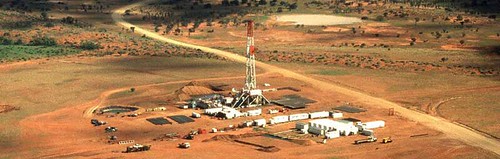
Australian geothermal energy company Geodynamics was an unusual subject of attention in the energy press last week, after cornerstone shareholder Origin Energy expanded their stake in their Cooper Basin hot rocks project, including Geodynamics' giant Lightning drilling rig, Australia's biggest onshore rig. Origin is hoping to leverage its experience in gas exploration, production and power generation and exposure to geothermal power generation in New Zealand.
I've been following the (slow) progress of this endeavour for a number of years now, as the field has the potential to supply a large amount of clean energy over a considerable period of time.
Geodynamics was floated on the stock exchange back in 2002 and has been drilling in the Cooper Basin ever since. Origin believes the company had the best potential of the various Australian geothermal prospects and that "geothermal energy will play an increasing role in the security the world's future for clean energy".
The company has been working towards tapping heat from granites buried up to 5km underground between Innamincka and Moomba to generate electricity. Geodynamics aims to bring in a pilot one megawatt generator at the site within 12 months. Further drilling should enable a decision in 2009 to invest in a 50 megawatt demonstration plant. If successful, that would be followed by a 500-megawatt plant operating by 2016.
The project has been delayed by heat and pressure problems, which have caused drilling difficulties and led to the construction of the specialised drill rig - and to the departure of founding CEO Bertus de Graaf, who is now with uranium company Uranoz and looking to develop the Limestone Coast geothermal energy project elsewhere in South Australia and prospects in the Indian state of Maharashtra and in Kyrgyzstan.
The Kyrgyzstan development is reported to have very hot granites at relatively shallow depths - estimated to be between 2km and 3km compared to the 4km to 5km depth of the Geodynamics project.
Geothermal energy is unusual compared to other large renewable power sources, in that it provides "baseload" power (thus placating those suffering from the "baseload fallacy") unlike other more intermittent sources like solar, wind and ocean power.
Tim Flannery dubbed this region of South Australia "geothermia" last year, pondering a future where a large proportion of the nation's power supply comes from the region, with an industrial and mineral processing hub developing to exploit the large quantities of energy available.
Imagine an Australia that decides to build on this natural wealth, creating a centre for minerals processing and natural gas conversion by using emissions-free power. Imagine linking the north-south railway with Queensland and Western Australia in order to bring bauxite and other minerals to the processors, and then to market them through the Port of Darwin. Imagine the exports of gas and of processed minerals from the mammoth Olympic Dam mine, which is nearby. And finally, imagine Australia with a fully linked and freight rail and electricity grid, all powered from zero-emissions sources. If you can do this, then you can imagine a nation transformed from climate-change pariah to leader in the fight for the survival of our planet.
All of this would require a new city in the desert - let's call it Geothermia. What might it look like? I imagine a solar collector towering over a low-rise city, providing shade and conserving soil moisture. Perhaps the infrastructure would be underground. Geothermia would be a city not of thousands but of hundreds of thousands - a place with its own critical mass. And most importantly it would be a fully sustainable city - Australia's very first.
Flannery appeared on "Democracy Now" recently to talk about global warming, geothermal energy and the geothermia vision.
AMY GOODMAN: Talk about geothermia and the hot rocks.
TIM FLANNERY: Well, look, it is so important that we get this new industrial revolution happening and move from the dirty fossil fuels to clean sources of energy. One of the most promising is geothermal energy. You know, it’s an old source, really. We’ve had some geothermal plants around the world for a long time. But recently there’s been astonishing discoveries of massive reserves of heat energy in the earth's crust. One of the biggest is in Australia. And I’ve proposed to our government that we try to exploit this clean and sustainable energy resource to run a lot of our heavy industrial needs, such as mineral processing. We could have a new city in central Australia that I’ve sort of called Geothermia, you know, based around the use of this resource, and use our national rail system to bring in minerals to be cleanly processed and then shipped out.
AMY GOODMAN: Now, explain how this was discovered, where it is in the earth.
TIM FLANNERY: Look, it’s in the most dismal spot in Australia. It’s right in the dead center of our continent, near Lake Eyre, which is a huge salt pan, and it’s four kilometers down in the earth. And it was discovered by an oil and gas company, who had discovered a ring of oil-bearing rocks and then a ring of gas-bearing rocks and, in the middle of this, really hot rocks.
They spent hundreds of millions of dollars drilling. And being an oil and gas company, they thought, “We like the oil, we like the gas, but these hot rocks, we can just post that information publicly.” And, of course, someone else came up and said, well, the amount of energy in the hot rocks is actually probably a hundred times greater than the energy in the oil and gas they discovered, so this is the real gem. And so, they got a free ride. They got a couple hundred million dollars worth of free drilling, and now they're going out trying to exploit this resource.
And we’ll know by Christmas, I think, whether this can be successfully done. The second drill bit is now deep in the earth. It’s getting close to those hot rocks. And if we can get circulation happening of the hot fluids, as projected, then we will have unlocked an enormous energy resource at about the price of coal. And that will change everything for Australia.
AMY GOODMAN: And how long would it last?
TIM FLANNERY: If you run the whole Australian economy on it, it will last at least a century. And that’s the one deposit, you know. This is -- there’s ten companies looking for more of these hot rocks in Australia now. And in China there’s great prospects, as well. There’s prospects in Europe and, doubtless, in parts of the US. So as we shift away from coal and take a medium to long-term view, we can’t just imagine the choices between clean coal technologies and nuclear power. There are other very formidable sources of power that can deliver large volumes of what’s called baseload electricity, you know, the stuff you need twenty-four hours a day, at low cost.
AMY GOODMAN: Let's talk about your proposals around a green electrical grid, green transportation.
TIM FLANNERY: Yeah, look, we know that in order to beat this problem we have to reduce our emissions on the order of 80% in the next forty years. Now, forty years might sound like it’s a long way off, but it isn’t really, you know. I suppose just to drive home to people what that means, it means that in forty years from now we can’t be driving cars that are fueled with fossil fuels, with oil. We can’t be generating our electricity by burning coal and natural gas. We have to have shifted decisively from those polluting sources of power to clean sources of power. So that’s why the race is on now for new affordable takes to harness energy of the sun, which is massive, to harness wind energy, wave energy, geothermal energy, all of these sources that will drive this new clean and prosperous economy of ours, if we can reach out, make the investments and push forward to avoid dangerous climate change.
The idea of shifting energy intensive industries to areas where there is abundant renewable energy (which is a good way to hedge against rising fossil fuel prices) is one which has started being put into practice already, with aluminium (sometimes called "congealed electricity") producers looking to set up smelters close to hydro power stations in Canada, Iceland, Greenland, and the Congo.
If HFR geothermal turns out to be practical on a large scale, South Australia may be a big beneficiary of this trend, as it also has high potential for generating power from solar and ocean (wave) energy - not to mention the world's largest uranium mine and some residual (albeit declining) oil and gas production. Another region which may have large scale generation potential is the Hunter Valley region, conveniently located next to a lot of existing coal fired power stations.
Other companies looking to development geothermal energy in Australia include:
- Petratherm - looking to develop another HFR resource in northern South Australia, initially to power the Beverley uranium mine. Managing Director Terry Kallis expects the cost of power "to consumers would be somewhere between $50 to $60 a megawatt hour or five to six cents per kilowatt hour". The company is also looking to develop projects in China.
- Green Rock Energy - operating in the area around the Olympic Dam mine and in Hungary
- Scope Energy (now part of Uranoz) - looking to develop a 100MW plant near Millicent in the south-east of South Australia. Principal Roger Massey-Greene expects the cost of power to be "very competitive with combined-cycle gas power plants"
- Torrens Energy
- Pacific Hydro
- Greenearth Energy
- Osiris
- Eden Energy
- Geopower
The industry is already fighting against "clean coal" backers for government funding and has formed the Australian Geothermal Energy Association, representing at least 16 companies operating in the sector. The organisation will have its inaugural meeting on November 21.
More data about geothermal resources in Australia is being gathered by Geoscience Australia's Geothermal energy project and the Research Institute for Sustainable Energy (RISE).
Background
Geothermal energy has been used for centuries for heating, cooking, and medicinal bathing. The first geothermal power generation plant was constructed in 1904 in Larderello, Italy, followed by Wairakei, New Zealand in the 1950's then the Geysers in California in the 1960’s.
There is currently an estimated 12,000 MW of direct use and over 8,000 MW of power generation using geothermal resources around the world. This generation capacity represents about 0.4% of the world total. The US is the largest producer, followed by the Philippines, Mexico, Indonesia, Italy, Japan and New Zealand.
If heat recovered by ground heat pumps is included, the non-electric generating capacity of geothermal energy is estimated at more than 100 GW (gigawatts of thermal power) and is used commercially in over 70 countries.

Existing geothermal power generation is sometimes called "wet" geothermal power - using natural hot water sources close to the surface to generate power using energy conversion technologies like dry steam, flash steam and binary cycle systems.
Hot Dry Rock / Hot Fractured Rock (HFR) power is still at the experimental stage, with the Geodynamics project being the most advanced in terms of commercial development. Besides the various projects underway in Australia, Swiss company Geopower Basel has tried drilling under the city of Basel - however this has been halted due to concerns about the drilling causing earthquakes - and other experiments are being performed in Germany and the french village of Soultz-sous-Forêts.
An MIT led study (funded by the US Department of Energy) last year said that if 40 percent of the heat under the United States could be tapped, it would meet demand 56,000 times over. The report estimated that an investment of $800 million to $1 billion could produce more than 100 gigawatts of electricity by 2050, equaling the combined output of all 104 nuclear power plants in the US.
The report noted that geothermal energy is important for several key reasons:
* fossil fuels (coal, oil and natural gas) are increasingly expensive and consumed in ever-increasing amounts
* oil and gas imports from foreign sources raise concerns over long-term energy security
* burning fossil fuels dumps carbon dioxide and other pollutants into the atmosphere
Herman Kahn was also very enthusiastic about the potential of geothermal energy, rating it as by far the largest available power source we have, dwarfing any demand for energy we are likely to have even with a massively increased population.
Technology Review had an interview with the author of the MIT report Jefferson Tester last year which noted that the amount of energy available is "thousands of times more than we now consume each year".
The figure for the whole world is on the order of 100 million exojoules or quads [a quad is one quadrillion BTUs]. This is the part that would be useable. We now use worldwide just over 400 exojoules per year. So you do the math, and you know you've got a very big source of energy.
How much of that massive resource base could we usefully extract? Imagine that only a fraction of a percent comes out. It's still big. A tenth of a percent is 100,000 quads. You have access to a tremendous amount of stored energy. And assessment studies have shown that this is thousands of times in excess of the amount of energy we consume per-year in the country. The trick is to get it out of the ground economically and efficiently and to do it in an environmentally sustainable manner.
A recent report from the Geothermal Energy Association (pdf) showed that the amount of geothermal power being generated is already increasing significantly.
"The number of countries producing geothermal power and total worldwide geothermal capacity under development appear to be increasing significantly in the first decade of the 21st century," according to the report. "The number of countries producing power from geothermal resources could increase 120 per cent, from 21 in 2000 to as many as 46 in 2010. Total geothermal capacity online could increase over 55 per cent, from 8,661 megawatts in 2000 to 13,500 megawatts or more."
New Zealand
New Zealand’s geothermal generating capacity (as of 2000) was over 400 MW, far exceeding that of Australia. The country has significant expansion plans for new geothermal power generation. New permits have been approved for a 60 MW power station in the Wairakei-Tauhara geothermal field and a 70 MW plant at the Kawerau field, with more permits expected to be issued in the future as part of the country's move to be the world’s first carbon neutral nation. Rod Oram reports the country could easily increase geothermal generation by a factor of 4.
Iceland
Byron King at The Rude Awakening recently had a look at the prime mover towards the use of "hot and steamy" geothermal energy - Iceland. Byron notes that the country is now energy self sufficient and is a good example of locations with large renewable energy supplies attracting energy intensive industries (one recent case in point is companies like Microsoft and Cisco considering using the country to host "green server farms").
When it comes to harnessing geothermal power, the go-to place on the planet right now is the Republic of Iceland. Yes, Iceland. It is a large island at high latitude, composed mostly of dense basalt lava flows. Iceland straddles the Mid-Atlantic Ridge, which provides that country with an almost direct link to the primordial heat energy within the mantle of our planet. And that is one all-but-immeasurable store of energy. Thus, Iceland is the world’s leading nation in terms of exploiting its local geothermal power resources. In Iceland, the insiders refer to the process of extracting geothermal energy as “heat-mining,” and they are getting rich from the effort.
Recently, the president of Iceland, Olafur Grimsson, visited the U.S. to speak at a number of events and testify before the U.S. Senate Committee on Energy and Natural Resources. In a speech delivered at Harvard on Sept. 26, President Grimsson emphasized the importance of geothermal energy to the economy and society of Iceland. He stated that Iceland has undergone a “radical transformation” from dependence on coal and oil in the past 30 years. As recently as the 1970s, Iceland was among the poorest countries within what was then known as the European Common Market (now called the European Union). That is, by most measures of gross domestic product and other economic output, Iceland was an economic laggard.
But then Iceland made a conscious, strategic commitment to develop its domestic geothermal energy resources. From large industrial projects down to the level of family housing, Iceland focused its public and private energy investment on making a geothermal energy vision into an energy reality. Now, according to what President Grimsson told his Harvard audience, Iceland is one of the most affluent nations in the world. Fully 100% of Iceland’s electricity now comes from renewable sources, geothermal and hydroelectric, and almost all buildings in Iceland are heated with geothermal energy. On the whole, about 72% of Iceland’s total energy usage is tied to geothermal sources, which eliminates essentially all carbon emissions and dramatically reduces reliance on imported fossil fuels of any type.
According to President Grimsson, Iceland has “turned this [geothermal power production] into an extremely profitable business.” For example, electricity is so inexpensive in Iceland that there is a booming business on the island that imports bauxite from the Caribbean area for the purposes of refining aluminum, a highly energy-intensive process.
In comments after his prepared speech at Harvard, President Grimsson expressed his “astonishment” at the utter paucity of geothermal power generation in the U.S., merely 0.3% of all electricity generated across 50 states. And much of that power comes from one location in California, called the Geysers. President Grimsson noted that the U.S. sits atop “the second largest geothermal resources in the world, following only Indonesia.”
President Grimsson concluded that by harnessing the “fireball on which we sit,” mankind could revolutionize energy production across the globe.

Iceland is not only making extensive use of its own geothermal resources but is looking to export technology and expertise to other promising regions, including Indonesia, the Philippines and the US - particularly a new company called Reykjavik Energy Invest.
Indonesia
With its hundreds of active and extinct volcanoes, Indonesia has the potential to produce an estimated 27,000 MW of electricity from geothermal sources. Reuters recently reported that Chevron is looking to expand its geothermal generation capacity in the country as part of the country's efforts to tap alternative energy sources to meet rising power demand and to cut consumption of crude oil as its own reserves dwindle.
Simon Sembiring, the Indonesia director general of geothermal and mineral resources, said earlier this year many foreign firms were interested in investing in geothermal energy projects in Indonesia, with the Icelandic invasion now underway - Reykjavik Energy Invest have already signed a preliminary deal to develop a geothermal power plant with Indonesian oil company Pertamina.
The Philippines
Another country astride the 'ring of fire" is The Philippines, where Chevron also run a number of geothermal power plants (including Tiwi, which is currently impacted by water shortages). The country currently generates around 8% of its electricity from geothermal energy - and another 15% from hydro power - making it the world's second largest producer of geothermal power.
The Icelanders are also looking to help expand the local industry here, with officials from Reykjavik Energy Invest visiting recently to discuss partnering in the development of other geothermal areas and bidding for a stake in power company PNOC-EDC (along with 23 other groups).
Papua New Guinea
Another country in the Asia-Pacific region looking to exploit geothermal energy is PNG, where gold miner Lihir Gold already has a geothermal plant powering mine operations. Bismarck Energy managing director Karl Yalo recently appealed to the PNG government to encourage geothermal power as high and rising fossil fuel prices hit the local economy hard.
“Several developing countries have well-entrenched geothermal plants complimenting traditional energy sources, thereby increasing energy output and enhancing economic growth. In PNG, we have seen the Lihir Gold Mine increase its base load capacity through geothermal energy, thereby reducing substantially use of fossil fuel and consequently converting the savings to sound profit,” Mr Yalo said.
Mr Yalo said numerous naturally occurring hot steams throughout New Britain and New Ireland showed the abundance of these opportunities and that serious consideration had to be given to examining the commercial development of geothermal as an alternative energy source particularly given the present high crude oil prices.
He appealed to the National Government to support the project as it will contribute meaningfully to the national economy through fiscal and other benefits. “With world crude oil price now trading at a record US$90 per barrel, there is no price relief in sight. “I believe fossil fuel prices will not come down to the late 90’s prices. The end result is that countries like PNG whose economies depend entirely on fossil fuel, will continue to face economic hardship, particularly people in the rural communities where bulk of them reside,” Mr Yalo said.
United States
While the US today makes only limited use of geothermal energy, it has a number of areas containing large energy resources, particularly Alaska and western states like California and Nevada. The Intermountain West Geothermal Consortium estimates geothermal resources of around 13,000 MW in the western states.
Producing geothermal power from oil and gas wells in the Gulf of Mexico is also being considered.
The largest geothermal plant in the US (and the world) at present is in Northern California, generating enough power for 800,000 homes, with the plant currently undergoing further expansion.
Iceland's Glitnir Bank plans to invest $1 billion in U.S. geothermal energy projects over the next five years in order to exploit some of the $40 billion market that they predict will develop over the next 25 years.
Another company from Iceland, Iceland America, plans to develop geothermal plants in the Salton Sea area in California.
While geothermal power generation is relatively limited in the US so far, passive use of geothermal energy in the form of ground heat pumps appears to be quite widespread, with estimates ranging between 500,000 and 1 million units already installed - Oklahoma is apparently leading the way in this regard.
Mexico
Mexico is currently producing around 950 MW - about 3% of the country's annual electricity consumption. By 2010 it is expected that an addition 220 MWe will be available - the total capacity of known resources is estimated at around 8,000 MW.
Germany
Hochtief and Exorka are looking at opportunities in the Molasse Basin of Bavaria.
Contact
- anz at theoildrum dot com
License

This work is licensed under a Creative Commons Attribution-Share Alike 3.0 United States License.
Archives
- November 2010 (2)
- October 2010 (5)
- September 2010 (4)
- August 2010 (8)
- July 2010 (2)
- June 2010 (2)
- May 2010 (6)
- April 2010 (7)
- March 2010 (12)
- February 2010 (11)
- January 2010 (7)
- December 2009 (10)
- November 2009 (6)
- October 2009 (7)
- September 2009 (10)
- August 2009 (10)
- July 2009 (3)
- June 2009 (14)
- May 2009 (10)
- April 2009 (15)
- March 2009 (16)
- February 2009 (16)
- January 2009 (15)
- December 2008 (15)
- November 2008 (23)
- October 2008 (25)
- September 2008 (24)
- August 2008 (30)
- July 2008 (44)
- June 2008 (38)
- May 2008 (48)
- April 2008 (43)
- March 2008 (29)
- February 2008 (32)
- January 2008 (30)
- December 2007 (26)
- November 2007 (32)
- October 2007 (11)
If I recall the median heat flux from the Earth's core is about 0.2 watts per square metre. On a clear sunny day the sun may give 850 W/m^2. Not only that in the case of photovoltaics there are no moving parts or liquids sloshing around. You build it and check on it 10 years later.
Half a gigawatt of HFR geothermal by 2016 will probably be less than 1% of what Olympic Dam uranium will be generating for northern hemisphere customers.
I'm not sure about relative energy densities, but the total amount of geothermal energy is still vast.
By all means build lots of CSP plants in the desert and stick PV on the roofs of all the warehouses in the western suburbs of Sydney - I won't complain.
But I still think its worth building a significant amount of geothermal capacity - both "wet" plants around the ring of fire and HFR where the process can be made to work.
If we have 5 GW of HFR geothermal capacity in 2025 I think we'll be pretty happy with ourselves - that's 5 nuke plants we don't need to build.
Theory (not mine) - Mars had an atmosphere until its core became solid.
Ergo - long term - if the heat of the core is taken away so might the Earths atmosphere.
(Just a reminder of a possible long term outcome - wonder what the direct into the mind movie about the impending loss of atmosphere will be called? Time to join the telephone sanitizers off-planet?)
In the time it takes for humans to measurably lower the earth's interior temperature we will probably have colonized half the galaxy. (assuming we get that far)
Earth's core is hot because of the sustained nuclear reactions that happen there. It is constantly producing and dissipating heat, it is not a reserve, like oil.
Geothermal energy is renewable on the same sense that solar is renewable.
While, today, such a statement is taken as true, similar statements were made about oil and CO2 in the air in the past.
I and any future generations I might know personally will not have to worry about the cooling of the core of the earth. I'd even be willing to bet that moving the heat from the Earth core into the atmosphere would be a bigger issue.
But as soon as you start removing the heat, you start cooling the rock... So you can say that there is a "reserve" of heat in a certain "field". I would say, geothermal energy is renewable on the same sense that abiotic oil is renewable 8O).
Solar, on the other hand, does not have that behaviour. Behind each photon there is another one, and the flow is exactly the same if you take 0% or 100% of them.
BTW, minor nitpicking, Iceland is not in the European Union (nor was in the European Common Market).
Although there have been suggestions to the contrary, the uranium whose fission provides the thermal in geothermal is not in the core but rather distributed in the crust.
Yes, geothermal is renewable (until the U and other unstable isotopes are gone), but the unfortunate timescale (see low heat flux stated above) means that what one is doing is actually mining stored heat. Yes, there is a lot of it (and in certain places it is rather close to the surface), but the very reason that the heat is stored at depth (low thermal conductivity of the rock) also means that harvesting the heat at an economical rate is a challenge. And if you solve that problem (perhaps using e.g. horizontal drilling), then you will nevertheless deplete the heat--you are limited by the thermal conductivity of the rock. Eventually, you will need to drill again elsewhere.
Actually, experience in the Geysers field in California shows you need to drill again rather quickly, owing to low heat conductivity of rock. Over human timescales, geothermal is definitely depletable, but you can compensate by constantly developing adjacent areas. This continual drilling has to be allowed for in your cost estimates, of course.
There's one other thing which has been done that's a bit odd at the Geysers: they're pumping (treated) sewage into the geothermal field to compensate for steam depletion. It regularly causes small earthquakes as the water vaporizes in steam explosions underground.
More at http://arxiv.org/PS_cache/hep-ph/pdf/0501/0501111v2.pdf .
Also, the heat it produces, it produces 99.999+ percent by alpha decay, not fission.
--- G. R. L. Cowan, former hydrogen-energy fan
http://www.eagle.ca/~gcowan/Paper_for_11th_CHC.html :
oxygen expands around boron fire, car goes
It's only, 20 mW, or .02 watts/m^2, or just one tenth what you stated. Solar flux averages out to less than 850 W/m^2 because of night, clouds, and the poles, but it's still well over 100 W/m^2.
If we took the heat coming up from the entire US (9.8M km^2), the sustainable thermal power would about 200GW thermal. Given a 20% conversion efficiency, we would get 40GW electric.
I'm also afraid of what cooling such massive volumes of rock could do to the geosphere. It will cause the rock to become less plastic and to shrink (thermal contraction). If done on a large enough scale, could this cause large scale subsidence (from denser rock sinking) or earthquakes (from thermal stresses and from subsidence)? Could it slow down the movement of the plate in that area by making it less fluid, causing stresses to build up.
My references say geothermal flux if .075 w/m^2, but whatever...
http://science.reddit.com/info/607sg/comments/
thanks for your support.
I'd say whatever WILL work is whatever HAS been working thus, only traditional use in places like Iceland and New Zaylund.
Hmmm - so if this was 1930 you'd say categorically that nuclear power will NEVER occur ?
As far as I know their are no major technical limitations to geothermal oil drilling technology can readily be adapted at least for pilot projects. Your talking about technical hurdles. If it was generally worthwhile then I'd think we would have a lot more then we do now. Think about some factory and its energy usage if they could recoup costs going geothermal then I think they would have.
I don't know enough to say if their is some breakout technology close. I'd think you would have to drill 20-30 miles down and get closer to the mantle to get a really good geothermal solution but drilling into or near the mantle is well beyond our capabilities.
I'm actually a big fan of the concept of geothermal.
As always, back to the basic net energy questions:
What is the size of the resource and what is the EROI of that resource? This will vary based on technology, but without both of these pieces together, it is hard to make a judgement.
And, at the very least, what is the cost per Kwh of electricity generated? (a little worrysome because low EROI sources are going to suffer the receding horizons effect).
I have been swimming in the Blue Lagoon in Iceland. From what I understand that was a failed geothermal project. Plenty of hot water, but too high a mineral content was how it was explained to me. It would seem that there are hidden limitations. But I still think places like Hawaii would be tripping over themselves to implement such a power source.
Jon Freise
Analyze Not Fantasize -D. Meadows
You need to differentiate between "wet" geothermal energy sources (which basically harness existing sources of hot water close to the surface) and HFR, which involves drilling very deep holes and pouring water into them (analagous in many ways to drilling for oil).
Wet geothermal is relatively uncommon, but still capable of providing reasonable amounts of power in a limited set of locations (the Geysers field in California powers almost a million homes, for example).
HFR has the potential to provide much more power, but is still experimental at this stage.The costs being estimated by the HFR companies in Australia make the power generated competitive with gas fired sources (and coal, once carbon taxes are introduced).
Iceland makes a lot of direct use of geothermal hot water - for heating (houses and even pavements) and hot water (your shower in Rekyavik was pumping hot water direct from the ground onto you).
I've swum at the Blue Lagoon and I don't remember reading anything about it being a failure - it is a working power plant as I understand it - the pools are just a side benefit using the water coming out of the plant.
http://en.wikipedia.org/wiki/Blue_Lagoon_(geothermal_spa)
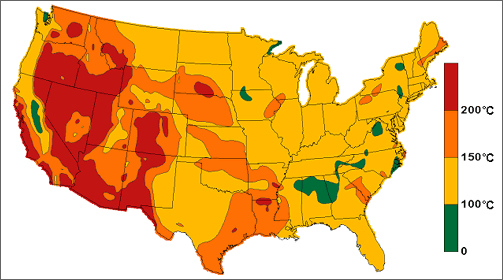
Looking at the US map, it is strange that both Hot Springs NC and Warm Springs GA are located in the "green zone".
Here is a much more detailed map of geothermal potential for North America:
Geothermal Map of North America
Thanks - nice map.
The University of Texas Bureau of Economic geology did some studies of the geothermal potential of the Frio formation in the Upper Gulf Coast and Mid Gulf Coast areas-near the Bay City Nuclear Plant thats about to be constructed by NRG. And, as I recall, Texaco drilled a geothermal test well near Chocolate Bayou in the Brazoria County-Galveston County area with a US Department Of Energy grant about 25 years ago.
With the new horizontal drilling techniques, setting up circulation downhole should be a lot easier, and the base load generation could be used to balance out the loads from wind in West Texas. The lack of radioactivity should be a real advantage over nuclear to remove environmental objections. If they can hold prices to the 5 cents/kwh costs like in Australia it will undercut coal electric generation costs. It sounds great, I hope it can become practical quickly in the U.S.
Bob Ebersole
So all we have to do to get the pro-nuke cultists to love it is to say: "It's nuclear power! But you don't have to mine it first!"
Or at least that will seperate out the cultists who merely worship the idea of atomic fission from the ones who worship the idea of a technocracy of guys in white labcoats bringing us limitless prosperity.
super390:
Today's power systems are based on the idea of a company providing electricity or natural gas inquantities to a customer who cannot produce the same quality power himself conveniently. In other words, a big utility company.
Solar power, micro hydro and small scale wind frees the customer from the utility company. Energy conservation helps free the customer too by cutting down on the amount of power needed. In other words, the resistance to conservation actually comes from utility companies because it helps the customer get free of paying a high monthly bill. That's why utility companies push clean coal and nuclear on their clients and ignore conservation.
Geothermal has the dual advantage of being green but not upsetting the current company/customer model. Its something utility companies can adopt without changing their business model. This has a chance of being adopted. Bob Ebersole
"Pro-nuke cultist"??? Or hard-headed, experienced man of the world who faces reality and his responsibilities?
Yes, I do think geothermal has good prospects - the best of the "alternatives" and I don't mean to damn with faint praise. I could see a couple of gigawatts added to California's supply in the next decade.
The hot dry rock source technology is a very sketchy idea. It might work in specific locations where you have hot, porous, insoluable AND permable rock but you need lots of water. This Australian site might have the rock but does it have the water?
All those grandious claims about super-abundant geothermal power are based on hot dry rock technology.
Yet again, this is another marginal niche technology that just seems to distract the weak-minded from the hard thinking required about energy.
"Weak minded" ?
That does sound kind of like a cultist phrase to me.
Underground water is pretty readily available in the area - see the map of the Great Artesian Basin elsewhere in the comments.
If you look at the HDR potential worldwide there seem to be plenty of other potential locations besides Australia.
And it doesn't have all the insoluble drawbacks associated with nuclear power, something that weak minded fool Herman Kahn was willing to acknowledge decades ago when peering into our energy future.
Of course geothermal doesn't lack radioactivity, nor is it reasonable to expect its leakage thereof to be less than that of nuclear plants; they concentrate it and wrap it in metal, hard to do downhole in a large volume of fractured rock.
The lack of threat to fossil fuel interests should be a real advantage over nuclear to remove "environmental" objections.
--- G. R. L. Cowan, former hydrogen-energy fan
http://www.eagle.ca/~gcowan/boron_blast.html :
how shall the car gain nuclear cachet?
Thanks Big Gav for the review, I really really like this idea added in to the future energy mix, lets get started ASAP! (after due diligence, etc, etc.)
A couple of posts show a bit of misunderstanding. Geothermal is not renewable (not in the strict sense of the term), but is the mining of a large heat source. It shares a low CO2 footprint with renewable, but once you use up the heat in a given location you will have to wait millions of years for nature to replace it. That doesn't mean we couldn't use it for the next thousand years though.
We aren't going to cool off the earths core by doing this. Only the heat in the top few KMs of crust is minable. It takes millions of years for this deep heat to diffuse upwards. There is no danger of the geodynamo shutting down, the sun will kill us by setting off a runaway greenhouse effect after a half to one billion years. That is much sooner than the time for the core to cool off.
What about simply drilling a few KMs deeper as soon as the heat is used up at a certain "heat well"?
The problem is that rocks become less permeable with depth (with increasing load pressure on top). That is, circulation of water from an injection well to a recovery well becomes far more difficult with depth. Also, hot water tends to react with hot rocks, forming hydrous clay minerals, further gumming up the works. I suppose one could prevent wallrock chemical reactions by passing everything through pipes, but the pipes would have to be greatly pressurized to prevent their collapse at depth, increasing the risk of a blowout on top. Further difficulties, as for any plumbing system, will include deposition of minerals (hard water deposits) and corrosion.
I'm moving to Iceland! I think their move from a poor to affluent nation coincident with the serious development of geothermal oil independence (a little like Brazil is doing with sugar cane ethanol) is a microcosm of what all the nations are now in for. Nations controlled by energy policy morons will be taking a back seat to those controlled by energy policy thinkers. I don't have a good feeling living in the U.S. in that regard. I've not read much on geothermal, but it seems to solve so many problems that plague peak oil policy . Once the massive infrastructure is built (using lots of fossil fuel) it would seem to be a self sustaining energy source with good EROEI. Are there any good numbers on EROEI after the plant build? Also, no CO2 or any pollutant, no having to prospect for it only to find it existing half way around the world with transport and geopolitical problems and having to move vast amounts of money out of our own pockets to other nations. As with solar, it's a vast energy source everywhere.
Considering Australia is suffering from a horrible drought - and the location of these "hot rocks" is in a very dry region, where exactly is all the water going to come from to make this happen (especially on a large scale)?
Same problem in the US. The sites easiest to utilize are the places with the least water. OTOH air is plentiful and can flow through less permeable rocks at a cost in efficiency. Efficiency of geothermal is more a matter of cents per kwh than btus out/btus in. Like all other renewables geothermal is diffuse making large central powerplants an unrealistic prospect.
Unlike fossil fuels geothermal sites that draw heat out too fast will regenerate that heat in a matter of decades. Careful engineering could match energy extraction with the natural heat flux.
You cycle the water in a closed loop.
Good essay though. Geothermal has probably got a future here and there, but it is a local solution.
Though to my mind , most of the best Geothermal sites are in play, but could be further developed.
Ideal candidates:
Any nations on the Pacific Ring of Fire, Japan , NZ ETC.
Any nations on constructive margins: Iceland
Any nations with an isolated mantle plume: Hawaii, Yellowstone. (BTW: mantle plumes may well be antipodal fossil remnants of meteor strikes, but that is a story for another day)
Any nations on failed rift systems: East African Rift.
In other words where tectonic activity is in close proximity and hard, crystalline rock types and / or proximity to active magma near surface, preferably blanketed with a porous overburden (pummice, volcanic ash strata) That way you have a strong, long lasting heat source, and an ability to drill and circulate water.
Without very high heat sources in proximity, a circulating system cools the adjacent formations more rapidly than they can re-heat to the initial, starting, temperature.
Geothermal heat can also be used as an initiator: You have another primary heat source (gas , coal etc) and you circulate geothermally hot water with additional surface heat energy inputs, Flashing it to super heated steam.
Closed loop systems are likely to be the best in tectonically active systems, since open circulation can and has brought some pretty toxic metals to surface: Mercury, Arsenic, Cadmium etc.
Closed loop systems are unfortunately liable to foul and / corrode. Some of the fouling can be LSA ( Low specific activity radiation). This would need cleaning out.
But, When all is said and done, locally achievable.
That is why NZ is attractive post peak.
Geothermal systems are also good for hot housing: So you can eat as well as keep warm...:-)
Do they have to use fresh water? Sea water is one thing we are not running out of!
Increased risk of corrosion, and of deposition of salts.
Have any efforts been made to produce electricity from hot dry rock by means other than steam?
a. ammonia-based turbine lowered into the bore shaft to prevent thermal loss
b. thermoacoutics - the use of shockwaves to transfer heat from a hot end to a cold end
c. the creation of pressure differentials between the bottom and top of the shaft to produce a low-pressure gas flow
Not that I'm aware of.
Remember this is the first time this has been attempted (HDR/HFR geothermal power generation) - its still experimental.
Most of the research is being done in Europe and Australia seems to be the only country actually drilling holes and trying to generate power so far.
If the pilot plant works I imagine the sector will be a hot one for quite a while afterwards - lots of potential for oil services companies to move into the electricity generation sector and as another commenter noted, it fits the large centralised generation model which is business / capital friendly.
Great post, nice to see this topic being brought up here for once. Just two minor questions:
1. If I understood correctly, these guys are planning to build a geothermal plant in the desert. Where do they get the water to cool the power plant?
2. There's a number that 800 million to 1 bn dollar investment could provide as much as 100 GW of power until 2050. This number seems a little low to me. Is it meant on an annual basis or in total?
I'm not sure where they are planning to get water - the Great Artesian Basin is one possible source though.
As other commenters have noted, you want to run this as a closed loop system - the water just circulates through the hole and the turbines.
Its not water cooled like a coal fired plant or nuclear plant is.
As for the cost estimate, it sounds low to me (I thought it was a total cost number), but I just took it from the MSNBC article on the MIT study.
The plant costs wouldn't seem to be particularly large - its mostly drilling costs from what I can tell (look at the amount Geodynamics has gone through so far).
But I'd still expect a number quite a lot bigger than 1 billion dollars...
If it were possible for heated water just to circulate through turbines and then back to a heat source, coal-fired and nuclear plant would be set up that way.
In fact working fluid that has done work on a turbine must then have waste heat removed from it, and it is at this point that geothermal, nuclear, or coal-fired plant all require some coolness from the environment. If cooling water is too expensive, the other option, on Earth's surface anyway, is air cooling.
--- G. R. L. Cowan, former hydrogen-energy fan
http://www.eagle.ca/~gcowan/boron_blast.html :
oxygen expands around boron fire, car goes
While I'm (obviously) not an expert on this, remember that the originating heat source here is only 250 degrees, not the much higher temperatures coal or nuclear fired plants deal with.
The process proposed to be used in the generation plant is the Kalina cycle. I don't really understand the detail, but it sounds like the idea is to minimise waste heat. More at the links below:
http://www.geodynamics.com.au/IRM/content/kcp.html
http://en.wikipedia.org/wiki/Kalina_cycle
http://vganapathy.tripod.com/kalina.html
It's a thermodynamic principle that it is impossible to generate work (i.e. electric energy) from heat. It always has to be generated from temperature gradients, i.e. the temperature difference between a heat source and a heat sink. The degree of efficiency eta achievable depends solely on the temperature difference:
eta = (T_1 - T_2)/T_1
All cycles that are engineered (including the Kalina cycle) can only approach this degree of effiency, given by the upper working temperature T_1 and the lower working temperature T_2 (With the temperatures in Kelvin). A fraction (1-eta) of the heat taken from the ground has to be transferred to the heat sink, which means there has to be some medium operating as the heat sink, which is heated.
As mentioned before, air cooling (in a hot dessert ;-) ) might be a possibility, if there is no water available, and it might work for a demonstration plant, but I cannot imagine that it can be done efficiently for a whole city, which they imagine to construct. However, this is a question of engineering which I'm not qualified to answer. It just seems very odd to me.
Fin-fan cooling would be many times the capital of cooling towers, and wouldn't get as low a temp for the heat sink.
Deserts aren't always at hot as you imagine - during the night it is freezing out there. During winter it isn't all that warm either (by Australian standards anyway) :-)
In any case, there is plenty of underground water that can be tapped from the Great Artesian Basin as I noted originally - not drinking quality but presumably fine for their purposes.
I wouldn't take the city stuff too seriously - I'd imagine some heavy industry out there one day, but cities in Australia are always near the coast (its extremely unpleasant that far inland).
The power generated by Geothermia would be used to feed into the national grid, not to build a giant city in the desert - Flannery is dreaming on that point...
Watch out. The requirements for such things as boiler makeup water can be more stringent than potable water.
I know that deserts aren't always as hot as one might think. But especially when powering some heavy industry, you'd probably want a constant power output, otherwise one would have to cut down on production. That is why I took a hot daytime temperature as reference.
I agree on the part with the city. Maybe not even a lot of heavy industry, since those would need workers, which would probably want to bring their families, hence there's a need for schools, etc. The result is a heavy industry city in the middle of nowhere. I definitely would not want to live out there. Sounds a bit like a colony on mars or somethin. And it'd probably anyway be a lot easier to set up a high voltage direct current power line to wherever the electricity is needed.
Well - "fly in fly out" is a fairly common concept in Australian mining towns - its relatively unusual for people to move to them and bring their families along - they do something like 10 days on / 5 days off and go back to their families in Perth or Adelaide during the breaks.
The North West Shelf LNG plants being a good example.
Then how might one explain the steam engine and even more fascinating - "The Flame That Cools?"
http://www.roburindia.com/technology.htm
This wondrous new technology is actually quite old. We had one of the venerable refrigerators that cooled with heat and contained no moving parts when we lived in a house without electricity. It came in handy for cooling the water from a hot spring - our only source of water. LOL!
It is not so mysterious if you understand the mechanics but, as with water pipes in our area typically freezing with the spring thaw rather than during the subzero weather, you have to understand the energy involved in the change of phase.
What defies normal logic is actually quite simple.
When hot geopressurized waters are flashed into steam simply by releasing the pressure, there is energy involved that is not quite so different from the binary systems for lower temperature waters and need working fluids with a lower boiling point.
Air cooling is done now. Ormat claims to have advanced cooling towers today that save water. I know nothing about them but cooling towers are quite common features of geothermal plants.
In any case the issue of thermal pollution is rather odd in some ways. What is a problem with very warm water dumped in a stream is also water that can provide heat where it is needed. I suppose a nuclear power plant's water could be used for heating homes but I daresay the idea of heating homes with radioactive water is probably not terribly attractive to many homeowners.
Best, Terry
Geothermal is a very flexible and adaptable resource that has many other uses in addition to electricity. Probably more so than any other resurce with the exception of oil.
The potential for electricity generation is substantial because it doesn't requie vast amounts of land like wind and solar. We'll need all the electricity we can get regardless of where it comes from, with the exception of nuclear. I don't like living in waste.
This is a great post; it’s a real puzzle to me why R&R money for deep thermo power was cut from the federal energy budget. You sure can’t give American politicians credit for being farsighted on technical issues!
Geothermal is the base loaded alternative power source we have all been looking for. Combine it with solar and wind for a good national grid system. We would have plenty of power to electrify to our ground transportation system with... It’s a no-brainer for clean energy independence.
The political side of trying to solve problems like this baffles me. The reality of it is that it’s a straight forward engineering problem, but no! Every idiot politician has to throw his ignorance into the situation to screw it up! It makes me mad to see how easy it was for Iceland to solve its energy problem and yet we sit on one of the best geothermal resources on the planet and aren’t doing a thing about it.
About 25 years ago there was an attempt to establish a geothermal power plant in the Imperial Valley of California, near the Mexican border. Although the valley is a rift zone and has a favorable heat flow, the project failed because of excessively mineralized water.
Perhaps some of the techniques learned in Iceland could be applied there. California environmental regs keep getting more complicate all the time though.
Jack Edmonds
Phoenix, Arizona
Apparently so:
http://tinyurl.com/22g63s
"Iceland America Energy (IAE) plans to build a 50-MW plant near the Salton Sea in California's Imperial Valley."
See also:
http://www.icelandamericaenergy.com/?i=3&expand=3
In the California marke there are two major proposals for new geothermal capacity. One is actually located in Northern Nevada just over the border and is maybe a gigawatt-electric. The other is in the Imperial Valley using the geofluid technology mentioned only updated a bit. I don't think it is as big. Both could work at some price. However, both are distant from customers and major markets.
The problem is transmission access. We're arguing about whether geothermal is "renewable" or not. If it is then it can be applied to the renewables mandate and would preclude most of the wind and solar projects based on economics. (All are still more expensive than new nukes.) But both geo projects would still need transmission line investments and who is to pay - the developers or the grid customers?
The Nevada project is even touchier since it would hook into the Pacific Intertie (a DC line if memory serves) and would have to bump some existing NW hydro due to capacity limitations.
As I've pointed out many times on TOD, the complexities of hardhat projects will intrude on idealistic policy preferences.
Expansion of the transmission system is a common issue everywhere where people are trying to expand the use of clean energy sources.
I've noted the politics of expanding the transmission system in New Zealand as new wind farms are added in a few recent Bullroarers.
Smart Grid News and Renewable Energy Access frequently cover the issue in the US from time to time (as do sites like Grist, at a much lower frequency, for that natter).
As we slowly shift to 100% clean energy sources, this will be a contentious issue - but I suspect we'll see an "electranet" boom in the next decade that simply overwhelms a lot of opposition to new transmission capacity being added.
http://www.smartgridnews.com/
http://www.renewableenergyaccess.com/
Been lurking here for a while and the posts are often very informative. I read on a this site by the Mogambo Guru about Byron King [of outstanding investments] on the EWG report that suggests we have 42 years of oil at current consumption levels.
Ennyhooo, I have read of geothermia before but I wonder if solar updraft generation is feasible as it doesn't require a wind nor redrilling for 'hot rock'
Frankly I'm about to connect a Delco Alternator to a stationary exercise bike via a v-belt that runs from a tireless back rim to said alternator that charges a 12 volt battery. Gilliganeration!
could you fix your second link? Thanks!
Been lurking here for a while and the posts are often very informative. I read on a this site by the Mogambo Guru about Byron King [of outstanding investments] on the EWG report that suggests we have 42 years of oil at current consumption levels.
Ennyhooo, I have read of geothermia before but I wonder if solar updraft generation is feasible as it doesn't require a wind nor redrilling for 'hot rock'
Frankly I'm about to connect a Delco Alternator to a stationary exercise bike via a v-belt that runs from a tireless back rim to said alternator that charges a 12 volt battery. Gilliganeration!
could you fix your second link? Thanks!
I've just finished researching and writing on this area. I read quite a bit from the MIT project and the Australian hot rocks.
The MIT project was interesting because of the implication of using defunct oil-wells drilled down around 10 km as geothermic heat-wells. I am surprised that people aren't getting really excited at this prospect.
I imagined a geothermic rush, with every man and his dog drilling wells in the Lower Forty. Then I thought about the potential for earthquakes (the Basle project) as the numbers of wells multiplied. Then I considered writing a film-script... The day the Earth Heaved.
MIT estimates about 5 years for the deep wells (not the hot rocks ones) to renew their heat, so you would be looking at fallow wells interspersed with active wells.
I don't know what they base the 5 years fallow estimate on. I have heard (from somewhere else) that the radioactive rock heat (hot rock wells) about 5km down are expected to produce heat constantly. I can't see how that would happen.
What do others think?
I agree that you'll probably need to keep drilling more "wells" as the heat in a given area is used up.
With HFR I suspect this may take some time though - the water is passing through a lot of (very) hot rock.
As for the Basel earthquakes, Basel has been flattened by earthquakes in the past - so its obviously near a fault line.
This makes it an unwise place to mess with the local geology. Central Australia is a different kettle of fish - no people, no towns, geologically stable.
As you mentioned Basel is on or near the upper Rhine fault line. AFAIK, it is not even clear IF the (very gentle) earth quake was caused by the geothermal project.
Then, in an article, there were two more facts raised:
1. Coal mining also causes gentle earth quakes. If we are willing to accept them there, we should accept them as well for geothermal projects.
2. Better to release the geological tension in a series of very gentle earth quakes which cause almost no destruction than just let the tension build up and wait for the big bang.
I cannot judge the credibility of those two arguments, for a lack of specific knowledge, but they sound sound to me.
The coal mining example is a good one (and relevant here in Sydney, as some of our local rivers have disappeared courtesy of some underground coal mines).
At the end of the day you always need to weigh up cost (or risk) / benefits...
Maybe a closed-loop (stainless?) system that used oil instead of water would prevent many inevitable corrosion problems. Also could handle higher temps. better?
Hot Dry Rocks is very promising in Australia. There are a few critical issues that aren't addressed in the post though.
What is recycle ratio? What fraction of water gets lost on each loop?
What is the rate precipitation of dissolved chemicals through the pumps and heat exchangers?
Will there be corrosion issues in the heat exchangers because of the highly saline water?
Australia's tectonic drift northward is blocked by Indonesia and the center of Australia is under compression. The are real geologic forces on the deep rocks. What will be the effect of many square kilometers of fractured rock on this? This technology has triggered earthquakes in Basel, Switzerland. What is the likelihood of similar events destroying the infrastructure?
I included a comment on the Basel incident and a link to an article discussing it.
The earthquake was very small, and not clearly linked to the drilling - Basel is on a fault line and has had real earthquakes in the past.
In many ways this isn't dissimilar to deep drilling for oil.
And as noted in the comments above, Central Australia is vastly different to a large Swiss city.
The other questions you raise are interesting, but I'm afraid I don't have any answers - this thing hasn't been built yet and I'm not privy to any design plans they have.
I read in one news article that far more than half the homes built in 2005 had a geo-thermal heat pump (Switzerland.)
The link shows about 12,000 new homes built in 2004, with close on 8,000 being heated/cooled with such. 2005 thus probably more.
There are ‘about’ 100,000 geo thermal pumps or more installed today (pop 7 plus million; it *can* get bloody cold.) This link estimates the savings in heating fuel at 250 million liters, and the CO2 emissions at 805 million kilos. A significant portion of geothermal heat pumps are replacements of older heating systems.
The link is in French but it has very clear graphics.
link PDF
I while ago I surfed a geothermal wabsite, which I can't now find. It said that drilling technology will soon be advanced enough to drill 5-6 miles down, where the rocks are all at hundreds of degC. Then by drilling practically anywhere on the earth's surface you could access vast ammounts of geothermal energy. If we could pospone the crisis till then it could solve all our energy problems.
From a listing of projects in Australia:
The most significant advancement in terms of demonstrating the potential of Hot Fractured Rock energy is Geodynamics’ drilling, fracture stimulation and flow testing of two wells that are 500m apart near Innamincka in the Cooper Basin in northeast South Australia: Habanero 1 (Total Depth: 4421m) and Habanero 2 (Total Depth: 4357m). The Habanero Project was the first and remains the most advanced Hot Rock ‘proof of concept' project in Australia. Flow of geothermally heated formation waters (20 000 ppm Total Dissolved Solids) at a maximum rate of 25 litres/second to surface at (up to) 210ºC was achieved in 2005. The geothermal reservoir is a water-saturated, naturally fractured basement granite (250ºC at 4,300 metres as reported by the Operator) with permeability that was effectively enhanced with fracture stimulation.
http://www.pir.sa.gov.au/geothermal/ageg/status_of_geothermal_licence_ac...
Golly Bill, that sounds an awful lot like an aquifer to me that those dang old-fashioned conventional geothermal wells have.
What is most unusual is that this resource Down Under (in HDR terms) is shallow.
The last timeline I saw is for a 40MW plant by 2013 with a 1MW power plant by 2010 with lots of difficult problems to solve, not to mention probable need for supplemental water in one of the driest areas on the planet.
You might compare to a Nicaraguan project that expects to have ~300MW by 2011, which may be increased by as much as 40% by the kalina cycle using low enthalpy residual heat before reinjection of the geothermal waters.
It is no accident that Geodynamics is partnered with an Icelandic company in the kalina cycle despite both it and Polaris Geothermal in Nicaragua having very hot resources. (In fact a blowout occurred in recent drilling in Nicaragua when an unexpected very hot zone was encountered. The well had to be abandoned and the rig repaired.)
A single kalina 2MW plant was built in the small village of Husavik, Iceland, that even uses a garbage-burning facility to add to the heat of the low enthalpy geothermal waters.
Meanwhile Chena Hot Springs Spa is generating electricity with the less efficient but now standard organic rankine cycle in 100's of KW's that they estimate is producing power for .07/kwh. Chena is also a partner in consulting on producing power from geothermal resources for oil and gas drillers in the North Slope. Texas has leased both producing and exhausted oil and gas wells for geothermal power production.
IMHO there is no alternative energy that gets less respect, about which there is more misinformation and has more potential than geothermal.
Mike Gravel made the most important proposal for both geothermal and wind power; that is, to upgrade the power grid. I saw no one else mentioning that though I might have missed others. Gravel has less chance of being elected president than Ralph Nader.
Geothermal power plants and wind farms are situated where the power lines are rather than where the prospects are best. The Salton Sea in California might produce more electricity than that from all sources today in California by itself. Development has been lackadaisical at best.
That does not mean that geothermal power is only available around the Pacific Ocean's Ring of Fire. The grandaddy of all geothermal power plants, one of two dry steam plants, is in Italy.
Geothermal power can be produced most anywhere on the planet without resorting to MIT's EGS, though undoubtedly development would unleash an enormous resource.
Earth's core is hotter than the surface of the sun. Some folks worry about exhausting the heat. How much do they plan to use I wonder. :-)
BTW it is the low enthalpy geothermal plants that are closed loop systems rather than the high enthalpy plants as some seem to think. Toxic elements in the effluent can be extracted by conventional means.
Best, Terry
As I've said, I too think geothermal could be better promoted as part of a national energy policy. However, I do caution that it will remain a niche player.
The reason? One number -
2 W/(m * deg K)
That is a typical thermal conductivity for dry rock at 500 deg C. That temperature is ~1000 deg F and a useful stretch goal for well drilling and power cycle equipment metallurgy. (Chrome moly steel is about 50.)
Sucessful projects do NOT rely on dry thermal conductivity - they exploint a down-well working fluid (H2O) which removes heat via fluid transfer. That brings up further problems caused by mass flow of the Perfect Solvent - water - that work against heat extraction and power conversion. Still, heat influx is constrained by the conductivity INTO the resevoir.
(BTW - source for conductivity number - http://www.agu.org/reference/rock/10_clauser.pdf)
In this discussion three time frames for heat recharging have been mentioned but none explored or referenced.
1. I said that in very deep drilling for core-sourced heat, an MIT specialist estimated 5 years for heat recharging every so often.
2. enemy of state on November 9, 2007 wrote (without being clear as to whether he was talking about hotrocks or deeper geothermic), "once you use up the heat in a given location you will have to wait millions of years for nature to replace it. That doesn't mean we couldn't use it for the next thousand years though."
3. And thomas deplume on November 9, 2007 said, "geothermal sites that draw heat out too fast will regenerate that heat in a matter of decades."
And, does anyone want to hasard an estimate of the rate one might extract heat so that the sites might be continually drawn upon rather than stopped and started every ... how many years? In fact, if that is at all possible?
More discussion & detail,references, sources etc would be greatly appreciated.
A billion years or so would be my guess for the rate at which maximum heat mining would exhaust most any resource.
Drawing down the heat of the earth is akin to wind mills causing loss of windS.
There are some shallow Atlantic sands somewhere that noticeably have a drawdown of heat but there is little danger of a hot magma being mined for an excess of heat.
If such was a concern, one might want to start mining the heat from Yellowstone as soon as possible before it has a chance to wipe out most of the population of the U.S.. :-)
Do you have a quote from or reference to the "MIT specialist?" Perhaps he was talking about exhausting the reservoir?
Best, Terry
Hi Terry,
You misunderstood my question. I wasn't asking about the time frame for the earth's cooling!
I was hoping to get some nuts and bolts about working a geothermic well. Anyway I went back to check my source, and lucky for me that I did, because I had got the times back to front. I remember being really sleepy when I first looked at this.
We are talking about deep wells - not radioactive granite/hot rock wells. I still don't have the answer for them.
Basically it is suggested for deep wells that you draw on the heat from one well for about 5 years, then you leave it 'fallow' 10-20 years, by which time a combination of earth core heat plus radioactive rock heat restores the site to its earlier temperature state. It was also suggested that the heat-miner (I just invented that term) not allow the well heat to drop below 20 degrees C before giving it a rest. And that the size of the wells is likekly to be around the 50-100MW each.
So, there you go. I answered my own question. The MIT person is Prof Tester, in a really good lecture on line at http://techtv.mit.edu
Sheila Newman