
 | The Bullroarer - Friday 20th June 2008 | The Oil Drum: Australia/New Zealand | The Bullroarer - Monday 23 June 2008 |  |
What you can do about Peak Oil and Petrol Prices
Posted by Phil Hart on June 21, 2008 - 11:02pm in The Oil Drum: Australia/New Zealand
This is a guest post from James Ward, with ASPO Australia in Adelaide.
What can I do about Peak Oil?
First and foremost, cut car use.
Why? It’s simple. Cars use the most oil. The 1 litre of fuel needed to move you and your shopping just 10km by car could get 100kg of freight almost 200km by truck, or 3000km by train.

If we try to keep our car use up by foregoing other luxuries, (a) we damage the economy (reduced consumer confidence and all that), and (b) we don’t actually reduce much demand for oil, because the lion’s share of the demand still comes from our car use. So as long as we keep driving, the oil price will keep rising, until one day we find we’ve actually wiped out the economy – and everyone finds themselves, quite literally, driving on a road to nowhere.
Once you realise that the vast majority of people are not in the “new car” market, you realise that hybrids and plug-ins are not going to fix the problem. It’s actually worse than that, because it seems the people driving the greatest distances are the ones without a great deal of money, living in the outer suburbs and towns. So the inner-urban middle classes can feel good driving the 2km to the organic café in a Prius or riding on a nice tram, while the outer suburbs revert to Mad Max as there is no alternative to the car and the car is too expensive to drive.
Or so we have all been led to believe.
In actual fact, for three quarters of the world’s population, cars have never been affordable and probably never will. It is a worthwhile (albeit humbling) experience to discover that the countries we have so condescendingly called “developing” or “Third World” may in fact hold the long-term answers to our socioeconomically diverse transport crisis. A mental trip to virtually any part of Asia reveals the dominant modes of transport: foot, bicycle, scooter, motorbike, car-pool, and mass-transit.
Car Pooling
For anyone with a bent for physics, it is a no-brainer. Lugging around 2 tonnes of metal with a frontal area of some two square metres just to shift one 60-100kg person is about the least efficient mode of transport imaginable, with the possible exception of the Space Shuttle. Fortunately, that 2 tonne vehicle usually comes equipped with multiple seats and every seat you fill with a passenger cuts the per-person fuel consumption. Staring out of a bus window this week, my father counted 100 cars zooming past (10% SUVs), and of the 100 there were just seven with more than one person on board. So there’s a good deal of low hanging fruit to be picked there, without the need to rush out and buy anything – just getting to know one’s neighbours and colleagues, and learning to live with fixed commuting times. Car-pooling gets the thumbs up as a cheap & easy way to cut fuel bills in half, thirds or quarters.
The Bicycle
Next up is the humble bicycle. Bikes are about the cheapest vehicle to buy – in fact a secondhand bike is cheaper than a pair of shoes, so why bother walking? Okay, barefooted cycling aside, the nice thing about bikes is that they run on whatever fuel you do – and given most of us eat more than we need, there’s ample energy left over to work the pedals. When used in place of a car, it is almost impossible for a bicycle not to pay itself off in the first couple of years, because every kilometre cycled saves 10-15 cents on fuel. Clock up just 20km a week and your annual savings in dollars hit triple digits. And in the good old days, people thought nothing of cycling 20km each way to work every day, so let’s get some perspective. A great advantage of bikes is that they give people access to public transport that doesn’t pass near their house – very important in outer suburbs and towns where the population is dispersed widely around transport hubs.
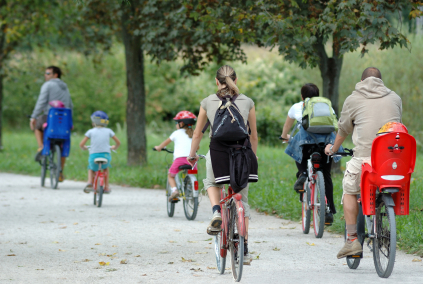
One you start talking about longer distances, bikes lose their appeal big time. But these days (“these days” being about 1940 onwards) there are efficient electric and petrol motors available for $1000-$2000 that attach to a standard pushbike – expect 1-1.5L/100km from a petrol version, and for the electric one perhaps 10-20 cents of electricity per 100km. The latter aren’t so great for long distances but if you’re travelling 10-15km each way they’re superb. The pay-back time for a moped is slower than a bike, but if it allows you to knock out a reasonable number of car miles (say 50+ km per week) it can still pay for itself within a couple of years.
So, mopeds would be a feasible solution for people at the bottom of the pyramid, were it not for the Australian Government doing its best to stand in the way of the adoption of this simple technology – by banning any more than 200 watts of power assistance on bicycles. For reference, 200W is about a twelfth of a hairdryer. May they be cursed for their obstinacy.
Scooters and Motorbikes
Those who want to abide by The Law can go down the path of scooters and motorbikes. Sometimes the fuel economy isn’t all it’s cracked up to be (expect around 3L/100km from a 50cc scooter and 4L/100km from a 250cc motorbike) but at $2000-5000 these are still far more affordable to your average Joe “outer suburbs” Bloggs than a brand spanking new hybrid or turbo-diesel car. However, in a textbook case of flatlining supply against surging demand, the South Australian Government has responded to rising demand for motorbike licences by simply raising the price to some $500 – thereby pricing out the people who need it the most. Fortunately 50cc scooters only require a car licence.
Between car-pooling, bikes, mopeds, scooters and motorbikes, we all have affordable ways to dramatically cut our car use without demanding that governments build an electrified railway past every one of our houses. By promoting these alternatives to car use, we may allow something resembling a functional economy and happy society to survive beyond Peak Oil.
You can download the complete "What you can do about it" article by James Ward from the ASPO Australia website.
Contact
- anz at theoildrum dot com
License

This work is licensed under a Creative Commons Attribution-Share Alike 3.0 United States License.
Archives
- November 2010 (2)
- October 2010 (5)
- September 2010 (4)
- August 2010 (8)
- July 2010 (2)
- June 2010 (2)
- May 2010 (6)
- April 2010 (7)
- March 2010 (12)
- February 2010 (11)
- January 2010 (7)
- December 2009 (10)
- November 2009 (6)
- October 2009 (7)
- September 2009 (10)
- August 2009 (10)
- July 2009 (3)
- June 2009 (14)
- May 2009 (10)
- April 2009 (15)
- March 2009 (16)
- February 2009 (16)
- January 2009 (15)
- December 2008 (15)
- November 2008 (23)
- October 2008 (25)
- September 2008 (24)
- August 2008 (30)
- July 2008 (44)
- June 2008 (38)
- May 2008 (48)
- April 2008 (43)
- March 2008 (29)
- February 2008 (32)
- January 2008 (30)
- December 2007 (26)
- November 2007 (32)
- October 2007 (11)
Another relevant thing that people can do is lobby politicians for an appropriate policy response. While it is fun to be on discussion forums covering a wide range of views, I would also like to find other people with similar views to my own to coordinate lobbying. The 3 policies I wish to press for are:
For a rationale please see http://docs.google.com/Doc?id=dg7nkx7d_41g5zrpx8k. People who more or less agree are invited to join a discussion at grampsgrumps.blogspot.com, or to e-mail me at rks987@uow.edu.au. Those who wish to disagree will reach a wider audience here than by posting on my blog. I'm already aware that most people currently disagree.
OK so I think your first two are good, but how does nucelar deal with a liquids fules crisis? There is not an "energy crisis" it is a liquid fuels crisis. Any response to that needs to be in the context of climate change.
The current liquid fuels crisis is just a symptom of a larger malaise.There are three overall problems.(1)Excessive population relative to resources.This is global and will eventually be subject to a Malthusian solution.
(2)There is an overall energy crisis as our sources,in the main, are not renewable and are causing (3) Environmental damage which translates into decreasing food production and the real wild card,climate change.
The current boom mentality in the political,business and media mainstream in Australia means that no effective action to address any of the issues is being taken and probably won't be until the situation deteriorates to the point of no return.
There is a lot which can be done.Nuclear power is one of the stop gap solutions although probably not so important in Australia because of our wealth in renewable energy sources.We are exporting large quantities of natural gas which is a good stopgap fuel in the transport sector.
I could go on for pages about the insanity of what we are currently doing.I think that the situation is going to have to get a lot worse before there is any realistic possibility of it getting better,given human nature and the abysmal quality of our leadership.
The first 2 points are good.
The third is unnecessary - nuclear power isn't the long term solution, so we should go straight to clean energy sources and avoid a repeat of the current problem using a different fuel.
231
As soon as the clean energy stuff is up and working we can give up nuclear. Let's not just step off the cliff with hope. So far our clean sources in production have been biofuels (an EROEI and humanitarian disaster), and wind. Denmark is often cited as showing what can be done with wind, but I think they only claim 7.9%, and that's misleading because often it arrives when not needed and they dump it on nearby countries; and they keep coal power up and running to provide fill in power; and they buy electricity from nuclear Sweden and other countries.
We'll need a lot of extra energy when the fossil fuels are gone, just to prevent a huge population crash. Nuclear, using thorium and breeder reactors, is a very long stopgap.
My point is that thorium and breeder reactors are more expensive and less proven than wind and solar (and continue the existing extract and pollute paradigm), so why bother ?
This is about making optimal choices, not "stepping off a cliff with hope".
Anybody that says we should evaluate options based purely on engineering considerations has my complete support. I think a vigorous open expert on-going investigation of the engineering considerations is crucial. My feeling is that we will need a LOT of energy because we are running out of other things as well as fossil fuels, and energy can substitute for many things (e.g. fresh water via desalination). I'm pretty pessimistic: I think we'll be seeing people starving to death live on TV, and the only question is: How many? Stalin said "One death is a tragedy, a million deaths is a statistic". It will be hard to resist that attitude if we don't have enough energy to do anything about it.
Personally I'd like to see us aiming for making energy cheap and abundant - everyone on earth hould be able to have access to as much energy as the average European or Japanese person enjoys today.
I agree desalination is just one more thing we'll be needing copious cheap (and clean) energy for.
As for people starving, it happens today - even with more than enough food and energy to go round.
There is more than one problem to solve here.
Conservation is a good thing, we all agree. But it will not save us from the impending Peak Oil catastrophe. The problem is that as soon as oil production begins to decline (this year or 2 at most), conservation will not cut demand enough to reduce the rate of oil extraction, and depletion scenarios will be much the same. Google or Yahoo search: peak oil impacts, and you will find a fuller explanation. Not too far in the future (10 or 20 years??), oil depletion means that highways and power grids cannot be maintained. When they go out, it's back to the stone age. Read what is at peak oil impacts, and get a grip on what is happening. Then you will see that it's time for planning on what to we do after oil. That is what people should focus on -- what do you do when nothing comes in on the highways -- food, goods, medicine.
"Conservation is a good thing, we all agree. But it will not save us from the impending Peak Oil catastrophe."
It buys us time, saves us money and reduces greenhouse gas emissions.
"The problem is that as soon as oil production begins to decline (this year or 2 at most), conservation will not cut demand enough to reduce the rate of oil extraction, and depletion scenarios will be much the same."
I think you're underestimating just how much we can conserve. Eventually, yes, production declines to below even frugal use. But that would be some decades away, and there are plenty of non fossil fuel using alternatives, as noted in James Ward's article and my own.
"Not too far in the future (10 or 20 years??), oil depletion means that highways and power grids cannot be maintained. When they go out, it's back to the stone age."
You are perhaps unaware that between the Stone Age and our modern age, there were the Bronze Age, Iron Age, Agricultural and Industrial Revolutions. We are certainly dependent on oil, but we need not be. It would be a work of some decades to remove the dependence, and involve much creativity and effort, and definitely lead to a different society and economy, but would be the end of society and economy.
"That is what people should focus on -- what do you do when nothing comes in on the highways -- food, goods, medicine."
You are apparently unaware that in the days before the internal combustion engine, we had not only interstate but international trade. It was trade of considerably lower volume than today, and imported goods cost a lot more, but necessities and luxuries both were brought to and from people across the world.
A sense of urgency is helpful. A sense of DOOOOOOM!! is not.
Unfortunately, we can't control our own behavior to conserve, and we can't get the other 3/4ths of the world to conserve. Thus, depletion will occur at the same rate and not buy much if any time.
We have wasted the easiest resources for farming, mining, and industry. And when there is no transportation (it nearly all runs on oil), we are back in the stone age. Read this: http://www.countercurrents.org/po-norman181006.htm
We don't have any trains that run or coal or wood, and both will be difficult to get without oil. No trucks, no wagons, no chainsaws.
We don't have, nor are we manufacturing anything for a post oil economy. We have few horses and wagons, and it would take decades to get that in place (it is hard to mass produce horses and mules). It is time for peak oil contingency and risk management planning.
Speak for yourself.
We haven't tried.
Unsurprisingly, if you never try to do something, then you won't succeed.
But plenty of trains run on electricity, and you can create that using all sorts of ways that don't require oil.
And you can always produce liquid fuels using coal if you must (although I don't recommend it) - enough to keep the trains running even if the car fleet is forced to become much more efficient or get used less.
Actually we do still have steam trains (saw one pull in to my station the other day). Building new steam powered locomotives is going to be easier and cheaper than trying to electrify distant inter city rail lines, although highly unlikely. I think that CNG running a gas turbines is much more likely for a large train than it is for a car.
Termoil
I not sure where you get this information from.
From an engineering perspective electrified rail has a lot of advantages over steam locomotives or in fact CNG power for this application:
- the technology currently exists
- the efficiency in power generation will be considerably higher for a centralised power station compared to small local power generation.
- electrified rail provides a seamless transition into transport that is fully powered by renewables.
- electrification provides for regenerative braking which is difficult for a stand alone locomotive.
Europe has an entire network of electrified rail. I appreciate the issues associated with population density but it is not unreasonable that in australia we at least have electrification on the main trafic routes between capital cities.
Phoenix,
I was simply pointing out that we do still have older technolgy which is still running today that can run directly on coal and wood. Trains really are one of the most versatile forms of land transport when it comes to diversification of fuel and electricity is proabably the top of the pile. But electrification needs density and regular services to make both the installation and maintenance of it worthwhile.
I have spoken with Tim Fischer about electrification and it just doesn't make sense at the moment until we have a thoroughly thought out integrated rail freight management plan. Tims focus is on achieveing the 15 key hubs that we need in Australia to distribute freight and first get the tracks up to standard.
Just by re-aligning the track betweeen Sydney and Melbourne you can shave a whopping 100Km off the current distance but it will cost an enormous amount of money. Throw electrification on top and you are looking at potentially a multi billion dollar project just for one line that may have at best half a dozen freight trains a day on it.
My point is that there are other options than just large scale expensive projects where the cost/benefit analysis would, I am guessing, be questionable. A gas turbine CNG fueled Hybrid locomotive with a pantograph attached for when it does get into a city would blow the doors of full electrification on a whole range of measures and would be far more doable in your five year timeframe.
cjwirth,
I'm right there with ya, believe me, when it comes to "we're all gonna die!" doomer days, I have had some doozies.
I agree with your sentiment, if handled poorly, PO + climate change could kick our collective asses.
Stop reading the Kunstler and LATOC for a while (they will still be there for you when you get back), read some Heinberg and Archdruid Report instead.
Don't worry about the 3/4 of the people on the planet who are doing the wrong thing, you can't change that. Don't worry about the other 7 Bil and counting, for that matter. Focus on what you can do. I wasted a precious year trying to convince my family that PO was not a whacko consiracy theory, all I did was piss 'em off. It finally occurred to me that the only thing I could do was prepare, on my own, as much as I was able, in the narrow window of time that is still available to me. Buy a couple cases of beans and a couple big bags of rice. I did, it made me feel better. I have about 6 months of food now, all stuff that we eat anyway, and all bought when it was on sale. If you have skills that will be useful post-peak, that's great. If you don't, now is the time to learn. Ditto with whatever you think will be important in terms of preparation.
The people who are close to you will be going through their own personal "oh shit" moments just like we all did. Focus on spending your time now preparing to be there for them when they are in need. You will feel better, I promise.
I find sometimes I need to freak myself out a bit with the doomer perspective on things just as a motivational jolt. But I try not to let it run my life.
We are living at the height of this civilization, judging from the fact that you are posting to this site with your computer and can string together a coherent sentence I am assuming that you are a middle to upper class westerner. In other words, compared to every single one of your ancestors, from cave dwelling days to present you are incredibly, unimaginably, obscenely wealthy. Take advantage of your wealth while you still have it and prepare. I don't mean get into debt (unless you think hyperinflation will magically whisk your bills away, but don't count on it), I mean use your brains to figure out what you think will be important and do it.
So you think the world in a few years' time will be short horses and mules? Take up animal husbandry and you have a safe and secure post-peak job, for example. I won't tell you what to do, you need to figure it out for yourself. But you get my point.
Also, take care not to accelerate the timeline. We are well into the beginning of the plateau now, is there rioting in the streets yet? -OK bad question, there is, but the pain will hit us last and less severely, like economic downturns always do. By all means, plan for the worst case scenario, but judging from the experts' reports, things look more like the midline right now.
Un homme averti en vaut deux.
-Old French folk wisdom
"A forewarned man is worth two."
Hi Mash, Thanks for the comments. I don't read those things, but rather do my own research, and these studies reveal peak oil impacts that are quite dire. We are running out of cheap oil and there are no real alternatives. Google or Yahoo search: peak oil impacts, and you will find my 50 page study. Others comment that it is the best explanation of peak oil impacts. You might try the report on your family, it is hard to deny.
It took 1.5 years to convince my family that Peak Oil is real. The next step is to convince them that they need to prepare, like find a new location, as they will die where they are.
I am not worried, as I moved to a most pleasant and very sustainable area of the world, bought 5 hectares (12 acres) of rich land on a river, am working with the local population so that people here are Peak Oil impact ready. This is working out better than I ever imagined. I inform other people and family members, but don't worry about them.
Anyone want to retire here? Get in touch. clifford dot wirth at yahoo dot com
You did better than me.
Despite the increasing cost of good, despite the fact my step-father has raised his prices twice this year to cope with rising Diesel prices, despite the fact my mother is quitting her job, despite the fact we're in debt for tens of thousands of dollars, despite the fact we have hundreds of thousands of dollars in machinery sitting in the yard going unused, Mum and the SF are going to look at a campervan this weekend...
I barely managed to talk them out of buying one of those freaking houses on wheels (but that may have been fuel cost alone).
"A sense of doom is not".I agree,Kiashu.However,a sense of reality is a hell of a lot more than helpful,it is essential.My sense of reality tells me a lot - in brief -
There is a plethora of actions,either individual or collective,which are effective.
The most effective actions are those which need leadership which is currently lacking.
The current cultural climate is putting very little,if any,pressure on the leadership to actually lead.
At the moment I don't see any way out of this dilemma.That doesn't make me a doomer,just a realist.
cj,
We're only talking about a steady decline in liquid fuels. Not (in the short term) natural gas or uranium, not coal, and in perpetuity not the sun, not the wind, not the waves and tide, not hot rocks.
Cheer up that doomy face! ;-) A lot of the electricity grid will still be there for a while, anyway. (And where electricity is oil-fired, presumably it will get priority allocation until it can be switched over to some alternative.) And why will you need highways? The Hummers will all have been refashioned into rather attractive bike trailers by then. (Railways are vastly more efficient for hauling freight.)
Conservation and efficiency buy us time. The truth is there's enormous waste that can be rolled back. Unfortunately price rises seem to be necessary to drive efficiency gains, because humans are not smarter than yeast when resources are free.
Avoiding Olduvai is possible, if difficult. http://europe.theoildrum.com/node/3565
Coal has peaked in the U.S., and not far off for the globe. Natural gas is peaking for North America, and 2025 for the globe. As the price of oil goes up, the price of all energies go up, as they depend on oil for extraction and transport.
Conservation and efficiency do not buy us time (see my comments above).
I have relocated recently to the most sustainable place I could find (this is my profession now), with the most stable political and social situation imaginable. I am working with local community leaders to prepare for Peak Oil impacts. Before coming here, I had a gloomy face :( but now I have a very smiley face :). Hey, want to retire to a nice sustainable place? clifford dot wirth at yahoo dot com.
Coal is a long way off peaking in Australia, as noted here :
http://www.theoildrum.com/node/3817
Almost anywhere can be made sustainable if sufficient focus is brought to bear on building out renewables (solar, wind, ocean, geothermal and biogas) and making urban design, building design and transport options as energy efficient (and electricity based) as possible.
Hi Gav, Very few places in the world are sustainable without: transportation that brings in food from the outside, diesel for tractors and combines, fertilizer (from natural gas), and power for irrigation. There is no plan of how electric power is going to address these problems. Given that Peak Oil is here now, these solar and wind options appear very challenging, to say the least. Coal liquifaction is real, but the quantify that can be produced is minimal without enormous capital input and CO2 output: http://news.yahoo.com/s/ap/20080623/ap_on_sc/sci_warming_scientist
While I agree with cycling and I did it for many years (Barton-outer Belconnen ACT) the fact is many people simply cannot manage it. The reasons may be hills, distance, unavoidable mixing with car traffic or being obliged to work at inopportune hours. I recall that it was chic to call in at the mini-mart and get a few small items. Like 'check my new lycra duds'. The big haul of groceries was left for a car trip.
I'd guess few Australian cities have hidden pockets combining affordable housing, budget shopping and cycle commuting to work. If so I bet they are like Adelaide with exorbitant water costs that prevent serious backyard gardening. If so cycling can only go so far towards the greening up process. Therefore I think everyone who can cycle should do so but the cities will have to be seriously reconfigured before car dependence is minimal.
Robert I agree that nuclear power must be part of the energy mix for Australia. For starters replacement of half or more of the coal fired baseload. It's bizarre that our Federal energy minister is in the Middle East grovelling for oil when the rest of the world will be asking for Australian uranium.
It's true that not everyone can cycle, but as I noted (or see here if you'd rather read at TOD than a blog, and not be able to comment) in response to that daft hypermiling article, almost everyone can reduce their driving a bit, at least.
As noted by [1Mb pdf] the World Health Organisation,
"More than 30% of trips made in cars in Europe cover distances of less than 3 km and 50% less than 5 km. These distances can be covered within 15–20 minutes by bicycle or within 30–50 minutes by brisk walking."
See my article for details, but only about a third of trips taken by car (work, child care, and possibly education) are non-discretionary and more or less unavoidable, assuming zero public transport and not able to bike, walk, etc. The rest can be set aside ("passive leisure", driving just for fun) or rearranged for efficiency - shopping from distant shops can be done weekly all in one go, etc.
So I think it quite plausible that Aussies could halve their car use. And I'm sure that similar efficiencies can be found in other areas of the economy.
I am 100% on the efficiency band wagon when it comes to car use and other draws on energy when it comes to my personal life, but the problem that keeps popping into my head is the business side of things.
If all Australians were to cut their car use by half does that mean that all business associated with that car use is also cut by half? Think about all the petrol stations, mechanics, panel beaters, auto parts stores, drive thru fast food outlets, distant factory outlets, outlying tourist destinations only servicable by car, trips to the local pub, tyre manufacturers, car washes, journeys to the semi-local Westfield, I could keep going on and on obviously.
All those dollars would now not be spent and half the jobs associated with those industries would have to go, that's a lot of damn jobs. Then all those people would lose their purchacing power further exaserbating the situation. The snow balling effects would be enormous. I doubt there's enough jobs in mining or the consruction of windmills to ever soak up the large numbers of people who will be out of a job after the decline of our discretionary spending economy which is highly dependant on high levels of car use.
Most of the people who work in retail are in effect unskilled workers, I have been in retail my whole working life. Although there are many skills that can be transferred to other service industries your average shop assistant can really only do shop assisting.
Also it's not just the people directly employed by discretionary industries, it's all the people who work in the jobs servicing those industries. Think about the delivery drivers, drinking straw manufacturers, salad packaging companies, cleaning staff, sign writers, trolley collectors. Again I could continue but I'm sure you get the picture.
I know I may be sounding a bit Kunstlerish with this kind of talk but it something that gravely concerns me. Believe me I have seen many stores I have worked at close because of there simply not being enough traffic through the door. With decreasing car use comes by default less traffic.
Help me out TODers, tell me my concerns just ain't so.
Oh no! What about the economy, what will happen to it if we're less wasteful?!
I answer this in But what about the economy?
I'm sorry Kiashu you haven't convinced me. I can't believe there is a job for every single shop assistant from every single store in Australia just floating out there ready to be filled when TSHTF. 'Tough' is just too nasty in my eyes.
If TSHTF, then we're not talking about a new kind of economy, we're talking about widespread collapse. Widespread collapse will not be less painful because we've spent all our money on buying cheap disposable junk first.
Absent sudden global collapse, which is not likely, we're looking at world economies changing. The shit does not hit the fan, we just have some hard times and a change. And that happens anyway, whether we work towards them changing or not.
When machines replaced workers, the Luddites marched, and the world said, "tough, just adjust". So when fossil fuels are no longer cheap, and when we stop buying disposable junk at a huge rate, and the shop assistants march and demand we buy more plastic wishbones, then I will say "tough, just adjust".
If we begin living as though we were in a resource-constrained world already, then when the world actually is resource-constrained, it won't be so painful. By saying "reduce, reuse, recycle" and "don't drive" I am offering a plan of preparation for and mitigation of hard times. The only other plans on offer are "ignore the problem and maybe it'll go away" or "despair! doooooom is near!"
Between the horns of the dilemma of blind hope and paralytic despair I choose a third way: reduce, reuse, recycle, and thus prepare and mitigate.
By all means, continue being wasteful, and be blindly hopeful or paralysed with despair. I do not consider it the duty of a citizen to support every business, however pointless or wasteful, in their country. Buy plastic wishbones - it's for the good of the economy! No, I do not have a duty to spend.
Part of my getting ready for PO is deciding how I'll be spending my (considerably less, I suspect) free time in the future. To that end, I'm spending a small portion of my income on, of all things, model trains. These things will last 10, 15, 20 years if properly cared for, so it's a relativly small investment for a long period of enjoyment.
If only more people thought about the amount of time they'd use their purchases for.
Books are another thing. You can build a significant library of books for a pretty small financial outlay. They'll keep you occupied and (hopefully) entertained when you're resting after a hard days work.
I am not or have no intention of being wasteful! Don't get me wrong I agree with you about reduce, reuse, recycle. Wastefullness is what has gotten us into this situation in the first place. Unfortunately the horse has bolted. We are in the situation where the very fabric of our society relies on wastefullness and our population is much larger due to our ability to be wasteful.
My personal life is in the process of trying to adjust to our resource constrained future but I am not talking about me personally in this discussion. I am expressing concern for the 98% of the population who have no clue or do not give a crap about what we are facing, our recision makers included. It's not about being a doomer, I'm trying to understand how we can accomodate millions of people worldwide when their jobs become redundant through lack of demand.
It is very easy for us in the comfy confines of easy Australia to talk like this, we have lived in fantasy land our entire lives. As a man in his early thirties I have never even seen anything close to suffering in my life. I was at a shopping mall the other day and there were literally thousands of people there and that was only a mid sized local centre. I can only imagine the millions of people worldwide who were doing exactly the same thing at the same time. When all the people servicing those shoppers lose their jobs, I'd like to know, What the hell are they going to do? You can say 'adjust' but into doing what exactly?
Saying 'Tough, just adjust' is using the same reasoning Jehovahs Witnesses use to justify the suffering of the human race through God inflicted disease, starvation and suffering. It's ok because all will be rectified one day.
During transition stages of our history millions of people have suffered. People died of starvation and resource conflicts have directly and indirectly killed many. Having a population hovering around 7 billion just adds fuel to the fire. Would you say to a person in Zimbabwe today when his hands are getting chopped off for casting the wrong vote that 'Oh well, Mugabe is in power, that's the reality, "tough, just adjust"'.
Please do not dismiss my concerns over this issue and offer fringe solutions. I look at the world around me and see very little being done. I am way ahead of the bandwagon on these issues and have a good understanding of our resources situation and I am still confused about many things, imagine what the average punter will go through in the coming years.
To offer a line from the movie Men in Black in closing.
'A person is smart! People are dumb panicky creatures and you know it!'
What are we doing to help the dumb panicky human race?
It's merely our custom to be wasteful. Herodotus called custom "the strongest of laws", but laws change. As Rebecca Solnit has noted,
"Sex before marriage. Bob and his boyfriend. Madame Speaker. Do those words make your hair stand on end or your eyes widen? Their flatness is the register of successful revolution. Many of the changes are so incremental that you adjust without realizing something has changed until suddenly one day you realize everything is different."
Customs change.
You have it backwards. Our wastefulness limits the number of people we can support. For example, we throw away about a quarter of our food; thus, we could feed one-third more people on the same amount of food as we now consume. Same goes for every other resource we use.
Your experience is not unique, however it is not universal. The suffering I've seen has convinced me that we can lose a lot of waste and change a lot without significant suffering or discomfort. Other people have gone through worse and come out alright. Undoubtedly the middle class will wail in horror, but they whinge no matter what so who cares.
It's not Christianity, it's the free market. Life changes. You adjust. Consider the changes a person has in their life from a very ordinary thing: having children. Just hold that in your mind. Now compare to that the changes of (say) getting rid of a car and walking, biking and using public transport. It's nothing. Trivial. If you can adjust to having the entire responsibility for another human being's life for about 8 years, and most of the responsibility for it for another 10 or so, you can certainly adjust to looking up train timetables.
The changes asked of us as a society are entirely trivial compared to the changes we bring on ourselves in the ordinary course of our lives - moving to new cities, getting new jobs, marrying, divorcing, having children, losing parents and so on and so forth.
That's why I say, "tough, adjust." Get a sense of proportion.
Naturally not. However, it is not clear that the transition to a less wasteful and more sustainable society necessarily means anyone needs to have their hands cut off. You're exaggerating for effect.
Getting rid of our cars, changing to renewable energy, eating less meat, and having more local production - these need not lead to tyranny and civil conflict.
Men In Black was science fiction comedy.
And it was entirely wrong.
You can say that again.
This I'm not so sure about :-)
I grok ya Turnpike. PO awakened me from my slumber of 35 years, and now I can't help looking at the world around me in complete dumbfounded amazement. I wait at my bus stop and count the cars driving past until I hit one with more than 1 occupant. It's usually around the 90 mark these days, let's see what happens when petrol hits 2 bucks. Then I wonder how many of these people own the cars and how many are making the minimum payments to the bank. And yes, shopping malls are pretty trippy places when you step out of the currently accepted version of society ("fantasy land" as you called it) and really look at the things.
I grew up in a middle-class, mainly white suburb in the US. It never occurred to me until well after I had moved away from my parents' place just how privilged a childhood I had, and how I had taken it thoroughly for granted. Now looking back at my life through the lens of PO awareness, I doubt if even the aristocracy of previous societies enjoyed some of the luxuries that we have come to expect as birthrights.
The people who are alive now and live through the oil shocks will adjust, simply because they will have no other option. Some will prosper, some will not. In a generation or two there will be a new "normal" and people will simply accept it as the way life is. Don't waste your energy stressing about the things you have no control over, put your efforts into the actions that will benefit you, your family and loved ones, and your community.
"May you live in interesting times"
-Traditional Chinese curse
I think you have assessed things fairly accurately.
Learning about peak oil has several phases to it which follow the grief patterns of shock, denial/bargaining, anger/panic, depression and acceptance. Learning of Peak Oil is almost like being told you have cancer. Suddenly everything in your life that you thought was solid and important melts away and you are left psychologically on shifting sands.
You really do need to go through all the phases and get to acceptance as fast as possible so you can then move on to whatever action or new direction your life takes.
Our society is going to have to go through this process as well but it will take a long time and will be a very bumpy ride as so many people will be at different stages and have differnt motivations. I think the most dangerous part is anger/panic and we are now starting to see the very beginings of that with protests around the world at the rising price of fuel.
Sitting here on TOD and trying to guess or justify any one position is actually part of the denial/bargaining phase and is exhibited by many of the technophiles who think that alternatives are going to somehow save us and we can continue business as usual. They may be right about the technology but I think we will have a very different BAU when we transition and that will require an acceptance of the loss of the previous paradigm.
The best advice I can give you is to allow yourself to connect up all the dots that make up yopur lifestyle noW. Read every product lable and think about how that product got inot your hands, how did cheap oil m ake it possible? What would I do if this product became prohibitively expensive or just unavailable? How are all my services delivered to me? How much of a role does oil really play in my life?
When you start to understand the magnitude of how dependent on the stuff we really are, you will get depressed. Don't fight it, but don't kill yourself either. Keep reading, learning and searching and eventually you will come to accept that a life with less oil may actually be better than what you have now. When you get to this point you can then move on with planning the rest of your life with the advantage of better knowledge than most of what the future holds. Good Luck :)
After 4 odd years of studying this topic I completely fail to understand how anyone who looks into it deeply enough can conclude that we will ever suffer long term "energy descent". True doomerism is just a form of escapism, not acceptance of 'reality".
So I agree completely when you say "I think we will have a very different BAU when we transition and that will require an acceptance of the loss of the previous paradigm" - though perhaps we have different paradigms in mind for the post oil period - but again, I agree when you say "eventually you will come to accept that a life with less oil may actually be better than what you have now".
There is more energy out there than we ever need - we just need to choose to harness it. Some places / people/ organisations are already choosing too - other aren't - but there are winners and losers in the world right now and I suspect that will always be the case.
Escape from oil dependence and prospoer, says I...
Hi Gav, You might want to read the Hirsch Peak Oil report, the U.S. General Accountability Office report, the 1977 National Academy of Sciences report, the U.S. Army Corps of Engineers report, and the U.S. Congressional Research Service report. All of these studies find major obstacles in using solar, wind, nuclear, and coal energies. These studies are summarized and linked in my Peak Oil impact study that you can find by Google or Yahoo searching: peak oil impacts.
Cliff - I read the Hirsch report years ago.
There are challenges in swapping over our entire energy infrastructure - very large ones - but the energy is there, we just need to choose to do the conversion. I think Hirsch is way to pessimistic about renewables.
As I noted before, some are choosing to make the switch, some are dithering and some refuse to. They'll have varying degrees of success pursuing these strategies as events unfold.
Hi Gav, You might also read the other reports cited above, including my report, which examines the formidable obstacles with alternatives -- more so than any other report, that is why you can find it by Yahoo or Google searching: peak oil alternatives. One important point is that when oil is scarce enough, the highways and power grid will fail. Without the power grid, the electric economy will fail. My report indicates that that time is not far away.
Gav,
I'm more in the liquid fuels crisis camp rather than homogenising all forms of energy and saying we are on a descent path. Oil as the great enabler has played its part in establishing a high energy use industrial society and its demise will take out some collateral damage.
Fair enough.
I'd like to encourage everyone - here and in the wider world - not to become part of that collateral damage or to accept it as inevitable though.
The people can be saved...their stuff on the other hand might have to go.
As if we needed another reason not to live in Adelaide! :p
You are absolutely right !!!