
 | Can A 'Shadow OPEC' of 'Global Guerrillas' Set Global Oil Prices? | The Oil Drum | House Democrat(s?) Call for Nationalization of US Refineries |  |
| The Bullroarer - Wednesday 18th June 2008 | The Oil Drum: Australia/New Zealand | The Bullroarer - Thursday 19th June 2008 | |
The Future of Air Travel?
Posted by Phil Hart on June 18, 2008 - 3:00pm in The Oil Drum: Australia/New Zealand
This is a guest post by Cameron Leckie, of ASPO Australia.
The organisation that I work for depends upon air travel for the movement of several thousand trainees around the country each year. I have been working on some peak oil risk management/mitigation strategies and the future of air travel is a key requirement that needs to be explored. This is a start on identifying the prospects for air travel in the post peak oil world. Ironically, this essay was planned whilst flying from Brisbane to Melbourne for one of this organisation's courses.
Introduction
Over the last couple of decades, the advent of cheap air travel has provided an unprecedented opportunity for large parts of the population in developed economies to travel. Cheap air travel has allowed both business and leisure travel to become an embedded part of the developed world’s culture, something that is currently taken for granted.
In recent years however, the rapid increase in the rise of oil prices, and in particularly jet fuel prices, has resulted in airlines around the world facing a pinch. At least a dozen airlines globally have filed for bankruptcy in the last six months and US airlines faced a collective first quarter 2008 loss of $11 billion according to the International Air Travel Agency (IATA). Since 2000, QANTAS’ fuel costs have increased from 10% to 24% of operating expenses, overtaking labour as the airlines greatest expense. Virgin Blue is also facing the same pressure, with its fuel costs rising from 15% to 35% of operating costs. As reported in the same article, "No airline business model was built for oil prices to be sustained well above $US100. If it continues we will certainly see airlines continue to fail."
The main stream media continues to portray recent spikes in oil prices as being a temporary problem and externalising the blame on speculation, a falling US dollar, OPEC or oil companies. However the underlying fundamentals of stagnant production, increased demand and falling exports lead to the conclusion that higher oil prices are here to stay and will most likely only increase in the future.
Those aware of peak oil have oft claimed that airlines would be the first victim of peak oil, as stated by the late Dr Samsam Bakhtiari. The peak oil e-mail group Running on Empty Australia (or ROEOZ) almost daily has posts titled ‘airline deathwatch.’ The recent attention paid in the media to higher oil prices and the actions of airlines in raising surcharges and reducing capacity leads to the question of how sustainable is air travel and airlines in a post peak oil future. This will be the first in a series of posts on the future of air travel and will focus on fuel economy.
Fuel Economy
The fuel economy of an aircraft is dependent upon a number of factors. These include the aircrafts aerodynamic efficiency, weight efficiency, the number of passengers carried and the fuel efficiency of the engines. As oil prices have risen, airlines have attempted to increase the fuel economy of their fleets in a number of ways. These include:
- Under fuelling aircraft to reduce the weight carried and hence reduce fuel consumption.
- Charging customers higher rates on baggage to encourage smaller luggage loads.
- Grounding older and less fuel efficient aircraft.
- Reducing route capacity to increase the Revenue Seat Factor (basically a percentage describing how much of the available seat capacity has been used).
Increasing fuel economy will no doubt be an important part of the airlines responses to higher oil prices. The chart included below is an attempt to compare the raw fuel economy of the current fleet of QANTAS Group (including Jetstar and QANTAS Link) and Virgin Blue, against the economy of these aircraft per passenger.
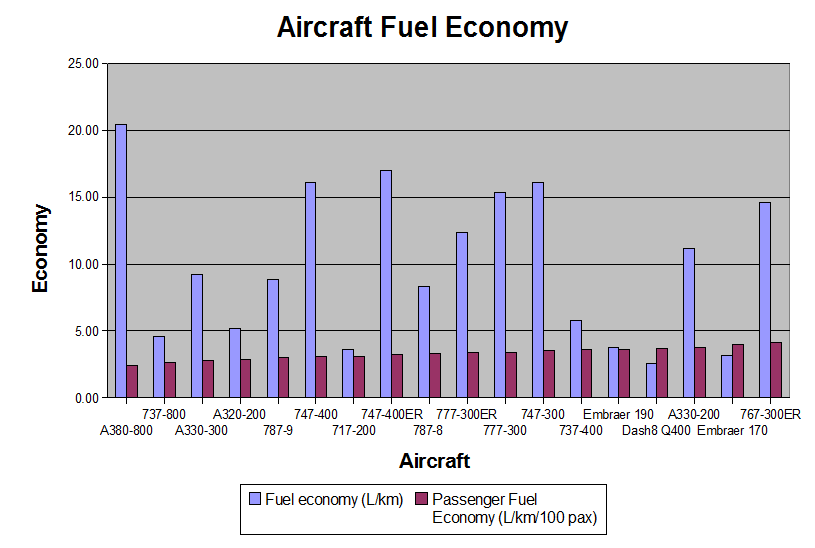
Chart One: Comparison of fuel economy and fuel economy per passenger of the current QANTAS and Virgin Blue aircraft fleets.
The process used to derive this chart used data sourced from Wikipedia and Virgin Blue’s website on each of the aircraft used by QANTAS and Virgin Blue. The fuel economy was calculated by dividing maximum fuel payload by the range of the aircraft to give a fuel economy figure in litres per kilometre. Whilst this may not be a technically accurate measurement of an aircrafts fuel economy, it provides an approximation against which to compare aircraft. As you can see and would expect, the smaller aircraft, such as the Dash 8, Embraer 170 and Boeing 717, use several times less fuel than the larger aircraft, such as the Boeing 747 and Airbus A380 to travel the same distance.
The next step was to calculate the fuel economy per passenger (this figure has been multiplied by 100 passengers to allow the data to be displayed at the same scale) for each of the aircraft. This was calculated by dividing the fuel economy figure by the maximum number of passengers the aircraft can carry. This provides a useful reference point against which to compare the relative efficiency of each aircraft type in moving passengers. What is clear is that the larger aircraft are more economical on a fuel economy per passenger basis than the smaller aircraft. For example the Airbus A380 was 28% more economical on a per passenger basis than the average figure for all of the aircraft sampled. This economy would be even greater on a seat kilometre basis. This is due to the disproportionate quantity of fuel consumed during take off and whilst gaining cruising altitude. Short haul aircraft are exposed to this requirement more regularly than long haul aircraft, thus increasing the fuel consumption of these aircraft. Unfortunately finding useable data on the seat kilometre fuel consumption of the sampled aircraft was difficult.
Comparing the fleet composition of both QANTAS and Virgin Blue, to the fuel economy per passenger of each aircraft type, results in some interesting findings. Whilst exact aircraft number by type for Virgin were unavailable, its Boeing 737-800 aircraft are the second most economical of those examined, whilst the Embraer 190 and 170 aircraft are amongst the least economical on a per passenger basis. QANTAS has both a far larger number of aircraft and a larger number of different aircraft types in service. Of note is that the Dash 8 fleet and Boeing 767 aircraft make up some 67 of QANTAS’ 213 aircraft, or 31%. These aircraft also happen to be amongst the least economical on a fuel consumption per passenger basis.
Fuel economy of aircraft is only one factor that needs to be considered in the context of future air travel. The next factor is the revenue seat factor.
Revenue Seat Factor
In many instances, an aircraft is not loaded to 100% of its passenger capacity. In an era of ever increasing fuel prices, this is not a good thing for airlines. Airlines regularly report their capacity statistics. Both QANTAS and Virgin Blue report on their Revenue Passenger Kilometres (RPK) and Available Seat Kilometres (ASK) which are used to determine their Revenue Seat Factor. The RPK is the number of paying passengers carried multiplied by the number of kilometres flown whilst the ASK is the number of seats available for sale multiplied by the number of kilometres flown. When the RPK is divided by the ASK, the result is the Revenue Seat Factor.
The latest data available from QANTAS and Virgin Blue is from March 2008. The Revenue Seat Factor for March 2008 and the current financial year to date are detailed in Table 1.
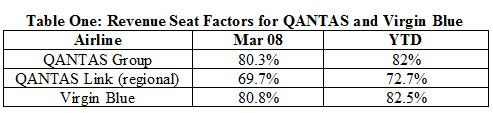
All airlines will obviously try to maximise their Revenue Seat Factor as close as possible to 100%. QANTAS Link, which provides regional air services throughout Australia, has a significantly lower Revenue Seat Factor than the remainder of the QANTAS Group whilst also using aircraft (Dash 8) that are the least economical on a per passenger basis. We can expect to see further capacity reduction as both airlines attempt to increase their Revenue Seat Factor, if oil prices stay high. It is interesting to note that the Revenue Seat Factor for March is less than the year to date figure. There could be a number of reasons for this, such as seasonal variations or the recent rounds of fare increases.

Chart Two: The RPK and ASK for QANTAS Group over the period 1999 – 2007
Chart Two details the ASK and RPK for QANTAS from 1999 -2007. Figures for Virgin Blue were unavailable. As can be seen, the increase in both RPK and ASK has held a close relationship with a slight increase in the Revenue Seat Factor over this time from 73% to 80%. The last data point in this chart was from 30 June 2007 when Singapore Jet fuel was 199c/gal compared to 377c/gal in May 2008. With the recent measures that QANTAS and Virgin Blue have instituted, it will be interesting to see over the coming months whether the Revenue Seat Factor will rise, fall or remain constant.
How this plays out will largely determine the future of these airlines in the post peak oil era. Some indicators could be:
If capacity (ASK) is reduced and the Revenue Seat Factor increases, the airlines maybe OK.
If capacity (ASK) is reduced and the Revenue Seat Factor falls or remains relatively constant, then the airlines are in trouble.
This will be something that I will be watching with some interest over the coming months.
Conclusions
A few key conclusions can be drawn from this analysis. Firstly, the smaller the aircraft, the more economical it is to fly on a fuel economy basis, however the larger (and newer) aircraft are more economical on a per passenger basis.
Secondly, that many of the aircraft in the QANTAS and Virgin Blue fleet are at the lower end of the fuel economy per passenger scale. It is likely that routes using these aircraft would be the first to be reduced, particularly if the Revenue Seat Factor is lower on these routes. No doubt, considerations such as this were key elements in Virgin Blue’s recent decision to cut the Sydney – Proserpine and Melbourne Darwin routes.2
Thirdly, the Revenue Seat Factor is highest in the long distance international travel area and lowest for regional travel. Regional services also have a generally lower fuel economy per passenger than the other services. It can be safely assumed that airlines will do whatever it takes to remain profitable. This implies that those routes that are not as economical to operate on either a fuel economy or capacity basis, will be reduced and if the oil price continues to increase, possibly removed altogether. It is likely that regional Australia, and industries such as tourism that are reliant upon air travel, will be the first to feel the impacts.
Fourthly, as the airlines struggle with the impact of higher fuel prices, we have a couple of indicators, particularly the relationship between Available Seat Kilometres and the Revenue Seat Factor, that will provide some guidance on the future prosperity or otherwise of our airlines.
Admittedly this post has only covered one element of the airlines operating considerations, however it poses an interesting dilemma for the airlines and industries reliant on air travel such as tourism. I would be interested in hearing from airline industry insiders and their comments on this post. One area that I have not explored is the maintenance costs by aircraft type and how this may sway the balance in total operating cost of an aircraft type.
I will follow this post up over the next few weeks with another perspective on the future of air travel. I can be contacted at Cameron.Leckie@aspo-australia.org.au. You can also download this post as a PDF.
Contact
- anz at theoildrum dot com
License

This work is licensed under a Creative Commons Attribution-Share Alike 3.0 United States License.
Archives
- November 2010 (2)
- October 2010 (5)
- September 2010 (4)
- August 2010 (8)
- July 2010 (2)
- June 2010 (2)
- May 2010 (6)
- April 2010 (7)
- March 2010 (12)
- February 2010 (11)
- January 2010 (7)
- December 2009 (10)
- November 2009 (6)
- October 2009 (7)
- September 2009 (10)
- August 2009 (10)
- July 2009 (3)
- June 2009 (14)
- May 2009 (10)
- April 2009 (15)
- March 2009 (16)
- February 2009 (16)
- January 2009 (15)
- December 2008 (15)
- November 2008 (23)
- October 2008 (25)
- September 2008 (24)
- August 2008 (30)
- July 2008 (44)
- June 2008 (38)
- May 2008 (48)
- April 2008 (43)
- March 2008 (29)
- February 2008 (32)
- January 2008 (30)
- December 2007 (26)
- November 2007 (32)
- October 2007 (11)
airlines are dead, as in toastada. no combination of palm oil and fuel efficiency will save them.
Say, what about oil from French fries, and maybe we can capture bovine gases and reduce global warming at the same time? :)
Well done Cameron,
This is a very informative post and the data for the graphics must have taken some effort to assemble. Thanks so much.
Airlines provide a transport service which has several distinguishing features:
- Speed. The time-saving for lengthy journeys is considerable compared to all other alternatives.
- Range. Having out-competed long-distance passenger shipping, air travel now moves the vast bulk of long-distance passengers.
- Flexibliity. Airliners can fly wherever there is demand. They can establish new routes and capacity very quickly compared to road/rail. They can hop over unpleasant or dangerous regions altogether. Airliners can still make money on "thin" routes - one plane a week, carrying a few dozen passengers, etc. Services can also be reduced rapidly and the airliners moved elsewhere without tears, compared to say rail.
So for these reasons there'll always be *some* demand for airlines - unless society collapes completely. (Back in the 1930s the cost of a flight from Australia to Britain was the equivalent of around 10 times the 2008 Economy Class fare, but government mandarins, business leaders and the rich valued their time enough to make it worthwhile.)
Up until now, cheap jet fuel has allowed an exponential expansion in mass tourism and has also enabled easy business travel/commuting, family visitation, overseas education and migration, etc. While there appears to be no future for a large proportion of this demand once fuel costs increase sufficiently (and telecommuting, SKYPE etc. are waiting in the wings as serious competitors), remember that airlines can respond to this demand reduction by quickly reducing their capacity. (Sacking workers, scrapping planes; it's harsh but effective.)
So airlines as an industry will survive unless they take their eye off their revenues and costs. They'll be leaner, probably with more emphasis on efficiency, less choice of schedules and a lot of company mergers, but while liquid fuels are still being produced, there'll still be at least some air transport.
On the other hand, the latest Super-jumbo aircraft such as the Airbus A380 may ironically become extinct despite their low fuel consumption per passenger. They may prove too big for the thinning demand for air travel as fuel prices increase.
You're the first comment to mention videoconferencing. I know with humans being a social animal, nothing will ever replace a personal visit, but videoconferencing and distance learning will have to pick up the slack as air travel becomes less and less affordable.
Irony : my company (a big European IT service company) just won a contract to manage videoconferencing for ... Air France!
Shhh! Don't tell the clients. Might give them ideas.
I really don't understand your reasoning here. On the intercontinental hub routes (e.g. London<>Bangkok) the A380 will rule. OK, the seat price may have to rise to all-business class fare levels and above and they will be packed in like sardines and only fly once a month but the very efficiency of the beast will ensure it is the cheapest option for these routes...
Nick.
I'm not a finance person, but given the huge capital costs of that beast, who could afford to fly it once a week? Just imagine the interest payments on a $330M plane. Maybe if it were sold at a steep discount in a bankruptcy auction.
I predict a total collapse of domestic flights on all continents, since these could be replaced by high speed electric rail - journeys would take longer, but should cost considerably less (why is Amtrak the international exception), also trains should be much more comfortable than cramped airline seats.
With regard to inter-continental flights; the number of carriers is likely to fall to just one per nation, with some countries not bothering if a boat to the nearest continent is practicable.
I agree that a jet like the A380 needs to spend 99% of its time in the air, and that, for example, one flight a month between London and New York is not going to be sustainable. However, one flight a month (or week, or whatever interval) for the route does not also mean only one flight a month for the jet.
I am much more interested in the relationship between the price of oil and the level of personal disposable income. As the price of oil rises, one would expect a fall in the number of passengers able/willing to buy tickets.
Also, what is the split between ticket revenue that is business and non-business. Is it reasonable to assume that businesses will be tightening their belts just as much as individuals?
At what price point do people start, en masse, to abandon SUV's and privately owned light aircraft. I read yesterday that some SUV's have depreciated more than 25% in the first quarter of this year, and in some cases the depreciation has been more than is expected in an entire year. Is the same true of light aircraft and small speedboats?
There is a dividing point between the truly wealthy and the rest of us. My guess is that the majority of people that can afford a light aircraft or luxury boat, are not that worried about the price of gas, and will only vacation 4 times a year instead of 6. Unless there is a real depression and their source of revenue bites the dust.
This is a time-honored way of taking debt off the books. The companies that put the satellites for satellite phones up went bankrupt; the companies that took over were relieved of the debt and thus had a lower cost structure. I haven't checked on this story in a while but the replacement companies were better set up to make a profitable business of it than the original company.
Giddaye Nick,
Surely (and I keep going back to this) the people that begged, borrowed and stole to get these things into production are not idiots. Surely someone along the line must have placed PO (or at the very least made some effort to estimate fuel prices in 20008 and beyond) in the "against" box.
It's so difficult for someone like myself to believe that the investors loaning out the trillions are that naive.
Regards, Matt B
Oh, believe it, Joe Average. Perhaps not so much naive as incredulous that oil could ever get really scarce. You don't believe they could be ignorant and they don't believe that no-one will fix this.
I don't think many businesses plan for contraction; most look for ways to grow. maybe an A380 represents a way to get costs down, if they can fill them. Now they have to figure out how to fill them. Frequently.
Just heard the President's comment to urgently grab two and a half years crude supply (for the US) in sensitive coastal areas - if ten years to actually get it out can be called "urgent". Two and half years worth... Then what?
Here's an everyday question for Todsters that sums up my predicament as a fence-sitter; just a Yes/No answer will suffice... My 13yo daughter needs braces, cost (AU)$3000 out-of-pocket - checked around, compares to other quotes. Though any problem is barely noticeable, Doc says it will be "better in the long run" (of course, the "Long Run" is why I visit here!). So, go ahead with the non-critical op or risk the wife divorcing me? (Kidding, but there'd be friction!)
Thanks in advance, Matt B
I wore braces; lots of stigma associated with 'em. Didn't have much choice either. Did what I could to get 'em off as fast as I could--2 years+2 years retainer. Created later enamel and cavity trouble costing more than braces. My advice is to leave the choice to your daughter, provided the money's not an issue.
What other things might she need with the $3000 given the economy we're heading into? On the other hand, we're vain creatures and I'm glad my parents got me braces way back when.
It depends on how bad her teeth are, braces might not be "just vanity" but a medical necessity. She shouldn't have (for example) physical discomfort while eating, or be unable to clean her teeth properly so she loses them to gum disease, etc.
I'd go ahead and do it. The only reason not to is that you think the caca will hit the fan sometime soon. But if the caca hits the fan then we'd have hyperinflation and bank failures and you wouldn't have the three grand spare anyway! Use it or lose it :)
Thanks, not that I had any say to start with (never ask sisters, sister-in-laws, school mums - in fact any woman! - for their opinion on such matters). Guess we'll just have to be another three grand behind the eight ball if current trends continue.
Further, never ever seek a second opinion and let your wife find out about it!!!
Ahh, to be out of debt...
Regards, Matt B
Still crossing fingers and toes, coz there's two other kids with teeth in this family.
Actually it only says the existing model is dead. Change the model (say cost plus basis) and some form of charter airline is still possible. As the low cost airlines have shown, different models ARE possible - its just a question of who jumps when.
I saw we make the move back to zepplins!!
I think you meant "say" not "saw".
Zepplins can't stage a comeback. The problem is the gas used to fill them. Helium is very expensive and helium is a by-product of natural gas production. We're facing "peak helium" sooner or later. Here's a list of lighter-than-air gases which could be used to fill airships - you'll see that they are all either toxic, flammable, or rare.
Hydrogen (H2)
Helium (He)
Methane (CH4)
Ammonia (NH3)
Hydrogen fluoride (HF)
Neon (Ne)
Acetylene (C2H2)
Hydrogen cyanide (HCN)
Diborane (B2H6)
Ethylene (C2H4)
Carbon monoxide (CO)
Nitrogen (N2)
The cheap option for overland travel will become the train; and the cheap option for over-sea travel will be by ship again. Apparently you can run ships on wind power ;-)
The last I heard kerosene was flammable too, and toxic.
Some of the alleged 'show-stoppers' that are suggested against virtually everything beggar belief.
In addition I believe that nitrogen is neither toxic, flammable nor rare.
Helium shortage may not be much of a show stopper, but airships have some other problems which are hard to tackle. Two of the worst disasters with airships, the USS Shenandoah crash and the USS Akron crash, involved helium filled airships.
Airships are much less capable of dealing with difficult weather such as thunderstorms than aircraft. They can hardly fly 'above the weather' like jet airplanes can and controlling them near the ground in any wind conditions over 5 beaufort is very difficult. So they have to operate in conditions that minimize the chance of this happening. Airships may be able to replace cruise ships, especially now that weather forecasting is much better than in the 1920's and '30's, but their potential in long distance point-to point travel like on the North Atlantic is somewhat limited.
There are a lot of things against air ships, as you say.
Lack of buoyancy agents would not be the biggie though.
no they aren't. people will always fly. the companies may not look like they do today, but we'll always fly.
People WILL always fly but they won't be the same people that are flying today...
At the current rate it's more likely 'the masses' will be more concerned with putting food on the table than cheap weekender flights to Vegas.
You have to put air flight into the context of a real squeeze on disposable income. Mass air travel has been the fortuitous confluence of cheap energy (enabling current air business model) driving a massive increase in disposable income (enabling usage of the business model). These trends are now turning.
Nick.
Always? Always?
John, If God had wanted humans to say 'always', she would have made us immortal.
Keep on believing, john15.
There'll always be a John15. Even centuries after he's bored all the other tod-ers to death.
--Ok, I'll waste a little time with a reply. Firstly for there "always" to be air travel there has to be a functioning kerosene-production system (or some John15s-may-fly new alternative discovered). I personally wouldn't bet on that being around in 30 years time.
More fundamentally there has also to be "always" some rich people willing to pay what it takes. But the present glut of rich people is itself a product of ultra-cheap oil and the resulting globalisation of markets etc. In the small local world of the future, xillionaires in MegaMansions are going to find (a) that their pre-existing xillions don't cut any mustard any more, and (b) that opportunities for gaining new xillions do not exist.
So there'll be no demand and also no-one rich enough to indulge in the insane speculative venture of satisfying that non-demand.
It always amazes me how people here can so accurately predict what will happen in 30 years time.
I would be very happy if I knew for certain what would happen in the 3.30 today.
They must have wonderful crystal balls.
An alternative scenario would see nuclear, solar and perhaps geothermal powering society successfully after a difficult transition, and some of that power being used to produce hydrogen to fuel aircraft, so that after a low point in 10-15 years air travel gradually resumes at some level.
Will this happen, or the scenario you present? I don't know - and neither do you.
Dave,
This is spooky. I could have said that.
Though I favor windmills producing ammonia and using some chemically modified version of that to make jetfuel....
Dave, you misrepresent my words there. I made no claim to "accurately predict". I merely said I wouldn't bet on it, in other words I reckon it's well below 50% chance there'll be planes in 30 years time.
As for the notion of there being functioning nuclear power "after a low point", I wouldn't bet on that either. Absent some miraculous turn of events, within a few years the entire human race is going to be struggling merely with the basics of food and shelter, and the prospect of a restart of industrial society is remote. Please take a history lesson from James Watt. Even with his ideas and vision and in an age of abundant fuel, he had a daunting struggle to see his vision actually manufactured because they did not then have the machines to make the machines. This is a most important principle in this field.
Fair enough - I thought you were being more absolute than was the case.
I see civilisation as a one-shot deal though, as high grade resources are too depleted to allow even civilisation at the level of the ancient world or the middle ages, which were dependant on exploiting these resources.
The people who I believe are entirely unrealistic (I am not arguing that you are one of them) are those who think we can get through to some kind of Woodstock society, with organic farming and windmills doing the job at anything like present populations.
If we screw up I would see a population at 4 million or so, call it one in a thousand for convenience, operating at stone age levels - after recovery, that is.
On the upside I find it difficult to see precisely why French or Chinese society should break down, even if breakdown occurs in many other areas.
I don't think it will be quite that bad. We do have a lot of metal that has already been refined, and charcoal will work perfectly fine for running basic forges. On the other hand, I'm not sure we could build back up from there. It may be impossible for us to get specialty materials like platinum to build more advanced devices.
Anything remotely like a large die off would lead to endemic warfare.
The resources like wood for charcoal would be pretty thoroughly trashed.
Rust would have won the race with mined metals before anyone was in a condition to utilise them.
On the topic of both warfare and jet fuel, the US Air Force is preparing for Coal-to-Liquids...
http://www.redorbit.com/news/business/1308384/air_force_eyes_coaltoliqui...
Took the words right out of my mouth Cretaceous.
The uber-rich and the military will be flying for quite a while still.
The rest of us... better take that European trip before the commercial airlines go belly-up.
Mash
--------
Father, Farmer, Doomer, Engineer, Drummer
I'd agree that people on this thread are underestimating how much people will pay to fly, especially across oceans. I think they'll be flying long after they give up driving or buy electric cars.
When I looked at the charts above my first thought was that the A380 will be a very successful plane!
People may fly for a while, but it probably won't be via airlines. The defining feature of a "line" be it airline or tramline or shipline is scheduled service. I suspect that businesses will turn to charter flying over airlines in the not too distant future. Charters fly out of smaller, closer airports, use smaller, cheaper, more fuel efficient planes, and leave on the customer's schedule. As airlines become less and less convenient, charter convenience will improve by comparison. Many larger companies already own their own private jets; these aren't generally used to send the office staff to training seminars, but they will be. There are "fractional ownership" companies that allow companies to share private jets so you don't have to pay full price for something you only use 20 times a year. Charter companies are the next step down but they will be convenient and cost-effective longer than the airlines.
--
JimFive
Has nobody consider the possibility that cruiseliners may take the place of airlines at least for vacations?
For example: a cruiseliner could get from New York City Harbor down to Miami in at most a couple days.
The fuel savings per passenger should be significant compared to flying all of them down.
Also: cruiselines could probably be made nuclear much more safely than airplanes.
An offsetting factor in regional travel is the lower absolute cost. A week long interstate holiday is less strain on the already vulnerable household budget than a month overseas. B&B operators give anecdotal evidence pointing to this. I also think people may not want to leave their work place for too long in case the boss decides they can be dispensed with.
So it may be that long distance travel has lower prices per km but reduced demand. Short distance travel has higher unit prices but more stable demand.
Rigamortis and ossification will set in for the airlines soon. Some weaker routes are being cut, some small airports have closed, and schedules have been reduced. Tourism to Mexico is down. My next trip to Spain is probably my last...$$$$$. Next is automobile travel. As soon as oil production begins to decline, about now, the price of oil will skyrocket. Without planes and cars, buses and trains will be swamped and reservations will be a "challenge." When the music stops where you are is where you will stay. Then, not too far down the road the highways will collapse (bridges out and no snow plowing) and the power grid will fail for the final time -- "the final blackout." That's it. Anyone want to live in a nice sustainable area of the world? clifford dot wirth at yahoo dot com or USA telly (603) 668-4207.
We will have the railroads. Coal to synfuel is not going to go away, either. Moving potassium and phosphate and food and coal is always going to happen. You may hitch a ride on a horse drawn wagon to get there, but you will have a train going down those tracks.
I just had a wild idea. All those lovely strong fuselages made of aluminum could be fitted on railroad flatcars as passenger rail cars. This whacko idea would only work for the smaller narrower jets naturally.
The only sane thing for the airlines to do at the moment (in Australia) is to form a consortium together with (say) Macquarie Bank and build out maglev train infrastructure across all the major routes. Then the airlines compete by running their train carriages on the shared maglev infrastructure.
This will be ruinously expensive of course (just Adelaide - Melbourne - Canberra - Sydney - Brisbane would be upwards of $100 billion) and I think I calculated only just has a positive return on investment if the interest rate drops to about 3-4%.
But it's not as if they have any alternative -- if you're in the long-distance passenger transport business, you won't be able to maintain a business using jet-fuel based vehicles for long.
The problem for Qantas is that it only can think about itslef as an airline rather than as a long distance passenger transport operator. At leaset Virgin understand that it's about making money and are not afraid to set up a new division which could canabilise another. Our rail tracks here in Oz though need some serious upgrade before you'll see the flying kangaroo on a train. Not sure that we will ever see Maglev but even if we could get a train going at 200km/h could seriously challenge some air routes. You could do Melbourne to Sydney in say six hours which isn't that bad on a train, especailly if you could have all the snazzy gadgets and mobile phone access all the way. 300Km/h and you would nearly be at par with air travel timewise CBD to CBD.
It doesn't even have to be 200kph. Overnight trains used to be quite popular between Melbourne and Sydney and so on.
If you could - say - take a train at 7pm, put your bags in your little cabin, go to a dining car and order from a brief but decent menu, enjoy the dinner with a wine while looking at the landscape passing by, have a bed to yourself and a good sleep, awake and have a nice breakfast and arrive at 7:30am or so at your destination, all for a day or two's wages - wouldn't you do it?
Many used to. Then along came economic rationalism, and they got rid of the sleepers and put everyone in seats so they could get a sore back, poor sleep and smell everyone else farting, the dining car was replaced by a pie warmer, the journey became rougher as the tracks weren't maintained, the price went up, you'd arrive at 4:30am bleary-eyed and exhausted with nothing open and nowhere to go, and... what a surprise, people stopped using the interstate trains.
Speed helps, but isn't the most important part - which is a reliable, frequent and pleasant service.
I've taken the current sleeper service between Melbourne and Sydney a few times.. the biggest problem is that it's bloody expensive (I've been able to do it with work a couple of times though).
Supporting trains is good, which is why I did it, but the reality is once you get down to the low density of passengers in a sleeper rail car, your emissions are starting to look pretty high again. since same the train and all the carriages are travelling the journey anyway, one additional sleeper passenger is almost no extra emissions, but if everybody started doing it..
~200km/h and the trip could be done in 5-6 hours - that would definitely work for me. the current trains can probably just about travel that fast, they just need better track (!). as it is now i just try really hard to avoid big trips completely (with moderate success).
I'm not so sure the emissions would be bad. The PTUA did another GHG rundown again, and came up with,
Of the public transport, they say, "this is based on operating energy figures per mode, government figures on emissions from power generation, and typical peak-hour passenger loads."
Note that the diesel V/Line trains are the least emitting already, at 8g CO2e per passenger-kilometre. I've taken them a few times, peak loads on them aren't like peak loads on the metropolitan train. There are less seats and nobody's standing; compared to packing everyone in standing on the met ones. The PTUA's being a big cagey and not telling us what those numbers are, though, so for all I know they're assuming 2,000 people per V/Line train.
Still, taking it at face value, you can get 2 people per cabin where without sleepers you'd get 8. I've not delved into their calculations to see how much is manufacture of the train and how much fuel, but we can say that the sleeper trains are still better than any private car.
I'm not claiming that's definitive, but at a casual glance the sleepers look good. And certainly better than any aircraft - 200+g CO2e per passenger-kilometre...
Of course if the trains are electrified and powered by renewable energy things look heaps better. Diesel trains are only less emitting than electric because we get our electricity from coal...
I'm not sure where you got 8g per passenger - km. The V/Line website shows 0.122 kg per passenger - km = 122g CO2 per passenger-km for the diesel train.
Kiashu's figure is for peak hour only. Maybe the figure you quote is an overall figure and, thus, more realistic.
If the figures for other transport is peak hour only, they may go down for off-peak driving.The chart could look very different when overall figures are used.
Peak load only? That the most creative distortion I've seen in a while. Global warming is the sum total of all emission. This is a candidate for Colbert. Perhaps they should only run the V/Line during peak hour, then it would be a fair comparison.
Guys, this topic of emissions from public transport is a really tricky one. It appears to me that the PTUA is adopting an understandable but questionable extreme position. They base their emissions comparison on the very high peak-hour passenger loads handled by suburban trains, trams and buses, but without pointing out clearly that such numbers are really the marginal emissions for someone changing their daily commute from car to public transport.
The extreme opposite position is taken by our public administrators whose reports such as http://www.climatechange.gov.au/inventory/2005/pubs/trends2005.pdf page 34 Fig 23 show emissions per passenger-km from urban light rail (ie Melbourne trams) to be higher than car emissions, and urban heavy rail (Connex, CityRail) only slightly lower than cars, with buses somewhat lower again. This position is based on thorough analysis of Australia's emissions sources and extensive data provided by Apelbaum Consulting Group's costly report "Australian Transport Facts 2006" which details all the passenger counts and travel distance assumptions by mode, state and urban/non-urban. (http://www.apelbaumconsulting.com.au/publi.html)
Essentially the government emissions numbers for public transport are much higher than PTUA's because they use average passenger-km over all the times of day that trains, trams and buses run, mostly empty, and they account for the high emissions from Australia's dirty coal-fired power generators. If our trains and trams switched to Greenpower tomorrow they would suddenly look fantastically low-emission, so one positive action we can all take is to pressure our politicians to commit to powering public transport from renewable electricity sources.
Think about it this way - trains are heavy and all that metal has to be accelerated and decelerated at every station. Furthermore the AC-to-DC conversion and transmission losses are significant, especially since much of the equipment is 50 or more years old (except in Perth). So it is not surprising that buses can turn in some pretty good numbers compared with rail vehicles, unless the electricity for trams and trains is from renewable sources. Extend the thinking - a battery electric car (Mitsubishi i Miev or similar) charged from solar PV or Greenpower would likely beat any other transport option on the PTUA emissions chart (and still clog up the roads like any other car).
If you are a cynic you might say that the official government emissions assessment supports the car lobby at the expense of public transport because it makes public transport look like it offers little or no emissions benefit over cars. I would argue that a more realistic and defensible position is somewhere between the government and the PTUA. This is because public transport provides high passenger movement density unmatchable by cars (the one bus lane on Sydney Harbour Bridge moves more people daily than all 8 car lanes) so the real comparison between trains, buses and cars has to recognise that they are not substitutable. First you must consider the utility being provided and then assess the emissions impact.
I would argue that passenger-km is too dumb a measure because it fails to account for the value of public transport in making possible bulk people movement at peak times. So I agree with the intent of what the PTUA is saying. But I am horrified by the heavy energy use and consequently high emissions per passenger of near-empty off-peak trains, trams and buses. There must be better ways to match capacity with demand. I believe that the South American BRT models show more balanced passenger use at off-peak times and therefore better overall emissions per passenger-km. Does anyone have such data?
Cheers, Mark
Well, also I think it's fair to talk about "peak hour loads" - not "crush" loads, but "peak hour" - because obviously public transport is a waste of emissions if nobody's using it, and obviously it's only worthwhile if lots of people are using it.
Talking about the emissions of public transport as things are now is like talking about the emissions of a car in the city which spends most of its time in traffic jams and waiting for lights to change. You're looking at the worst-case scenario. You have to compare like with like, such as comparing a car doing a mixture of city and highway driving with a public transport people are using all day.
Kiashu and Anawhata both have the right idea. Trains use a hell of a lot of energy, so the imperative is to run them at high occupancy. Running empty trains around is a waste and places an obligation on the managers of the system to boost patronage.
But if you've been following the progress of the somewhat misnamed 'Regional Fast Rail' initiatives in Victoria, you'll know that trains between Melbourne and cities like Geelong and Ballarat have seen huge growth in patronage since they started running more frequently, so that in peak hour they are regularly fully loaded.
For V/Line trains, fully loaded means all seats occupied, as distinct from metro trains which are fully loaded when there are as many people seated as standing. So the load standard for metro trains is 800 passengers per train, while regional trains may be fully loaded at 200 passengers. (Metro trains, of course, are more than fully loaded at the moment.)
The PTUA figures (which I prepared) are for emissions, not energy use, so V/Line's diesel trains benefit hugely from not running on coal-fired electricity like the metro trains do. That's the main reason they come out ahead of metro trains on emissions; in energy terms they're actually quite a bit behind as a consequence of carrying fewer passengers.
This page from our website has lots more details on comparative energy use:
http://www.ptua.org.au/myths/energy.shtml
That chart of comparative emissions was the simplified version for the media, and does relate specifically to peak hour conditions, which in the view of some is cheating. But the thrust of all our campaign work at the PTUA for decades has been policy change to make public transport compete properly with car and air travel, the way it does in most of Europe and even in parts of North America, so that trains, trams and buses are more fully occupied all the time. I wouldn't want to prolong this thread indefinitely on this topic, so I'll just note that there's heaps of detail on this on our website, www.ptua.org.au.
@Anawhata: no consultant is infallible, even a well-regarded one. The only really reliable figures for passenger-km and energy use on trains and trams are the ones provided by the operators themselves, and they are now a closely guarded secret thanks to privatisation. No consultant's analysis can substitute for that, even if we are forced to rely on such analysis in lieu of proper information. The last time it was possible to get enough information in the public domain to produce accurate energy intensity figures was in the early 1990s, and our own energy use figures have been checked against estimates that researcher Patrick Moriarty obtained and published at that time. I have seen more recent figures from consultants that defy reality, for example by implying a catastrophic decline in tram patronage in the 1990s when operator figures show it to be rising. Our own assumptions are documented on our website and we believe should stand up to tighter scrutiny.
Don't ask me, ask the PTUA. I give you references for a reason.
Lot of interesting discussion here. Since you mention the issue of the energy cost of manufacturing trains, I suppose this is the best point to pose an idea I floated once before. Considering that any large-scale reinvigoration of rail transport will, under the circumstances, require most extraordinary measures, and considering the energy costs of disassembling aircraft, melting down their aluminum and then reprocessing it so that it can be used to build trains (or whatever) from scratch - wouldn't it obviously save a bundle of energy to simply slice the wings off aircraft, and mount the fuselages on chassis designed for rail use, with different size fuselages used for different gauge tracks (according to different route requirements). Certain additional modifications could be contemplated as they are necessary or affordable - new doors, emergency exits, maybe larger windows in some cases.
If this is reasonable, then one item on the agenda in the way of emergency legislation should be to assure that permanently grounded aircraft are used for this purpose, rather than recycled in the "normal" manner, or simply abandoned. (Perhaps the jet turbines can be retrofitted for other applications too, though presumably not in the domain of rail transport.) I'd hate to see them shipped off to China as scrap metal, or otherwise used to support the last gasps of the totally unsustainable patterns of our own throwaway society, rather than used for something that could actually help society survive.
If we have to do things the "normal" way, they probably will not be done at all.
Steve Athearn
Definitely thinking out of the box.
My initial guess is that:
Regarding your two points:
1. My own guess is that most of the relevant engineering would go into the chassis, not into the box that sits on it. Today, we mount shipping containers on railroad chassis. While I'm far from the sort of thinking that says engineers can solve any problem put to them, this doesn't strike me as the sort of problem that would stump the best engineering minds in the world, organized under emergency conditions.
2. Some of the trains I've seen or ridden in have compartments comparable to larger sized jets, though not the largest ones. I would think these, and the smaller ones, would give us plenty to work with. Length would also be subject to modification - say, cutting off the nose and tail.
How in FSMs name does a bus of any description emit only half the CO2 of a tram?!
Occupancy is critical.
It doesn't even need to be a bus - there was a recent study of an off-peak line in the UK where the CO2 emissions were less if you travelled by car with one passenger.
Trains are big things to move around when they are mostly empty.
Not all the answers that you get are obvious - you need to carefully look at the particular case.
Most trams here in Melbourne - which is where their graph is aimed at - carry less people than most buses. It's like a Hummer with six people being more efficient than a Yaris with one person.
Also, the trams are electric, and we get most of our electricity in this state from coal. If the trams and trains got their electricity from non fossil fuel sources, the emissions would be much lower.
Spot on, Kiashu. Sleeper trains are a civilised way to travel long distances.
My wife and I are going to Jacksonville, Florida to visit her mom at Thanksgiving. Luckily, we had a pair of free airline vouchers to use since we took a voluntary bump on an overbooked flight last year.
Normally, the trip would have cost US$1500.00 round trip. (A far cry from ~US$250 a few years ago.) For giggles, I looked into what a train trip would have cost. We live only 6 miles from the train station. We'd leave at 5:30PM, have dinner on the train, a private room for sleeping, and breakfast the next morning, arriving at 9AM. Total cost - US$987. Not cheap, but not terrible considering we get a room, 2 meals, no security hassles, and is far more comfortable.
As far as straight economy goes, the car rules. Round trip, the Prius would use US$180 in fuel, ~US$150 for food, and US$100 for a room for the night. (1000 miles in one day is possible, but a LONG drive) Down side is the exhaustion of the road
Most people don't completely account for the cost of operating an automobile. When comparing other modes of transportation, which by necessity are covering all of their costs, you need to do the same. I own a 2006 Toyota Tacoma truck. When I did a complete cost analysis of what it cost per mile to operate the truck, I came up with US$0.53 per mile. This includes the purchase price minus what I expect to sell it for divided by the number of miles I expect to drive it in that time, plus insurance and maintenance per year divided by the miles driven per year. With all this considered, your car trip would be US$1060.00 for the car plus US$250.00 for other expenses. US$1310.00 for the car trip. With the Prius the fuel cost will be less, but the purchase price will be higher. Either way the real cost is much higher then you calculated.
Most of the cost you included doesn't vary with miles driven - mainly depreciation and insurance.
Only marginal costs matter to the cost analysis of a vacation trip: fuel, additional depreciation due to additional mileage, and additional maintenance (both of the latter 2 pretty small).
On a highway trip the Prius will get 45MPG, and fuel cost will be less than 10 cents per mile.
True, one would have to determine whether public transport would be more cost effective, in total, versus the car, then decide to either ditch the car or never use public transport.
It sounds like, if cost were the only factor, the car would be ditched. As we know, cost is never the only factor.
Modern engines are pretty good at highway use. Ditto less stress on the car from fewer potholes than city streets. I'd still fly, though.
The Prius is depreciating a LOT slower than the Tacoma. My car cost $22K new, but is leased. My agreed buyout price at the end of the lease is ~$12K. Looking back on 2005 Prii that are coming off 3 year leases, they are retailing for ~$17K. I'm sure the rush to higher mileage cars is keeping the resale value high. I absolutely plan to buy the car at the end of the lease. Get $17K for $12K - oh yeah!
So, the car has depreciated ~$5K, and insurance runs ~$1K/yr. Add a set of tires, and some oil changes, and we're close to $9K for 36K mi.
That's $0.25/per mi.
I'll calculate fuel at $4.50/gal. Combined with my historical average on the car, since new, of 48 mpg, that's $0.093/mi.
Total car cost for the trip = 0.343/mi. or $686.00 Add in the $250 for the other expenses, and it's at $936 total. Pretty darned close to the train.
But, I'm not sure it's a completely fair comparison. I have the car anyway. It's going to depreciate and cost me in insurance if I drive it on the trip, or it sits in the driveway.
Given that depreciation is the lion's share of the 'cost' or operation, the best way to get there in a reasonable period of time would be to take a beater, $2K Civic that won't depreciate much more and carry only liability insurance on it.
You left out one biggie which is rarely mentioned: the replacement cost for the battery bank for the Prius.
Most of them are still going strong, I believe.
New batteries from 123 etc are likely to have still longer lifetimes, as are lead-acid when used in conjunction with capacitors to prevent deep discharge:
http://www.technologyreview.com/Energy/20105/
Technology Review: A Cheaper Battery for Hybrid Cars
Actually, the batteries are always mentioned by those who are, shall we say, skeptical, of the EV.
Oddly, they never attempt to account for the cost of an ICE rebuild after a couple of hundred thousand kilometres either. ;)
Current failure rate for Honda batteries is %0.002. Toyota's failure rate is %0.003. Both figures are lifetime, in or out of warranty. The factory warranty is good for 100k mi.
I'll take my chances.
Kiashu, the problem is that trains are neither reliable, frequent or pleasant. In NSW (Australia) they are talking about replacing the unreliable XPT trains with busses.
Govt needs to spend big dollars now to improve the system and have the train system we deserve when the airlines, cars and busses get too difficult.
I agree that nothing beats a comfy overnight sleeper to arrive relaxed.
On a side note the airlines will still be here for years to come. My 17 y.o. son is training to be a pilot at Bankstown airport and they want him to get qualified to be an instructor ASAP as their instructors are poached by airlines and they are desperate. The flight school is training heaps of Indians (Air India?) at the moment.
My sister is in management for a regional airline and they are so short of pilots that they have cancelled routes and are willing to pay to train pilots from scratch in return for service.
Of course it is possible to go from boom to bust very quickly (anyone got a reliable crystal ball?)
I don't have a crystal ball, but it sounds like airline service in the fast-growing economies of India and presumably China is expanding at the moment. Like you said, this expansion will reach its limits before long. Also, the obvious thing to do with the surplus airplanes AND pilots from the contracting airlines in "developed" countries is to export them to the "developing" countries. This will kill the airplane manufacturers. A used plane at fire sale price beats a brand new one even if the fuel economy is, say, 20% worse.
I agree.
That's just the way I like to describe the issue, in simple business terms. If you provide a reliable, frequent and pleasant service, you will get lots of happy customers. If your service is unreliable, infrequent and unpleasant, then you'll lose customers, or the customers will be unhappy.
The approach taken to public transport, both back the publicly-owned days and in our private operator days now, is not to try to get more customers and make them, but to provide the minimum service that stops them being lynched. This is rather like the worker who does the minimum work to avoid being fired - they don't have a sunny career ahead of them.
However, public transport custom is growing despite is infrequency, unreliability and unpleasantness, simply because our congested roads and increasing fuel costs make driving a car worse than public transport. Not for everyone, obviously - most people still prefer cars. But a significant number of people find that traffic and fuel prices make driving unreliable (you can't be sure when you'll arrive at your destination) and unpleasant (traffic is boring and dangerous).
Or in short, people are choosing public transport not because it's good but because though it is shit, it is less shit than driving.
Of course, it could in fact be good. All they need do is adopt an efficient business attitude instead of a whiny defensive defeatist one. I note that in yesterday's Age we were told by Connex and the government that with 193 million passengers a year the system was rapidly approaching "capacity". However, the system once easily dealt with 204 million passengers... in 1950. With less tracks, and before the Loop was built, and of course with manual signalling and everything co-ordinated by rotary dial telephones.
Which suggests that if we are straining capacity, it is not the physical capacity of the rail network, but the management capacity of Connex and the government.
I think we have all had the experience of working somewhere and seeing that two people can be given the same amount of work to do, and one works efficiently and quickly, and the other one panics and stuffs everything up. The second one doesn't say, "I can't deal with this," but "it's impossible to deal with this."
I don't think planes are exempt from this approach. After 14 hours packed into the economy seats of a 747 from Sydney to SF, I was convinced that the engineers had calculated the least possible space they could give each passenger before the inhabitants of the plane went murderously feral.
I have taken several overnight trains, more for fun than as a "commuter" and can certainly commend them, e.g. leave London in the evening have a nice meal onboard then wake up next morning in the Scottish highlands. Unfortunately they tend to be a bit on the expensive side with room for dining cars and beds.
The Commonwealth Government undertook a feasibility study into very high speed passenger rail along the east coast (Melbourne-Brisbane) in 2001-02. The conclusion makes interesting reading in today's context:
Interesting quote!
If you could add just a few more words (about the original report or current context) we’ll run it as a TOD post in it’s own right.
When the VFT (Very Fast Train Brisbane-Sydney-Canberra-Snowy Mountains-Melbourne) was first proposed decades ago, I became very keen about working on the project. I didn't get any closer than talking to one of their engineers who related a very memorable line...
The life and death of an airline makes interesting reading. Of particular note is the 1939-40 fare between New York and Southampton being "equivalent to $5,300 today." The article points out that a multitude of factors put Pan Am out of business. Given the time (14 days), one could travel by liner from Miami to London, with stops in between, for under $850, with rates between other ports similar. But "Time is Money," so TransAtlantic fares equal to Concorde will become the norm.
The real question is just how much money will non-executive class people actually have to spend on vacations in five-years time, which in turn begs the question, how much will the economy implode due to the evaporation of discretionary spending?
The next question to ask is: is there any reason to believe that fiat currencies that are exchangeable all over the world will continue to exist? Quite a system of trust and stability has to be present for our current system to continue.
I expect we will soon see businesses and countries refusing to do business with volatile or rapidly depreciating currencies.
I keep waiting for the decoupling to begin...
I do not see what is holding everything together anymore except peoples' belief that the good ol' US of A is the economic powerhouse of the world, and, by golly, the Yankee Dollar is the vital pumping heart of that belief.
I keep waiting for the decoupling. And yet I fear it happening before I get the root cellar / chook shed / water storage finished.
Mash
Exactly.
The airline industry will adjust.
" Optimally, the 787 will get 100 miles per gallon per seat, compared to the 76 passenger miles per gallon of a 767. "
http://www.time.com/time/business/article/0,8599,1641341,00.html
In the long run hydrogen powered aircraft will be very low emission.
http://www.dailymail.co.uk/news/article-512375/Son-Concorde-New-hyperson...
Check out the NWA magazine article on fuel use: http://msp.imirus.com/Mpowered/imirusApp.jsp?volume=nwa08&issue=6&page=12
Lots of specific info on aircraft fuel use: "We are looking at new ways to manage climb, cruise and descent speeds on many of our routes..." I could swear they were practicing coasting on our recent descent into Minneapolis.
"the A330-300 flies more than 75 passenger miles per gallon, making it the most fuel-efficient plane in our fleet.." This is on the high side of the average from a Wikipedia article: http://en.wikipedia.org/wiki/Fuel_efficiency_in_transportation. There is also an EPA document I found: http://cta.ornl.gov/data/tedb26/Edition26_Chapter02.pdf
Still it should be apparent that there is a high value to bringing people together, one that could easily supercede (outprice) a whole lot of discretionary personal travel.
I don't see in this fascinating article a discussion of speed. My understanding is that turboprops (definition? http://www.answers.com/topic/turboprop?cat=technology ) operating at maybe 80% of the speed of jets are vastly more efficient per passenger mile.
As fuel drives operating costs and ticket prices upward, surely most travelers would trade more travel time for lower cost.
---------
Now think WAY outside of the box. Imagine passenger gliders. They could be powered by turboprop engines that can be turned off and tucked away... or pulled out for use as needed. With dopler radar and analysis of winds and thermals an efficient course could "easily" be plotted.
The energy expensive takeoff could even be supplemented by a solar/electric winch launch system. The space shuttle already demonstrates routine deadstick (powerless) landings.
Can it go far enough? There have been 1000 km glider trips: http://en.wikipedia.org/wiki/Thomas_Knauff Who can say what might be possible in a large power assisted glider?
Would passengers trust a transcontinental glider trip? Well, what if fuel was $1000 per barrel, and it got you there in, say, 20 hours, at a vastly lower cost than a fully powered airplane? We can imagine there would be a market, can't we? It would be faster than a train... and probably consume less fuel/passenger mile than a train. (Or maybe not?)
Anyway the main point is that energy costs can drive trade-offs between speed and cost... and can spur new aeronautical options that substitute in part information (about weather and thermals) for fuel.
Of course I'm just making this glider stuff up... but all great ideas get invented first by some lunatic on the internet.
---
See? Piece o' cake... http://www.metacafe.com/watch/91540/turbine_powered_glider/
Just scale this baby up from one person to 80 and you've got a transcontinental glider business. :-)
Again all that stands between these machines (http://en.wikipedia.org/wiki/Motor_glider ) and transcontinental glider service is the ability to carry about 80 to 100 times more people than they do.
On the other hand, this 5 to 7 passenger Soviet model only needs to be scaled up 20 times to reach 80 passengers... http://en.wikipedia.org/wiki/Antonov_A-7 and this American model http://en.wikipedia.org/wiki/CG-4_Waco is only short of a commercial load (about 80) by about a factor of about 6 (it carries 13 passengers).
Whoa. http://en.wikipedia.org/wiki/Airspeed_Horsa I just keep finding bigger gliders. Here's a 28 person model. Could they take advantage of thermals? I don't know, but that's one honking big glider.
It would be interesting to estimate the potential fuel per mile expenditure, on average, taking into account thermals, winds, glide ratio and the rest, for all of these machines.
Yes the airlines should (will?) slow down.
As for gliders, their main advantage is their aerodynamic shape. Current jetliners actually are as aerodynamically efficient as the big WW2-era gliders you mentioned (lift-to-drag, i.e., glide, ratios around 20). The reason they use so much fuel is because they insist on flying so fast. Energy to cover a given distance is proportional to the speed squared. Half the speed = one quarter the fuel use. Not with the same airplane, necessarily - may need to enlarge the wings a bit and replace the engines with others (presumably turbo-prop) that are optimized for the lower speed.
Another thing that glider pilots (and the smarter slow-plane pilots) do is to work with nature rather than against it. Adjust flight altitude, path, and even schedules to fit the winds. E.g., with a 40-mph headwind a 240-mph plane only covers the ground at 200 mph, losing about 20% in fuel efficiency.
Thanks for your comment/explanation.
These are in no way "routine" landings.
The big problem with a glider or other aircraft that cannot take off on it's own is demonstrated when you are 150 ft above the runway and a flock of turkeys or herd of deer decides to stand in your way. The solution to this is a powered aircraft is to throttle up and go around. You can't go around in a glider.
Also, I suspect that the physics problem of creating a glider for 100 passengers would present problems that were difficult to surmount (huge wingspans for example).
--
JimFive
Well, I was talking about a powered glider, for what it is worth.
The viability of any transport system is always relative to alternatives and includes a utility function that includes time x cost x risk x hedonic value... and more. So let's say that a certain procedure increases risk... but risk is only one factor in the overall value of the system.
thanks!
"The space shuttle already demonstrates routine deadstick (powerless) landings."
What's their reliability record, flights/crashes? I think I'd rather go by bike.
If current fuel costs are only roughly 28%, then fuel costs would have to increase by 4.5times to double the total cost. And I expect the airlines and aircraft manufacturers are going to make a major effort to further increase passenger km/liter. So (at considerably reduced number of passengers) airlines should be able to survive even $500 oil. Of course the existing airlines probably wouldn't be able to service their debt, but someone would pick up the pieces of the failed airlines at bargain basement prices, and be able to make a business of it.
The graph below shows fuel costs approaching 40%. 40% is already way too high.
My understanding is that most airlines were already in a difficult condition even before oil prices started their relentless rise. The sector is too capital intensive, there is way too much bureaucracy in large airlines (and these are the only ones capable of achieving the necessary economy of scale) and there is too much competition, which prevents passing extra cost on consumers. The rise of fuel prices came on top of all of this and changed the situation from not good to almost desperate.
In the end the sector will let out the bad blood and consolidate. We will continue to fly (and drive), but we have to say so long to cheap flights. No stupid thing like going back to steamships will happen.
It is likely that the fuel costs of many airlines have been hedged so they are not yet fully exposed to today's costs.
I understand that many hedge for up to three years, e.g. 50% hedge next year, 30% year after, 20% final year. Given the steep increases over the last year their problems will only worsen even if fuel stays the same as now.
The organisation that I work for depends upon air travel for the movement of several hundred seamen around the world each year.
The Chinese are actively building and remodeling airports. There are plans to quintuple the capacity of the Chongging airport by 2010.
http://www.martinfrost.ws/htmlfiles/chongquin.html
I have been trying to get a few members of parliament and technocrats, here in Jamaica, to be peak oil aware. I see signs that my efforts have not been in vain but, after reading this article, I wish I could get our minister of transport to look at this.
Since the early seventies, Jamaica has had a "national" airline, Air Jamaica. The justification for this was that with a tourist industry highly dependent on air transportation, it could not be left to the private commercial carriers to keep air routes to Jamaica open. In hard times , if passenger loads dropped enough, privately owned airlines could drop routes to the island and..bye, bye tourism. A government owned airline could keep the routes open, even if not economical from the airlines point of view, just to keep the very important revenue flowing into the tourism industry.
Regardless of whether the cost benefit analysis was properly done, the airline has been a significant financial burden to the taxpayers of the island. Attempts were made to privatize the airline, largely at the behest of the IMF and World Ban,k while they were providing balance of payments support to the government. The sincerity of the privatization attempt was questionable.The private management group that attempted to take over the airline was supposed to make it profitable but instead, ran the airline further into debt and then handed the whole mess back to the government.
I try to support the airline by using it whenever I can. Although it has an excellent safety record, it has a poor reputation for quality of service and punctuality. On the flights I have taken the passenger loads have seemed extremely low, low enough for me to think, it's no wonder their loosing money. Peak Oil means that adventures like this are something poor, third world nations will not be able to afford. How long will it be berfore the creditors pull the plug on the airline or worse the government?
Alan from the islands
As a cruise ship entertainer who travelled from Ocho Rios to the Montego Bay airport on a weekly basis for more than two years - during a period when I was already very Peak Oil-aware - so much of what I saw in the way of tourism oriented "development" seemed utterly tragic. After the interminable road construction on this 1 hour 45 minute stretch, the road is now finally very much improved - ultimately saving at least ten minutes on the average trip - but for what end, and at what cost in debt? I asked the same questions to myself regarding the sight of the several big, new, all-inclusive resorts that were going up at the same time. Or the major expansion of the Montego Bay airport. Or the news of the agreement with one major cruise line for the expansion of port facilities in Montego Bay.
Such projects no doubt provided some badly needed jobs for a few years - but again to what end?
Similar thoughts constantly arise closer to home, of course. But thinking of my friends in Jamaica, the only consolation is the thought that perhaps they are still better off in terms of their survival prospects than the folks in the Caymans. It seems that there is some level of cultural memory of such useful things as edible plants and wattle-and-daub construction. (The fact that Jamaica's poor today build their abodes out of scrap plywood is surely another aspect of the degradation of Jamaica's indigenous culture.)
Part of the tragedy is that some of this road construction is still going on. They are in the middle of an extension of the Montego Bay-Ocho Rios improvement to the eastern resort of Port Antonio. A new toll road is being built to bypass a narrow, windy mountain road that is too often blocked for hours by disabled semis and is a key conduit between the north and south coasts. An extension to an existing toll between the capital Kingston westward to the middle of the island is about to commence.
The good thing about the toll road construction is that, the financing is done in part by the French contractors/toll operators with an agreement for revenue to repay the loans. The big new hotels have are all privately owned AFAIk mostly by Spanish interests.
I bet there are going to be a lot of big businesses that are going to be very upset with somebody when TSHTF. I mean c'mon, there are some very well paid people who are supposed to guide businesses with long term planning and seem to have been guided by the rosy EIA/IEA/CERA forecasts. OTOH, the biggest local hotelier, the owner of the Sandals chain, may be getting Peak Oil aware as he has announced that he is getting into alternative energy.
The final tragic irony is that most of the new road construction going on in Jamaica, is geared toward improving road transport between the islands airports and it's resorts. Incidentaly both international airports are practically at sea level (right by the sea) and very vulnerable to predicted sea level rise.
Alan from the islands
I'm not an insider, but I have a professional interest in this matter, so I find your post very interesting and timely.
Some very quick thoughts on issues that are worth noting, imho:
Jet fuel Crack Spread

Airline fuel costs are rising faster than crude oil price
Jet Fuel premium over Gasoline

The refineries are geared for gasoline (it seems) and the premium for jet fuel over other distillate products is increasing.
Fuel vs Labor costs

Fuel costs have surpassed labor costs some time ago. Even if oil would stabilize at avg. level of $100 for 2008 (completely hypothetical and impossible, imho), that would still represent a c. 35% rise in fuel costs over their 2007 costs (year to year). This cannot go on for long, 2008 will be ugly for the airline industry, but wait till recession really hits in 2009 and if the jet fuel price does not crash.
Fuel costs have climbed over 200% in 8 years

While fare costs are going down in nominal terms and
quite a lot in real (inflation adjusted) terms. Sure, most protect the price rise with derivatives. Let's say an average of one standard deviation rolling 6-8 months ahead, so not all of the fuel rises kick in at full speed and immediately. However, this has not been enough for airlines, as can be seen...
Airlines are sacking people at rapid rate

Delta just let 4000 go. Analysts are saying 22 000 need to go this year alone. But it's still not enough to control costs, which are making the industry lose c. $10/passenger (US). USA's seven largest airlines lost $1.32 billion in Q1 alone. The same trend is going on elsewhere in the world. This is not unproblematic, as the satisfaction for airlines is going down, causing contradictory pressure to lower prices, in order not to lose customers.
Lots of airlines have gone/are going bankrupt already

That's just H1 and USA only. Alitalia, Mesa Air, etc. The risk watch is growing. 24 airlines gone bust in the past 6 months alone worldwide. And that's just the beginning according to many.
But there is still too much over-capacity on many areas and the demand is highly price elastic, so one cannot easily transfer fuel costs to prices. For one fairly small airline with a fairly load seat utilization rate of c. 60%, a drop of utilization rate of 1% cuts revenues c. 10%. The same applies to avg price of fares. Nobody wants to lose customers, so we are beginning to see airlines start to death spiral in unison while waiting others to crash first. US airlines have now started raising prices slowly, but fuel costs have far outpaced both fare hikes and conservation efforts.
Lots of more bankruptcies are predicted, unless kerosene fuel price drops rapidly. It's not enough to crude oil to correct some. It needs to be a big correction and also mirror in the kerosene price.
Share of fuel cost of all costs is nearing 40%

It's getting so desperate, that airlines are stripping everything out of the planes to save on fuel costs (drinks, jump seats, carts, etc). I have read that the only thing they've not allowed to take out is the pizza oven (only in America, lol).
Further, Boeing and Airbus are already seeing their orders go down. Many airlines can't afford to order/lease the new fuel efficient planes, even though they could bring an additional -20 to -30% fuel cost savings (at max). Besides, the planes are still too far off into the future to save them now, even if they had the financing.
Now, that's just now, before we've gone past the peak (a mere plateau) and with no fuel supply disruptions and a fairly moderate oil price rise, if you ask Matt Simmons.
So, what are the analysts saying that will happen after this first round of cleansing:
I'm not all too convinced of that. Skrebowski/IEA/et al prediction for the major oil crunch is coinciding in 2011.
That can't mean good for the aviation industry anywhere in the world.
Fuel efficient planes like A350XWB will go into service 2013-2015. At about the time when IEA says we will go into uncharted territory in production. According to Skrebowski, we are already at peak and probably past by that time.
Post Peak oil is predicted to make aviation a sunset industry

Of course there are many small 'positives' out there: too big to fail, politically important, alternative fuels may help a little at some point in the future, etc.
However, for the next few years, unless both crude oil and kerosene prices really crash 50%, I don't see a lot of hope for the airline industry. Sure, it'll continue to operate, and prices may not rise abruptly (instead steadily), but once they do, I don't think we will go back to the merry days of yore.
As such, barring any unforeseen events, I remain quite pessimistic about the passenger aviation industry and about any ordinary business/tourism travel that relies on such a cheap form of travel as we have become accustomed to.
It probably will survive in some form even after post peak, barring a really catastrophic overshoot cliff type drop-off. However, most of us mere mortals will be priced out of the market.
But as always, I'm not an aviation industry expert and I have no crystal ball. I've been wrong before. Caveat emptor.
My apologies if there are errors, I'm in a bit of a hurry, so I posted in quite a haste.
Jet fuel is a middle distillate, a pure petroleum product. Gasoline can be diluted with ethanol, natural gas liquids. The widening spread between gasoline and diesel (jet fuel) might also be caused by additional demand for diesel, think electricity generation in Pakistan or other places with a failing grid.
Aviation uses about 5% of all crude produced. Post peak the key question is the economic value added in comparison to other petroleum products. Well it can´t compare to insulation panels or pharmaceutical products.
Good points, thanks. The Crack spread for kerosene was explained in all the sources I've read as stemming from the refinery situation.
I also agree that utility for economy as a function of crude oil spent is probably going to be a critical determining factor post peak, when deciding amongst distillates users.
BTW, my comments above pertain to the airline passenger industry. Sure, goods cargo and passenger aviation are intertwined, but my wild guess is that much more of the air cargo industry will survive than of the passenger hauling industry.
I don't see such a huge worldwide economic benefit for moving fat OECD citizens to developing countries for spending sprees. Much of what businesses do can be done on video conferencing and in fact, the smartest of the companies are already charging full speed ahead on this. Commuting to work using airlines... well let's just say that most of those people will find out the meaning of physical reality quite fast.
It would be interesting to see a breakdown of agricultural and manufactured goods transportation pathways and cost structures worldwide, but that's a theme for another post.
Passenger aviation looks mortally sick in near-term to me (barring a significant fuel cost drop) and beyond peak I think it can survive as a severely downsized and further diminishing industry, at best.
SamuM,
this is an excellant post -thank you for all this additional information. Its almost worthy of its own Post.
Anyway, it was the current stress seen in the airline industry that has really shaken my faith in many airlines ability to survive once we hit Peak (2012+_year IMO). I think we could see prices oscillate between $100-$150 for the next few years, there is a recession on the way and some new supply. Iraq seems to be sorting itself out. I think the airlines will see this as an ugly period and like many businesses 'hang on in there', expecting things to pick up.
I think the real pain comes post peak -I can see prices going up to the $250-$300+ mark very quickly, this will be the nail in the coffin. For this reason I have just put my vacation home on the market. I really don't want to waste $6000+ on a pair of tickets each year...
Nick.
Wonderful post, thanks!
In another thread, the argument was being made that a reduction of flights of the order of 30% would result in the collapse of the air traffic system, and of the support industry, as costs would spiral out of control on the remaining flights.
I felt this unlikely, but know little of the industry and so could not argue the case.
What do you think? (Or others)
Thanks for the comments!
You question is way beyond my capability to analyze. However, if I can take a wild guess based on systemic effects, then yes. I think such a possibility remains. I have no idea what the reduction level would need to be and how fast the change would need to be.
But yes, if the change is rapid and severe enough, a systemic meltdown is surely a possibility.
What would that result in, after the ensuing chaos had been cleared, is a different matter.
Only ultra-pruned super-cheap airlines, ala Ryanair and the ilk with a very high separation class for the ultra rich? A system like today, but just smaller and more expensive? A totally different kind of system altogether? No system at all?
I have no idea, but I believe that the urge and need to fly things and people is systemically so strong that people will try many things, before they give up completely.
What many do not understand, that not all systems can be fixed with money. Usable physical work matters and that is powered mostly by liquid fuels, not paper money. I suspect this realisation may be really hard for some people, when they finally get it.
Very nice post samum. The thought occurred to me (this is a change of subject!) of the brouhaha going on over the northrup-grumman/boeing tanker contract. It would seem to me we should not be building new tankers. We could limp along a while longer with the old KC-135s. In 20m years what will be the demand for inflight refueling?
Fuel vs labor cost pic should have been this:
It would seem to me that airlines should be procuring their own sources of biofuels. Green Crude from Sapphire was recently demoed on a trans-atantic flight. Why aren't airlines joining forces with such companies? It seems obvious (but I may well be wrong) that transportation companies dependent on liquid fuels have to secure their own fuel sources at cost of production rather than at open market price. This seems the only way forward in my opinion.
Vertical integration of aviation companies might be a problem. After all, if the fuel is worth much more on the open market than it is possible to pay for aviation use, then why would a company forgo profit on the oil to subsidize another part of the business with questionable profitability?
I agree with your point. If there are still profits to be made, just not as much as gained from selling the fuel on the open market then perhaps governments have to get involved if jet passenger aviation is to continue. Interestingly it seems a bunch of airlines have just joined ABO. Maybe I'm not too far off the mark.
I would point out that what is going to sink most of the airlines is the mountain of debt on each of those aircraft that has to be paid for by selling tickets and flying it.
If they retire aircraft, slash routes and don't fly them, then they can't pay the loans since gross revenue declines. They are caught in the perfect debt trap.
Yes, they don't earn anything unless they're in the air, so you can't fly them once a week instead of daily. The fares would have to increase threefold just to cover the debt let alone any increase for fuel.
Phil
You haven't mentioned the spread of fares (ie Business class subsidizes el cheapo fares). Cheap fuel has allowed public transport to be a 'capital utilization' based business, as the fuel cost rises, this model ceases to work, as the operating cost (fuel) are exacerbated by the simple aim of 'fly more'.
I think we will see a return to the airlines of the 40's-50's where RSF was invariably 100%, fare structures I assume were a lot flatter (everybody on board paid).
In the mean time we will see just more parked aircraft, lease companies sucking huge losses (no point putting the liquidating the airline as there are no funds to be had), How much these losses will 'surprise' the merchant banking world, we don't know, maybe someone should look into how the planes are funded.
State airlines, will continue BAU as governments hope it is a glitch and need to continue to support increasingly uneconomic tourist industries.
Current Airlines will fail as they 1) Are not prepared to 'break ranks' and change their business model and 2) Investing in new more efficient Aircraft will require more capital investment from bankers who are sucking losses on parked Aircraft around the world (Bankers don't like risk).
If the oil price rise continues we will see the 'New Airline' which is 100% full, flat fared, more cramped than cattle class and considered a luxury.
Interesting times
Neven
See my post upthread about the national airline of Jamaica. Insolvent governments will not be able to support insolvent airlines. National airlines like Singapore Airlines are in much better shape but, how is the very vulnerable economy of Singapore going to cope post peak? Emirates, now that's a whole different ball game. They can continue BAU till the wells run dry.
Alan from the islands
"State airlines, will continue BAU as governments hope it is a glitch"
I don't think so, they may continue for a little longer but not much. When we get to the stage where air travel has significantly decreased then the tourists won't be coming.
Not too long ago I flew to NYC and stayed on Long Island. The Airfare from Chicago was $179 round trip. The hotel was about $300 per night.
The airlines need to raise fares.
If air travel decliines, does it really mean the end of intercontinental travel?
Anyone care to make any bets on a revival of passenger steam ship travel? The steam ships can run on coal as they once did (airplane engines don't run to well on coal!) Or maybe sail assisted steam ships?
In 1960 I flew from new York to Frankfurt on Lufthansa 4 piston engined Super Constallation. 18 hours flight time time of sardine can hell.
I came home from England to New York on the SS Rotterdam. I would definitely prefer travel by ship. Much more civilized and you don't spend three days getting over "jet lag".
I am also a licensed private pilot and have nothing against flying (as long as I can be the pilot (big grin).
Yes, ship travel may not be so bad. Much better than nothing. I wonder whether any of the cruise ship companies are starting to consider ramping up operations for popular travel routes? Perhaps a good time to invest?
I remember back in 68-69, as a 7 year old, my mom took my siblings and I to get acquainted with the country of her birth, the UK. We traveled by diesel powered banana freighter both ways. I can still remember getting whiffs of the diesel fuel over the week or so that the boat trip lasted. My memories of the trip are not unpleasant and we have pictures of us playing with other children, in the small pool on the ships deck.
I'm sure increased use of wind assisted shipping will happen through companies like Skysails, whose technology can be retrofitted to existing ships. The future of shipping looks a lot better than the airlines.
What goes around, comes around I guess.
Alan from the islands
And while I don't believe that new and better technologies will enable people to keep zipping through the skies in the numbers and at the prices they now enjoy, this is really cool:
http://aviationweek.com/aw/generic/story_generic.jsp?channel=awst&id=new...
And here's a picture: http://seattletimes.nwsource.com/html/boeingaerospace/2002973147_boeingc...
Per my glider speculations above, I wonder what would happen if you combined these fuel efficient engines with very high aspect wings and retractable engines.
Ah, the sweet fantasies of the oil age. No combination of technologies can solve the underlying problem, but it is fun to imagine the straws we will grasp at as the flood waters rise.
I don't think I'd want to fly in the Gonzo.
I expect in 20-30 years planes to be flying on hydrogen, using highly efficient precooled jet engines. Hydrogen will be produced from renewable and/or nuclear energy sources.
A quote from the article: “Our work shows that it is possible technically; now it's up to the world to decide if it wants it.”
— Alan Bond, managing director of Reaction Engines Limited
I think the world very soon will realize that it wants it - as soon as airlines start dropping out like rocks. How long until we get it is another question but I am more optimistic on this one than for example large scale nuclear build - so much economic activity depends on air travel that I think we will soon have government backed program to explore the possibilities to save it post peak.
This is a very interesting and informative article, but I find one error in your data.
Your lead graph shows "Passenger Fuel Economy", but this is not what the graph is measuring. By dividing the fuel consumption per km per 100 seats you get "seat miles per gallon". To get "passenger miles per gallon you would have to multiply the load factor by seat miles per gallon, which would give a figure of 20 to 22% lower for most airlines.
Another factor to consider in energy used per "passenger" for airlines is the actual miles traveled by air to go from point A to point B. Very often in the US and even more so as the airlines cut direct service, the passenger travels by a connection which adds to the air miles considerably. I drive from St. Louis to Fargo, ND, USA several times a year. The cheapest flights (all are connections) are through Denver and result in air miles being over 1500 while the highway miles are 840 and the rail miles are 960.
Even direct flights from Kansas City to St. Louis during congested air traffic periods result in flights that travel over 310 miles (airplanes going 35 miles east of St. Louis then loop back), versus 256 highway miles and 278 rail miles.
Correction to my comment: The article refers to "revenue seat factor", which I call "load factor".
The English History books tell us that a century ago the average citizen of an English Village had never gone more than 10 miles from home and had a working vocabulary of about 500 words.
Those were good times.
I do not have much sympathy for the airlines even though I used to fly them. I started on DC3, Viscount, The gas guzzler A model Boeing 707 and then 737.
I am old enough to remember when we used to take steam trains for anything up to 1000 miles and ships for anything over that. A bit slow but very humane.
The colonies used only to get news of the Homeland twice a year and they seemed pretty happy between events.
Those were the good old days.
Many airlines started as National Airlines because they were cost prohibitive and provided a "public service".
As soon as the systems became viable the business prostitutes moved in, public service moved out and "Profits" were the new order of the day.
This model of Consumer flying, as with consumer car buying and consumer food and junk transportation is luckily going to die.
We will again become dull parochial dolts but happy dolts.
We will talk about the bad old days.
Lol.
Thanks, I'm 41 and you just made me feel young again... :o)
Nick.
We talked about sleeper trains. What about sleeper planes? On transoceanic flights lasting a dozen hours or more what about changing the plane design for passengers to be stacked coffin like in horizontal positions and given a non drousy tranquilizer or sleeping gas? Each cabin could be equipped with heart and vital signs monitors and one of the stewards or stewardesses trained as an RN or doctor?
I have another suggestion - stack up a few hundred thousand of us into container ships and let that sleeping gas on. They wake you up in a month at your destination, but for you only a moment has passed. Jesus.
It's got to be the wine, I was practically on the floor with that one ! Hahahahahha!.
Nick.
[Edit] But seriously, this is how we will colonize the Galaxy, millions of us wrapped up in 'sleeper pods' cast upon the winds, drifting endlessly through space. Timeless, motionless, until a distant lonely lifeless planet beckons. Then we land and wake from our deep slumber and find...., wot no oil?, sod that for a game of soldiers... Hahaha. , erm, mmm. Yes, maybe it is the wine.
I am an anesthesiologist who likes to travel on ships. Send me an application!"Now folks, we are just clearing port. Everyone count backwards from 100...."
They already do this - it's called "free drinks on intercontinental flights".
I'm curious how fuel efficient are airships? Is it time to consider bringing them back?
It is difficult to imagine and admit, but our Airline industry will be practically dead within 1 – 2 years after some more mergers and bankruptcies.
It will experience a ‘double punch’. The first will be fuel price, which will continue to rise.
Any aircraft assembly requires hundreds of vendors to work in unison to provide for thousands parts and services. When price of a gallon will reach $5…$8 and more, the USA economy will suffer greatly across the board and hundreds of supplying factories will start their layoffs massively. It will be extremely difficult to execute any even small order. This will constitute the ‘second punch’.
Will people fly? Sure they will but in a number which can be ignored. However, it will be for a relatively short time for a lock of spare parts, proper services and even fuel.
The following is a probable chain of events:
If gas will be priced above $6 then haulers will go on strike.
If haulers will strike then out economy will go into a deep recession.
If the recession will continue for a long time then other power industries will be shuttered and depression will take place.
Zeppelins? Those are high tech pieces which will not be supported for the same above reasons.
Do you realize that we are at the rope end already?
The problem with your scenario is EU fuel cost has for a long time been much higher, yet they've built several AirBus models. 1948 in the USA, overcapacity in aircraft manufacture threatened to bankrupt the industry. In stepped Truman with his War Scare to save the industry and ramp up the Cold War. I suspect something similar will happen again. Aerospace is too strategic for the Empire and its foes to be allowed to die.
Thanks everyone for your comments and further info. I intend to do a couple of follow up posts to build a complete picture on the future of airlines from a couple of different perspectives to develop a logical conclusion on their future (not just a gut feel).
Note with the fuel economy figures they are only an approximation - I had difficulty finding a complete dataset on all of the relevant aircraft types.
Cheers
Cameron Leckie
The US airlines were deregulated in the 1970's. Before then, US airlines were told by the Civil Aeronautics Board (CAB) where they could fly and how much they could charge. I spent many years working behind the ticket counters of various airlines, both before and after deregulation. The deregulating of the US Airlines created many positive economic changes; (unless you worked for an airline and saw your pay and benefits slashed). However, the current challenges facing the airline industry require the highest possible load factors and more time flying and less time on the taxiways. I can't believe I'm saying it, but I don't see any way the US airline industry can prosper again unless the government steps back in.
The tremendous capital investments in new, fuel efficient aircraft design can't be funded by bankrupt airlines. The wasted time and fuel spent on the ground awaiting departure clearance, or in the air while waiting to land at a congested airport, must be evaluated and assigned a dollar value. The unsold seats on two or three competing flights leaving at roughly the same time and to the same destination are no longer acceptable.
Federal regulation of the US airlines actually worked well. So did deregulation, up to a point. Each has its pros and cons. Given the dismal future of jet fuel prices, I don't see any other choice. The US airlines can't violate anti-trust laws in order to work together to improve the economics of the industry. Another solution is needed.
This is only one of the points you made, but why do you think there will still be congestion? All signs are that it will soon become apparent that the new airports are white elephants.
Sorry, like many of you I suspect, late night posts before falling asleep sometimes are not as clear as they should be:) I did not mean to imply there will still be congestion; I meant to say it will be important to correctly identify the cost savings from more efficiently scheduling flights. To bring regulation back to the airlines will require real numbers to counter the knee-jerk reactions of the public and politicians who will oppose the idea.
To elaborate more, the cost savings from reducing delays include lower employee expense, substantial fuel savings, and lower maintenance expense. These savings go directly to the bottom line, helping to offset increasing aviation fuel expense. An equally important number, but harder to quantify, is the savings to businesses whose employees are less productive because of flight delays
Then there is the revenue enhancements that come from regulating flight schedules. Airlines will be required again to schedule flights in a way that maximizes load factors.
I agree that more airports are not a solution. I'm not a pilot, but perhaps one could chime in on how additional airports don't reduce congestion in the air. I look at airports as exits on the interstates. More are nice, but the traffic does not move faster.
Nice post. Fortunately, I've already the pleasure of visiting OZ+NZ a dozen times over the years. You're a long way away.
People may be aware that the UK wishes to do a major expansion of Heathrow Airport, to be done by 2020 (maybe), incidentally requiring removal of 700+ houses North of the airport, to accommodate the expected substantial increase in air travel. The residents are unamused.
The latest projections of fuel prices can be found in page 3 of this report. They give low, medium, and high projections for 2030 as $45, $75, and $105/bbl.
At least, that's better than the newest report I could find for aviation specifically, from a few years ago, which said:
"A2.12 Aviation fuel prices The price of oil is assumed to stabilise around its current value of $25 a barrel, although in the longer term it may decline. As fuel is approximately 10% of costs even a 50% change in the price of oil has a modest effect on air fares but nevertheless a significant one compared to other drivers."
While Heathrow (now) could certainly use some expansion, if you look on GoogleEarth, you can find several other airports near London that actually have fields around them, rather than houses.
I offer a new term: "Instant Stranded Asset".
Also, observe that airports are often built via bond issues, secured by net airport revenues.
Finally, while airlines can run less flights and layoff some staff, to have service at some airport requires some minimal fixed overhead supported by a certain amount of traffic, else it becomes uneconomical. Of course, shutting down somewhere may also incur costs.
Here is an article in yesterday's FT by their "Aerospace Correspondent"
Opponents 'do not know how hub works'
Personally, I have had a letter published by the FT some time ago in which I warned that by 2020 aircraft "will be flying on empty". It got published perhaps because they thought I was joking.

The bulldozing of peoples homes to make way for something that will not be used is indeed sad.
On the other side of the fence much energy is wasted by campaigners against air-travel -e.g. GreenPeace- based on its polluting effects or . Its the price signal that got us into this mess and it's the price signal thats going to do their work for them...
Nick.
John,
"The latest projections of fuel prices can be found in page 3 " you should have turned the page, there is a high-high scenario that predicts a whopping $150 in 2030.
Unfortunately even the high-high scenario predictions for 2010 have all been exceeded for oil and natural gas. Since this was published as recently as May I don't hold out much hope for the Uk government to "get it".
Berr do say "Detailed yearly assumptions are available on request" so maybe I will ask what their assumptions are, where they get them from and what they are smoking. Also they say "review these assumptions on a regular basis, annually in autumn (starting from next year)" so we should be Ok then!!
Interesting that the cost of Heathrow Terminal 5 was more than the entire cost of the new Beijing airport.
tonyw: Thanks, I'd missed that.
Who knows, maybe the optimal path is to consolidate all London flights in Heathrow, shutting down Gatwick, Luton, Stansted eventually... but it sure seems that if there's a transient need for more capacity, it would be way cheaper to expand one of the others for a while.
In any case, my years of going through Heathrow half a dozen times/year are long over; we usually fly through Manchester to see relatives or Amsterdam to Leeds/Bradford; either seems more civilized.
I tried digging some more stuff, that might be of interest to aviation industry watching readers here:
Just FYI.
To be honest, airlines don't make money now, and never have. Any brief period of profitibility is transient. The only thing that will change will be the rate at which they don't make money. Richard Brandson, the UK billionaire, was asked how to become a millionaire, he said:
"start out as a billionare, then buy an airline"
i see two factors working here; 1. flying becoming more expensive so fewer people fly. 2 global recession caused by oil prices giving few people dispensable income or jobs that require them to fly, thus reducing the number of people flying.
So in many ways peak oil is going to attack air travel in two ways.
high costs and a smaller customer base that will inturn influence each other.
We all know that oil went up in price ten fold during the 70s, anyone know what impact this had on air travel over that period??
If it stayed the same why? Why didn't it plummet? If fuel was so very cheap that even a 10x rise made no difference to passenger numbers why wheren't many more people flying at the start of the 70s??
Nick.
Something to consider in all this as well are the aircraft manufacturers, Boeing and Airbus. Other than the 767 class 787 and A350 (and Airbus with its very large A380 and Boeing's new version of the 747) - they're selling the same model and version of aircraft they've been making as fast as they can 4 years ago. Nothing they're selling now is radically more economical than what you could buy from them 4 years ago (other than the 787/A350) - and airlines have been buying them by the boatload (lots out in the marketplace and new). Here's the problem, as airlines implode (as they are starting to) they'll throw large amounts of newer efficient aircraft on the market (A320's and 737-600/700/800/900's for example) that will quickly go for firesale prices...much cheaper than you could purchase a new model from Boeing or Airbus that is the same efficiency. This happened during the ~1981 recession in the US. The other problem is that the capacity of the industry to own/use the number of jets, in a particular class (like 150 seat class), will be radically lower with these higher fuel prices in the future - you won't need near as many in the marketplace to meet airline demand.
Boeing and Airbus, over the last year or two, both delayed creating a new 150 seat aircraft (the sweet spot of the market place) because the current ones were selling so well. It takes 4 years or so to develop a new aircraft (Boeing tried thought it could cut this down to 3 years and will now take longer than 4 years for the 787 because of the reckless management choices they made) - and can take even longer than 4 years if you need a radically more efficient engine (like the unducted fan GE is talking about resurrecting) as its development is the pacing item. So nothing new, other than the 787 and A350 is coming (besides the huge mega size 747 and A380's of which their probably won't be a huge market with the high fuel prices).
Give the market a couple of more years for lots of airlines to disappear (along with their orders/throw their existing fleets on the market at liquidation pricing) and the remaining airlines to cancel their orders (since they won't have the money and they'll be able to get the same thing on the market for a song) and Boeing/Airbus could be in a tough corner where they won't have many buyers for their aircraft and the marketplace capacity for their aircraft has become radically smaller (how many 787's/A350's will the market support with Oil at $200/barrel? Did Boeing already produce that number of 787's by 2013? etc.). It's not a pretty picture.
Excellent article with solid conclusions. My simple question is what is the fuel consumption per passenger mile compared to propeller driven aircraft? The jet engine is a fuel hog party as a result of its design and of course also because of the drag associated with high speed and the necessity to climb high in the stratosphere to reach cruising altitude. It would seem logical to me that short haul flights are in severe jeopardy. The rich will not deal well with fewer flights less often and I assume they will shift to private jet transport. Will society tolerate the expense of airports lightly used by just the rich? Should all airport expansion plans be shelved or at least reconfigured and reevaluated?
Hi hugho,
I read one paper (sorry no link at the moment) which came to the conclusion that jet aircraft when originally introduced were less fuel efficient than the latest generation turbo props by a significant amount. It also found that the current jet aircraft are only marginally better in economy terms than latest generation turbo props.
Will try and find document again.
Cheers
Cam Leckie
Burt Rutan, the brilliant innovative airplane designer, when asked what the airplane of the future would be, responded that it wouldn't be an airplane; it would be videoconferencing. Why move bodies thousands of miles when all that is required are their voices and expressions? This is the kind of non-conventional thinking Rutan is noted for.
I have read only some of the comments so the point I am making may already been covered. There are naturally many comments on the price of fuel but what about the continuing availability? Avtur is a specialised fuel obtained from crude oil. An alternative fuel obtained from coal has been used to a very limited extent. another from biomass is also being examined. The necessary widespread adaption to an alternative fuel will be a very lengthy and costly process as there are numerous technical problems to be over come. I was an aeronautical research scientist. I find the continuing belief in the industry in its future health completely inexplicable with the fuel availability being only one of the debilitating factors.
I wonder if you would be prepared to lay your thoughts on the issues out in more detail for us?
Having an expert on board to give us a run-down of the issues would be very valuable.
Thanks.
denisaf,
I think you could extrapolate this mindset to cover any aspect of modern industry that centers around the availability of cheap fossil fuel inputs...
Oh, wait, that's every aspect of modern industry!