
 | DrumBeat: June 12, 2008 | The Oil Drum | A Little History of the Affordability of Domestic Energy in Great Britain |  |
| The Bullroarer - Thursday 12th June 2008 | The Oil Drum: Australia/New Zealand | RACV heading down the wrong road | |
Australian Natural Gas - How Much Do We Have And How long Will It Last ?
Posted by Big Gav on June 12, 2008 - 9:50am in The Oil Drum: Australia/New Zealand
Last year I took a look at the question "Should Natural Gas Be Used To Power New Zealand ?", after reading an article from NZ PEPA executive John Pfahlert arguing that New Zealand should be building new gas fired power stations instead of trying to become carbon neutral, and concluded that this seemed a rather risky strategy - depending on continuing offshore exploration success.
The view of the Australian government and gas industry seems to be that our gas supplies are essentially unlimited, with the phrase "more than a century of supplies left" bandied about at every opportunity. Ex-Prime Minister John Howard used to dream of Australia becoming an "energy superpower", with a vastly expanded gas (LNG) export industry being a cornerstone of this vision, based on Western Australian LNG exports from offshore gas fields.
In this post I'll have a look at how much gas Australia has and how long it will last under a variety of scenarios - from an indefinite continuation of the current rate of production to a pell-mell conversion to use gas for all our energy needs combined with a rapid expansion of LNG exports.
In the lead up to the Australian election last year, the APPEA (Australian Petroleum Production and Exploration Association) was also arguing that gas should be our fuel of choice for power generation as we transition away from coal to a clean energy future, an idea which received a limited amount of support from Labor during the campaign. Since the election, the APPEA has continued to promote the vision of a gas fuelled power industry, recommending that at least 70 per cent of new electricity generating stations constructed in Australia to be fuelled by natural gas by 2017 and maintaining that "Australia's vast reserves of clean, natural gas are the key to meeting the nation's energy needs while reducing greenhouse gas emissions and maintaining economic wellbeing".
New Energy Minister Martin Ferguson also views natural gas as the key to Australia's energy security for liquid fuels, in the form of gas to liquids (GTL - as well as its more environmentally unfriendly cousin, coal to liquids, or CTL) and compressed natural gas (CNG). The view that CNG is a way to reduce our consumption of foreign oil is quite a common one, judging by some of the comments made on TOD ANZ - and elsewhere - from time to time.
The thing that strikes me as being rather quaint, to put it mildly, is that we pay anywhere from about $8 billion to $25 billion to import the oil and we get a paltry $4 billion for the gas that we sell to overseas countries. It seems odd to me, especially given gas is a superior fuel for many, many purposes including the use in motor vehicles - Ollie Clark, Natural Gas Vehicle Association
Recently Western Australia has announced that it will build a new coal fired power station to meet growing energy demand, ruling out a natural gas fueled plant because of supply shortages. This situation which seems to be at odds with both the APPEA's recommendation and with the notion that we have so much natural gas that we can not only be a large LNG exporter but also use it to fuel both our power plants and our transportation system, along with more traditional domestic and industrial uses.
Australian Natural Gas Reserves
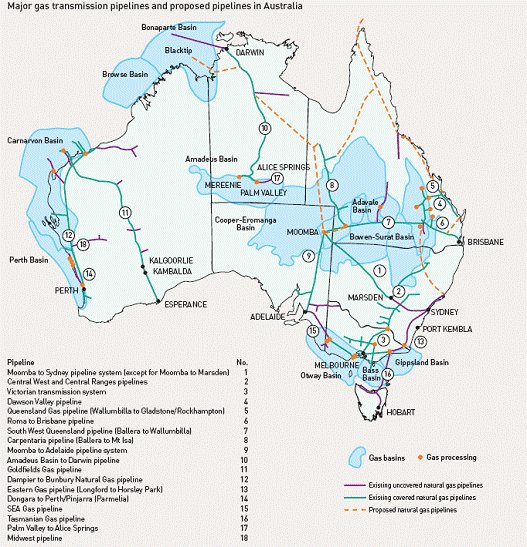
Most of the data in this section was sourced from a paper published earlier this year by Mike Roarty of the Parliamentary Library research section on "Australia’s natural gas: issues and trends", and Brian Fleay's paper "Natural Gas, "Magic Pudding" or Depleting Resource" (pdf), which in turn used data from the Geoscience Australia "Oil & Gas Resources of Australia 2004" (pdf) report. Where newer information has been available I've linked to the source (more often than not either The Australian's Nigel Wilson or Bloomberg's Angela McDonald-Smith, who do the most comprehensive coverage of local energy news).
Cooper Basin - The largest onshore conventional gas reserves occur in the Cooper/Eromanga Basins in north-east South Australia and south-west Queensland. This source currently supplies much of the domestic eastern Australian gas market (South Australia, the Australian Capital Territory, New South Wales, and Queensland), but is mature and now depleting rapidly.
Bass Strait - Victoria and Tasmania are primarily supplied by the Gippsland Basin offshore from south east Victoria, with a newer development in the area, the Kipper field, expected to come online in 2011. There have also been new developments in the Bass and Otway Basins offshore south western Victoria - including the Yolla, Minerva, Casino, Geographe and Thylacine fields. In recent years, BHP have upgraded their estimated of Bass Strait gas reserves, with the Gippsland Basin thought to still contain around 7 tcf of gas.
The older fields in the south east are expected to have run down by 2020, but the newer developments in Bass Strait should extend that date out by another decade.
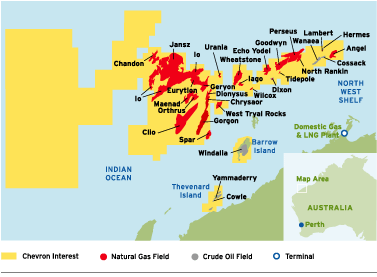 North West WA - Carnarvon and Browse Basins - Over 90 per cent of the reserves are located offshore from northwest Western Australia (Carnarvon and Browse Basins) and in the Timor Sea to the north of Australia (Bonaparte Basin) - far away from the primary domestic gas markets in the south east.
The Carnarvon Basin is home to the existing North West Shelf gas fields - with the Gorgon / Jansz fields being the largest in the country. The area includes a number of fields supplying gas into the domestic gas network, particularly for use by the mining industry. Besides the existing North West Shelf gas project, other planned new LNG projects in the area include the Pluto (at the early stages of construction), Gorgon, Wheatstone and Scarborough fields.
The Browse Basin is the most active new frontier, with the area seeing successful exploration in recent years - reserves figure for Inpex's Ichthys field recently being upgraded by 3.3 tcf to 12.8 tcf of gas, for example. Woodside's planned Browse LNG development is also in this basin.
Northern Territory - Bonaparte Basin / Timor Sea - The area between the Northern Territory and East Timor is the other region currently producing significant amounts of gas (and oil) with an LNG plant recently starting operation in Darwin and other fields being considered for development.
The division of gas revenues from the region between East Timor and Australia has been the subject of a lot of controversy over the years, which has contributed to continuing delays in developing the Greater Sunrise field.
Papua New Guinea - For many years it appeared that a gas pipeline would be built between Papua New Guinea and Australia, enabling east coast gas markets to access the gas reserves held by PNG (estimates range from 14 tcf to 40 tcf). Hopes of this occurring were still flickering as recently as the beginning of the year, however Oil Search and ExxonMobil have now decided to develop an LNG plant instead, making any future pipeline project very unlikely.
How Much Gas Do We Have ?
As at 1 January 2005, Australia’s Category 1 and 2 reserves totalled around 144 trillion cubic feet (tcf), according to the Geoscience Australia report, a slight decline on the previous year.
According to the Financial Times (quoting PFC Energy), Australia has so far produced only about 15 per cent of its gas resources, compared with 25 per cent for Norway and more than 80 per cent for the US’s lower 48 onshore reserves. Whereas US production has peaked (and Norway’s is expected to peak within a matter of years) Australian production is expected to expand until 2030.
| Basin | Reserves (2005) |
| Carnarvon | 80.6 tcf |
| Browse | 33 tcf |
| Bonaparte | 22.9 tcf |
| Gippsland | 7 tcf |
| Otway | 2.4 tcf |
| Cooper/ Eromanga | 1.9 tcf |
| Others | 2.5 tcf |
| Total | 150 tcf |
The table above has been adjusted to include the reserves revisions I've noticed since 2005 - Gippsland Basin from 3.1 to 7 tcf and Browse Basin from 30 tcf to 33 tcf (if you know of any others, please leave a comment).
Since then, based on an annual consumption rate of around 1.8 tcf, we have consumed around 5.4 tcf of gas, which would bring the current reserves number back down to around 144 tcf.
To put the Australian figure in context, proven world gas reserves are estimated to be over 6200 tcf - Australia has around 1.4% of the total.
How do we use the gas ?
In the domestic market, gas is primarily used for :
1. Manufacturing (36% of the total) - smelting, fertilisers, plastics and glass/brick/cement production
2. Power generation (32%)
3. Mining (13%)
4. Residential use (12%) - water heating, space heating and cooking
Obviously these will be joined by transportation if Mr Ferguson's plans for GTL/CNG are put into practice, and power generation will increase in importance if the APPEA's suggestions are implemented.
The fertiliser industry is an interesting one - globally the industry seems to be migrating towards natural gas supplies, particularly in the middle east, but also to Western Australia, where the Burrup plant now produces around 6% of the world's tradeable ammonia.
The rest of our gas goes to the export market, in the form of LNG (plus some condensate).
At present, there are 2 LNG plants in operation - the North West Shelf gas project (operated by Woodside Energy) near Karratha in WA, and the ConocoPhillips Darwin LNG plant in the Northern Territory. The North West Shelf project is the third largest LNG exporter in the world, with its fifth LNG train due to commence operation this year, bringing the capacity of the plant to 16.3 million tonnes (0.85 tcf).
A number of other projects are underway, in planning or actively under consideration - the table below lists all Australian LNG projects (using conventional gas).
| Project | Operator | Location | Yearly Capacity | Fields | Start Date (Est) |
| North West Shelf | Woodside | Karratha, WA | 0.85 tcf | 22 tcf | Existing |
| Bayu Undan | ConocoPhillips | Darwin, NT | 0.17 tcf | 4 tcf | Existing |
| Pluto | Woodside | Karratha, WA | 0.22 tcf | 5 tcf | 2010 |
| Browse | Woodside | TBD | 0.5 tcf | 18 tcf | 2015 |
| Gorgon | Chevron | Barrow Island | 0.8 tcf | 40 tcf | 2012 |
| Ichthys | Inpex | Kimberly (TBD) | 0.3 tcf | 12.8 tcf | 2013 |
| Sunrise | Woodside | Floating | 0.26 tcf | 9 tcf | 2015 |
| Scarborough | BHP Billiton | Floating | 0.3 tcf | 11 tcf | 2015 |
| Wheatstone | Chevron | Karratha | 0.24 tcf | 4.5 tcf | TBD |
| Evans Shoal | MEO Australia | Tassie Shoal | 0.13 tcf | 6.6 tcf | TBD |
| Total | 3.7 tcf | 132 tcf |
Australian LNG exports currently rank in the top 3 globally, however looking at new projects around the world, you can see that Australia's LNG exports will shrink in importance as projects in Qatar, Iran and Russia, in particular, start to deliver large volumes of LNG.
Political Factors
As I noted in the preamble, Western Australia recently opted to build a new coal fired power station instead of using gas as originally planned, due to the shortage of gas in the south of the state.
The WA domestic gas shortage has resulted in a local pressure group called the "DomGas Alliance" being formed to try and force the oil and gas companies holding offshore leases to either develop the fields or relinquish the leases - a move the APPEA oddly claims would "discourage exploration".
Martin Ferguson has also backed the "use it or lose it" idea, though he has apparently already been called in for a "quiet chiding" over this issue by the APPEA.
The APPEA is also unhappy about the state passing a law to force developers of LNG plants to set aside 15% of their reserves for domestic consumption, which is the only sign of the Export Land Model making any form of appearance for Australian energy production - and a pretty feeble one at that.
A planned expansion of the pipeline from Dampier to Bunbury should partly alleviate the gas supply issue by 2010, though in the short term an explosion at Apache Energy's Varanus Island plant has left the state gasping for gas, particularly the mining industry. This outage is expected to take months to repair.
One interesting side effect of the WA law is that BHP is considering building a floating LNG plant for the Scarborough and Thebe fields, partly to avoid these sorts of regulations.
Woodside have also been considering a floating platform for the greater Sunrise project, again in part to avoid any political risks associated with a plant in East Timor.
The only other form of notable state government intervention in the sector is the Queensland government's "smart energy policy" which mandates that 18% of power consumed in the state come from gas by 2020 (up from the earlier 13% target).
The recent federal budget eliminated a tax break for condensate production by the North West Shelf venture, prompting an expression of annoyance from Woodside CEO Don Voelte. At the time it was rumoured the industry would probably see the money returned via incentives for GTL production or faster development of LNG projects.
This has duly happened, with Ferguson kicking off a review of the tax system by Treasury secretary Ken Henry that will "include an assessment of the barriers to investment in large-scale downstream gas processing projects in Australia, the particular hurdles faced by remote gas developers, and consideration of the future policy framework for new sunrise industry development in the gas sector, including new LNG, gas-to-liquids and domestic gas projects".
The point of tax breaks isn't clear to me, given that the primary constraints on development of LNG projects in Australia are firstly finding a customer who will sign up for a long term supply deal and secondly availability of skilled labour and service companies - neither of which will be altered in the slightest.
It may perhaps encourage the development of a GTL project which might otherwise be unviable as a standalone LNG project though, such as Wheatstone.
The most obvious impact of the LNG export industry on the local gas market has been to push gas prices up, as the market is exposed to international supply and demand forces rather than purely local ones. Western Australia has already seen this (Santos CEO David Knox saying prices are headed for "LNG parity") and the same thing seems likely to occur on the east coast.
Another impact of the LNG export industry is that it will further increase the nation's dependence on income from fossil fuel exports.
Coal is currently our major export earner, which has prompted concern about Australia suffering from what is known as "The Dutch Disease" - the theory that an increase in revenues from natural resources will deindustrialise a nation’s economy by raising the exchange rate, which makes the manufacturing sector less competitive. The term was coined in 1977 by The Economist to describe the decline of the manufacturing sector in the Netherlands after the discovery of natural gas in the 1960s.
With the value of gas exports likely to rise to a similar level to that of coal if all the planned LNG projects go ahead, we could see more than a quarter of national GNP coming from these 2 industries.

How long will the gas last ?
According to the Parliamentary Library report, our resources are "capable of sustaining our future production and exports well into and probably throughout the 21st Century". While the paper was published on April 1, it appears to be serious.
Australia’s natural gas consumption for 2005–2006 amounted to 1,184 PJ. Additionally, exports in that year were 12.5 million tonnes (Mt) of LNG equivalent to 685 PJ - a total of 1,869 PJ (equivalent to around 1.77 tcf). Given the reserves and resources figure quoted of 144 tcf, this would mean our gas supplies would last for 81 years at the current rate of consumption.
One complicating factor is the use of biogas. According to the ESAA renewable sources of gas (primarily landfill gas) comprise about 16 per cent of Australia’s domestic gas use - which would equate to around 189 PJ (or 0.18 tcf).
Taking this into account, supplies under this simplistic scenario would last around 90 years - roughly the "end of the century" timeframe mentioned in the Parliamentary Library report.
Of course, neither domestic consumption nor exports are expected to remain static, so let's consider a few additional scenarios.
Note - as these scenarios are just examples, I haven't been particularly rigorous in running the numbers - they should be accurate to within 5% or so. Please bear this in mind if you feel the urge to nitpick - however if you can see any gross errors in the calculations please feel free to derive some alternate figures and explain them in the comments - its entirely possible the conversion factors have gone badly awry in the more complicated scenarios.
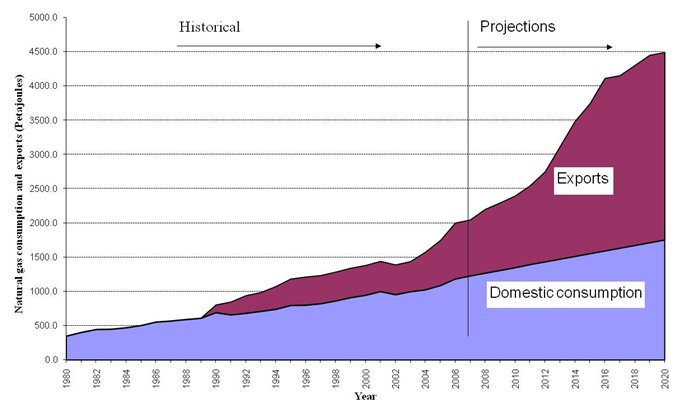
Scenario 1 - Increasing domestic demand and exports until 2020, remaining stable thereafter
The figure above shows the forecast growth in production from ABARE and the ESAA - continuing growth in domestic gas use and a sizeable expansion of LNG export capacity. By 2020, production is expected to reach 4500 PJ per year (or 4.3 tcf).
Allowing for biogas production at the same rate as today, this would mean natural gas supplies would last until 2046 - approximately 38 years.
Scenario 2 - Increasing domestic demand to 2030, static LNG exports from 2020
If domestic gas use continues to expand at the rate shown above, we'd expect to be using 2000 PJ per year for domestic purposes. Assuming no new LNG plants are built after 2020, we would be producing almost 5000 PJ per year (or 4.75 tcf).
Again, allowing for biogas production at the same rate as today, this would mean natural gas supplies would last until 2044 - approximately 36 years.
Scenario 3 - Increasing domestic demand and exports until 2020 (then stable), GTL/CNG for all transportation from 2020
As our energy minister is a strong advocate of using gas for transportation, it is worthwhile considering what would happen if the vehicle fleet was switched over to use CNG and GTL products, combined with scenario 1 for domestic use and exports.
Kiashu was kind enough to try and work out how much gas it would take to replace our current consumption of petrol and diesel, and came up with this set of calculations:
Petrol usually has about 34.6MJ per litre. Natural gas here in Australia is 38.87MJ per cubic metre at atmospheric pressure. Both vary a bit, obviously, but we can use this for some guesstimates. So we see that 1lt petrol is equivalent in energy to 34.6/38.87 = 0.89m3 natural gas.
An ABS survey [pdf- http://www.ausstats.abs.gov.au/ausstats/subscriber.nsf/0/12594B5543CA578CCA2571E2001C705D/$File/9208055005_2006.pdf] tells us that petrol use is a bit uncertain, figures are within about 10% only, but nowadays it's about 20Glt annually [numbered pp78, pdf p13-14].
20Glt petrol is equivalent in energy to 17.8 Gm3 of natural gas.
However, the natural gas must be compressed to 200-220 atmospheres - call it 210. As with the air car, this takes energy. The energy E required to compress air at 25C is,
E = 110,000 x ln (P1/P2) /m3/mol
There are 44.74 moles of methane in 1m3 of natural gas - natural gas is usually about 95% methane, and 5% carbon dioxide, propane, butane, sulphides and so on. Let's assume it's all methane to save ourselves the headaches. We're compressing it to 210 times atmospheric pressure, so P1=210 and P2=1, so the energy required to compress 1m3 of natural gas into CNG will be,
E = 110,000 x ln (210) = 588,181J = 0.59MJ
0.59MJ is 0.59/38.87 = 1.5% of the energy of the natural gas. So turning NG into CNG uses 1.5% of the energy content. Put the other way, you only get 98.5% of the energy from CNG you would from burning NG directly. Thus, 20Glt petrol is equivalent, after compression of NG into CNG, to 18.07Gm3 of NG (not a typo - we don't care about the volume of the CNG, only the NG feedstock)
I don't know about CNG efficiency compared to petrol and diesel. If that's lower or higher it'll obviously affect how much natural gas we need. But we can say that a figure somewhere on the cricket pitch is 18 billion cubic metres of natural gas to replace the 20Glt of petrol we use these days. ...
Hmmm, actually the ABS here says that in 2006 total fuel use was 16.3Glt petrol + 5.74Glt diesel = 22Glt. Must be more than 22Glt by now... but you can take the conversion factor of lt petrol ---> m3 natural gas of 100% --> 90% as being about right. For every 1Glt fuel you replace you want 900M m3 of natural gas.
By my calculations, 900 million m3 of gas equates to 32 billion cubic feet of gas (or 0.032 tcf). So for 22 Glt of fuel, we are looking at 0.7 tcf of gas per year for the present day vehicle fleet.
If we assume the fuel consumption of the national vehicle fleet remains static, and it suddenly switches from petrol and diesel to CNG/GTL in 2020, we'd be consuming 5 tcf per year minus biogas.
This means natural gas supplies would last until 2042 - approximately 34 years (ie. the new gas powered vehicle fleet could be used for just over 20 years before we had to junk it and replace it with electric transportation).
Scenario 4 - Increasing domestic demand and exports until 2020 (then stable), domestic gas use for all new power generation
As noted in the preamble, the APPEA is keen for us to transition to cleaner energy source by using gas for power generation until we get finally around to replacing coal (the dominant source at present) with renewable energy sources.
Doing the numbers (with some input from kiashu again), natural gas contains around 38.8MJ/m3, or 10.78Kwh. Our natural gas reserves of 144 tcf (4077 billion cubic metres) could therefore generate 43,950 billion Kwh (or 3.26 tcf per trillion Kwh) - at 100% efficiency.
Modern natural gas plants manage around 55% efficiency in the turbines, so if we allow for another 5% loss in the system we'll end up with about 23,000 billion Kwh (or 6.26 tcf per trillion Kwh).
National electricity generation in 2006 was 255 billion Kwh. Historically, electricity generation has been increasing at around 3% pa.
Assuming that we generate all new power from gas, natural gas supplies would last until 2043 - approximately 35 years (ie. the new - and old - gas fired generation capacity could be used for just over 30 years before we had to junk it and replace it with renewables as well).
Conclusion
There are a myriad of scenarios that could be applied (try working out one where the export land model applies to our gas exports for example, which would increase the timeframes somewhat, or one where exports keep increasing after 2020, which would significantly decrease the timeframes), but I think its safe to assume that if we start treating natural gas as a silver bullet we will run out in less than 40 years - with gas fired power for new generation being much less intensive in its use of gas than using GTL/CNG for transport.
One factor which may slow the rate of extraction is the inability of the industry to develop projects as quickly as it might like - Woodside has pointed out that the supply of skilled labour simply isn't sufficient to develop the pipeline of projects as fast as the industry would like.
The X Factors - What Other Sources Of Gas Do We Have ?
In the scenarios outlined above I've used our current known gas reserves as the total supply available.
There are a number of ways of further increasing (or extending the use of) our gas supplies :
1. "Just find more"
Martin Ferguson's preferred approach to oil and gas depletion is apparently to "just find more". This isn't totally out of the question of course - the recent expansion of "Australia" to include all of the continental shelf (see pdf map here) will no doubt include more oil and gas - but how many more years worth is an open question.
The APPEA argues that Australia has 50 sedimentary basins, of which just 12 are producing oil and gas (4 basins have been deemed non-commercial) and that there is still potential for drilling in little explored areas. Acsording to a recent report, only 17 per cent of Australia's offshore sedimentary basins and 26 per cent of potentially prospective onshore basins are covered by petroleum permits".
How much potential there is depends on your view of exploration programs. If you think that exploration is now a well understood science, and that companies target the most likely areas when exploring, then you'd assume that there isn't a great deal of gas left to be found.
If, on the other hand, you think that exploration is similar to roulette (the cynical view), or that governments and oil companies wish to restrain discovery and production (the conspiratorial view) then there may be much more - maybe twice as much as has currently been discovered.
The safest assumption to make is the first one.
2. Efficiency improvements
There are some obvious areas of improvement that could be made to reduce gas usage on the power generation and domestic use front. A number concentrated solar thermal plants under construction are combined with gas fired power to reduce total gas consumption (though obviously the long term direction for these plants is to burn no fossil fuels at all).
Another mechanism for improving the efficiency of gas usage in power generation is cogeneration (capturing energy from waste heat, which is already done by some large scale industrial users, is another useful technique).
Usage of gas in plastic production could be reduced in some cases by producing bioplastic instead.
Finally, usage of gas for water heating could be reduced or even eliminated using solar hot water heaters.
3. Biogas
As noted earlier, biogas is already providing a proportion of our gas production. Getting a handle on just how much gas could be produced from biomass is quite difficult, but if you consider that methane from waste bananas alone could power a town of around 25,000 people, there is obviously quite a lot of potential. If you read the preceding link you'll see that the German Greens have proposed some incredibly ambitious targets for biogas production in Europe, so it is conceivable that biogas could provide a significant proportion of our energy needs.
Of course, if we produce enough, someone may decide to start turning it into LNG and shipping it offshore, so this wouldn't necessarily be a panacea.
3. "Unconventional" gas sources, Coal Seam Methane and Shale Gas
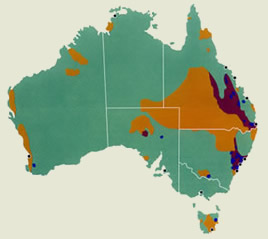 The real X-factor for gas production in Australia is unconventional gas sources, in particular coal seam methane and gas from shale. As both coal and shale are plentiful (and likely to remain so for some time), these are likely to provide significant quantities of gas.
No one seems to be attempting to extract gas from shale in Australia at this point in time, so I won't attempt to quantify how much gas we could possibly obtain from this source (see this post for a discussion of unconventional gas, including from shale, in the US).
Coal seam methane, on the other hand, is now the focus of a boom in Queensland. As there has been so much activity in the area lately (and reserves numbers are so vague) I'll make this the subject of a separate post - and re-run the scenarios based on various estimates of CSM potential.
Cross-posted from Peak Energy
Contact
- anz at theoildrum dot com
License

This work is licensed under a Creative Commons Attribution-Share Alike 3.0 United States License.
Archives
- November 2010 (2)
- October 2010 (5)
- September 2010 (4)
- August 2010 (8)
- July 2010 (2)
- June 2010 (2)
- May 2010 (6)
- April 2010 (7)
- March 2010 (12)
- February 2010 (11)
- January 2010 (7)
- December 2009 (10)
- November 2009 (6)
- October 2009 (7)
- September 2009 (10)
- August 2009 (10)
- July 2009 (3)
- June 2009 (14)
- May 2009 (10)
- April 2009 (15)
- March 2009 (16)
- February 2009 (16)
- January 2009 (15)
- December 2008 (15)
- November 2008 (23)
- October 2008 (25)
- September 2008 (24)
- August 2008 (30)
- July 2008 (44)
- June 2008 (38)
- May 2008 (48)
- April 2008 (43)
- March 2008 (29)
- February 2008 (32)
- January 2008 (30)
- December 2007 (26)
- November 2007 (32)
- October 2007 (11)
Thanks for your support :
http://www.reddit.com/info/6n05q/comments/
It is somewhat of an understatement to say that Gav has spent a long time preparing this post (several months by my count! :-)
Help us out by clicking the Reddit link (or use the 'Share This' button) and register if you haven't already done so (it's easy!). More new eyes on this post is more encouragement to write the next one!
Phil.
Gav
An excelent summary of the situation. I hope that this message (34 years of capacity) gets to the politicians responsible for approving the mad scramble to expand our export of LNG. We need this resource to ensure our own future energy security.
I am a strong believer in the use of CNG as an interim bridging fuel source. I am greatly comforted by the calcualation you have done for the conversion of oil based transportation to CNG. Comforted and a little surprised. The figure of 0.7 tcf seems very low, especially when you consider that this represents less than half the current Australian gas production rate.
Have you done a calculation on the level of gas supply that would be required to replace the entire Australian oil consumption.
Well - I've explained the calculation behind the CNG figure - I hope its correct, but I'm not certain about it.
I've also ignored future growth in demand, so from that point of view it may be "unrealistic", in that it assumes that we get more efficient in our transport fuel usage or learn to live with less (which we'll have to do anyway of course).
I'm not sure how much use of oil we make outside of transport - presumably heating oil consumption is small compared to transport usage, but perhaps diesel fired power generation uses a large enough amount to make it worth considering as well.
I too am a little comforted in that your calculations suggest we could potentially make a relatively smooth transition to electrify our personal transport, assuming we don't export too much CNG. Hopefully we will eventually end up with something like green crude to power our trucks and planes.
I think it is ominous that gas rich Western Australia is turning to coal for electrical generation. IMO gas baseload power should be bottom of the priority list as we will need that gas for a dozen other essential purposes. I note that several scenarios have 35-40 year depletion horizons. It would be interesting to contrast gas supply vs demand timelines for northern and southern Australia. Also whether biogas and coal seam methane could stretch the resource.
However the most urgent problem is reducing oil imports which suggests using NG as a transport fuel. Obviously trucks and buses that return to a depot should convert to CNG and this is happening. Poster Neil suggests a way that cars could daily commute on domestic gas and I think that would work out cheaper than hybrids. GTL has high capex and wastes some energy then again it won't require vehicle modification.
At present the assumption seems to be that all new gas is available for foreign sale. If Australia is to retain a large percentage and use it as an oil replacement there needs to be an official policy, not the current scramble.
For reference, domestic gas ie. piped to your house sells for around 2.1 c/MJ in the eastern states. Long term industrial supply contracts for power generation are being set around 0.6 c/MJ. If a industry was established to supply CNG for a proportion of the Australian vehicle fleet you would expect a retail sale price somewhere between these two numbers, say 1.5 c/MJ. This in turn corresponds to a petrol price of $0.49 per litre or a diesel price of $0.57 per litre.
This to me sounds like a pretty attractive alternative to oil based transport fuels. Even at home gas prices you could refuel at an equivalent of $0.70 per litre. Conversion of vehicles costs around $4000, but I am sure that this would be much lower if it was factory fitted.
CNG should be equally attractive for industrial equipment. I am currently engaged in convincing a prospective new mine developer to go down this route for the powering of his mining equipment.
I'll look at the east vs west discontinuity in the next (coal seam methane) post.
Biogas and CSM will obviously extend the life of east coast gas supplies - the question is by how much, which is what I'll be exploring when I look at how long the east coast supplies will last...
Gday Boof,
"...At present the assumption seems to be that all new gas is available for foreign sale. If Australia is to retain a large percentage..."
Don't forget, in the UK we have we have much colder winters and have burnt through a high percentage of our gas so we need yours:-)
Thanks, that is an exhaustive account that needs to be read at least twice because it has implications for a lot of other places in the world, not least Russia. Perhaps for CNG read GTLs, in the form of methanol or other liquid fuel. Australia was on the verge of becoming a methanol fuel producer not so long ago and this is a safer, more easily managed fuel than CNG. I don't mean the fuel cell (which has been on the verge of a breakthrough to my personal knowledge since the very early 1970s) but methanol has a direct liquid fuel for blending with gasoline.
The current price of oil is likely to be the baseline for future energy prices which makes a lot of things probable instead of possible as they have been for decades. Exports of liquid fuels from natural gas and/or coal may be a better bet than LNG long term because the world needs liquids not gas. Same goes for power stations. Keep the gas for fuel and feedstock and use nuclear and solar for power. They work, they are economic and they will last for a while (as indefinitge as we can go actually).
Thank the oil price for this opportunity. To be sure the OPEC countries and Russia will so so.
Methanol is very toxic.
CNG is very safe compared to toxic liquids like methanol (high octane gasoline substitute), dimethylether (high cetane diesel substitute), gasoline, and diesel. The liquid fuels are explosive as well as poisonous and CNG is merely explosive.
"Was" isn't quite right - while plans to produce methanol have been around for ages, they haven't died (OK - the Methanex one has, but Methanol Australia, now MEO Australia, lives on).
MEO's Tassie Shoal project I mentioned above (one of the least likely at the moment, but on the drawing boards nevertheless - though I remain a little confused as to whether or not this is related to Evans Shoal or is a different venture in the same area) is supposed to produce methonal. While they are a small outfit they seem to be getting some sharemarket attention.
http://www.meoaustralia.com.au/_project_tassie.asp
OTOH methanol production isn't very efficienct in terms of energy usage, so they may never float...
http://www.chemlink.com.au/methanol.htm
There is also a plan to produce methanol using an algae and solar power by the guys behind the "Wizard Power" CSP plant I talked about a while back:
http://www.news.com.au/heraldsun/story/0,21985,23811816-664,00.html
What is your opinion?
cheers
Well - on the whole he is right that burning gas to produce electricity isn't the best way forward (though by all means burn biogas, says I).
But his next bullet point says that electricity can't replace oil, which is just silly - trains can run on electricity, plug in hybrids and electric cars run on electricity. Oil and liquid fuels aren't mandatory - we can (and will) switch away from liquids to electricity over time...
Matt Simmons is right but he might have added one more key energy source criterion: stop wasting what we have already. The best and cheapest new barrel is a barrel or a cubic foot of gas saved.
Old oil supply is declining by 4-5 million barrels a day because we are taking out only one barrel from every three discovered leaving the rest in the ground. On top of that we can make our economies work just fine if we stop wasting oil, gas and power the way we do in the rich countries. This level of oil price, followed soon perhaps by the same price equivalent for gas, will do that job by force where we would not do it by reason.
All long term forecasts assume a lot of our remaining gas goes to power generation. We need to reverse that mad idea very soon. Australia can easily achieve Matt Simmons' criteria. The USA, most of Europe, China, India and Japan cannot do so for a long while yet.
CNG -- compressed natural gas may be more economical for Australia than GTL's. Argentina and Brazil have many natural gas cars and CNG stations. Pakistan is also a big user of CNG autos. Some in Pakistan have been asked by Iran to help develop a chain of CNG stations in Iran; as Iran has much natural gas. UPS is one of the largest delivery companies in the world and they used CNG for their delivery vehicles. Public buses in Washington D.C. operated on clean natural gas. Natural gas is much cheaper than gasoline per mile driven and was clean. Some people were able to fill their cars with natural gas in their garages with a pump system.
One small thing to point out - the above photo was taken in in India no Pakistan. Gujarat is the westernmost state of India.
Well spotted. It looks like they have made a concerted effort to do this.
http://www.hinduonnet.com/thehindu/2003/09/29/stories/2003092903541300.htm
http://envirolibrium.blogspot.com/2005/09/cng-in-gujarat.html
However it hasn't been without problems regarding safety and supplies:
http://www.rediff.com/news/2007/may/14bus.htm
http://www.thehindubusinessline.com/2008/05/19/stories/2008051951340100.htm
Your calculations show the problem with stating resource lifetimes based on current consumption.
However, I wonder if your scenarios take into account production declines? Although natural gas has a very different production profile to oil, the region, as a whole, will still experience a peak and a decline. Did you do any work on trying to determine the peak date for each scenario? For instance, some politicians may think 40 years is a great timescale to have, considering they are only in power for a few years or not much more than a decade. If peak production is likely to occur within their period of power, they might think again about basing the economy on gas.
I've never understood how analysts (the BP Statistical Review being a notable offender in this regard) can say with a straight face that we have "X" years of supply left, with a footnote that this is at current rates of consumption - its a meaningless number.
If you extrapolate past growth rates forward you'd have a much better indication of how long you have before you'll be forced to change your ways.
As for my scenarios, they are just based on consumption rates under various assumptions, with the "end date" defined by when cumulative consumption = total reserves (proven + probable).
They don't take into account production rates / declines of individual fields - they simply assume we can produce as much as required to meet consumption, until supply abruptly runs out.
These aren't "realistic" in that production will obviously peak and drop off at some point - they are just intended to give a rough idea of how long we could get away with particular usage profiles...
I don't have anything near the sort of data required to do a real bottom up model (I'm not sure anyone does), but it would be an interesting exercise to do if the data became available.
Big Gav - excellent article and reinforces the fact that all fossil fuels are limited not matter how big they appear at first.
Also the current gas crisis here in WA at the moment highlights the fragility of our energy supply. Putting all of Australia's eggs in one basket of natural gas will only make this worse. Imagine a similar accident cutting of 30% of Australia's gas supply instead of just Western Australia.
I will have a look at the gas required to run Australia's cars as it does seem a little low however I am sure you are correct.
Agreed - the Varanus Island explosion is an interesting demonstration of what happens when you have shortfalls in fuel supply.
Please do check the CNG and electricity generation numbers - they need to be validated to make me comfortable I'm getting it right.
Awesome stuff! Yet again it all boils down to: "We can't just burn stuff forever, some day we have to do things without burning stuff."
Or as Thomas Edison put it in 1910,
What a great quote! Thanks!
Interestingly, that one pipeline explosion in WA has already affected the price of milk and public hospitals are on linen rationing because their is reduced gas supplies, not just the big miners,smelters and manufacturers that are affected. We need some STORAGE FACILITIES perhaps. If one pipeline explosion is immediately felt then two would have us belly up overnight.
Thanks for a very informative post, I'll try to figure out reddit stuff and do the biz for you.
Reading about the Honda Civic NGV with home refuelling it sounds like a worthier recipient for public money than the Camry hybrid. AFAIK Honda unlike Toyota doesn't do any assembly in Australia.
My guess is that WA have done the sums on de-mothballing the coal fired generators and even with 2-5c per kwh carbon tax it works out cheaper. Until the carbon cap reduces by serious amounts if that will ever happen.
Agree that CNG is worth exploring. We face a bit of a chicken and egg problem in that there are few refueling options (aside from home compression) and so no cars on the market (aside from conversion kits for petrol models). Most of the major manufacturers are now delivering CNG models -especially for the Indian market where it is becoming an increasingly poplar choice.
I believe we will be seeing a convergence of energy forms as substitution between them becomes more possible. It won't be true for much longer that electricity is not a transport fuel, gas is already (in some countries), food is too (if you include biofuels). As coal to liquids also becomes a possibility (though an ugly one) it should be clear that oil needn't have any sort of monopoly over this application, and would expect some degree of price convergence also. In future hydrogen may provide a medium to transport energy that is produced from electricity, gas, coal gasification or other sources.
The question then is how to make the most efficient use of resources. The options are to liquefy the energy source (GTL, CTL) so that they can be used with existing infrastructure and fuel tanks or to adapt our vehicle fleet and infrastructure to suit new fuel types.
The first is inherently inefficient - much energy is burned in the conversion and emissions are raised accordingly. Its really a short term fix, but whether this type of project is even possible in the short term is questionable. The second option is far more efficient and would result in the lowest fuel prices, emissions and best use of available resources. There is some amount of infrastructure build-out required so would ideally have political sponsorship behind it.
As I've yet to hear a politician mention alternative fuels as a policy response to the oil crisis, I don't hold much hope for the short term. Perhaps technological developments with the vehicles and the lead of other countries may steer them in the right direction.
Yes, you're right. If we move to world parity price for natural gas (currently over $8 per GigaJoules), coal is cheaper than gas until the emission charges for CO2 are over about $70 per tonnes of CO2. That would give a producer price for electricity of around $120 per MWHr.
New nuclear is likely to cost $60 per MWHr but is highly interest rate dependent. At current prices the Uranium for nuclear contributes $3 per MWHr.
It seems a total waste for Natural Gas to be used for power generation. The WA government is correct. Pity their own green lobby is preventing them from adopting genuinely climate friendly nuclear.
I think you meant climate friendly solar and wind power.
North west WA is one of the best spots on the planet (top 3 I think) for CSP power generation.
And, as anyone who has ever lived there knows, the wind tends to blow strongest on hot afternoons - just when power demand is at its peak. Even better, there is no shortage of arid coastline to place wind turbines on without having any complaining NIMBYs piping up.
No need for dirty nuclear power in WA...
I'm sorry I don't believe CSP, Wind or GeoThermal is in the same ballbark in delivering electricity that the coal fired plant will. If it did, lets face it we'd build them in immediately.
They all have MUCH better press than coal and every Labour politician in Australia would love build them.
So why don't they? It's simple really....
So now WA has a new coal fired power plant which emit 5-10 million tonnes of CO2 per year.
Well done Greens.
The Labor party is every bit as much in the pocket of the coal industry as the Liberal party is - particularly in NSW, where the coal industry unions (both mining and power generation) are very strong influences.
I haven't seen anything out of the Rudd Govt or the State Govts yet to encourage large scale generation from renewables, If we were serious we'd be doing what Spain and California are right now - lots of CSP developments and lots of wind farms.
I think these guys know what they are doing...
http://www.bloomberg.com/apps/news?pid=20601109&refer=home&sid=a_TUtlIwV7Fw
Ah well, we will see. I've been hearing and reading about these announcements for 15 years. In the meantime worldwide nuclear capacity is set to take off. As FF's get priced out of various markets maybe we won't even need to cut our CO2 emissions. Reductions from the rest of the world might mean we can keep on with our own.
No evidence, just FUD, as per the usual nuclear industry PR drivel.
Show me a reference to someone claiming they had large scale CSP as prices equivalent to coal power 15 years ago.
If you can't you are just spouting rubbish and should give it a rest.
The nuclear industry will go into complete meltdown within 20 years as it starts getting priced out of the market.
"The nuclear industry will go into complete meltdown..."
Bad choice of metaphor...
Wow talk about calling the kettle black. You constantly FUD Nuclear.
But still fair enough, I provided no numbers in the quote above. It's annecdotal evidence from a constant stream of renewable energy people giving presentations. A good friend of mine went to work for a company who promised to have solar energy comparable in price with coal by 2005.
Look I don't have anything against renewable energy except if it stops people from implementing solutions that will help us now.
If renewable energy is cheaper to implement than nuclear in 2020, fantastic! We will still get 50-60 years of cheap power from the investment we make in those plants now.
If only price matters, then we should build more coal-fired stations.
Of course, most people feel that price is not the most important thing, and so they consider other aspects.
References ?
But you are right - I should do an objective analysis of the problems with nuclear power - I'll do one in a couple of weeks time.
It might be tough to do any 'objective analysis' since you already know the results you require.
All you need to do now is dig up some 'facts' to shore your result up.
This is a well-known fallacy in science, I believe, as it renders objectivity impossible.
Actually, scientists almost always go into experiments knowing the results they "require". It's called a "hypothesis".
1. See some data which require explanation.
2. Make up hypothesis which explains the data.
3. Do experiments - gather more data - to test the hypothesis.
4. If hypothesis is not proved, return to 2.
5. If hypothesis is proved, publish paper with methods of gathering data and references which others can check, and make it all open for criticism. If criticism invalidates hypothesis, return to #2.
Scientists almost always begin with assumptions about the results they'll get. That's not a problem. If #3 is done badly, then #5 will reveal that, and the process continues.
That's why with Gav saying, "nuclear sucks" we just ignore him. But if he writes an "objective paper" on it, then we can take part in step #5, so that if there was some dodginess in #3, it'll be brought to light.
You should welcome his attempting such a paper, rather than trying to discourage him as you are here. If he is wrong, the more detail he writes about things, the easier it'll be to show he's wrong. The only reason to discourage him is if you fear he's right.
Yeah, we are all going to wait with bated breath to see what conclusion Gav reaches after his 'impartial' and 'objective' investigation! :-)
Forming an hypothesis is one thing, holding something as an article of faith quite another.
It is usually possible to distinguish between the two because the faith-based response is absolute, ie nuclear bad, renewables good, whereas a reasoned approach is usually nuanced, and sees the world in shades of grey, where most of us live, with one technology often being suitable in some circumstances but not in others.
It seems weird beyond belief to me that with most major present energy sources, oil, gas and coal, either running out or causing unacceptable problems in the very near future, some do not seem to find that challenge tough enough, but wish to rule out one of the few major replacement energy sources proven at a large scale on a priori grounds - the first challenge is obviously not thought tough enough!
Just to be quite clear, I am 100% in favour of renewables where practical, for instance we are going to know very much more very soon on the actual costs and problems of solar thermal, and Australia would obviously be a very good place to further evaluate this.
It does not seem sensible to me though to just assume that this will work out.
In response to your last point, any attempt at a little more objectivity would be very welcome.
I fear what we will actually get is a litany of 'issues', with no attempt at balance, and the comparisons will be with presently non-existent systems - IOW fairy dust.
That's where #5 comes in, mate. If what he writes is bollocks then you get to tear it to bits.
Of course, you could write your own brilliant and impartial piece telling all of us how marvellous nuclear is. And if that turns out to be bollocks, we get to tear it apart, too.
It's all part of the scientific method. Repetitive comments in endless unrelated threads, not so much.
Ignoring the ad hominen, which also appears to apply to others in repetitive and unsubstantiated knocking of nuclear in endless unrelated threads, I repeat that I am very keen on renewables too, and would very much like to see solar thermal, for instance, work out.
As you say, the proof is in the pudding.
It will be interesting to see whether we get a balanced assessment showing pros as well as cons, or a process of rationalising a priori positions and data picking.
Rightyo, so you won't be writing any paper about nuclear (or anything else which interests you?), just critiquing others?
Yep, I know the type. Never wants to be the frontseat driver, just a backseat driver with right of veto over the frontseat guy.
Even I've written papers on things, and I'm just an average idiot who makes an effort.
I'd be interested to see an honestly-written paper on nuclear. Normally we just get casual dismissal from the antis, and industry netvocate PR stuff mixed with pie-in-the-sky stuff from the pros.
Come on, if you can write 10,000 rough words in comments about how awesome nuclear is, surely you can write 2,000 well-researched and clear words in an article about it. If you've got time to write all these comments you've got time to write an article.
That's what I do. There's the occasional dud article which gets through on TOD, I'm not an editor so I can't do anything about that, but I can respond with my own articles in some attempt to raise the average standards a bit. If when he's written and published it you find Gav's written a below-standard one on nuclear, you can do the same. Me, I was told - put up, or shut up. So there you go.
I write up my ideas, and then put them up there for everyone to tear apart. Why not do as much for your beloved nuclear? If it's so awesome then it shouldn't be hard to do.
Come on, instead of criticising Gav's article before he's even written it, show us your own brilliant one.
I agree that is hardly "constant FUD". I somehow put you into the Greens Party which does constantly FUD Nuclear.
My apologies BigGav.
BTW I think there are a variety of questionable assumptions in this paper:
http://www.sustainabilitycentre.com.au/BaseloadFallacy.pdf
Firstly that wind is Australia will be more reliable when gathered over a wider area. In general this is true but there is also a study that shows that the location with the best wind resource, South Eastern Australia, has temporal correlations as weather patterns move through. Last week for example we had a large scale High pressure sit over us which essentially killed wind output.
See: www.environment.gov.au/settlements/renewable/publications/pubs/windstudy...
Secondly that report only has wind rising to 20% of total power. The study DOES require substantial consistent power sources.
The report names GeoThermal and BioMass as providing this. Both of these are very speculative at this point in time. GeoThermal in Australia requires circulating very large volumes of water deep underground through artificially made fractures underground deep in the desert. A 2% of water loss per cycle would render the scheme uneconomic. There are also concerns about the long term geological stability of fracturing cubic kilometers of rock under compression. Deep in the outback earthquakes are unlikely to do damage except to the holes and carefully constructed fracture zones required to heat the water. If this happens the heat collection zones will at best need to be re-drilled (the most expensive part of the process.)
It is not the least obvious that burning biomass waste will be economic on a large scale, although it could (and does with BaGasse) make a difference in local specific communities.
With regard to CSP, you're up against a fundamental problem that sunlight is inherently a diffuse source of power.
Taking 1 KW/meter squared as the peak power density and assuming a 35% efficient heat engine, averaged over a year, your plant produces 1000*0.25*0.35 = 87 watts per meter squared.
So you need 11 square meters to get 1 KW. To get close to coal power you need to get your capital cost down to around $2000 per KW. Then just including the collectors and neglecting all the piping and heat engines, means you have to get your collectors to cost $180 per meter squared.
Building and maintaining a large scale structure in an exposed location for that price is an inherently hard thing to do.
The Victorian CSP project is expected to produce 150 MW peak, 37.5 MW average for a cost of $400 million dollars. That is $10000 per KW which is still a factor of 5 above coal. To the fair to the Victorian project all that power is during the day, when electricity is most needed, especially in summer, so the economics are better than the first glance estimate.
So, be fair to the WA government. If they oversee an infrastructure that either subjects WA to blackouts or costs 3-5 times what people are used to, they won't get re-elected.
Good article,Gav.
Maybe somebody can explain to me why Australia is selling gas to overseas buyers,a lot of it I believe on fixed price contracts(ie, cheap) and is having to buy oil at spot prices(ie,expensive).
As gas is a good substitute for oil as a transport fuel in many applications it seems to me in my simple minded way,that we would be better off conserving our gas for domestic use to enable a less painfull transition to a sustainable transport system.
Dear me,my old cynical self is striving to answer the question - it's the same old,same old short term gain,long term pain attitude.Gee,it was a great party,pity about the hangover.
Well, Australia operates under the same "pump it and sell it as fast as you can" mentality that Great Britain displayed with the North Sea oil fields.
Also most of those fixed-price contracts were signed before the significant spike in FF prices and during the regime of the cornucopian, infinite-growth based Howard government (not that the Rudd government is necessarily any different). Basically it was abysmal myopia on the part of Australian business and politicians at the time (not that their eyesight has much since).
The CEO of Woodside recently hinted at trying to force a re-negotiation of those contracts on the basis that its not economic to produce the gas in the first place if they aren't going to get a decent return. Not sure if he's had any luck with that though.
Correct - those fixed price 25 year supply deals were fixed about 5 or 6 years ago - just before prices started soaring.
Woodside and the NWS venture partners have been trying to renegotiate - I don't think they have had any success (the Chinese say a deal is a deal) but it sounds like they are still trying :
http://money.ninemsn.com.au/article.aspx?id=577121
Prices for gas from the 5th NWS train are another matter of course - they'll be making out like gangbusters on that stuff. Ditto for production from Pluto.
There is an interesting article at the Asia Times on Chinese gas imports and how they are faring in trying to play off potential suppliers (Russia / Gazprom vs LNG exporters) against one another - not very successfully.
http://www.atimes.com/atimes/Central_Asia/JF11Ag01.html
I just ran some numbers on a Plugin Gas Hybrid
Imagine that you have a smallish tank of Nat Gas in your boot and you have an engine that can switch between NatGas and petrol. You use the NatGas for daily commutes. Then you could fill up your car at night from your domestic gas supply and drive during the day. For longer trips use petrol. You just need enough gas for say 60 KM.
Using a standard Camry with 10l/100 km as the benchmark I ran some numbers.
1 litre of petrol has an energy content of 38 MJ
A fuel economy of 10 litres/100 km implies 60 km requires 6 litres of petrol.
That has an energy content of 228 MJ.
Cost of a 60 km commute, assuming $1.50/litre is $6.90
In Victoria Natural Gas costs $3.5 per gigajoule so that same 228 MJ of energy would cost $0.80.
If we move to World Parity pricing at $8 per GigaJoule then the cost of the 60 km commute becomes $1.80.
This seems like a total goer.
Why isn't there a plugin-GasHybrid conversion market?
Fuel excise on CNG is on the cards, see the table halfway down this web page. It suggests starting around 4c per m3 in 2012, then add carbon charges. However gumbmints won't want fuel revenue to drop if there was a big changeover from petrofuel.
When you say 'plug in' gas hybrid I'm envisaging a large battery pack as well as a gas cylinder. No room for the mother-in-law. It appears the Aussie built Camry hybrid won't be plug-in in the sense of home battery charging. The Hyundai Avante/Elantra will be electric drive with LPG fuel. Some LPG (propane-butane) comes from NG not just crude refining.
As for low carbon baseload the enthusiasts have been telling us renewable baseload is just 5 years away. They told us that 6 years ago.
No I mean, I take my existing Camry, put a small gas cylinder in the boot. Enough for 60 km. Then the plan would be to plug it into my domestic gas supply at night.
The principle is the same as a plugin-electric hybrid in that I have to remember to "recharge" my CNG cylinder. If I forget I'll use (and pay for) petrol the next day.
The major advantage is that this could be done for around $2000 within the next year. This would get us Australians through the next 10 years quite handily.
Waht modifications need to be done to the engine and how does the gas go through the injection/carburettor. i am very interested in converting my wifes car to CNG as an experiment as we could certainly live within a 60Km daily budget. Also what is the maximum pressure the gas needs to get to and what would be the outlet pressure and flow requirements. There is not a lot of CNG conversion info about so I am ssuming it is much harder than you have described. If you can get it right however, there is a very lucrative conversion market.
Well - geothermal power has been around for over a century, so they were pretty slow if they only just realised 6 years ago. Maybe they should have visited Iceland, New Zealnd, California, The Phillipines, Indonesia etc etc etc
Quite a large portion of the world's power is generated by hydro as well, for that matter. Ditto biomass.
Now we are even better off, as we have large scale baseload solar and wind power plants under construction - with the solar ones likely to be cheaper than coal in the next couple of years.
In any case, its best not to get too hung up on the "baseload fallacy" (http://www.sustainabilitycentre.com.au/BaseloadFallacy.pdf) - distributed renewables are effectively baseload even without storage (storage for CSP is vital though as it makes the economics much better).
Plus all the smart grid initiatives underway will slowly make supply variablity just another factor that the grid itself handles - as it has with demand variability for decades.
Not seeing a problem. ;)
Give me AU$6 billion (same value as the 500MW LaTrobe coal-fired plant) and I can have 1000MW in under 8 years, and incremental generation after the first year.
Modularity is the key.
Hello Ozzie-TODers,
Wouldn't geothermal be constrained by a lack of freshwater?
http://www.independent.co.uk/news/world/australasia/the-drought-that-dri...
-----------------------------------
The drought that dried up the Outback
It is difficult to comprehend the scale of Anna Creek. The farm covers an area larger than Wales, which provides ample space for its 16,500 cows to roam. But it is soon to close - brought to its knees by the severity of Australia's drought...
-----------------------------------
Bob Shaw in Phx,Az Are Humans Smarter than Yeast?
Good observation Bob. Anna Ck is near the word 'Eromanga' on the map in the article but I believe it missed out on artesian water, oil, gas and uranium. Now rainfall as well. To some extent the sandstone basins overlap a huge mass of granite which it was claimed yesterday contain 50% of the world's easily recovered uranium. The sandstone cap has trapped heat from the underlying radiocative decay. In theory the granite geothermal plant near Moomba should send the same mass of water from deep underground back to the surface as hot water and steam (>200C) to a two stage boiler then cooled and sent back underground. It needs to be a closed loop to conserve water in an arid environment (ie not topped up so much) and to prevent the release of radon gas. Some people are enthusiastic about this plant. I'm not.
To the east near pipeline no.8 is a town called Birdsville which has a once-through (ie not looped) hot water system which powers a kind of reverse refrigerator. The hot water (98C) has little radon and is sent to an evaporation pond.
Depends on the local water table. It's supposed to be a closed loop, so you just need some artesian water to start with. It doesn't need to be drinkable either.
Yes - it should be closed loop, and I believe that is what is planned.
With all this discussion about using natural gas to make electricity, power vehicles and export LNG, has anyone considered how we humans will manufacture fertilizer and feed everyone when the natural gas is depleted? It seems to me that NG should be reserved to make this rather vital product. Business as usual will spell our doom. We need to go renewable, sustainable and environmentally friendly pronto to mitigate catastrophe. Burning NG achieves none of these.
That question comes to mind: Are humans smarter than yeast, a species that madly consumes its finite resources until depleted and then produces spores to lie dormant through the hardship?
The thing is that NG, like oil or coal, isn't going to "run out". When they talk about "reserves", there are a few levels of it. Really there is shitloads of the stuff, it's just a matter of how much effort you have to go to in getting it.
We normally think in terms of how much money or energy we have to spend in getting the stuff. For example, when oil was ten bucks a barrel nobody talked about drilling in Alaska, they wouldn't make a profit. But at $135/bbl it looks a bit more attractive. And when a well is "dry" it's rarely actually dry, it's just that the flow has slowed to some level where it's not worth the trouble - there are wells out there producing 2 or 10 barrels a day.
There's also the question of how much energy we have to spend to get the stuff, compared to how much we'll get if we burn it. If it takes more energy to get it than we'll get from burning it, we don't usually bother. But if we wanted it for something other than burning, we might.
For example, the South Africans had a uranium mine in the 1970s where it took more energy to extract the uranium than they'd ever get from it in their reactor. But they didn't care, because they didn't really want nuclear-generated electricity, they wanted nuclear weapons.
Similarly, we can imagine a whole system of pumping oil, digging coal or getting natural gas, where it takes more energy to get the stuff than we'd get from burning it, but we don't care because we're not burning it - we're making plastics or fertilisers or whatever.
So I think it very likely that fertiliser from natural gas (or coal or oil made into gas) will continue for centuries after the last fossil fuel-driven car grinds to a halt. The fertiliser will be a lot more expensive, certainly, but it'll be made nonetheless.
The expense of the artificial fertiliser will mean that people seek more natural means of fertilising the ground. We'll return to proper crop rotation, having animals on the farms, and so on. Around half of world food production today is already done without any fossil fuel inputs at all, and we produce twice as much food as we need for the world. So absent fossil fuels entirely, we'd produce exactly as much food as we need.
We don't need artificial fertilisers to feed ourselves, they just make it much easier, and let us be lazy and not very good husbandmen of the Earth.
"For example, the South Africans had a uranium mine in the 1970s where it took more energy to extract the uranium than they'd ever get from it in their reactor. But they didn't care, because they didn't really want nuclear-generated electricity, they wanted nuclear weapons."
There has never been a South African uranium mine that consumed more energy than the uranium contained. There were two South African enrichment plants at Valindaba (next to Pelindaba outside Pretoria) the Y-plant and the Z-plant. The Y-plant was a prototype that had the potential to enrich to bomb grade (90+%) and I do not know the energy balance of it. The Z-plant was a "semi-commercial" plant that was not able to enrich beyond 5% (commercial grade) and could produce 300,000SWU a year which was substantially more than was required to fuel the South African nuclear plant (Koeberg near Cape Town). The power consumption of the Z-plant was 256MW and the power production of Koeberg is 1844MW (2 x 922MW PWRs).
Even if uranium is extracted from seawater (where there is about 4500 million tons of it) there is still far more energy in the recovered uranium than is used in extracting it.
I see similar statements bandied about without much proof...
These schemes seem to start with the assumption that all of the U can be extracted... which is false. Just as you can't extract all the oil from a field.
The schemes commonly suggest putting large "sheets" or "filaments" of some exchange material, presumably selective for dissolved Uranium species, into the ocean.
You need to ask;
- how robust these sheets and filaments are going to be when the first storm hits? After all, a truly massive surface area will have to be deployed to make the extraction rate economic.
- how do you prevent biofouling of your exchange surfaces?
I suspect any ion exchange resin that likes uranium oxides is going to have some preference for PO4... and algae just love that.
A common criticism of solar is that the source (sunlight) is diffuse... and the same criticism applies here.
The EROEI in experiments they've done in Japan are pretty promising.
Interestingly, the sheets can be folded up into bundles in baskets. This would increase their durability. They also found they were able to reuse them several times, biofouling wasn't a problem, saturation of the active stuff was a problem.
But in the end, they've drawn out less than an ounce of uranium from seawater, anywhere ever. So we can't really make any statements about the commercial possibilities.
When someone makes enough for a single rod of uranium - or even, say, a single kilogram - then perhaps we can say something reasonable about the EROEI and the commercial situation of extracting uranium from seawater. It's really just too early to tell. Speculating about it is only slightly more meaningful than speculating about fusion power's costs and benefits.
That's just the way I think it's sensible to look at things - when someone's doing it on a commercial scale we can talk seriously about it, until then it's just geek dreamware. Let's look at what we know works well today.
I beg differ - I quote from the Japanese work
"The total amount of uranium dissolved in seawater at a uniform concentration of 3 mg U/m3 in the world's oceans is 4.5 billion tons. An adsorption method using polymeric adsorbents capable of specifically recovering uranium from seawater is reported to be economically feasible. A uranium-specific nonwoven fabric was used as the adsorbent packed in an adsorption cage 16 m2 in cross-sectional area and 16 cm in height. We submerged three adsorption cages in the Pacific Ocean at a depth of 20 m at 7 km offshore of Japan. The three adsorption cages consisted of stacks of 52 000 sheets of the uranium-specific non-woven fabric with a total mass of 350 kg. The total amount of uranium recovered by the nonwoven fabric was >1 kg in terms of yellow cake during a total submersion time of 240 days in the ocean."
That is over 1kg, or 2.2lbs
A single kilogram of yellowcake is not a single kilogram of uranium. A single kilogram of yellowcake dissolved in acid is still less a single kilogram of uranium.
The scientists themselves discuss the experiment here. They achieved 2g U3O8 extracted per 1kg adsorbent over 60 days. They found they could use an alkaline wash and reuse the stuff, but its performance declined.
Also, the amount extracted is the amount deabsorbed from the adsorbent, and forming ions in the acidic solution. The amount actually precipitated from the solution after that is less again. Every physical or chemical step drops you have to take drops the yield a bit.
Again, these experiments are very promising, but it would be unwise to rely on the process when planning for the future.
Thank you for the link. I do not suggest that the Uranium from sea water is a short term solution - because the current Uranium land based reserves (~40m tons) is more than adequate for some 600 years at the current usage rate - or 100 years if all current electricity came from current generation nuclear reactors. If a closed (breeder) cycle was used it is about 60 times greater and if a Thorium cycle was used there is about 3 times as much thorium as uranium.
What is interesting from the link is the estimate of an absorber cost of ~4100 yen per kgU, or about $40/kg - or <$20/lb. While it is not the total cost of such a scheme, it is far less than the current spot price of ~$60/lb for Uranium.
Of interest a kilogram of yellow cake (U3O8) contains ~0.85kg of Uranium.
First up, uranium ore, like oil, is never 100% recovered, lots gets left behind, especially with in situ leaching - done at Australia's biggest deposit at Olympic Dam. So just as we might have (say) 1,500Gbbl of oil reserves yet that doesn't mean we'll get 1,500Gbbl of oil out of the ground to burn, so too with uranium.
Your estimate of 60 times as much for a breeder cycle is overly optimistic, no-one's ever made them work that well. A factor of 10 is more reasonable - if we could get all of them to work "best practice" which of course does not happen in practice.
Your estimate of 3 times for thorium is overly pessimistic. The real limiting factor for thorium, given proven reactor designs, is the need for plutonium to be mixed in, so that conventional reactors are needed to provide the plutonium for the thorium reactors. So you're looking at a bigger factor than 3, but not a huge factor like 100.
I wouldn't try to guess more closely than that. I believe in democracy, so that people ought to be able to decide what goes in their region, and I also believe in distributed power generation for the sake of resiliency in the system. Those two things combined mean - well, people just aren't going to vote for nuclear (or coal, for that matter) in their backyards, so the exact details of what it can do aren't that important.
Nonetheless, in the interests of fairness, I think you're being overly optimistic about breeders, and overly pessimistic about thorium.
Look more carefully at the seawater extraction paper - their cost estimate comes from "okay, we managed 2g U3O8 per kg of adsorbent, but we hope that in future we might manage 6g or even 10g, and if we used a different acid then perhaps we could reuse the stuff more times and then add in declines in cost from mass production and..." So there's a lot of ifs and maybes and optimism there. The actual cost in practice we could expect to be rather higher.
In practice I think that whatever the possibilities of nuclear, or extraction from seawater - we just won't get to the point where it matters. As I write here, I think we'll do not much productively for the next decade, and about 2015-25 there'll be a fossil fuel supply crunch, leading to the risk (not the certainty, but the risk) of systemic collapse in the West. So if we build alternatives, it'll be lower tech stuff. Lots of wind turbines and batteries, not much PV or nuclear. I mean, we'll have the resources and skills to build the things, we just won't have our shit together enough to do it.
The total production capacity of both North West Shelf and the Conoco Phillips plants will reach 24MT per annum in the next couple of years. One tonne of NG is equal in energy output to around 5.75 barrels of oil therefore the number of barrels of oil that can be substituted by NG if these 2 plants were to supply Australia "petrol needs" would be 138MB or 378,000 barrels per day slightly more than one third of our oil consumption. That would suggest NG production from Northwest Shelf and Darwin would have to be raised to 60MT per annum to supply half of Australia's oil needs and continue exports of LNG.
Politicians don't also consider what countries like India,Japan,Korea,China would do if NG supplies in an oil depleted world were devoted to Australia's business as usual,rather than supplying badly needed gas for export. The Idea that Gas can supply Australia's new electricity needs,exports and transport is absurd, this policy would only result in business as usual for maybe another 20 years and even this time frame is doubtful.
The electicity arguement of the NG lobby "building a bridge" to some green future is illogical, why not move straight to the renewables and avoid the bridge building costs.
Gas powered electricity could also end up being very, very expensive as gas pricing moves in sync with oil prices (todays cheap fuel could be tomorrows unafordable fuel).Renewable like wind and solar have a final fixed cost and no fuel costs.
Gas needs to be reserved for essential exports, domestic heating and cooking and Railroad/Agriculture/Truck fuel.
Private Automobile use needs to be curtailed quickly an the associated manufacturing infrastructure closed.
Hi kcobley,
The argument for using duel NG/Petrol is not to save costs, but to stretch out petrol supplies. If all new cars could be PHEV that would be preferable but its unlikely that Australia's vehicle manufacturing could switch over quickly, as it seems 10,000 new hybrids per year( 1% new vehicle sales) is a big deal. The advantage of duel NG/Petrol is that it could be added onto most new vehicles with only small changes to manufacturing, would be lower cost, and lower risk, and could be retrofitted to existing vehicles. Based on Big Gav's article above, a 60L CNG tank at 100 atmospheres pressure would be equivalent to 6L petrol( 60 km range). We are not talking about replacing all petrol with NG, just helping to transition until PHEV,and BEV become a significant portion of fleet, as they have real economies in a high priced oil and NG world that we are going to be moving into. My parents had stories of cars in WW2 running on towns gas using a rubber bag on roof or cars running on carbon monoxide generated from a charcoal burner. These were times of extreme petrol rationing, so surely we can do better, second time around. One thing is for sure, people are not going to abandon suburban homes or stop driving vehicles, or starve, whatever the price of oil as long as many other non-oil options remain available.
The only issue is the time it takes to move to a very high priced oil world. The only thing that can stop it happening would be a short term decrease in oil prices below $100 a barrel.
Thanks again Big Gav, there are some interesting comments here, but what I think its missing scenario 5; that is that Gas is not so so good in piston type engines, There are a few different types of engines that can use gas, Turbine Hybrids seem to be the sexiest at the moment. These have proven to be very successful in trucks and busses. I also predict that gas household gas consumption will fall dramatically as new technologies come one line. The most wasteful use of gas is in domestic heating and cooking systems, these should be replaced by efficient electrical products and gas powered shunt station generators which will come online during paek loads. There is also room for huge improvements in electric motor/generator efficiencies. Currently they are very wasteful, because we have never had a need to make them better because the solution is always "plug it into the wall there is heaps of power there" so these motors are about 100 years out of date. A tripling of outputs would not be too difficult, 50 % would be easy. So there is a 60% reduction in domestic gas demand right there. The biggest threat to our gas supplies would be electric cars. Unfortunately I have seen serious proposals for electric cars that use in house gas generators, and proposals for service stations to have a similar setup, use a fast charge system of Zinc based capacitors/batteries based on the assumption that we will have helium 3 fusion power in the next twenty years so this would make a good stop gap measure. Scary stuff. As for the availability of gas, I tend to go for we have yet to discover most of it, not to mention in the Southern ocean near Antarctica, the problem for us hear on the east coast, is logistics, the Nth West shelf and Timor Sea are just too far away. There may be more gas Nth of Broken Hill on the NSW SA border and some Geo thermal possibilities too. Unless the solution is a local energy source, it will be increasingly expensive. I think we should just sell off as much of the WA gas as we can, and work on renewables for the East Coast
Does this include motors for electric cars? I have seen figures of around 250/watts/mile for them, so are you saying that a 80 or 125watt/mile is obtainable?
Thanks.
SthPacific
I have to take you up on some of the points you have raised:
- there are gas fired reciprocating engines in service for many years with no problems at all. They are used for power generation where they are required to run without maintenance for thousands of operating hours. There is no problem with this application whatso ever.
- the most effective use of domestic gas is for heating and and cooking. To use electricity which is inherently only 30-40% energy effeicient (because of the generation end) for these applications is extremely wasteful.
- Generators and motors. Well, manufacturers of these pieces of equipment have been perfecting this equipment for years. They have spent millions in R&D in order to extract the last 0.01% out of the efficiency. If you have any brilliant idea on how they could be improved I am sure Siemens would pay you well.
- Exactly how would any improvement in efficiency reduce domestic gas demand ??? Please explain.
- There is no problem with the construction of a pipeline from the NW shelf. The Moomba to Sydney line is already a third of the way there. But this is not necesasary. There is an abundance of CSM in the eastern states, probably more than NG in the north. What we need to ensure is, that this supply is not sold as LNG to overseas buyers at the expense of the Australian nation interest.
Thinking on gas supplies and how long they will last makes me think that an idea I had a while ago, that of producing methane from sun, water and CO2 from the air might not be such a bad idea after all.
I wrote it up here:
http://stevegloor.typepad.com/sgloor/2004/09/the_methane_eco.html
From the map the gas pipelines in WA pass through one of the sunniest places on Earth near Canarvon and also in the Eastern States right through the sunny Western NSW. If we only have 40 years of natural gas left then we can start soon to build solar methane plants strung out along the gas pipelines that already exist. If we did it in a controlled manner over many years the investment would not be too high and as natural gas from the wells dried up manufactured methane could be progressively substituted keeping the supply constant.
Of course we will still need CSP plants generating electricity however with some of the solar plants making methane we can store it and use it in existing peaking plants when there is not enough renewables. The beauty of it is the industries that use gas for heating etc would not have to change thereby reducing costs to them as the natural gas production declines.
Excellent article.
As a recent arrival in Australia (and working in the oil & gas industry), I simply cannot understand the government's approach to renewables. The recent budget seems to have reduced incentives to install household solar systems.
They have an enormous country with an abundance of resources to generate power. If they were serious about doing something and reducing consumption, they would make it mandatory for everyone to have both a solar panel and a solar hot water system on their roof. Not sure how much it would save, but it must be a significant amount.
Unfortunately, the politicians here simply do not seem to have the necessary will and vision to make the country a world leader in this type of technology.
Excellent encyclopaedic article Gav.
I believe in showbiz the saying is 'if you've got it, use it'. Several posters here seem to be saying use nukes instead of NG for electrical generation and save the gas for transport fuel instead. That also seems to be the policy of GWB's favourite country
http://www.evworld.com/news.cfm?newsid=18434&url=http://english.farsnews...
Good shot Gav. Wonderful.
I can't believe that people are incapable of thinking even 40 years ahead. It is actually a very short time. 40 years ago I was still tearing a strip off the world. What a downer if they said then we only had 40 years left, I think I may have changed my lifestyle.
Oz has just elected Rudd and nobody has told him yet what he has to do.
The US has two turkeys and neither is being held accountable.
How much longer can we pretend that it is not going to happen in our lifetime?
How much longer can we give the politicians a free ride? If nobody holds their feet to the fire, they do nothing except serve themselves.
Simply google lng gas conversions..
They are an over the counter affair in India.
Kits with lpg to lng conversion bits including a plug in ng pump to fill your tank from your home outlet are available.
Reputable lpg convesion centres can rejet your existing lpg system.