
 | The Bullroarer - Thursday 8th May 2008 | The Oil Drum: Australia/New Zealand | The Bullroarer - Friday 9th May 2008 |  |
A protein possibility for the "oil we eat:" the in-vitro meat beast!
Posted by Big Gav on May 8, 2008 - 7:00pm in The Oil Drum: Australia/New Zealand
 Animal rights group PETA recently announced a $1 million reward for the first person to make in-vitro meat (leading Bruce Sterling to dub them "People for the Ethical Treatment of Alien Lumps of Flesh").
While PETA's aim here seems to be to be to publicise their opposition to the consumption of animals (as shown in the quote below), there is another angle to this story which is perhaps more interesting for those interested in energy issues - which comes back to "the oil we eat."
"Why is PETA supporting this new technology? More than 40 billion chickens, fish, pigs, and cows are killed every year for food in the United States in horrific ways. Chickens are drugged to grow so large they often become crippled, mother pigs are confined to metal cages so small they can't move, and fish are hacked apart while still conscious — all to feed America's meat addiction. In vitro meat would spare animals from this suffering. In addition, in vitro meat would dramatically reduce the devastating effects the meat industry has on the environment.
"Of course, humans don't need to eat meat at all—vegetarians are less likely to get heart disease, diabetes, or various types of cancer or become obese than meat-eaters are—and a terrific array of vegetarian mock meats already exist. But as many people continue to refuse to kick their meat addictions, PETA is willing to help them gain access to flesh that doesn't cause suffering and death...."
The Oil We Eat
The link between oil and gas production and agriculture is one that should be well understood by now - and has been covered by a diverse range of writers including Dale Allen Pfeiffer (Eating Fossil Fuels), Richard Manning (The Oil We Eat), Stuart Staniford (Food To 2050), Sharyn Astyk (Is Relocalization Doomed ?) as well as my review of Herman Kahn's book "The Next 200 Years" (The Fat Man, The Population Bomb And The Green Revolution).
While I don't want to restart the debate about "reversalists", I think its worth looking at where a large amount of the grain we produce goes - meat production.
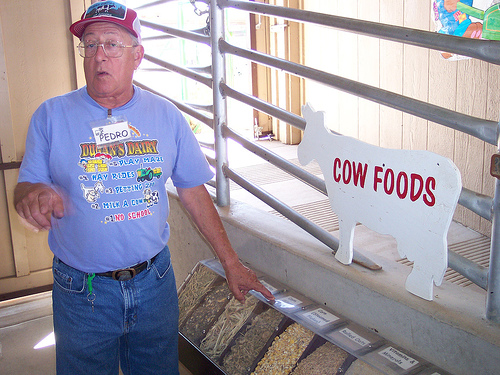
Feeding grain to livestock
Corn, wheat and rice prices have all soared in recent years - this has been attributed to a number of factors, including:
- rising input prices for fertiliser, pesticides and diesel fuel
- the use of grain to produce biofuels
- adverse weather events like the Australian drought significantly reducing production
- commodity funds and other speculators on the markets
- "hoarding" and export restrictions being put in place (particularly for rice)
- productive land being built over by expanding cities
- increasing demand for grain courtesy of an increasing population
- increasingly affluent consumers in Asia increasing their meat consumption
 While there is a lot of debate about which factors are the dominant ones in the price rises that have occurred so far, it seems clear that reducing demand would go some way to keeping prices down, and that finding alternative sources of protein would be one way of achieving this.
The Food and Agriculture Organisation of the UN publishes a World Food Outlook in May and November each year. The November 2007 edition shows that about a third of the grain produced (750Mt) is used as animal feed - compared to around 350 Mt that was used for biofuels (hat tip to Kiashu for providing the data).
| 2005/06 | 2006/07 | 2007/08 | Change: 2007/08 over |
|
| estim. | f'cast | 2006/07 | ||
| million tonnes | % | |||
| WORLD BALANCE | ||||
| Production | 2 051.4 | 2 009.4 | 2 108.9 | 5.0 |
| Trade | 246.6 | 255.4 | 251.5 | -1.5 |
| Total utilization | 2 037.6 | 2 062.4 | 2 105.0 | 2.1 |
| Food | 982.5 | 997.5 | 1 008.7 | 1.1 |
| Feed | 748.7 | 735.9 | 739.6 | 0.5 |
| Other uses | 306.4 | 329.0 | 356.6 | 8.4 |
| Ending stocks | 471.4 | 428.0 | 427.0 | -0.2 |
| SUPPLY AND DEMAND INDICATORS | ||||
| Per caput food consumption: | ||||
| World (kg/year) | 152.2 | 152.7 | 152.6 | -0.1 |
| LIFDC (kg/year) | 156.9 | 157.2 | 157.0 | -0.1 |
| World stock-to-use ratio % | 22.9 | 20.3 | 20.2 | |
| Major exporters' stock-to-disappearance ratio % | 19.2 | 15.0 | 13.5 | |
Another 101 Mt of oilseeds (out of 404 Mt total) is turned into "oil meals and cakes", which is primarily eaten by livestock.
It is worth noting that not all of the animals fed end up on our dinner plates (or in hamburger wrappers) - dairy cattle are also included here and their milk production is another output from the use of these agricultural commodities.
Artifical Meat and science fiction
Artificial meat is a topic usually left to science fiction writers (see Kornbluth & Pohl, H Beam Piper, Samuel R Delany, Frank Herbert, Rudy Rucker or John Brunner for some examples), with a "meat beast" (or some other form of artificial protein produced in a vat) gracing the bowels of many spaceship kitchens and basements of remote arcologies, where raising livestock isn't an option.
Soylent Green is probably the example that comes most readily to mind, but this isn't really appropriate, as that meat wasn't artificially grown of course.
Where's the beef ? Is anyone seriously trying to make this stuff ?
Science fiction isn't usually meant to be predictive, so its surprising to see this sort of idea being (somewhat) seriously considered here on Earth in the present.
While PETA may or may not just be performing a publicity stunt, there does appear to be some research underway in this area, which is known as "In vitro meat".
There are basically two approaches for producing in vitro meat; loose muscle cells and structured muscle, with the creation of structured muscle being far more challenging than the former.
According to Wikipedia:
Muscles consist of muscle fibers, long cells with multiple nuclei. They don't proliferate by themselves, but arise when precursor cells fuse. Precursor cells can be embryonic stem cells or satellite cells, specialized stem cells in muscle tissue. Theoretically, they can be relatively simple to culture in a bioreactor and then later made to fuse. For the growth of real muscle however, the cells should grow "on the spot", which requires a perfusion system akin to a blood supply to deliver nutrients and oxygen close to the growing cells, as well as remove the waste products. In addition other cell types need to be grown like adipocytes, and chemical messengers should provide clues to the growing tissue about the structure. Lastly, muscle tissue needs to be trained to properly develop.
A number of teams are actively pursuing the cultivation of in vitro meat.
In 2001, dermatologist Wiete Westerhof from the University of Amsterdam and businessmen Willem van Eelen and Willem van Kooten announced that they had filed for a worldwide patent on a process to produce in vitro meat. A matrix of collagen is seeded with muscle cells, which are then bathed in a nutritious solution and induced to divide. They have now set up the InVitroMeat Foundation to promote the idea.
Jon Vein of the United States has secured a patent for the production of tissue engineered meat for human consumption, where muscle and fat cells would be grown in an integrated fashion to create food products such as beef, poultry and fish.
A group at the University of Maryland has participated in some experiments for NASA looking to grow meat during space flight, and is also looking to develop processes for terrestrial application. This group of researchers started the non-profit organization New Harvest, with the goal of promoting development of in-vitro meat. They claim cultured meat in a processed form, like sausage, hamburger, or chicken nuggets may become commercially available within several years.
In April 2005, a research project into cultured meat started in The Netherlands. It is carried out under the lead of Henk Haagsman at the University of Amsterdam, the Eindhoven University of Technology and Utrecht University, in cooperation with sausage manufacturer Stegeman. The Dutch government granted a two million euro subsidy for the project. In Amsterdam the culture medium is studied, while the University of Utrecht studies the proliferation of muscle cells and the Eindhoven university will research bioreactors.
A tissue engineer at the Medical University of South Carolina has proposed a countertop device similar to a bread maker that would produce meat overnight in your kitchen.
In recent weeks we have even had the world's first international conference on manufacturing meat.
Advocates for in vitro meat claim it is safer, healthier, more humane and less polluting to produce - as well as being one way of adapting to rising demand for food and constraints on the supply of inputs to traditional industrial agriculture. But one question remains, should a commercial meat production process ever be put into action - can we get past the "yuck" factor ?
Cross-posted from Peak Energy
Contact
- anz at theoildrum dot com
License

This work is licensed under a Creative Commons Attribution-Share Alike 3.0 United States License.
Archives
- November 2010 (2)
- October 2010 (5)
- September 2010 (4)
- August 2010 (8)
- July 2010 (2)
- June 2010 (2)
- May 2010 (6)
- April 2010 (7)
- March 2010 (12)
- February 2010 (11)
- January 2010 (7)
- December 2009 (10)
- November 2009 (6)
- October 2009 (7)
- September 2009 (10)
- August 2009 (10)
- July 2009 (3)
- June 2009 (14)
- May 2009 (10)
- April 2009 (15)
- March 2009 (16)
- February 2009 (16)
- January 2009 (15)
- December 2008 (15)
- November 2008 (23)
- October 2008 (25)
- September 2008 (24)
- August 2008 (30)
- July 2008 (44)
- June 2008 (38)
- May 2008 (48)
- April 2008 (43)
- March 2008 (29)
- February 2008 (32)
- January 2008 (30)
- December 2007 (26)
- November 2007 (32)
- October 2007 (11)
There's a wonderful scifi story by Arthur C Clarke where the meat produced in vats turns out to be one almost everyone today, regardless of religion or lack of it, would be reluctant to eat... :)
The important question, though, is what's in the "nutrient solution"? It may be that vat-grown meat wouldn't reduce the required inputs much. Logically it should reduce the required inputs because you're only supporting the meat, not the bones, brain, blood and guts - but then, it might need more concentrated stuff.
For example, according to The Rapid Growth of Human Populations, one-third of the world's wild fish catch goes to farmed fish. According to this powerpoint presentation, wild fish catch is about 76Mt, and farmed fish are 36Mt. So if 25Mt of wild goes to help produce 36Mt farmed, the net gain is actually 11Mt.
Thus, fish available for human consumption are not 76Mt wild + 36Mt farmed or 112Mt, but 51Mt wild + 36Mt farmed or 87Mt.
Who knows about the inputs to this vat meat? We'd have to see some proper write-ups of it, rather than just enthusiastic news pieces.
Local teenager did work experience at a trout farm. He said he couldn't wash off the stink of oil from sea mackerel used to hoodwink the trout to eat grain pellets. Some caged salmon farming around the Tas coast uses probiotics and is exposed to heavy metal plumes from upriver mines. I suspect calories/fossil inputs << 0.1 the EROEI of most foods.
We're all supposed to be healthier if we restrict our animal protein to 100 grams a day or somesuch. I'm thinking a plate of stewed turnips topped with a fish eyeball. The way things are going with global meat consumption the Japanese will have a taller basketball team than us.
Dunno about synthetic meat but the global livestock herd should be greatly reduced, with particular emphasis on cutting out grain feeding. OK maybe a few oats for Melbourne Cup runners. Rather than just a source of meat (wool, leather, recreation etc) I think hoofed animals should be moved around a lot. They could reduce the fire hazard of park land near suburbs and turn roadside weeds into manure for the garden. We'd get used to seeing flocks of animals swarming down the street. After all soon there won't be so many cars.
It's late, I'm not going to look this up, but I think that the ~100 gm calculation comes down to nutrient balances.
Your "average" adult, excretes a certain amount of nitrogen per day... the breakdown products of cellular metabolism. To replace that, a source of nitrogen is needed. Protein is the richest source of N in the omnivores diet. To provide all the nitrogen requirements while maintaining the requisite balance of essential amino acids (ie those we can't make) a minimum of just over 100 gm of high quality protein is required. Eggs are a good source. But then you miss out on those good fish oils. And every diet needs just a little fat.
NB These calculations are for adults. Growing children are a different story.
Like anything, over consumption bad, under consumption bad. A little bit of everything.
The book, Omnivores Dilemma is a reasonable read. PETA probably hates it.
Okay everyone a reality check.
Ruminant animals (like cows) have multiple stomachs that act as fermenters to digest cellulosic plant material. They evolved as grazing animals that can digest and get energy out of material that most animals (mono gastric, one stomach animals) can't use. Modern feed lots have substituted grains (mostly corn) to improve weight gain and feed efficiency for profit reasons in beef and milk herds. It makes meat and milk faster, and until recently, cheaper than allowing cows to graze grass the way their physiology was designed to do.
I don't disagree that most westerners could use less meat in our diet. That misses the point however that meat has been historically cheap because grain has been historically cheap. This has produced an over supply of meat in western countries (keeping the price low) that is produced in a non sustainable way. Putting more grazing animals back on pasture lands rather than, say growing pasture land for cellulosic ethanol, could help moderate the rise in meat prices and encourage farmers to be good stewards to the land.
There are many studies out of the University of Wisconsin that high intensity rotational grazing practices are both good for the animals and good for the soil. But these approaches are labor intensive and only scale so far. They are not competitive with enormous feed lots when grain prices are low.
So my point is don't try to take the animal out of the equation but change the farming equation so that more sustainable practices have an advantage. Food and grain prices may be doing this already but it would be nice to have a concerted policy for planning. Lastly, westerners probably eat too much meat but much of the world doesn't get enough meat protein, but that is an economic problem (distribution of resources) that I don't have a solution for no matter how meat protein is created.
Great exmple of the absolute facile rubbish that certain members of society now have time to waste on thanks to the fossil fuel supported inputs to the rest of their lives. Peak oil is going to make factory farming unviable in pretty short order so I think we will all be forced to reduce the amount of meat we eat anyway. It won't be replaced with this sort of hi tech mush which probably needs a source of animal protein in the nutrient mix.
Ah a breath of sanity! If we're that worried about animals and fish, etc., which we'd not have to be if we're get our own population down, and if we don't want to eat nice creatures like chickens and cows and pigs, then we really ought to get over our cultural taboos about eating bugs.
Bugs look cute but they are basically little robots. There's really no soul to a bug, more of a flow-chart. There's not "anyone" there to wrong, in eating a bug. And generally they're tasty, a real treat. As non-Western cultures will attest. And you can raise them at home. They're not generally smelly or messy, and their manure can be used on the garden.
These high-tech "solutions" are BS,
... WTF?
Or we could just eat less meat. Billions of people eat very little, and manage not to keel over instantly.
I don't think we need eat roaches. But if that's your thing, by all means go for it.
Without wanting to encourage our doomer friends above, I feel the need to point out that some people do eat bugs - in Cambodia I saw people snacking away on fried spiders and roaches quite happily.
http://www.flickr.com/search/?w=all&q=fried++spider&m=text
Truly whoever manages to perfect such a process will have created something new and useful for society. Alas, I may never be around to see it.
Now if you'll excuse me, I'm going to go prepare my Quorn sandwiches for work tomorrow.
:-)
I was going to mention Quorn (mushroom based stuff) but decided it was drifting a little too far away from the topic...
Just on the Quorn... we can get an idea of what might be required to produce this kind of "food". All the inputs are highly refined.
I'm not saying it's more or less energy intensive than intensive meat production... but let's not assume that becuase it's fungus grown on glucose + growth medium it is.
And of course, in the US, the glucose comes from...?
There are quite a few vegetable protein sources that are near complete - maybe complete?.
Quorn loses my vote since:
They put egg in it - so it must be crap on its own
Its damn expensive
Horrendous packaging overheads etc.
I can't blame them though for trying to increase their sales. It tastes OK. Really the public should embrace this stuff.
So where is:
QUINOA
Nutritionally, quinoa might be considered a supergrain - although it is not really a grain, but the seed of a leafy plant that is distantly related to spinach. Quinoa has excellent reserves of protein, and unlike other grains, is not missing the amino acid lysine, so the protein is more complete (a trait it shares with other 'non-true' grains such as buckwheat and amaranth). It contains a good supply of complex carbohydrate and it is low in fat. Quinoa contains more iron than other seeds and grains and contains high levels of potassium and riboflavin, as well as other B vitamins. It also contains folic acid and vitamin E. It is also a good source of magnesium, zinc, copper, and manganese. It is gluten free.
Information provided by Dr Joan Ransley, Lecturer in Nutritional Epidemiology, University of Leeds
http://www.vegsoc.org/cordonvert/articles/quinoa.html
http://www.realseeds.co.uk/grains.html
The info out there is published by 'enthusiasts' or suppliers.
Solid science published on this is damn hard to find. There is presumably little in the way of research, or maybe the info is so straightforward that no research is necessary.
FWIW, my observation is that some people survive well on a meat free diet, others lose health.
I have never seen a table published of what plant combinations add up to complete protein. All you see repeated is 'beans and toast' add infinitum.
Can anyone supply this data?
For the past 25 years or so there has been a debate, largely confined to the vegetarian community, about whether "protein complementarity" makes sense as a practical nutritional concept at all. There's no question that you need all the "essential amino acids" and that plants have these amino acids, which can't be manufactured by the body and are thus "essential" in the diet, in differing quantities. The question is whether this matters, because even the amino acids in the least quantity in (say) corn are still supplied in sufficient quantity to meet the minimum requirement.
Check out this flyer which I wrote years ago:
http://compassionatespirit.com/protein.htm
I did calculations some 25 years ago and came to the conclusion that at the current U. S. requirements for each of the amino acids, almost all plant foods (if consumed exclusively and alone to provide all your calories) would give you both enough protein and enough of all of the amino acids. Among vegetarian advocates Dr. John McDougall is the most prominent supporter of this position.
The more traditional position, advocated by the American Dietetic Association and others, is that protein complementarity is needed but not at the same meal. As far as I know, there is no particular evidence to support this, it is just maintained because the idea, adopted by "Diet for a Small Planet," that "protein complementarity" is necessary for plant foods, is the traditional one and it has never become hot enough an issue to be debated. I am fairly confident that if this were to happen, the whole concept as a practical issue would disappear.
I would emphasize that you DO need all of the essential amino acids and you CAN be protein deficient, just that as a practical matter protein balancing is not necessary. If you're getting enough calories, you're getting enough protein unless you're an alcoholic, eating nothing but cassava, something like that. If you're getting enough protein, your proteins are balanced unless you're eating mostly grapes or some other foods. The easiest way to be protein deficient is not to get enough calories. I managed to do this once myself, without knowing it, when I first became a vegan.
http://compassionatespirit.com/vegetarianism-and-genetics.htm
By the way (citations in my book "A Vegetarian Sourcebook"), they have done studies in which they fed people diets of corn alone, potatoes alone, wheat alone, or rice alone. These diets are not adequate for other reasons (like not enough vitamin C, for example) and so you would not want to eat such a diet on a regular basis. However, they were protein adequate and provided all the amino acids.
Keith Akers
Many thanks, that is very useful information.
Yes - thanks for those comments.
Regarding potatos, I vaguely remember some spud advocates claiming man can live on potatos alone.
Random links - its the year of the potato
http://www.potato2008.org/en/index.html
http://www.csmonitor.com/2008/0507/p17s02-hfes.html
http://www.treehugger.com/files/2008/04/can-the-potato-save-the-world.php
I had a feeling this post (from Peak Energy) was going to make it over to TOD today. Well done Gav.
I pretty much restrict myself to chicken and occasionally ham and fish these days. As I understand it, its red meat that's the real problem. Putting aside the cruelty factor, battery farmed chickens are actually a pretty efficient way of producing protein.
Cattle waste an enormous amount of the energy in the grain they eat through body heat and methane gas emissions in burps and flatulents (the energy in manure is usually recovered as fertilizer). Cattle methane emissions are a major source of green house gases and global warming; this no BS. Same is true of many animals grown for food.
Then a lot of diesel and natural gas is wasted in refrigerating and transporting meat.
"Diet for a Small Planet" of the early 1970s summed it up pretty well. The solution of course is to eat the grain, or sprout it for more vitamins and protein. Sprouting is easy and fun, and sprouts are tasty :).
Then to make the energy waste stuff worse, many "modern" cultures take human "waste" and dump it into rivers. Human urine and feces make good fertilizer, why dump them into the rivers, damage estuaries, and disperse good fertilizer into the ocean? In the old days, in the dark of night, the outhouse hole in the ground was filled with water and the stuff was pumped out onto the fields for fertilizer-- called "night soil."
Uh oh, I see another problem. Peak oil and peak natural gas are here now, and very soon we will not have the diesel and electric power needed to treat sewage effluent. Untreated fecal matter will be dumped directly into the rivers. Those people living down stream will be drinking water that has a very high bacteria count. Most people will get serious intestinal infections, and worse. Without antibiotics, a lot of people will be very sick and many will die. No BS. One wonders, how did we come to waste good fertilizer in a manner that will soon kill millions of us?
It's not just cattle that waste a lot of energy eating grain. Hogs and chickens do the same. The wasted energy has to be replaced with imported oil at a much higher price.
My nemesis is the hog factory of which there are six within a 3 mile radius of my house. The stench is horrific in the summer if the wind is from the wrong direction.
Those who oppose ethanol for environmental and EROI reasons don't seem to understand that the corn will then be used for animal feed, either in the U.S. or abroad. What is the EROI of a pig, cow or chicken? It makes ethanol look like a bonanza.
I've read several comments posted at The Oil Drum stating that human urine and feces make good fertilizer. I wonder, though -- doesn't all of the various medications that people ingest contaminate this type of fertilizer? And what about disease -- bacteria and viruses from sick people could end up in the food stream this way. Or is that not possible? I don't recall anyone addressing either of these, and I really have no idea. Can anyone speak to that?
How about the book "The Humanure Handbook" by Joseph Jenkins?
The medication issue is one of the reasons that recycled drinking water from sewerage plants is often rejected on health grounds. The water may be biologically fine to drink, but the chemical poisons introduced by the mountain of modern medicines that are currently consumed in the west is not necessarily taken out by treatment process. There are plenty of other things put into the sewerage system as well that may not make for good fertiliser once it comes out the other end.
There are composting toilet systems available which kill all the pathogens and provide an excellent compost mix for the garden but they are controlled by householders who know or should know exactly what the original inputs were.
I think the jury is very much on the side of continuing with centralised sewerage for overall health benefits than risking some of the waterborne diseases that come from improperly treated sewage. There may be ways to recover more nutrients at the plant and if Super phospahte gets any more expensive, some enterprising water authorities may start to look at this as a way to squezze a few more bucks out of the infrastructure. Happy eating.
GeoffC is spot on re the usefullness or otherwise of Homo Sapiens (in my book - Very Dangerous Monkey).
Merv_NZ,you would be well advised to read Cormac McCarthy's "The Road".Perhaps you then would not be so ready to flippantly dismiss a statement of the bleeding obvious.
I think McCarthy will be recognized as one of the most prescient of Western writers.Certainly "The Road" is the equal of Orwell's "1984"
Another chemical that water can have is cafinee. Some of the tea/coffee/soda does pass unproceesed by the body.
Humans waste an enormous amount of heat and energy and produce a whole heap of greenhouse gases, and they're generally good for nothing. Lets get to the root of the problem instead of messing around on the fringe.
Hi GeoffC
If we can get around the legal hassles, I'm sure that I could find a place for you in my compost heap. This will surely improve next year's pumpkin crop so that I can grow bigger and tastier pigs for the table of another "good for nothing" human.
LMFAO = laughing my - - off
I think this has already been done,guys.
http://www.foodfacts.info/mcrib/
Is that crackling?????.....mmmmmmm
whatever happened to the movement to make meat substitutes out of fungi, like yeast or mushrooms? Or even out of some kinds of algae? It could be flavored in various ways for people's appetites, and besides, I like the taste of mushrooms and yeast myself. Although things like oatmeal make the best soil for mushrooms, they can grow quite well using wood waste (like they do in the woods), so they would be much easier to "farm". A food like that would be a lot simpler to make than trying to cultivate masses of animal cells in an artificial medium, and would be much less susceptible to dangerous bacterial contamination. Bacteria would grow like crazy in a warm solution of animal cells.
Many of our fungi buddies are quite high in protein---
I am a avid mushroom hunter (Northern Cal), and eat wild mushrooms all winter, and am a member of the SF mycological society.
The English and the Americans are fungi phobic, which makes more for me!
Hightrekker - when I am back in the Bay Area, planning for next summer, let's get together! I love mushrooms but am afraid to pick and eat 'em at random, and in fact I have to suppress the childish glee found in kicking 'em over when found on a lawn or in the park.
My new "professional bum" lifestyle should give me real wealth, time, to do things and learn things.
One poster above mentioned a mushroom based meat substitute - Quorn :
http://en.wikipedia.org/wiki/Quorn
Ah some one beat me to the Tempeh comment, Yes the Indonesians have been making tempeh, since moses was a boy. It is usually made from Soya Beams but it can be made from any fatty legume, Chick pea Tempeh is very delicious. When using a different bean you need to use a different culture. It is not unlike yogurt, which is also cultured. The main reason why we dont know about it is because it is regarded as poor peoples food and people are embarrassed to admit they eat it. If your rich you eat Water Buffalo Meat.
Fungi's position - take complex carbs (plant cell walls) and convert them into protein.
Research Oyster mushrooms. Note how straw can be converted into feed for livestock.
(And off the topic of fungi)
And as I can't make a comment on the main page:
Vat grown meat - I can see 2 issues.
1) Prions. If the vat becomes infected with prions - what will be the testing and cleaning process?
2) Virus infection. Examples of this is how batches of vaccine have been infected and made useless in the past years.
http://digg.com/environment/A_protein_possibility_for_oil_we_eat_the_fak...
http://reddit.com/info/6ipb1/comments/
As oil becomes more and more expensive, a portion of the population of the U.S. and Europe will start walking and bicycling much more than before.
They may actually eat _more_ meat than when they were sedentary, especially if they want to build strength for possibly long 5x/week bicycle rides.
It would behoove (no pun intended) those in leadership positions to focus on food for human consumption and _not_ biofuels...and also to consider the possibility of higher levels of exercise and the related caloric consumption.
Veganism? Unless they have a perfect protein balance and abundant calories, a vegan is going to have a hard time with the endurance and recovery to bicycle to and from work 5 times a week on a route of any distance more than maybe 10-12 miles. Some can do it, but the balance is quite hard. Lacto-ovo vegetarians get sufficient protein, however.
The prices of eggs, milk, and whey protein have been rising noticeably.
Leadership is sorely needed to assure a food supply for humans that is not diverted towards biofuels. That leadership needs to be cognizant of possible changes in food consumption patterns as large segments of the population become more active. Demand for things like eggs, chicken, wheat, oats, oils (e.g. olive) will rise, while demand for refined carbohydrate foodstuffs may stay flat or go down slightly.
Personally...I eat lots of chicken, eggs, and fish....and beef/pork only occasionally.
Is it any wonder that every nation wants an Kalashnikov (AK-47) factory? Seeing this, I think most of us would rather fight it out and then become cannibals over the bodies. How absolutely disgusting....I will agree that if you aren't willing to kill it, skin it and butcher it yourself, you don't deserve to eat it, BUT is there no shame to this vegan garbage?
PETA Member
People for the Eating of Tasty Animals.
You seem to be suggesting we need leadership to tell us what to eat, how to live, how to behave and obviously how to think. If you look around you will see a situation created by "leaders" passing the cost of their lifestyle on to everyone else, yet you say we need more of the same?
People may eat more meat when they cycle, but they don't need to. Meat's not needed to build strength, and in any case strength isn't needed for bike rides, but rather fitness. And there's no rule that the cycle to and from work must be at top speed the whole way. See this Copenhagen cycling blog for examples of people just cruising along... the guy says that you can always tell the foreigners in Copenhagen because they're the ones wearing "cycling" clothes.
Meat consumption is cultural and wealth-based. New Zealanders have 1-5% (depends on who you believe) of trips by cycle, and eat 142kg of meat and fish each annually, the Dutch have 30+% and 89kg, the Danes 30+% and 146kg, Australians 2% and 113kg, and so on.
Basically, if you're a wealthy First World country, or part of the upper class in a Third World country, you'll tend to scarf down 100+kg of meat and fish each annually, whether you're biking or driving or walking or cartwheeling or whatever.
I know four very keen cyclists, each of whom cycles no less than 200km a week. One is vegetarian, one is a light meat-eater (2-4 meals a week, and small portions), the other two are regular Aussies - big meat-eaters. There's no significant difference in their cycling performance. The light meat-eater has the lowest bodyweight, but that's because she's single, lives alone and generally eats not much, though she is extremely fit and in good health.
The human body is pretty resilient and versatile in its dietary stuff. It can handle everything from McDs every day to "macrobiotic organic free range vegan."
Anyway, the average Aussie car uses 1,250lt of fuel a year, producing 3,500kg of greenhouse gases. The 100kg of meat consumption is responsible for about 1,000kg emissions, depending on the mix of meat and fish consumed. So if you replaced all your driving with walking and cycling, you'd have to eat 350kg of meat annually for your meat-sourced emissions to equal that of your driving emissions. It's physically possible to eat a kilogram of meat a day, but I doubt it'll be terribly common. So overall we're definitely better off, in emissions terms, by walking or cycling.
If you just putt along, you use surprisingly little energy bicycling. If you're a "scorcher" you'll use more.
Basic transportation cycling is possible under a variety of diets.
I'm pretty sure that macrobiotic organic free range vegans are rare enough to be on the threatened species list so you're not allowed to eat them, that's as far as I'm going.
Your job may not be 10-12 miles from your house post PO. You may not have one. Gives you more time to raise om chooks for meat and eggs and manure for the veggie garden. Persaonlly I think aquponics has some great merit too, along with guinea pigs and rabbits grown in the backyard for variety. 100gms of protein per person per day should be easy.
I am a Vegan and have run two marathons in my late fifties and regularly run over 6 miles every other day in my early 60s. I certainly did not notice any decrease in endurance or strength after I transitioned from being a meat eater. I guess my protein must be perfectly balanced. I could, of course, be a freak of nature.
I would be interested in any studies you might be able to link to which would demonstrate your assertion.
Sssssh! Get those facts away from him! Really he only eats a burger every day so he can do the Tour de France some day! :p
Always some peculiar and interesting stuff at TOD.
Vat-grown meat is certainly a PETA PR strategy in this case... and it worked!
Problem is, well there are a lot of problems, but one that comes to mind is acceptance. I recall a story about some meat company - Hormel? - doing research that showed they could make hotdogs and stuff with a lot less grain if they raised rats instead of other animals. They even ran some wording past their PR folks... "selected rodent meats", etc.... but concluded there was no way they wouldn't wind up referred to as "rat dogs" and avoided like the plague.
Eating bugs is pretty efficient... hell, with termites you can feed 'em cellulose and fry 'em up for high-protein gruel. A little curry powder, a little coconut milk, and presto, you've got something to feed the neighbors while you're in the next room covertly eating your hoarded SPAM.
Then again, we already have "organ donor" cards established. Rather than having cannibalism be an adversarial process, how about a bonus of some kind for leaving your body to the sausage factory? National Lampoon had a nice article - maybe in the early '70's - about product names to be used when selling dogfood made from foreigners. Maybe in the case of "ethical cannibalism" like this, products like "Fogeylinks" or something would be accepted.
There's gonna be plenty of meat in the world, what we have here is a marketing problem.
The 1970s National Lampoon kicked ass. I'm just old enough, and my Mom just permissive enough, to have seen a glimpse of the greatness.
Rats are eaten a lot of places, just not generally in the US. However I do know a guy who killed a rat in his shed with a knife, and in keeping with some sort of principle, cooked and ate it. He provides a full set of photos - the dinner plate with meatless bones is hilarious.
Remember: Vote Papoon, and Poopaine!
On various other threads, especially on Drumbeat, there has been discussion of this point of view as being an obsolete and incorrect paradigm that is in the process of changing because of recent review and analysis of nutritional research. My own view is that meat is generally the primo food and people would be healthier with a larger proportion of meat and fat as opposed to carbs in their diets (sugar is the real baddie). This does pose a dilemma for the 'small planet' diet. The root problem, as always, comes back around to over population. Regardless of one's views on diet, it would be easier to maintain a healthy diet with a lower planetary population.
There are no solutions, only strategies.
This PETA initiative is a good effort, but a tough sell. Over at KC's Rib Shack in Manchester, NH http://ribshack.net/ they sell T-shirts that say "PETA -- People Eating Tasty Animals," and their advertising says stuff like: "Horrifying vegetarians since 1998;" "We decided to have a healthier joint, so we offer CPR;" and "We made a deal with the other restaurants around here, they don't offer anything that tastes good, and we don't offer anything that's healthy." This is American culture and it will be hard to change. Peak oil, however, will soon mean that meat will be very expensive, so the effort is timely and can ride the wave of reality.
I have some favorite non-meat, non-dairy, very healthy foods: Westsoy Unsweetened Soy Milk and Westsoy's Unsweetened Chocolate Soy Milk is delicious; pasta primavera made with Ronzoni whole wheat fussiloni (spiral shaped) extra virgin first press olive oil, fresh veggies and shrimp and chopped clams on the side; soy burgers or soy hot dogs with bread and butter pickles, lettuce and tomato, salsa, and mustard. Got any good ones to share?
"There's gonna be plenty of meat in the world, what we have here is a marketing problem."
Thanks that's the funniest thing I've heard in awhile.
"Peak oil, however, will soon mean that meat will be very expensive, so the effort is timely and can ride the wave of reality."
Of that I have no doubt, but I think the states will go the way of the third world, ie chickens, goats and cows everywhere grass grows. My farm friends tell me that goats are much easier to keep than cows, too bad the meat isn't available in more places, it tastes better than beef.
Peak oil also the reason you learn to get it yourself, 1 bullet vs 40-60lbs of vension is a pretty good return on investment. If things get really bad, that Canada goose or squirrel in your backyard can keep you from starving in a worst case.
I'm reading a lot of comments straight out of the popular press of how eating less meat, especially red meat would be so good for us. This is nonsense. Only meat has the complete set of 20 amino acids (and making your body manufacture missing ones is inefficient). Going to a heay grain diet, in addition to making all of us shorter (1.2 metres in the middle ages), will skew our blood metabolism away from protein, towards higher sugar levels, diabetes, high LDL cholesterol and cardiovascular problems --all are a direct outcome of a low fat diet.
You see, all food is protein, fat or carbohydrates (sugar) --and most protein is bound with fat, like it or not. Cut out the protein (meat) and you greatly increase the proportion of sugar in your diet (the fact it might be "whole grain" does not alter this fact 1 iota).
Red meat from a grass fed (not an agribusiness grain fed) animal has substantial quantities of omega 3. Without meat, people will be shorter, more spindley-limbed, be prone to diabetes and many would have an inability to put on muscle no matter how hard they exercise --something I learned the hard way during 7 years of vegetarianism.
Our planet is an overcrowded fish tank that is running out food with the nitrate (air pollution levels) rising. There are probably no viable solutions except the one Nature will impose on us. The problem of protein will be solved when only the quick and the dead are left.
Such claims require sources, and an explanation of how many billions of people around the world lack significant amounts of red meat and yet are not 1.2m tall and lacking vitality.
If squirrel was good enough for Elvis it's good enough for me...
Nick.
Unfortunately, when the trucks and interstates no longer carry grain from the Midwest a lot of people will eat every animal that moves (and some that don't move -- :), and thus the tasty critters won't last long. Most people will starve, that is those who hadn't already died of exposure (no fuel oil, no natural gas, and not enough wood around, few wood stoves, dead chainsaws, and no trucks -- back to the ax and saw, while they last, and then???).
What happens when you run out of bullets? Better get a crossbow and figure out how to make em and make the bolts (arrows)too. So don't let your meat loaf. Hey, we need some humor here. Anyone got any meat jokes?
Goats, looks like a good idea, but...... I visited a farm last summer, just to see what I could see in the future. Lots of manufactured stuff, a lot of it made from oil, manufactured with the help of oil, natural gas, and coal, and all of it transported with diesel and gasoline. Plastic water bowls, plastic water pipes, fiberglass roofs, medicines, glass, cement, lumber, wire fencing, etc. None of this stuff will be available, not to mention what the people need to live. Looks like it's time for some risk management planning. I've gotten to the meat of the matter, no??? :) :) :)
Forgetting about whether a person feels it's ethical to eat animals, it is important to remember that meat animals were historically raised because it was the best (and often only) use of the land or resources to produce high quality food. Massive confinement of animals is a really recent invention.
For example in the mountainous area of northern California where I live, row crops aren't possible but there is a great deal of range that is suitable for cattle. It could be argued that the land should be allowed to remain open for just the critters but that's another ethical issue.
Todd
I think the argument that it is immoral to cause needless suffering of animals is valid. So I basically will only eat organic meats (I know that the standards need significant changes). But I am not against eating meat per se, just as long as the animals' suffering is minimized and their death is relatively painless. This has left me a de facto vegetarian since it is not easy to get organic meats here. I still eat eggs and milk (organic), and eat that Yves cold cuts for lunch (veggie ham, veggie salami, veggie baloney tastes fine to me). Between milk, eggs, beans and veggie protein I don't miss cutting down on meat at all and I figure I'm getting plenty of protein. If the standards for humane meat production were made law I'd probably eat more. It's unconscienable that the laws for humane treatment for animals that you and I have to follow with our pets is waived in the case of big business factory farms.
The PETA prize is not that motivating to the companies pursuing this.
$1 million is how much chicken the KFC franchise sells in about 5-10 minutes. It is about how much chicken one chicken restaurant sells in a year. The PETA prize is only for chicken that can pass a fried chicken taste test and be selling in ten states commercially. If a company could pass the PETA tests then $1 million in chump change.
http://nextbigfuture.com/2008/04/1-million-prize-for-commercial-in-vitro...
Most companies and researchers are targeting the easier goal of ground meat and sausage filler, luncheon meat etc....
In terms of the yuck factor. People eat many things that are less like food like twinkies or things based on chemicals. There is also meat slurry.
There are plenty of points of meat substitution can occur where there would not be a yuck factor. You do not have to target the pure steak market until you are really good at it.
http://nextbigfuture.com/2008/04/meat-factories-food-substitution-and.html
For energy (like this site and readers care about.) in vitro meat can be 4-20 times more energy efficient than cow meat the old fashioned way. Plus with gene therapy of the stem cells in vitro meat hold the possibility of being healthier for the eater.
So those who care about their energy footprint should look at this in 4, 5 or 10 years when they are expected to be selling.
"meat slurry" ????
I don't even want to think about what this is...
Meat slurry is part of chicken nuggets (like at McDonalds)
http://en.wikipedia.org/wiki/Meat_slurry
A meat slurry, reconstituted meat, or emulsified meat, is a liquefied meat product that contains fewer fats, pigments and less myoglobin than unprocessed dark meats. Meat slurry also eases the process of meat distribution and is more malleable than dark meats.
Meat slurry is not designed to sell for general consumption; rather, it is used as a meat supplement in food products for humans, such as chicken nuggets, and food for domestic animals. Poultry is the most common meat slurry; however, beef and pork are also used.
some other Poultry science
http://www.uga.edu/news-bin/artman/exec/view.cgi?archive=8&num=3497
So people can say yuck - invitro meat.
But deep fry it and call them McNuggets.
http://www.mahalo.com/Chicken_McNuggets
4.8 Billion Chicken McNuggets are sold annually
Soylent Green anyone ?? or maybe ethanol ???
http://tinyurl.com/6qgvyo
I read a book on the Irish potatoe famine circa 1850 a few years ago. Irish peasants back then subsisted on avg 8 pounds of potatoes per man per day and apparently thrived having families of 8 or 10 children and performing hard labor all day in the fields. When the potatoes rot came they were forced to live on turnips and blackberries. That's when the famine began. Recently I read a newspaper article that claimed they ate potatoes AND milk. My question to anybody out there, maybe of Irish descent, did the Irish peasants back then subsist solely on potatoes (which are adequate human nutrition in sufficient quantities when eaten WITH THE SKIN) or did they have some animal protein/fat in their diet also?
Apparently (according to the article below) potatoes lack calcium and Vitamin A, so you need some milk to supplement them if they are all you eat.
http://www.american.edu/ted/potato.htm
Not sure if the skins contain the missing elements...
How about some green leafy veggies and carrots?? Humans have not been consuming for long, and it is pretty foul stuff, animal fat, hard on digestion, and generates a lot of bovine and human methane gas, bad for global warming, and very stinky too :)
At the end of the day, humans will eat what humans want to eat and/or have access to. PETA's efforts are a waste of time. It will be an incremental change of little or no consequence to how many chickens are killed each year.
Humanity' *socially* evolved eating living things. There is virtually no society, no culture that doesn't involve some form of animal injestion. Probably the biggest block of veggies out there lives in India. And few of them are vegans, I might add (Go Yogurt!). Most Indians eat meat (Lamb, Chicken, Fish).
I have to assume that once all the faux-chichen is in place, PETA will push for a ban on the sale of chicken. At that point PETA will be over as a serious organization.
Personally, I'm in the "other PETA": People Enjoying Tasty Animals. I like my meat. Rare. Raw in some cases. Should I eat less meat? Yes. Should I eat no meat? No.
David
Pure Methane is odourless.
Hydrogen sulphide on the other hand...