
 | The Bullroarer - Tuesday 6th May 2008 | The Oil Drum: Australia/New Zealand | The Bullroarer - Thursday 8th May 2008 |  |
$100 a barrel: Going, Going....
Posted by aeldric on May 6, 2008 - 7:00pm in The Oil Drum: Australia/New Zealand
This is a guest post by Phoenix, an engineer working in the energy sector, and a friend of mine for well over 3 decades.
In January 2006 Phoenix emailed me a spreadsheet that predicted an oil price of $100/barrel by 2008, followed by an ongoing geometric rise in oil prices. I remember immediately phoning him to point out that the scenario was impossible because it is unsustainable - $100/barrel would cause economic havoc comparable to the oil shock of the 1970s and if a geometric price progression followed, then no economic recovery would be possible and... well, I recall using the phrase “rioting in the streets inside of 18 months”.
As we know, oil hit $100 in January 2008 and kept climbing, surpassing even Phoenix’s predictions. So when Phoenix offered to explain the model that generated those numbers, I leapt at the opportunity. Here is the story of how Phoenix became Peak Oil aware and generated his Price Calculator.
Click to Enlarge
Going, Going .... Gone
So what’s a barrel of oil really worth?
At the start of 2006 I became peak oil aware. Most of the readers of TOD will have lived through the turmoil of concern and dismay that this realisation usually brings on. In the months following, I proceeded to digest as much information on the topic as I could. However, after a time I noted that, while there was an abundance of predictions on amounts of oil and the depletion rates, there was little in the way of forecasts as to the future oil prices that would result.
At that time (and still today) I was an avid believer that the consequences of oil depletion will unfold as an economic crisis rather than as direct impacts from the shortage of energy. This being the case then why was there virtually no debate or a plethora of predictions as to the long range prices?
Perhaps everyone was relying on the output of the IEA for such forecasts? A quick review of the IEA numbers at the time was distressing. They were forecasting a drop in the price back to the US$40-$50 range. Even worse, world governments were probably using these predictions to set energy, social and infrastructure policy. I decided for my own piece of mind, to attempt to generate a simple model for predicting the long range oil price.
Basic Theory
Traditional oil market economic theory seems to be modelled around the notion that the price for a commodity is simply a reflection of the input costs. Markets, while they may experience temporary upsets due to imbalance between supply and demand, through the forces of competition will correct themselves so that prices are governed by costs.
Being an engineer rather than an economist I felt at liberty to toss the above theory out the window. It seemed to me overly reliant on the concept that the world was infinite and that markets always have the capacity to expand to meet demand.
Instead I started from the premise that the production of a commodity is limited. Of all those people vying for the commodity someone inevitably will miss out. They will not be able or willing to pay the market price. The price then will be governed by the maximum amount that this person is prepared to pay.
Supply
The starting position for the model was the prediction of oil supply rates over the future 30 years. As mentioned above there are many, many predictions concerning these numbers. I had to select one based on a consensus of the data available. I used a simple bell curve with the following parameters:
- peak of 85 Mbpd in 2007
- ultimate remaining capacity 850 billion barrels
- standard deviation set to give a depletion rate of 2.7 % by 2020
I am sure there will be a range of views on the veracity of these numbers.
On top of this base supply number I had to account for the growth of alternative fuel substitutes that will inevitably develop as the oil price climbs to a point that makes them viable. Predicting the capacity and ultimately the take-up of these alternatives is a little tricky. I lumped these into two areas:
- Alternative fossil based fuels (Oils sands, Coal to Liquid and Gas to Liquids)
- Renewable fuels
Against each of these I assigned an estimated * maximum capacity that was achievable and a price sensitive take-up rate.
Demand
As indicated above my basic premise for the model was demand destruction due to price sensitivity. To facilitate this I divided the demand into a number of economically predictable groups. This division was somewhat compromised by the necessity to obtain current consumption rates for these groups. The first division was made between OECD and non OECD countries. Within this I divided into the following sectors:
- Personal Transport
- Public Transport
- Heating
- Industry
- Shipping
- Air Transport
- Military
- Power Generation
- Products
Even this list involved a degree of interpretation *of the available data on consumption.
Against each of these sectors I assigned * a price sensitivity profile. As far as I have been able to research there is no definitive numbers or reported figures for these profiles. In my research I have come across a number of reports that provide indications for particular national groups. Where possible I have ensured that the profiles I have used are consistent with these reports. For the most part, however, these numbers are based on my personal experience and the experience of some of my associates. This is not ideal but it is the best I could do.
Model
I constructed the model in spreadsheet form. It simply compares the demand and supply and determines the price level necessary to suppress the demand to meet the supply. I have set the model up on a yearly period going out to 2040.
Results
Having run the model for the last two years I have noted the following:
- The results while fairly accurate in emulating the observed market price for oil, do not take into account a number of distorting factors affecting the market. These factors include, supply disruptions and the human factors (greed and panic) that affect any market.
- The prices are on a 2006 USD basis. I subsequently added an allowance for inflation into the analysis. Anyone want to take a guess at what inflation will be in 30 years time? I have used a consumption- weighted figure between OECD and non-OECD current inflation rates and applied it to all future years.
- There will be an increasing trend for governments to hoard and lock up future supply. I have made a very rough attempt to * forecast the volume and timing of this factor in the spreadsheet. My view is that by 2030, all traditional oil sources will be subject to this government interference. Hence the above curve only represents the market price up till that time.
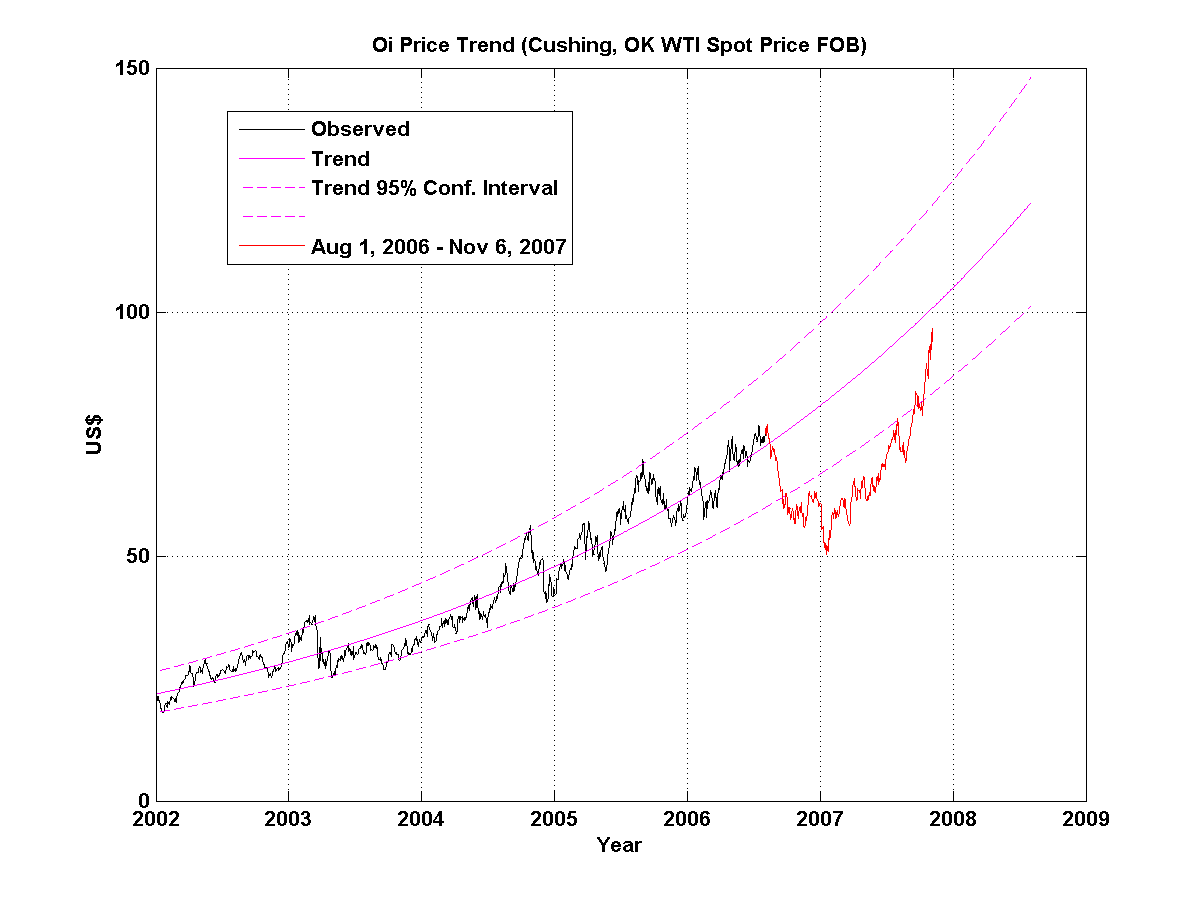
See the oil price prediction curve below:
Click to Enlarge
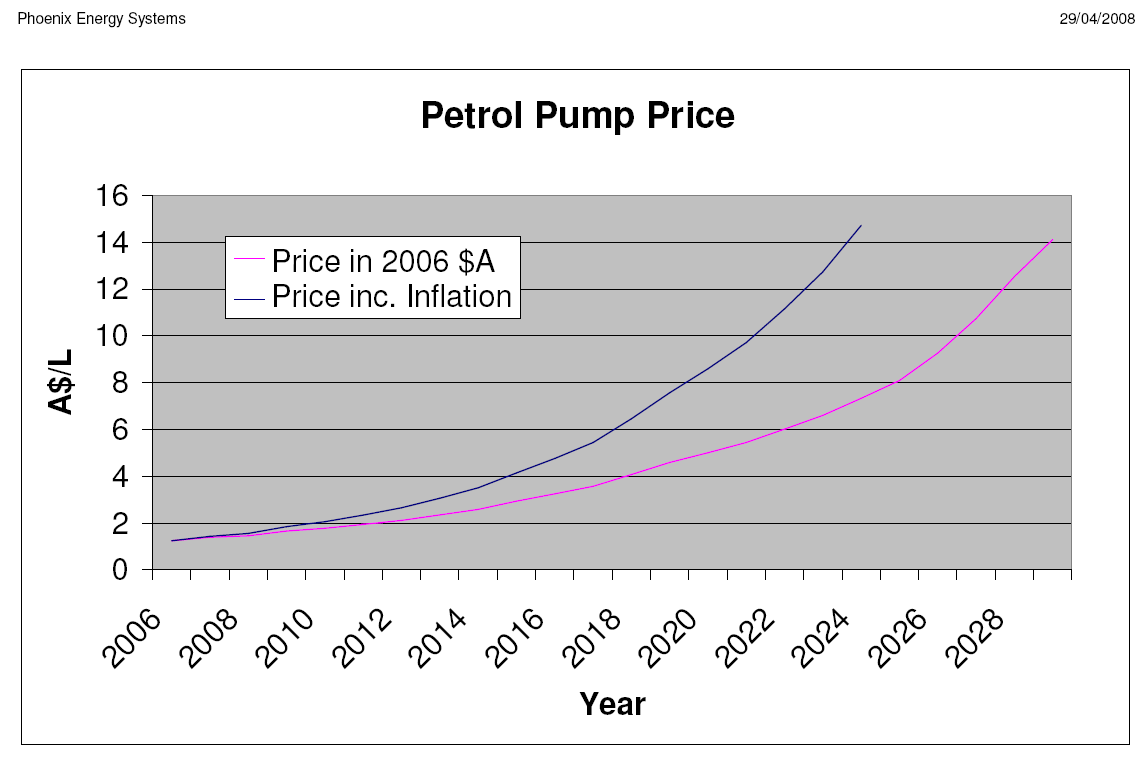
For Australian readers I have translated these numbers into a predicted pump price for petrol.
Click to Enlarge
Future Development
As can be seen from the above, the model generated suffers from a number of limitations (highlighted by *). For the most part these limitations spring from the extremely limited resources available to an individual. Yet despite this the results are considerably better than the IEA predictions.
In order to improve the accuracy of the model I intend to undertake the following revisions :
- Further division of the demand sectors with a separation of China/India from the non OECD group.
- Generation of separate sectors for essential services and perhaps agriculture in order to get a clearer idea of the likely effects government intervention may have on the demand.
- Incorporation of feedback on secondary demand destruction resulting from economic slowdown.
I hope the above curves form a useful discussion point for TOD members.
Contact
- anz at theoildrum dot com
License

This work is licensed under a Creative Commons Attribution-Share Alike 3.0 United States License.
Archives
- November 2010 (2)
- October 2010 (5)
- September 2010 (4)
- August 2010 (8)
- July 2010 (2)
- June 2010 (2)
- May 2010 (6)
- April 2010 (7)
- March 2010 (12)
- February 2010 (11)
- January 2010 (7)
- December 2009 (10)
- November 2009 (6)
- October 2009 (7)
- September 2009 (10)
- August 2009 (10)
- July 2009 (3)
- June 2009 (14)
- May 2009 (10)
- April 2009 (15)
- March 2009 (16)
- February 2009 (16)
- January 2009 (15)
- December 2008 (15)
- November 2008 (23)
- October 2008 (25)
- September 2008 (24)
- August 2008 (30)
- July 2008 (44)
- June 2008 (38)
- May 2008 (48)
- April 2008 (43)
- March 2008 (29)
- February 2008 (32)
- January 2008 (30)
- December 2007 (26)
- November 2007 (32)
- October 2007 (11)
Good post. I don't have any data precise data (no one does), but my years of experience, the research that I've done on Peak Oil (not allowed to reference my report here/stuff gets deleted/but you can find it), and common sense tell me that your forecasts are too conservative. Oil could hit $1000 in a few years after the peak, especially if some of the dire oil production decline rate projections turn out to be correct, see Jim Kingsdale's review of this: http://www.energyinvestmentstrategies.com/peak-oil/
and also the German Energy Watch study: http://www.energywatchgroup.org/Oil-report.32+M5d637b1e38d.0.html
ASPO is going for a slower production decline rate: http://www.aspo-ireland.org/index.cfm?page=viewNewsletterArticle&id=43
We will see soon enough, and even if you are on target, it's going to be a rough ride down. Hold on, cause alternatives are not coming to the rescue. Clifford J. Wirth
I would tend to agree. Even with oil at $120, large inefficient vehicles are still being sold and fleet efficiency is hardly budging.
I would expect a series of dramatic increases, followed by price plateaus as demand is destroyed to meet the new level of supply. We will get to 100 mpg plug-in hybrids by 2030, and if we do, we could support a oil price of $1000 per barrel because we will be using so much less per individual. Just imagine: $25 gasoline. Ouch!!
CLZ09:
This comment is, I feel, a little too pessimistic. What we need to do is look at the leading indicators and allow for lags. "Fleet efficiency", for example, is a function of all cars on the road. Given the way SUV sales were booming through the 90s & even until about 2005, we could expect fleet efficiency figures to be dropping as old, pre-SUV cars go to the wreckers. In these circumstances, having fleet efficiency being static is an indicator of how the graph is actually beginning to turn.
Second, sales of large inefficient vehicles are dropping. In Australia the local vehicle manufacturing industry is in hot water because it's based on making large 6 cylinder cars. Sales of 6 cylinder cars have been dropping markedly. Mistubishi has closed its factory. Ford & GM Holden have cut production and staffing. Ford has also announced plans to begin making four cylinder cars here - though it will probably take a couple of years for them to tool up.
Looking at the remaining buyers for 6 cylinder cars, they're mostly fleet buyers. If a car is sold to a households, it will be kept on the road for 20 years or more, probably going through 3 or 4 owners in that time. Fleet (note: this is a term used in the vehicle industry and is different from the usage of "fleet" above) vehicles, however, are usually run a lot harder and often are written off after about 3 years. At a certain price point for petrol, fleet buyers will shift away from the Falcons & Commodores en masse and the effect on average fuel consumption will be fairly rapid.
In Melbourne, the rising price of petrol has provoked a major switch towards public transport, to the extent that the sytem is now running at capacity. The newspapers are full of bitter complaints about over-crowded trains, so it is clear that even at present prices, there is considerable latent demand for a switch in travel modes. Invest in public transport and watch travellers fill the trains & trams as fast as you put them in service. As petrol prices increase, this will become an even greater pressure and will eventually overpower the road lobby.
Finally, the rising price of petrol is causing an increase in the geographic price gradient of real estate in major cities like Melbourne & Sydney. The first effect has been a reversal of the long-term trend for a decline in population density in the inner suburbs. This will accelerate. At a certain petrol price, people will decide that they are prepared to live in a shoe-box if that's what it takes to let them travel to where they need to be (e.g. work, study, essential services). While the outer suburbs will be full of McMansions that the owners can't give away, the city, the inner suburbs and certain other favoured locations will fill up with people rapidly:
* Luxury hotels which will go broke because of the collapse of the tourist trade will be converted to residential accommodation;
* People with large homes in inner suburbs but who are thrown out of their job through recession and/or Peak Oil undermining the economics of their industry will have rooms to rent. Before the inner suburbs became fashionable, there were many large houses which had been built 100 years ago as expensive homes for rich people, but had been converted during recessions to boarding houses. This phenomenon will return;
* High petrol prices will also bring about a resurgence in medium and high density development. Not only will demand skyrocket for good locations (as noted above), but fewer people will be able to afford to go up-market with renovations etc. The general level of maintenance of the housing stock will therefore decline and houses that come up for sale will therefore be a good deal more likely to be bought by developers.
There are some factors which will act as flies in the ointment, though. First, the Save Our Suburbs mob will do their level best to keep out the riff-raff by preventing medium-density development. Eventually their cries of NIMBY will be overwhelmed, but they'll be a drag on the inevitable adjustment process. Second, so much of the modern housing stock is based on open plan design, which assumes that energy is virtually free. Doors will come into fashion again when people find that they can only afford to heat one room in winter. This will be expensive, though, to retro-fit to all modern and renovated housing.
So, I'm not as big a doomer as many of the commentators here. People will adjust, though not without a lot of pain and even a substantial dose of bankruptcy. But adjust they will. If a couple have jobs that take them long distances in different commuting directions, one may decide to take a lower-paying job a lot closer to home because they'll come out ahead after transport costs are deducted. And so forth. People will have to adapt to a new lifestyle, but adapt they will.
You are probably right about the fact the significantly higher prices are possible.
The model I have generated is premised on there being a free and fair market in oil. There is no allowance for supply restrictions or market speculation simply because you cannot sensibly predict the effects of these actions. I prefer to think of these graphs as a floor price and these other unpredictable factors will drive the price higher than this level on occasions. The frequency of these occasions will grow over time.
Giddaye, Clifford (I see your name pop up a bit around the place).
I'm one of those Average Joe / Average IQ blokes that stumbled across the notion of PO sometime last year (curse that film, "A Crude Awakening"!). As a father of three, all I care about is my kids future, so have been taking an interest in sites like TOD to try and get some sort of handle of where the world is headed.
While I agree fuel prices could be seen as an indicator the PO notion is happening, I still find it difficult to accept for very simple reasons: The MS papers, radio, TV stations don't acknowledge it; very, very few of my friends, family or colleagues had ever heard of it (P. Coyle? Who's that? was one response); my mechanic doesn't believe it; and the owner of the local petrol station just rolls his eyes and says, "Nah, there's plenty of it left".
So I guess I'll just move on, business as usual and all that, wish all you TODsters the best and get back to sleeping properly at night. If nothing else, your stories have been great reading!
Regards, Matthew Blain (Melbourne, Aus)
Hi, Joe Average.
It's good to remember that there is always a lag between the discovery of new knowledge and when it becomes generally known.
As the price of oil continues its rise and if you should choose to come back to visit, you'll be welcome.
-Andre'
Matthew,
I recently went to a seminar where Richard Neville (hippy futurist)spoke about listening to the weak signals to really get the full picture. MSM does report on Peak Oil but they report the symptoms rather than the cause. You just need to learn how to read it. Drumbeat and the Bullroarer are fantastic summaries but theere is a motza of other stuff out there, which appears completely unrelated to oil, but if you follow the threads will lead back to oil.
At some point someone in a position of power is going to crack and say "What the hell is going on with oil. Don't keep feeding me the bullshit, I want to know what the deal is with $300 barrel oil. Why is it that high? it didn't just happen by itself. There must be a root cause" Then the MSM will be all over it and if if you have not prepared yourself by then, it will be too late. Options for the masses to make better living arrangements will rapidly close.
Journey Well.
Matthew Blain,
Well, First off I've got to say 3 things.
1. Your mechanic and petrol station are not a reliable source for economics or petroleum geology.
2. The average person doesn't give a shit or care, on average.
3. It has been all over the mainstream media if you've paid attention, but the MSM only puts entertaining like paris hilton on the front cover.
4. Seriously, if you wanted advice about your children would you listen to the MSM, your colleagues, the owner of the local petrol station owner or your mechanic, do some research and figure it out for yourself mate?
Let me ask you this?
Why would Bill Clinton, Warren Buffet, T Boone Pickens, Matthew Simmons, The CEO of Conoco-phillips, the Former VP of Saudi Aramco Sadad Al-Husenni, The VP of Lukoil Fedun, The President of Total, The CEO of Shell and 10 Congressmen, Several Mayors and cities and volumes of respected petroleum engineers, geophysicist and petroleum geologist all be concerned about peak oil while you shouldn't? Most people don't take the time to do the research but that's fine because their loss can be my gain. Good luck though
Swords,
Just finished watching "I Am Legend" with the wife (why'd it have to turn into a zombie movie?!) and thought I'd check in one last time before bed. It occured to me, might the bleakness of the first half of the movie be an exagerated expression of what life might be like after a few more decades of business as usual?
And that's my point. To me, an Average Joe with limited sources such as yourselves to converse with (further - and not to offend - it doesn't help that I don't know any of you from a bar of soap, much less all the respected names you mention) and though I completely understand Mother Nature only produced so much of the stuff, the concept of Peak Oil doesn't FEEL REAL to me. I'm not saying PO is nonsense - indeed, a tipping point makes perfect sense - it's just that at this point in time I find it difficult to accept: THAT LIFE AS WE KNOW IT MIGHT BE COMING TO AN END?!
It almost feels like an idea for a movie, a good yarn... Actually, as it stands, a conversation killer!
Swords, I AM concerned (about all sorts of things) and HAVE been trying to figure it out, which is why I've been visiting here these past months, as well as e-mailing local media figures (the sensible sounding ones that is, though not much return there. Even tried someone at ASPO - forget who - without answer). The trouble is I'm no rocket-scientist (clearly!), or a person of power or influence, or someone "in the know" and as far as the research goes, most of what you guys write about goes way over my head.
But even as I see oil hit $122 a barrel, while record car sales continue in this Land Down Under, I think what can I do about it anyway? Get smarter? How's that going to help? So FOR THE MOMENT, as I look out for the front-cover headline somewhere above the picture of Britney Spears, "World Running Out Of Affordable Oil", all I can hope is that you guys (and gals) are missing something.
But if you're right, at least I won't be surprised.
Cheers, Matt B
For the record, I take the education of my kids very seriously. The eldest (school captain last year) is at the pointy end of her class in an accelerated learning program - also plays a great game of tennis; and her little brother is hot on her heals. Such opportunities kids have these days. I hope they continue.
Matt,
I have three kids too and they all have great talents. But I don't sit around and passively hope anything for them. I take them out gardening. I teach them how to read whats happening around them to give them a bit of rat cunning. I teach them how to cook and how to use google to suck up as much knowledge as they can,just in case. I've adopted the no regrets appraoch to life. I don't teach my kids to be afraid of the future, I am teaching them how to be prepared for wahtever comes down at them.
You sound like you're just a little too attached to your comfy middle class lifestyle and not quite ready to accept the possibility that it all might go sideways any time soon.
As Phoenix says in his opening paragraph, all of us have gonne through a moment of shocked disbelief as we have absorbed Peak Oil and its potential ramifications. The truth is none of us really know what the future holds. By exploring the scenarios however you can learn a little bit each day and start to mitigate bit by bit.
I'm sure your kids are great tennis players, and I'm sure you're proud of them. BUt you need to ask yourself this question: If TSHTF have I done enough to give them the necessary skills to survive and prosper in a world where the oil ration is going to be severely curtailed?
And I don't buy your Joe Average excuse either. You seem like a pretty articulate guy to me. I suggest you go into Dymocks and buy The Long Emergency by James Howard Kunstler. Read it, absorb it. Take a week off work and recover, the come back and join us here on The Oil Drum for counselling and support.
OK Termoil, you've convinced me to keep the door open. But if it's OK, I'll still try and get some answers from local personalities - finance talking-heads, editors of motor magazines, presidents of car associations and the like (perhaps I'll even write to a few ministers, not that I'd hold much hope - the Australian Government can't even make a decision whether to ban plastic shopping bags or not!).
For the record, I read David Strahan's "The Last Oil Shock" late last year, which pretty well supported everything I saw in that film. Probably need to read it again along with your book suggestion. Also read Richard Dawkins', "The God Delusion" recently... Who's right and who's wrong about such things?
At the end of the day, it's still trusted faces and headlines that will convince me.
Thanks for replying, Matt B
PS. Don't Average Joes exist in "Middle Class"? That is, Average / Middle? I guess I am pretty handy with a trowel and hammer!
You read books. That alone puts you way past the "äverage" joe.
In my area, Northwest US, people fall into two categories when you talk to them about PO: those who have never heard of it and think you're a kook; and, those who have heard of it, don't believe it, and think you're a kook. Perhaps a lot more people would believe we have a PO problem if the powers that be in GOVERNMENT (not industry --> "gougers" -- and not Peak Oil Theorists --> kooks) would put their PR fears aside and make an unequivocal statement that PO is here and we have to get serious about the problem. Of course, fat chance of that happening...
In the meantime, they are merrily buying SUVs and giant pickups -- and getting great deals!
Thank you for sharing your model. I like the pragmatic engineering feel of it. FWIW in my personal experience as an engineer, your approach often yields a very close model to actual for at least short time frames of 2-3 years. In years out beyond that, more possible error, but empirically it sure looks like some parts of the base model are dead on. The whole competition for finite resources is core to your model and is what I expect to occur. I wouldn't give economists a second of thought or any respect. As some later commentator put it, they'll come around in a few years but the conservative nature of most highly paid economists is detrimental to making progressive insights using the frightening data that is accumulating now.
I did a conversion to USD per gallon and you can simply multiply A$/L by 4 to get USD/gal. I think the gasoline prices in USD/gal sound reasonable too. It keeps sneaking up over the next few years but by 2016 the hurt will be felt by most in USA (they'll feel it sooner than that but realization that TSHTF is really spraying brown all-day, every-day will likely take much longer, IMHO :-/ )
I agree with other posters, if you would be willing to share the actual Excel spreadsheet, this would radically help more discussion and evolution of the model. I'm not sure if you are seeking recognition or using the model for personal gain & planning. It really is a good chassis and could foster more development and thinking. So please dare to share. (Not to mention clog up TOD for a while with hot discussion :-)) It would be fun to watch though!
Interesting work.
Is it possible to share the actual figures on the assumptions you have made, especially the rate of renewables substitution?
The substitution rate is not as simple as a fixed dependancy on oil price. Unfortunately it also has a significant time lag. I have tried to model this time lag.
In terms of real numbers I have a total (renewables plus substitutes) of 6.3 Mbpd by 2020.
Thanks for the reply.
I understand that you are in a somewhat delicate position being employed within the industry, but I wonder if it would be possible to post the spreadsheet showing all figures and assumptions?
Anonymity would still cast it's kindly cloak!
Anyway, many thanks for what you have so far shared and the valuable insights it gives.
This is impressive work, using sterling logic. It is limited only by the lack of accurate information.
I was wondering if you might explain what role a bell curve plays in your calculation. I did not realize that statistical analysis was required for a prediction of this kind.
You point out that, in a hard-scarcity situation, a commodity price is set by the threshold at which successively stronger low bidders drop out of the market. That simple point should be disseminated. I hope it receives some attention in the world press.
Sadly, in the U.S. no major media company is likely to publish anything so terrifyingly clear and logical on the subject of commodity allocation. Any such revelation might rattle the cage of denial in which we USA-ans are expected to remain confined indefinitely. The real sin against "patriotism" here is to reveal some fact that threatens to discourage the populace, even momentarily. Like any confidence game, the "demand-driven economy" is mortally afraid of reality.
Well, I'm a reporter with Wired, and I'm (at least) thinking about it... (Not to derail the main discussion but here's the problem with something like this making it into the MSM: A) It's hard to know how to get into a story of this magnitude as B) editors are not exactly prone to running stories about models C) from anonymous sources, even ones that clearly have done some great thinking and analysis.
If Phoenix were willing to go on the record with his energy background fully presented and send his model to some economists or other specialists, etc. Then we could really get a story going. Just saying.
I am an analyst with one of the Big Four. Phoenix's model would not survive contact with our economic analysts because:
1. It is still too immature and relies heavily on guys in the industry providing a "best guess".
2. It flies in the face of everything we have assumed thus far.
The fact that phoenix's model has made better predictions than anything that we have come up with is really immaterial at this time. I am not trying to denigrate my colleagues - they are intelligent, hard working and generally open to new ideas. Eighteen months or two years from now they will be willing to talk about this idea. But not today.
I will contact phoenix and ask him to reply to you, but all of us have jobs. We need to buy farmland out in the country, install watertanks etc. A "career limiting move" might not be what phoenix has in mind. Anyhow, I will contact him and let him speak for himself.
The ABC news tonight had two separate price predictions Goldmans: $200 and CitiBank: $40.
I think one of them needs you Phoenix - great post.
...and the last time I heard oil prices mentioned on CNBC they called it a bubble...at what price point does that end, $200 or $40? I think they are going to stall until one or the other is reached...too much rides on their opinion, like advertisment revenue associated with a rising stock market.
Once they stop calling it a bubble, it will burst..
Think contrarian.
Sixteen years ago, while attending a composites conference, I sat next to the Director of Advanced Engineering for GM. I told him that if he wanted to see a paradigm shift in his industry, he needed to hire some farmers, because farmers solve engineering problems all the time but most haven't been to engineering school, so they don't know the "correct" way to solve a problem. They go ahead and solve the problem anyway, often in very creative fashion, because their minds are unconstrained by conventional ways of thinking.
I've noticed that economists tend to have a very narrow education, being grossly lacking in botany, biology, anthropology, geology and environmental science in general. I wouldn't be too concerned about the evaluation of industry economists of Phoenix's oil price model. It's obvious that the entire industry is caught in a rut, a particularly virulent example of group think, and will have to be rescued from the outside.
Fred Schumacher
retired farmer
member, Mankato (Minnesota) Peak Oil Task Force
Alexis,
Here's the rub, or the caution, having economists review the theory. There are some that would be willing to look beyond orthodoxy, but they will surely be countered by the traditional "balanced opinion."
I feel somewhat qualified to comment on both areas as I am an engineer and I minored in economics. Phoenix's perspective is dead on about the traditional economic models that seem to be based on infinite supply. I had the same gut feeling this wouldn't measure up in the long run.
Wired hasn't been shy about publishing controversial subjects, but I guess this hits too close to home for many. Frankly, I don't like looking at those price projections either. I think there has to be some major disruption to cause a redefining of the model (i.e. war on a major multi-national scale).
A result of my undergrad thesis was the very beginning of dynamic modeling technology. The postulate based on experimentation and good old number crunching was that highly complex systems cannot be defined by a static model over time. The boundary parameters can remain static, but their functional relationship can change, thus causing a reshaping of the functions such as feedback, motive force, output level, etc.
In retrospect, it could be the physical proof of the axiom linear thinking is dangerous.
I would hope influential academics and professionals would take your model into serious consideration. Too bad being just plain right versus far off straight line projections ought to be enough. It is sad, really sad that prurient interest is more important than fulfilling one's duty to the public good which is a cornerstone of professional obligation.
I can't wait till I get my model together what I found is that complex systems post peak are almost impossible to model but they fall into two major groups collapse and a exponential decline. The latter arises from the central limit theorem. The former from the massive amount of coupling that takes place when a complex system becomes resource constrained especially if the resource is not renewable or has a renewable rate greater than the consumption rate. Despite the literature on collapse most of the approaches fall into a predator prey model that only deals with one type of feedback loop. I've not been happy with the literature on the collapse of complex systems. I've come up with Nate Hagens with a concept of coupled logistic functions that get steeper over time as extraction rates increase. The final collapse is the result of effectively eating the last supply of the resource with the final logistic. The nice aspect is it seems to keep both consumption rate and the population of consumers high right to the bitter end.
More generally it seems that the system becomes a group of coupled harmonic oscillators with increasingly steep wells or increasing frequencies. Think of turning a thousand amped microphones sitting together on cranking the amplifiers and the feedback loop.
A experiment I'm keen to perform :)
The opposite case of a exponential decay is a group of oscillators that become uncoupled and generally widen effectively disappearing over time although they are uncoupled so some can sharpen and disappear. But in my opinion this requires a really slow change like a decaying climate. If you think about it post peak aggressive moves will be made to decouple the global economy as fast as possible so the decoupling case is easy to understand and it matches the central limit theorem thus collapse must be the coupling case by default the central limit theorem actually eliminates all other cases except the one where it does not hold i.e coupling.
In any case I'm giving away my punch line to prove collapse you only need to prove coupling and thence the central limit theorem does not apply.
Could somebody interpret memmel’s manifestos for me? It’s as if he transmits FM and I receive Betamax. I like his ideas, but I often feel like I’m bobbing for an apple when I read his posts.
No disrespect intended to memmel, it’s just … I’m not getting it.
Fractional Flow left me feeling the same way. Other drummers helped me get the goosebumps. So if you “get” memmel, could you restate his ideas in your own words? Thanks.
Cold Camel
Heh, you said exactly what I was thinking :)
My take on memmel's post was that "coupling" is another word for business-as-usual globalisation, with economies based still on provision of credit, on just-in-time deliveries over large distances instead of stored inventories, on "growth".
By clinging tighter and tighter to those BAU methods, society will in affect be pushing down on the accelerator and careering headlong over the PO cliff ... at which point the finance system is irretrievably broken, JIT has failed, and the debt for our pursuit of infinite growth has been called in -> sudden and precipitous collapse.
"Decoupling" is a move away from globalisation & back to localised economies. Personally I doubt there's many places in the western world that would be capable of this - we've all become hooked like junkies on international trade to supply things we can't grow/build/pump ourselves. That aside, if an economy is decoupled its less prone to a domino-effect crash, but suffers from its own limits.
That's my take, which may or may not be more readable than memmel's post, and may or may not interpret his words correctly :)
Well, a complex system could fail in two ways. One of them is failing completely, when a small failure of one component leads a biger failure of another and so on. This way, everything goes down quite fast. The other way is from partial failures, where failure of one component leads to a smaller failure of the others and so on. This way, you have some troubles, but will end with a set of simpler systems at the end.
Also, he describes a precise mathematical model for both kinds of failure and proposes that the model may help we discovering what kind of failure to expect.
For non specialists some of the terms need defining for this to make much sense.
I look forward to when you have the time to lay your thoughts out in more detail.
The one which springs out as needing definition are 'central limit theorum'
The distinctions between the two models and how they relate to the central limit theorum are also unclear, as is the relation between this and other posts indicating that collapse would be fairly limited.
I think I have the general drift but can't be sure.
Just saw this and thought I may be able to help...
The central limit theorem (CLT) is a result in statistics that describes the result of averaging independent random variables. Roughly stated, one version of the theorem says that the average of N independent outcomes of a random variable with finite variance (a technical assumption), will approach a normal (gaussian) distribution with variance that scales as 1/N. Think of flipping a coin a large number of times, counting 1 for heads and -1 for tails, and averaging the result. The central limit theorem says that the average will behave like a bell-shaped distribution around zero, where the variance will decrease as you increase the number of times you flipped the coin (the chance of the average being far from zero will get smaller as you increase the number of times you flipped the coin).
This result only holds if the trials are independent ... imagine flipping 100 coins that were somehow glued together so that they all landed heads or tails together. Then the CLT would not apply, and the average value of the experiment would not typically be close to 0.
I think this is what memmel was referring to with coupling ... if global systems are decoupled then the outcome of collapse in one location of the earth will be independent of the outcome of collapse in a distant location, so one could use the CLT to get an "average" collapse condition that would make sense (i.e. many areas would be close to the average condition with high probability). But if the global system is "strongly coupled" through trade or financial networks then the outcome of collapse in different locations will not be independent, so it is more difficult to describe an "average case" outcome. Or, as the CLT wouldn't apply, there may be no reason to expect that the situation in any one place would be close to the "average case". We would all sink or swim together.
If I've misinterpreted what memmel was saying, I apologize.
Thanks for the reply.
In that case then you would have a whole range of likely outcomes depending on the degree of coupling - results are strongly normalised for a sequence of 100 coin throws, but less so for 10.
There is also the thought that although the collapse in a strongly linked system might be universal, the outcome might not be, as within particular societies the degree of linkage will vary.
For instance, some are nearer to subsistence agriculture than others, so the result of a collapse might be a return to the village, whereas other societies are much more heavily dependent.
IOW a universal collapse might itself imply the creation of a less strongly linked system, so at later stages a whole variety of results will obtain.
The effects on someone living in New York City will be different to those in small-town Middle America, although the impetus might be common.
Nah, sorry didn't help but thanks for trying!
Thats exactly what I'm saying I should add that most people think that WestTexas's ELP ( Economize,Localize Produce) concept makes a lot of sense from my approach it seems to have very strong mathematical support. Somehow it seems he nailed it.
But the reason I was more generic is this does not only apply to economies it also applies to oil extraction. How oil is extracted once a region has past peak is strongly coupled in many ways. The first coupling is simply attempts to maintain and increase production at the global level regional production effects price etc. If you buy into a coupled global economy then you realize that the oil industry is the most highly coupled global industry on the planet.
Think about that for a bit.
Memmel
Your model sounds similar to the work done by Didier Sornette to use complexity theory to predict earthquakes, which he has then used to understand stock market crashes and housing crashes. I didn't investigate all the maths, but the basic signal was an overall up trend with an oscilation about the trend of increasing frequency. My guess is that your coupled logistic functions might come up with the same type of signal, but I may be reading too much into this.
Still the article is intersting anyway if you want a different view to how stock markets work from the standard economic textbooks.
Long article
Shorter article with charts
Jeremy
Hi Jeremy,
Thanks. My short Q: has the oscillation held as predicted? WRT oil, I don't know but my impression is, it hasn't, really. Just up and up.
I don't have the link but for whale oil found this but its not the original.
http://www.energybulletin.net/3338.html
The price range was 200-1500 a barrel. Pretty much in the range ware are talking about for initial post peak prices.
I'd say we are in the very early stages of post peak oil pricing. Simple analysis of disposable income and the lack of change in demand avert a 500% increase in price means that we have not even come close to prices levels that cause
demand destruction. If I had to guess we won't see the oscillations until oil is over 300 a barrel at least.
A better metric is when the world is clearly down by at least 2mbd and its obvious that we are probably post peak.
This is the point that real post peak pricing fluctuations become possible. Right now I'd say the market is slowly realizing that oil might possibly be a precious non-renewable resource.
Your links are fakes :)
I found this.
http://www.jsmf.org/grants/cs/essays/2000/sornette.htm
I did not find the actual theory paper but will dig.
Thanks.
alexismadrigal,
I was thinking about MSM attention to the idea that limited supply necessitates price increases until the necessary number of bidders drop out. (More precisely, the sum of bidders dropping out multiplied by the quantities not purchased by each of the dropouts, must equal the shortfall.)
This is a good approximation as long as the wealthy purchasers do not change their buying habits much.
Since the US, as the largest consumer, is not yet dropping its usage significantly, I suspect the price will continue to rise until there is some demand destruction here in the US. If that is true, we will see the price continue to rise in the near future.
Your forecasting the price of oil to be about 150$ by the end of this year, that sounds about right to me. Although you might want to take into account falling net exports which will decline faster than production. The total production doesn't matter much compared to whats available to buy on the oil market. I'd like to see your results once you include that. If you need some resources on that you should check out the Export Land Model or ELM. Good Work
http://www.theoildrum.com/tag/export_land_model - post on ELM
These are a very scary set of predictions but to evaluate them, I guess we need to see your assumptions on demand destruction and alternative growth rates.
From a technical perspective there are a variety of technologies that provide transportation with a far smaller liquid fuel requirement and various alternative fuels that could replace crude oil. The question for both is what is the take up rate for them?
Can you show us some graphs with these assumptions too?
I can imagine 20 KB/day CTL in Australia by 2010, rising to 100-200 KB/day by 2015 and many hundred KB/day by 2020.
Those prices would make such ventures astoundingly profitable.
The problem with CTL and Tar Sands and other such alternative fossil fuel and renewable ventures is while if the fixed cost of operating such a venture remained the same then yes they would remain pretty darn profitable. However, such higher oil prices is going to feedback into the system and make these ventures not a profitable as one might think. The cost of energy is going to drive up the cost of all the materials and stuff required due to inflation driven by energy. The profits are not going to be as insane as anyone thinks because they think in 2008 based cost and 2020 based profit...
Australia used 877000 barrels of oil a day in 2007. That is 140m litres. 200k barrels is 1/7th of 1%. Probably will not matter one way or the other.
That's 200,000 Barrels per day of CTL, so that's around 22% of 877,000 barrels per day.
OK, I'm convinced -where do I put my money... :o)
[Or put another way: which CTL companies look set to make a killing, I know of only one: Sasol of South Africa]
Nick.
I covered CTL (particularly in Australia) recently here:
http://anz.theoildrum.com/node/3817
This is good work, but not very useful since you don't account for falling exports. Exports will decline faster than production. By 2030, global oil exports will be approximately zero (refer to WestTexas's ELM).
Can you redo your calculation considering exports instead of production?
Also, I don't think any model will be valid after everyone comes to know about peak oil. In about 5 years I expect governments to intervene and impose rationing, etc. which will change the dynamics and invalidate the simple demand/supply model.
Either way, please keep up the good work.
Phoenix's numbers do not go past 2030 because he agrees with you. He refers to it in different terms, but a full explanation of everything that goes through your head as you write would lead to a 20,000 word article (a problem that I struggle with regularly).
Taking into account the way consumption is prioritised due to limited supply (ie country of origin, then military, then government, then agriculture, then industry... etc) is possible with this model, but sadly phoenix has a day job... so it may take a while.
I have read some of the work on the ELM and agree with much of the conclusions. The concept of ELM is that export nations will essentially separate themselves from the world market for oil. My model is based on the idea that the price you pay for a barrel will be the same in Australia or the US or Saudi.
You could create a model that takes into account only the external trade portion of the market. But to do this you would need to look at each individual nation in the same way that I have looked at the OECD and non OECD. It could be done but it would take a lot of effort.
Thanks for the response. I don't think you have to look at each individual nation. You can look at two hypothetical nations, viz., importland and exportland. Westtexas's ELM model tells you the rate at which net exports will decline every year. You can then put that information in your spreadsheet and calculate the price importland will have to pay to win the bidding war for declining exports.
My premise is that the price of oil is being set at the margin as importers bid against each other for declining oil exports. To add fuel to the fire, the price of refined products is subsidized in many exporting countries, but once production starts declining in an exporting country, my simple mathematical model (ELM) and several recent case histories indicate that the the net export decline will be rapid no matter what. For the ELM, I assumed a 2.5%/year rate of increase in consumption (resulting in net exports going to zero in 9 years). Even with no increase in consumption, net exports would go to zero in 14 years.
In the importing countries, let's divide all consumers into five groups, and rank them by income. At the top of the top quintile, we have consumers like Bill Gate. At the bottom of the bottom quintile, we have a poor Third World consumer. Imagine the price necessary to force Bill Gates to conserve energy, versus the price necessary to force the Third World consumer to conserve. As forced energy conservation moves up the food chain, the upper quintiles have vastly greater buying power, which requires an accelerating rate of increase in oil prices, in order to balance supply & demand. When we combine this factor with an accelerating net export decline rate, we get, IMO, a geometric progression in oil prices: $50, $100, $200, $400. . .
The only real question is the time period between the doublings.
Each of the quintiles by wealth would also have an energy use profile. The rich quintiles would be the bigger users of oil and have more ability to tolerate the higher price without it becoming a budgetary factor for them. If you were to quantify the use of exported oil this way, you could actually try to model the bidding war for oil as it moves up the buying power range.
You'd probably see that it's pretty hard to get much demand destruction in an oil price climb. This was abundantly demonstrated during the 1970s. Here, against a global economic backdrop wracked by severe recessions, no China explosion, no India, you had a demand and price surge in oil just from the motoring increase by the land barges in the U.S. and pre-BRIC consumers. It was not "the embargo". There was no embargo that lasted the whole decade. On the contrary, the Arab swing producers strained production beyond safe limits to deal with this demand surge. Yet the price of oil climbed 900% during this 10 years. By the conventional wisdom discussing demand destruction today, this price climb should have crushed the consumption of oil. What did global consumption actually do? It suffered no destruction at all and, in fact, climbed at more than a 3% per year rate before the death of the land barge and a recession caught up with it in the early 80s.
This ELM/bidding war effect in todays BRIC world, not to mention the fast approaching net energy cliff thing, could produce more of a climb in oil price than we think is reasonable.
As I was reading this, the thought struck me that, perhaps, there is an inverse correlation between global per capita boe availability and the price of oil, that is, the price of oil will go up as the amount available per person goes down. This is sort of a take-off of Richard Duncan's Olduvai Theory.
Todd
Well my approach is not to different but I start at the end game and work backwards.
I assume a assured supply of 40mbd at some point in the not to distant future.
I assume that 10-20 dollars a gallon in 2006 dollars is a reasonably price for just about any renewable replacement for oil.
Add in a 50-100% shortage premium and you get a maximum possible price of 40 dollars a gallon.
In any case 20 dollars a gallon for gasoline equates to a price of about 600 or so a barrel.
At the end level diesel for farming or other critical needs will distort the pricing picture quite a bit but much over 20 dollars a gallon seems to be the price at which renewable approaches are very competitive and the amounts used are low enough that renewables can replace.
So you work backwards from that. The next assumption is effectively no real demand destruction till prices climb over 10 dollars a gallon. You will have conservation but at best this will only cover growth in economies in India and China.
So I think your right about the bidding war but wrong on the price points at which demand will really begin to fade.
And next the point at which viable substitution seems to happen is at least above 10 dollars a gallon given the fossil fuel inputs that would be needed for agriculture probably closer to 20.
Between where we are and 10 dollars a gallon for gasoline your not looking at any real reason for price increase to stop.
In the US it means moving closer to work and ditching the SUV in Europe and Australia similar belt tightening but less of a impact. In short the most flagrant waste can easily be excised up to about 10 dollars a gallon. Considering cars getting 40mpg. Economies will slow and effectively be in a depression but other than that I just don't see points at which the price can back off. Any drop in price would quickly spur suppressed demand.
So I think its not hard to find reasonable limits to fuel costs. Although scary to your average McMansion/SUV driver they are not high enough to cause the end of civilization.
So what is the impact ? Assume that gasoline triples in price in the US from 4 to 12 dollars assume that fuel costs are 10% of the economy you would need a 5% economic contraction to in effect absorb high fuel costs. So this is spread over 2-3 years and your looking at say a 2% retraction or so each year. So a negative GDP of 2% a year which is a combination of both money absorbed in higher prices and reduced business activity is more than enough to handle even alarmist price increases.
http://calculatedrisk.blogspot.com/2006/07/energy-consumption-as-percent...
So going from the end and looking backwards I don't see any real issues with prices getting well over the 400 a barrel range over the next few years and 800 by say 2012-2014 is not unreasonable and can be handled. At that point real substitution is very attractive and usage should be down enough to make it feasible.
Given that no real barrier exists to prices rising north of 400 a barrel I think that if you factor in Export Land etc your optimistic by twice the number of years.
Finally prices have risen 500% in the last five years without substantial decreases in production. I think assuming a 500% increase within 3 years is not unreasonable at all given real declines and export land. That puts you at 500 a barrel by 2011. Assuming 500% in five years which matches the past gives 500 dollars a barrel by 2013 and you have it at 2020 in your inflation adjusted dollars. Basically your non-inflation adjusted numbers are probably correct real numbers since oil prices are fairly immune to inflation over even a 6 month scale. Considering the nature of oil I don't consider it possible to really change the price over even fairly short lengths of time with monetary inflation.
Fine analysis, Memmel.
I have never quite understood how the doomers get to what they feel are the inevitable consequences of peak oil, although of course many are totally disenchanted with our society and have little interest in it's continuance.
If we make enough dumb decisions we could certainly tip over into breakdown, but it seems to be by no means inevitable.
On a different note, do the figures you have just given include allowance for the increase in other fuel costs, and the knock on effects on everything from food costs to a build for renewables and nuclear?
It seems the approach i have used is very similar to your own. I have just been a lot more detailed in the calculation of the "shortage premium" by breaking it down into economic and industry groups.
I am not sure I agree with your statement "oil prices are immune to inflation over even a 6 month scale." It depends on what your definition of inflation is. A large portion of the huge oil price increase over the last 6 months can be attributed to the weakness in the USD. Maybe I have misinterpreted your last paragraph.
To be clear attempts at monetary inflation will backfire with oil leading to price increases. By this I'm talking about devaluing the currency. The price of oil will drive higher to overcome any attempts to inflate away the real cost of oil.
What a lot of people think of as inflation which is increasing wages and prices is not happening. For example the latest attempt at monetary inflation by lowering interest rates has lead not only to a spike in oil prices but a fall in real wages as wages remain stagnant or decreasing and more important consumer credit is undergoing a massive deflation. Its wrong to look at price inflation for goods and services vs oil since high oil prices spur that inflation. The best metric is percentage purchasing power devoted to oil. Using that metric its obvious the real cost of oil has risen dramatically over the last year. A simpler measure is percentage income. But this is not correctly adjusted for price inflation of other goods that require oil.
For a lot of Americans that have lost their HELOC and maxed out their credit cards gasoline and food now take all of their disposable income. On this basis many have seen percentage expenditures on gasoline increase by 100% or more. Real purchasing power for many has dropped several hundred percent via loss of Heloc's move to lower paying jobs and increased costs in general wages have been stagnant to declining etc.
This is the number that matters on a bigger scale its the number of people hitting this wall. This has also increased substantially. The only thing they can do now that they have run out of credit is move to cheaper housing and try to purchase cheaper cars. This group in effect are the first lemmings to fall of the cliff with more to follow.
Its not the end of the world for them but its the end of their existence as a member of the consumer class they are reduced to whats considered subsistence existence in the western world. They pay rent gas food and electricity and cable tv with effectively nothing left and use payday loans and pawn shops for credit. But this is a critical point these people are at the edge and cannot afford any increase in cost. At that point generally what happens when the attempt to ride the bus or take other transport they lose their job. Most employers won't even hire you in the US if you don't have a car. Eventually the an emergency tips these people over the edge. In a growing economy the can struggle forward by working overtime taking a second job etc but in a shrinking economy its difficult to do this. This is your inelastic demand that your interested in that only stops via effectively catastrophic demand destruction. And as I said its measured as a percentage of income.
Now here is the problem the oil usage by even these people does not change all that much vs wealthier classes. The minimum amount is surprisingly high. One of the reasons is most families are dual income so moving close to work is not possible since their jobs are not close together. One spouse may move close to work and not drive but the other is often left driving quite a bit. This potentially eliminates a car payment but with many jobs spread out into the suburbs one long commute is common. And of course most of these people work in the service sector which sells goods and services to a rapidly shrinking middle class with disposable income. So you can see that at least in the US the real cost of gasoline has seen a dramatic rise using my metric which I feel better reflects both the economic hardship of high prices and inelastic demand followed by real demand destruction as it becomes uneconomic to drive to a low paying job. Taking that step is a tough one. But this is where people finally seriously cut their oil usage they either manage to work and use public transportation if they are lucky or the quit working. Since demand cannot exceed supply oil will increase in price as needed to force as many people as needed over this edge. This price is much higher than your approach suggests.
If you play with various scenarios given income level of 15k-30k numbers of people in these income brackets and living expenses its pretty obvious that nothing keeps gasoline from hitting 10 dollars a gallon given that real declines in production are forthcoming Indian and Chinese economies will take a while to reach negative growth and export land.
Some get pushed over right now a bit more at 5 dollars a gallon but you have to take it all the way to 10 to force a significant percentage to the edge so they fall over.
Just a quick example.
Wage 12 dollar a hour 40 hours a week = 1920 a month lets be optimistic and throw in some overtime so average take home is 2000 a month. Or 23k a year not a bad wage.
You can get some real numbers here.
http://community.stretcher.com/forums/t/4326.aspx
Housing               500
Utilities             200
Food                  300
Car payment insurance 200
Phone cable            60
Credit card           100
-------------------------
                     1360
200-1360 = 640
30 miles a day 30mpg = 1 gallon a day = 4 dollars a gallon = 120 for gas
120/640 = 18% of disposable
At 5 dollars a gallon
150/640 = 23%
Now this is a direct 5% loss in disposable assume we see a general price increase of 5% as fuel cost passed on.
Say it hits food and utilites they where 500 they got to 525 So the real cost is
175 not 150 so the real precentage is
175/650 = 26%
Now it gets worse store hours are cut back so no overtime buddy sorry and in fact I'm going to cut your hours some.
Lets say this takes us down to 1800 take home from 2000 so you lose 200 a month.
650 - 200 = 450
175/450 = 38%
So gasoline cost when from 18% of disposable incoem to 38% or basically a 50% increase and this dropped your money available for consumer spending by 50% !
Now what does the price of gasoline have to go to to force this person to quit driving ?
A first estimate
450/30.0 == 15 dollars a gallon. But do a bit more of food price inflation and say lower the work week to 30 hours gives
1440 a month assume that he manages to take all this home with a few 40 hour weeks assume just a 0 dollar increase in food costs he is eating cheaper.
1440 - 1385 = 55 dollars at 30 gallons a month he needs gasoline prices to be 1.83 a gallon.
He is toast with this scenario so let throw him in the unemployed pile and start over.
So lets cut his clone some slack but its obvious that however you play out the scenario this worker is right on the edge as gasoline crosses say 7 dollars a gallon not 15. You can see where I come up with 10 dollars a gallon based on a 30k starting hourly wage.
But since supply equals demand
http://en.wikipedia.org/wiki/Household_income_in_the_United_States
68% of Americans earn less than 25k Gasoline prices will rise quickly to the 7-10 dollar a gallon range to take these consumers out to balance supply and demand. You see that percentage of disposable income is the critical metric.
Demand destruction may happen elsewhere at lower prices but the poorer regions tend to be less dependent on gasoline and can do substitution given the amount of oil the US uses its the American consumer that has to be taken down before the rate of increase in oil prices will begin to moderate. To take out the next level which has probably fallen given the high prices requires heading albeit at a lower rate into the 10-20 range. Only at this point has the pool of consumers been reduced to the remaining upper middle class and they have reduced their demand. But the next big group is the 50k range which is 45% of the population so to take this one down requires the doubling of prices again into the 20 dollar range.
So however your figuring the price of gasoline and the oil price required in my opinion my approach pretty much tells you the price points that will wipe out enough demand to match supply so its pretty obvious that prices will rise until they accomplish the task. On the positive side if any its also clear that you don't have a lot of reason for prices to rise much over 20 dollars a gallon since the percentage of the population that can afford that is small esp in a devastated economy.
A lot fewer people will be in these upper income brackets and your consumption has dropped low enough that alternative fuels can finally supply a significant percentage. And obviously the government would have been forced to provide better public transport car pooling and a real movement back to the cities would have happened at this point.
US demand would have been effectively cut in half from 25mbpd to 12mbpd probably lower. 30% -50% of the population is living in poverty so you effectively have 3rd world demographics in first world countries in fact the US demographics seem like they will closely match Brazil's current demographics. God only knows what happened in the 3rd world at this point basically subsistence living for many given the low dependence on oil however they may actually fare better than expected.
But believe it or not it pretty much stops here. Further development will focus on supporting a oil free society so overall things get slightly better. Its not the end of the world just the end of the first world. Now throw in a touch of global warming and things get quite a bit more miserable but still potentially generally livable if you can stay out of squalor.
You forgot to mention that the 30% to 50% of the US population that are to be living in squalor will be highly pissed and armed. And the idea that our nuclear-tipped military industrial complex will not die quietly.
memmel, I think you are pointing up the short term change that I saw when I began modelling this. At some point in the not too distant future the US poor will begin to find it impossible to afford their vehicles. Maybe they will substitute, maybe they will crash. It all depends on their baked-in level of discretionary spend. After the past few decades, I think that is less than your maths assumes - people have signed up contracts that lock them into break even spend, or close to it. Their demand will fall away (already is) and US consumption will actually fall for a number of years.
The point is, if you are modelling future prices you need to include such effects within the model. I expect that the fall in demand will result in deep recession, economic problems in China and India as a result, and thus a larger drop in global oil demand. All that will produce a plateau in prices as oil exporting countries recognise the coming decline and take the opportunity to cut back on production to keep prices stable and conserve capacity.
In short, to model this well you HAVE to include the various feedback loops and delays. They drive the shape of the curve and determine the change of attractors (from a CAS standpoint). Simple differential maths can't hack it, we're entering a period where things will flip instead. A good model doesn't spit out smooth curves in that environment.
Your analysis seems great for the US, and perhaps Australia.
It would not seem to apply to Europe, as not having a car does not usually stop you having a job.
This does not apply to a lot of people in rural areas, or some who use their car in the course of their work, but for most of us we would just put up with the inconvenience of catching a bus.
Food and residential fuel costs will hit poorer people hard, and the consequent recession throw lots out of work, but he effect would not seem great enough to create third world conditions in most of Europe, or in Japan.
Not having a car does not stop you having a job in much of Australia.
I've only had one job in the last 10 years that I drove to work for (and that meant I had a 30 minute drive instead of a 1 hour train trip, so it wasn't like I couldn't have used public transport if I couldn't afford the car trip). I don't particularly like commuting by car so I ditched that job when my contract renewal came up (the company had moved location) and went back to a job where I had a 10 minute train ride instead.
High fuel prices will adjust the parameters people use when deciding where to work and where to live - there is a lot of slack and waste in the system that can be reomved to cope with declining oil availability / rising prices....
Memmel - I'm out travelling - left a note for you on Luis' coal crunch thread.
Interesting stuff. What is your chart showing? The numbers add up to about 150. Further breakdown of the $25K+ (whats that?) group would be required. Does minimum wage distort the picture here - meaning that a large chunk of the US population fall into poverty simultaneously?
And what $ / barrel does $10 / gallon translate to?
Memmel misread the graph. It describes the percentage of US earners over each amount. So 68% below 25k is actually 68% over $25k.
I actually agree with the analysis - it will get nasty for low income folk, but the numbers affected are small to begin with, less than half the numbers memmel quoted.
I read the caption again and I think your right its not 68% but about 30%.
And that just means the price has to push higher to match supply and demand. The number effected is constant.
All that changes is the price points.
Found another similar grouping.
http://www.econlib.org/library/Enc/DistributionofIncome.html
So about 30% looks right.
Dyslexia strikes again.
I believe poverty is set at 15k.
But understand what your saying is that prices have to climb higher to cause demand destruction.
You have a larger population more resistant to price increases. Also although I did not work it out disposable income does not increase all that rapidly as you go higher in income in general housing/car/food expenses simply increase.
Credit becomes more available and more income becomes devoted to paying credit card bills.
I work it out for hypothetical cases that use realistic numbers. So basically doubling the income results in it getting fairly equally distributed on a percentage basis.
So
20k == 400 disposable per month
40k == 800 disposable
80k == 1600 disposable (this is probably now high if you include taxes and affluence)
Notice that the 40k group is twice as resistant to high prices. You cannot dismiss the housing bubble and credit bubble since this has eaten heavily into disposable income for the 40k and higher crowd.
As has been stated many times here at TOD due to higher taxes we here in Europe are already paying double or triple the US rate (UK: $10+ / Gallon). I see no real demand destruction yet.
It's possible that as prices rise some of the taxation will be cut out of the final pump price in order to relieve the burdon as the 'base price' (non-tax) signal will be doing its work of cutting demand. For example we have a 70%+ 'taxation cushion' here in the UK. Another post noted that Europe has a greater reliance on public transport.
Meanwhile in 'Chindia' the newly affluent still perceive cars as a luxury and fuel as expensive and will seek to buy economic cars -i.e. there will be more 'Tata Nano' types (with 4 people in) and less Hummer H2s in Mumbai- in addition these societies have not developed the 'Kunstler Wasteful Suburban Sprawl' model of living.
In short, US society has developed an existence that is effectively a highly leveraged 'gamble' on the continuation of cheap energy -an existence that will be strained to breaking point in the coming decades.
As to the pump price, we cannot know the future -Black Swans, Bahktaries phase transitions and all but it will probably fit inside the region to the right of this diagram :o)
Regards, Nick.
P.S. Where can I get hold of a copy of The Model -I would love to have a tinker...
Memmel, you did not include federal and state income taxes. In 2007 for a single person without dependents:
Social Security & Medicare: $24,960 * .0765 = $1,909
Taxable income: $24,960 - $5,350 (standard deduction) - $3,400 (1 personal exemption) = $16,210
Federal tax from 2007 schedule X: $782.50 + ($16,210 - $7,825) .15 = $2,040
Total federal tax: $3,949 / year
State tax varies a bit in different states so assume a rate of 3% to cover income, unemployment and disability tax:
$16,210 * .03 = $486 / year
Total tax: $4,435 / year
Actual monthly take home pay: ($24,960 - $4,435)/12 = $1,710 / month
Your guy only has $1,710 - $1,360 = $350 / month after your subtractions. He is not paying for automobile registration (in Arizona, it is 1% of the list price of the vehicle decreasing 10% per year since its model year), repairs nor maintenance. Your guy likely has a used car. He is likely renting a room in a house or has a roommate in an apartment. The utilities and services bill could be significantly different than $260 / month depending upon where he lives and because it is shared with the roommate. In California at the beach the weather is mild, but in Minnesota it is cold in the winter making home heating expenses larger. It is difficult to generalize.
When the economy goes into recession, the investment income of his automobile insurance company will go negative. In 2002 my rate was jacked up 26% in a 6 month period for this reason. After several years it dropped back after their investment income was restored. His utility and services bill will also rise with increasing gasoline price. His landlord will increase his rent to compensate for his increasing expenses. He will be hit with price increases from multiple sources. If possible, he will probably sacrifice the cable and telephone service before the car. He may seek lower rent somewhere else or an extra roommate. He may get a second job, but that is unlikely during a recession. He may supplement his income with blood donation (the blood is donated but the person is paid for his time). If he loses his job, he may sacrifice the apartment to live in the car because it can serve as both transportation and room. An unemployment check paying 50% of his wage can not sustain the apartment, utilities, services and food, but it can pay for food and the car. The car is more important than rent but less important than a mortgage. Becoming unemployed greatly reduces the amount of travel.
Memmel's approach is fabulous. It is great to see it spelled out this way.
I think Memmel underestimates the cost of credit card debt/payments. Memmel figures $100 per month, but if you owe $10,000 at 25% interest, you have to pay $200 per month just for the interest. There are many people who owe much more than this (now that they can't use their home equity as an ATM machine), and the interest rate rises to 25% very quickly if your credit is bad.
Well see the other comment I was off by 50% in the number of people in the wage group.
And obviously I did not want to get into taxes etc.
As I posted as you go higher up the income ladder the disposable income seems to remain a fairly constant percentage
as more money is devoted to homes cars food etc.
Just real quick it seems like you have this sort of model for the US. This is the price point at which demand destruction becomes a issue.
20k === 5 dollars a gallon
40k === 10 dollars a gallon
80k === 20 dollars a gallon
160k+ never
160k+ group
40 dollars a gallon coupled with percentage of population at this income level ensures they can buy plugin hybrids.
Renewable based fuels are sensible economic destruction (depression) reduces the absolute numbers in this group significantly say by 50%. So incomes over 80k probably can handle a transition with reasonable lifestyle changes
Using 40mpg cars for most trips. Decent plug in hybrids for short trips. Trains etc. The only issue is it does not
make sense to subsidize a extensive road network for this small of a percentage of the population. They can afford to drive anywhere but we cannot afford to build them roads. This group can also compete for the best places to live to lower
energy costs etc.
A lot of the 80k group can also transition fairly well.
With 26% of the population making greater than 75k and assuming that half of these get wiped out in a serious economic contraction leaves 15% of the population able to purchase oil at insane prices 20+ dollars a gallon. We use 25mbpd
So that puts final demand at 3.75 mbd double this to include intrinsic uses such as farming freight etc and you get 8mbd.
So if you take this together with purchasing power I see no reason that we won't maintain a class of fairly affluent people pretty much regardless of the price of oil. We can afford to transition this 15% to a decent post peak lifestyle.
Pretty much every single alternative to oil works if you consider you only need to apply them to a demand level 15% of todays levels.
Assume you get 2mbd from Cananda as a fairly constant supply from the oil sands. US production above 2mbpd for some time and CTL + bio resources. And assume that the US controls production in at least Venezuela or Iraq for the foreseeable future and potentially Iran. The US should be able to get sufficient oil supplies to support 8mbd for a long time.
No matter how I work the numbers it just seems like the net result is you have a large class of people in desperate poverty and a large group that lives in a apartment in town and takes public transportation to work. They pretty much can only increase their affluence by buying a condo in a better part of town or slightly larger one. You seem to get locked naturally in a fairly rigid class structure. About 15% continue to live something similar to what we consider a upper middle class lifestyle. About 40% or so live what I'd call a lower income European/Japanese lifestyle or for the US what we see in New York. This is high rise apt complexes little movement in standard of living up or down. I think its very much a trickle down sort of economy with stratified class structures.
The notable difference is this fairly large class of poor that used to only exist in the second and third world.
And of course you have similar issues in the second and third world but probably relatively larger percentages of the population living in abject poverty. The net result is a persistent large communities of poor people in the world.
This is a political time bomb. And the real reason I've done these sorts of calculations is to figure out if you can have a scenario without a large poverty stricken class and the political implications I just don't see how.
All the high rise low energy usage spots are taken up by the downward movement in income of various skilled and higher labor classes. Your typical poorly educated 6th grade education workforce is forced down. I'd assume that we will eventually build shoddy high rise tenements similar to soviet era architecture for this class. Or we could see third world shanty towns. No matter how you look at it America and Europe will again have large poor populations as a very stratified class structure something that not been true since WWII. I'm a bit interested in watching when Europeans decide to pull the plug on its lower classes and limit social support to basics. I'm pretty sure the US will eliminate its welfare programs etc and will at best keep some basic food programs. Europe will eventually be forced to make some hard decisions.
Your model makes some sense for America, less so for Europe, as by and large most people don't need to drive a car to get to work.
Even in the States if the choice is no job otherwise people will ride motorbikes to work, or move into town and live in crowded conditions.
Fuel costs for heating will hit the poor as hard as high transport costs, but I can't see any reason why this low standard of living should become permanent.
This is the most coherent look at demand destruction that I have read. Basing it on the amount of extra income someone has by back-of-the-envelope calculation of expenses and hourly pay, together with the portion of the population at that income level - it just makes so much sense to me.
I want to add something about practical substitution that I've learned recently. Perhaps other posters have noted this, but just in case they haven't, I'll describe.
Most of us have heard the statement that replacing the current auto fleet with cars equipped with [pick your not-yet-ready tech fix] will take 15 years or so, based on manufacturing rates, etc. What this really says is there is very little that the first world people can do personally to rapidly reduce their oil consumption, once depletion really starts to hit. This is because cars are really expensive, relative to their gas consumption, and not enough of them are made every year, and they will only start seriously wanting to mitigate once severe shortages hit, at which point it will be too late.
Inherently, the problem is how to retain personal transport in first world nations during the bumpy downward slope until [your favorite technical fix] becomes viable, public transport is improved, and housing becomes more dense.
My simple-minded solution? Do what the Vietnamese do. They all have motorbikes. Personal transport, on a $5-10/day income. In Vietnam, everyone rides a motorbike. Mom, pop, grandma, entire families. They also function as light cargo carriers, pizza delivery vehicles, and taxis. Once you get used to the idea, its actually quite practical, and they are much more effective than cars in traffic. Take a motorbike taxi to the airport: 7 km, $2.50. And parking is so easy - no parking lots, just a horde of motorbikes in front of shops everywhere. It allows the cities to be much more compact.
Let's do a back-of-the-envelope calculation. Scenario: the United States no longer receives foreign oil imports, due to the Export Land Model, hoarding, and so on. This happens over a 5 year period. As a national leader, your job is to continue to provide personal transport to your people (they have houses, need to commute to work, etc) yet get them to reduce gas consumption by 75%. Assume they don't want to carpool, and major public transport projects take 10 years to implement.
One way is to get Americans to convert from a 25mpg car to a 100 mpg motorbike. Capital cost for 200M drivers x $500 chinese motorbike = $100 billion. Chump change for the $5T USG budget. Start gas rationing to "encourage" usage, and give 'em away for free to every citizen, and at the end of the 5 year conversion period the US can rely on domestic oil production, while still providing personal transportation for every American. You might need to throw in some warm clothing for those with unfortunate weather in the winter. Also, provide free parking for motorbikes in the cities, and motorbike-only lanes on the multilane highways.
Will distant suburbs become unpopular? Yes. Who wants to ride a motorbike 50 miles to work every day? Comfortable? No. Possible? You bet. Entire nations do this right now.
This is just a little thought experiment to show one mitigation strategy in use today that retains personal transport and can be deployed relatively rapidly and cheaply in a first world country.
Absolutely right. A lot of the more apocalyptic visions rely on people sitting around like stuffed dummies whilst everything falls apart.
So you rapidly end up with starvation scenarios, because people will 'never' accept the inconvenience of a motor bike ride to work.
For the shopping, it is possible to bodge up an electric car on your present car platform.
A lot of the demand destruction will involve less sacrifice anyway, getting rid of the biggest, most gas-guzzling car in the household, with the lower paid person taking a job closer to home, perhaps part-time.
For those who are stuck a long way from work, many will take lodgings during the week to reduce travel.
People will knock up partitions in large, expensive to heat rooms, and building a solar thermal hot water system is well within do-it-yourself capability.
Simple measure like outlawing ordinances precluding home vegetable gardens could help a lot, but one way or another most people are likely to survive a 50% fall in oil use without ending up starving.
It is a different matter in the Third world.
Like your reasoning Dave. Do you think that the Chinese will really be able to or want to deliver 200 million motorbikes or would the government be better off building a home grown domestic motorbike production industry? Personally I'd like o see an IPO for the home grown industry and let teh market decide who wants to ride a bike and who wants to car pool.
I think car pooling is way more efficient in the immediate future but it will require a huge cultural paradigm shift to the way we look at how a car pooling system might work. I believe that with a little bit of co-ordiantion a traveller should be able to effectively hitch hike pretty much anywhere they want to go by using an ad-hoc car pool system.
It would worka bit like catching the bus only you would wait at a car pool pick up point from which drivers who pick up riders drop them off at a pre defined point. For example a pick up oint on a freeway entrnace ramp may have a corresponding drop off point in the inner city and vice versa. There could be many predefined multiple routes in a city and with a huge number of cars and spare seats going past you at any given time, you would not have to wait for a bus on a timetable and you would get to your destination much quicker as teh car would not stop if it was full or the driver didn't want to stoop more than for one pick up along the route. With suitably signposted interchanges, pick up points and coverage, this system could work in a way which optimises use of the car fleet on the road which would reduce overall fuel consumption, congestion, parking issues, without having to replace anything. If the natioanl car fleet is also used less, it should last longer, whih does give us more time to work out what or how we are going to replace it. It may be that people will adjust their living arrangements to not need so much car travel, long before it really crunches us.
The part I have'nt quite worked out yet is how the drivers are fairly compensated. You would want to make the system as fast as possible and fair as well so you don't want people trying to negotiate a fare every time they pull over (or do you). Security for individuals is also a big blocker for this as we now have a society that believes every stranger is a pedophile, rapist or muderer until proven otherwise. Existing ITC technolgy may help us overcome some of these isues but i would be keen to hear any ideas.
You seem to have found yourself a business.
People will pay to know that they are being picked up by non-criminals, so you can charge registration fees and do security checks.
Co-ordination is via the web, on a purpose built site, and via the mobile phone - a security code is sent to both prior to a lift being given, so you know that the lift is authorised.
Thanks Dave. I think there is something in this ad-hoc on demand approach that gets over the hassle of having to have every car pool trip pre-organised and co-ordinated. More work to do to make the whole thing run as a self organising, low overhead system. I'll keep you posted.
Memmel
Thanks for the detailed comments. While I agree with the thrust of your arguments (in fact my demand destruction rates are probably closer to your numbers than you may think) I have to take issue with your overall analysis. US motorcar drivers are not the only users of oil.
It is interesting that you have nominated the figure of US$10 per gallon being the breakpoint for demand destruction in this group. You should consider the position of European drivers. In places they are already paying this level for petrol. Their susceptability to being pushed "over the edge" is therefore imminent. It does not require oil to rise the $400 for this destruction to occur. In Australia the last year has seen a huge uptake of public transport. to the extent that the existing systems are struggling to cope and governments are scrambling to increase services.
To get an accurate forecast you have to look at the total consumption across all industries and sectors. And across all nations.
Its depends in Europe the average distance driven is less and alternatives to the Car are more viable. Your cities are livable i.e apartment blocks in town. Europe is not the US. I happen to attribute some of the recent strength in the Euro to its ability to handle higher prices. But understand that a lot of your high prices is taxes which are reinvested so its wrong to compare a absolute price increase with a post tax price. Assuming a constant tax then the problem point for europe is 15 dollars a gallon not 10 I don't know your tax structures etc etc.
I'd say demand destruction in Europe is a lot harder to accomplish and its economy is more resistant to higher oil prices.
What this means is its economy will remain stronger and its demand constant as prices increase so price driven demand destruction is harder. Europeans have a bit of advantage over the US but this just translation into ever greater pressure on the people who can be demand destructed.
10 dollars a gallon minus taxes still works out to be the break point at which you will see some real demand destruction as you work through disposable income. You would have to play the same game for a average European at various income levels to figure out how much they can afford to spend on gasoline/diesel before they are negative.
I don't know European rents food prices tax etc.
So people always say. Just picking out the first links that pop up in google, we get the following average distances driven per car - not per person, but per car,
US, 19,064km [Source: CERA]
Germany, 14,500km [Source: German car-sharing company]
France, 15,000km [Source: Energy savings site]
Denmark, 14,000km [Source: Århus Bike Busters]
Australia, 14,600km [Source: ABS]
Interestingly, the one of Australia tells us that Queensland with 15,600km was the highest average, and Tasmania the lowest with 13,500km. Looking at the map,

we might have expected Tasmania to be much lower than that.
While the US is considerably higher, there's no obvious correlation between distance driven and the cost of fuel, or even population density. The argument that "the US is big, so we have to drive a lot" should apply to Australia, too. And by that argument we'd expect a much greater difference between Queensland and Tasmania.
If population density affected distance driven, then we'd expect that Denmark with half the area and ten times the population of Tasmania would have less kilometres driven than them. Yet those with vehicles drive more.
Having alternatives such as biking and public transport, and the price of fuel certainly determine whether you have a car; but they do not seem to affect distance driven once you have a car. That seems pretty solidly 14,000-15,000km per car across the world.
I don't know if their is a measure of suburban sprawl but I'd say it depends on this. Even if its of the form of living in a village and working in a city.
http://www.sierraclub.org/sprawl/whitepaper.asp
Absolute land area is probably a poor metric. I don't think much about it but a car centric lifestyle seems to be very prevalent.
As the price of oil averaged $10.40 in the first quarter of 1999, and has risen 1100% since then, it doesn't seem unreasonable that it will go up another 1000% in the next ten years. After all, what is the real value of 20,000 hours of manuel labor? If anything it is conservative, since it was only through part of the last nine years that peak oil had a part to play in the rise. The rate of increase is accelerating and, while unknown influences, both economic and political will undoubtably throw wrenches into any smooth theory or curve, the lack of supply will invariably win out. ELM will also add impetus. The enormity of what we are now going through is hard to fathom. Even those of us peak oil aware for many years tend to forget the scope of the human tragedies that will unfold. I guess it is just too dismal to think about realistically for very long. My wife cannot deal with it at all. I end up like many of you, living in two worlds at the same time. Best of luck to us all.
Hi Treeman, Maybe look into growing some macadamia nut trees and other stuff. I've got 12 acres planted in coffee here in the state of Veracruz, Mexico and I'm sure the price of coffee will soon hit the skids as soon as the global recession worsens. I'm investigating planting macadamia, bananas, oranges, limones/limes (all of these can be used to shade coffee here), and a variety of veggies and beans. Keep in touch. clifford dot wirth at yahoo dot com.
Does your demand sector take into account our communications and information infrastructure? I would guess that comes under industry. I would be curious to know how much energy it takes to keep the phones and the internet going? For me, if we begin to need to decide what gets to "stay on" in in an energy starved country. What have you found to be the best sources to get energy demand info by sector?
Aledric;
As it so happens, earlier this evening I applied for position as a flight nurse for the helicopter air evac service run out the hospital I work at. Between the price of jet fuel being what it is, and your forecast for the cost of crude oil, perhaps staying in a job that isn't dependent so completely on getting Jet A for the aircraft would be the better idea. Maybe it's not to late to get my application back...
SubKommander Dred
Looks like this graph has merit, yet it's too conservative - too linear in its projections into the future. Rice exporting countries this past year stopped exporting i.e. hoarding rice to make sure their own people had sufficiant supply. As soon as peak oil hits the fan on a global scale, hoarding will reduce exportation to minimal or possibly zero. When that happens we'll be forced to ween ourselves off oil, and onto plan B, which doesn't exist.
I've been reading TOD without commenting for about 2 months. Even though I am only a student at a reputable university's energy program, I have to agree about the conservative approach this study uses. Yes, it is indeed a good approach to analyzing the future curve of oil. I wish this post can prove me wrong when I say we will reach $150 oil this summer, not in several years as the curve may point to. Hence, I agree with Cslater8 in his comments, but I disagree with his negative outlook that we are not ready. The technology is there, it is just that the social behavior of adaptation has not reached the point where we switch to the most efficient sources as soon as we need to. We need a bigger push with the policy makers to avoid future issues. I guess what I state is nothing new to TOD but, I just wanted to put in my 20 cents.
I disagree AlvaroJ, but so does Simmons and many others. Remember 94% of all transporation runs on refined oil. So how does this plan B replace oil driven transportation? If you state electric transport, then explain what energy source the electricity will be generated from. Also keep in mind that the vehicles on the road will need to be replaced, a huge undertaking that will take approx. 20 years. Also, the percentage of energy production at present from renewables is fractional as compared to the energy received from oil.
Now there may be a plan to have a plan B some day, however at present no such plan exists to make the switch. And with the price of oil rising as fast as it is, time is short. But I'd love to hear your plan.
Sorry to butt in here..
Assuming a "Plan B" means that there is a "Planner" out there. Short of God, who in the world is supposed to make "Plan A" or "Plan B"? Ask the Soviets if they're up to write one of their 5-year plans.
At least economics skips this issue by calling it an "invisible hand". I have no problems with that, as long as the government is thought of as the most invisible hand in the equation, usually reacting to events instead of "planning".
Cheers from Munich,
Dom
You are right, there's no current plan b, and it will take a very long time before it can happen. Sometimes I have very big issues putting my thoughts into words. What I'm trying to say is that humans need to become more conservative in their energy use and take advantage of those current technologies that permit them to increase their energy efficiency. I think we can all agree on that. Easier said that done, I agree. But when a person takes his car on a Sunday afternoon because he wants to go buy a milkshake 5 miles away from his house, there is a big problem. This necessary luxury of running on oil needs to change. Yes, renewables may be less efficient than oil, but what we need is to get from point a to point b, and forget about how much torque or horsepower we have. A strong campaign coupled with a few legislation can at least put a dent into consumption, and perhaps can become an increasing trend. Call me a wishful thinker, but I can't underestimate the power of law and media.
Follow-up AlvaroJ to my above response to your post. Read today's article entitled why oil is a 120 dollars. It explains how the US imports 70% of the 21 MBD and how it will take many years to ween ourselves off of fossil fuels and will be a painful process. It's a good primer for understanding the peak oil situation our country faces.
I think your whole concept is excellent. In the past, prices were set by production cost, because there were more Producers than Consumers. Producers were in competition. And you can still see that in NA Natural Gas pricing. Look at this chart to see prices sitting just above production cost.
However, with peak oil, there are more Consumers than Producers. And that means Consumers are in competition. Whichever consumer is willing to pay the most for a barrel of oil wins the barrel.
And, most importantly, whoever wins the bidding for the barrel of oil gets to keep their economy running *and so they have money to pay for more oil*.
A barrel of oil is worth about $600 of GDP (total BTU energy/GDP). So paying $120 a barrel still leaves most of the value to the importing country.
What is the maximum price an importer can pay for oil? My thought was that it should be the cost for that importer to upgrade a barrel oil into goods that an oil exporter would want to buy. Say it costs $200 to turn a barrel of oil into $600 worth of goods and services. Today, the Consumers are pocketing the $280 margin ($600 value - $120 oil price - $200 upgrade cost = $280.
But in the future, Consumers would bid against each other, essentially giving up that huge margin, until the price rises to just cover the upgrading cost.
Your sector by sector approach is very interesting, because we can expect the value delivered per barrel to be different for each sector. Can you post more details on how that part of the calculation was done?
JonFreise,
I think your onto something here -I like this concept of calculating a barrel of oil being worth $xyz for an importer by using the GDP. Those PetroDollars have to go somewhere...
Extending this (have a look at my post above) you could say that the efficieny of an economy in its conversion to GDP is also a key factor that indicates Productivity. I havn't got the figures but guess that after decades of higher taxation and resulting lower energy usage per-capita Europe is 'more efficient' than the US and is likely to be hit less as the margin crumbles...
Nick.
I do think Europe is "more efficient" and it is also closer to remaining sources of oil and nat gas so I expect it will do better. The US is too modern to survive intact. Isn't it a tragedy when something good turns out to be something bad?
I am thinking that if you model each sector or country with a bell curve around the Energy to $ conversion rate, you could roughly approximate how demand will be destroyed as prices rise. So, in a bell shaped population of airline companies, for example, the most efficient will survive the longest as prices rise. But the airline sector as a whole will be gone before the cargo ship sector is even half destroyed, due to the much greater efficiency in that sector.
There are studies relating energy to $ for each sector. Costanza did some. I need to go read those. And I would be great to hear what Phoenix did.
Europe is more efficient because it is densly packed. Public transport works because most of everything here belongs to a metropolitan area. Bavaria alone has about 70% of the population of Australia and Munich has "only" 1.4 million inhabitants...
Thanks, Phoenix, for your price prediction!
Below is my latest price prediction which includes inflation which is similar to yours. I think that some of the recent price increases may be due to investment demand, in addition to commercial demand.
click to enlarge
The price used above is "All Countries Spot Price FOB Weighted by Estimated Export Volume (Dollars per Barrel)" from http://tonto.eia.doe.gov/dnav/pet/xls/PET_PRI_WCO_K_W.xls
Price elasticities of demand are used to forecast the price increase which is necessary to reduce forecast notional demand downwards to supply.
http://en.wikipedia.org/wiki/Price_elasticity_of_demand
I am assuming that there will be a temporary drop in price in the next few months due to oil demand destruction. Table 15 from the IEA April OMR shows many negative refining margins (full cost basis, fixed plus marginal), especially for the less profitable hydroskimming refineries.
http://omrpublic.iea.org/omrarchive/11apr08tab.pdf
The IEA April OMR also stated that "The poor state of hydroskimming refinery margins, estimated in this report to have averaged -$4/bbl on a full-cost basis for Urals crude in Europe during March, kept the pressure on less complex refiners to minimise crude throughputs. At this level even marginal economics do not support incremental crude runs by hydroskimming refineries."
page 45, http://omrpublic.iea.org/omrarchive/11apr08full.pdf
In other words, crude oil demand from refineries is being destroyed due to increasing negative margins on a marginal cost basis.
Thanks for posting a chart that includes supply and demand, clearly showing the resulting increase in price on a much shorter time scale.
I'm of the position that once peak is past, skyrocketing oil prices will cause events to unfold fairly quickly, i.e. on the order of a few years rather than a few decades.
ace:
I was hoping you would weigh in - your price forecasts have been very accurate lately.
I think the thing we need to all remember is that there will be variability around the trend line, so that the actual plot will end up in more of a sawtooth pattern than a smooth line. As I keep saying, the price of oil will go up and down, but there will be more ups than down, and the ups will be more up than the downs will be down. Your plot illustrates this pretty well.
As far a motor fuel pricing is concerned, the really big question, though is: when do governments introduce motor fuel rationing? Whenever they do, then the rules of the game change, motor fuels will no longer be rationed by market price.
Hi Ace,
What elasticity of demand did you use? Have you back casted the elasticity to see if you can predict the historical prices? That is not a criticism, as I tried it, but I overestimated the early prices and now underestimate the current prices.
Great article. I am intrigue by your approach. I have been pursuing peak oil since the 1980's, when I first bought a multi-fuel furnace for my house (I have been involved with alternative energy for a lot longer, since I grew up in the Alaskan bush where power isn't available). In 1999 I predicted peak oil would push the cost of gas to over $10 a gallon by 2010. At that time I drew a nice smooth curve, which is (of course) not realistic. In actuality I believe the price will get more and more erratic as we go over the peak. History indicates that price spikes up to four time the current price may occur (I sure hope not!). I think the *value* of fuel is about $10 per gallon; at that price I feel there will be enough alternatives available--eventually--to replace petroleum (probably after some major spikes above that--there are some places already paying $18 a gallon). In 2005 I began to change my infrastructure (I own apartment buildings, heated with oil) to escape the rising cost of fuel. I since then I have reduced my use of heating oil by 15,000 gallons a year, and expect by the end of this year to reduce it by another 10,000 gallons (leaving me buying about 5,000 gallons a year). This infrastructure change has been very, very difficult. I've done things that someone less scared of high fuel prices would consider to be irrational (eg I paid for one of my coal boiler installations by not paying my property taxes, which puts the property at risk of foreclosure, high penalties, etc). The court is still out on whether my moves will prove smart--or financially suicidal! So I am really glad to see other predictions of high oil costs.
alaska_ray
Are you expecting inflation will bail you out of paying your real estate taxes? Could be.
Are you expecting that high costs for heating oil and wood will allow you to charge lower rent/utility for tenants and recoup your costs that way? Could be.
I don't remotely have any advice to give you. I gave up predicting economic events some time ago. If I was a central bank banker I would have been dumping the dollar twenty years ago, and it's still here!
Yes, I expect rents to go up as other landlords have to compensate for increasing fuel costs. Since I am saving so much money ($15,000 a year per coal boiler installed) I don't think I'll have any trouble paying off the taxes. Although I am expecting a real spike in inflation, I don't think it will happen soon enough to counteract my taxes...
I like you're approach, and I believe it is much better than IEA's numbers.
However, I would like to point one thing out...
There is one alternative technology that is always ignored...
That's battery electric vehicles. They have already had the capacity to cut oil consumption by massive amounts (worldwide, something like 40 million bbl/day with current BEV technology). They never happened because nobody got the gonads to go up against the big car companies. The big car companies didn't buy into BEV's because oil was cheaper...
Right now it is largely ignored, driving prices up, but once they start to proliferate, oil prices will crash (to something like $100/bbl).
That kinda assumes there's tons of surplus electricity capacity ready to be utilised in charging up a new fleet of electric vehicles. There isn't. Where will all that extra electricity come from in a world of shortening oil supplies?
It assumes that at least a large proportion of the driving public will be able to sell their gas guzzlers at a time when no-one wants to buy them, and then have the money to purchase new electric vehicles. They won't.
No-one's ignoring the technology. The reality is that while the technology itself may be feasible, we just can't implement it on a such a grand scale in the short time available. Unfortunately the same problems apply to pretty much every other silver bullet alternate energy - they're ok as far as they go, but none of them can even come close to replacing oil.
Yeah, I've built an EV myself but I just gotta laugh when people say BEVs and/or PHEVs will moderate oil prices anytime soon. There won't be major volume (eg. hundreds of thousands of units from many manufacturers) until 2013, and then it takes a decade or more to replace the car fleet, assuming by 2013 the same amount of the population can afford to buy a new EV, which is questionable at best. More likely to be increased cycling and transit use as the affordability of car ownership gets decimated.
Not any time soon, probably around 2013. But I seriously doubt we'll see $1000/bbl of oil.
There have been studies done on electric vehicle usage and the grid, they find that depending on when the vehicles are charged, could be no extra capacity or an extra 200-300GW of capacity (in the USA)... It all depends on when the vehicles are charged.
Also, electricity production is not as dependent on oil prices as we like to think. Two big examples, nuclear and hydroelectric.
Well, its nearly impossible because the numbers dont add up.
At $100/bbl and 85 million barrels per day or 31 billion barrels per year, oil consumes over 3 trillion dollars of the global economy's 44 trillion dollars, something around 7%. At 1000/bbl it would represent over 70% of the global economy. The economy would have to grow significantly or oil production would have to implode.
Demand destruction sets in far sooner than that.
Unless I'm mistaken, oil production is counted as part of global GDP, so 1000/bbl would increase dollar GDP in line with the oil price.
Of course, the price increase would be accompanied by (and also mainly caused by) a post-peak decline in net energy lasting several years, meaning that actual growth, apart from the height of buildings in Dubai and the extent of the human population, would be negative.
How do you finance the gap? Print dollars like crazy. Then we're off on a hyper inflationary race to wars, pestilence and famine.
As a UK TV ad (ironically for a bank) suggests: There is a better way.
A dollar represents a dollar's worth of value... or a dollars worth of another person's time...
A barrel of oil represents $120 worth of somebodies time/effort.
Currently, 7% of our effort/time (as a society) is spent to produce oil. So, in a $1000/bbl economy, 70 % of our time/effort would be spent to produce oil.
Granted, there are other factors, but this gives you an idea of the situation...
I don't think this is correct your assuming a constant oil production. 1000/bbl implies that the amount of oil available for sale is significantly less than today. And the supporting economy is also smaller.
I don't know the exact numbers but before oil a significantly lower amount of the economy was devoted to supporting transportation. Lets say for us it 50% not 70% the 30% difference is demand destruction consisting of people too poor to afford basically anything and others that live a very low oil usage lifestyle. Even with your metric only a small number of people could be supported by the 30% non-oil economy in any sort of modern lifestyle. So $1000/bbl implies that somewhere in the world significant demand destruction has taken place. We would have undergone at least one economic transition at that point.
The first is true, the second isn't. In order for oil to sell at 1000/bbl either the economy has to be larger or oil production has to be smaller or some combination of both.
Its unsustainable long term of course simply because you can produce synthetic diesel fuel for far below that price from nuclear or solar inputs.
Whilst cooking breakfast for my brood I heard a journalist on financial programme almost casually mention a report produced a year or so ago by analysts at Goldmund Sachs that predicted oil at around $100 dollars a barrel, this report was perceived as being rather alarmist at the time. Now Goldmund Sachs is 'predicting' oil at $200 dollars a barrel on the horizon. One of the guests in the studio remarked that he thought oil would reach $150 a barrel by the end of the year, so maybe Goldmund Sachs' numbers weren't too far off!
What they fail to do on programmes like this, and in most other serious journalism, is understand the true nature of our society. We live in civilzation built on cheap and plentiful supplies of oil. Cheap, easy, and plentiful supplies of energy are literally the lifeblood of our civilization and way of life. Curtail or remove all that wonderful cheap and easy energy and society will change radically. The only real question is, how will we deal with the 'radical' change that is coming? Will we change with the changing times or will we do our best to ignore them and attempt to carry on regardless, no matter the cost?
Looking at things optimistically it's possible that we can re-organize society, because we don't really have choice, change is coming anyway; but how probable is this, how realistic? The last thirty odd years of economic ultra-liberalism have been form of counter-revolution, designed to squeeze the last drops out of redundent economic paradigm - socalled 'Free Market Capitalism', most of the 'growth' has been 'conjured' and isn't really real or sustainable. Increasingly this model is fraying around the edges and collapsing like a house of cards, a giant house of cards the size of the Twin Towers.
I believe rampant, free-market capitalism was the product of specific historical factors; primarily the massive increase in consumption of the world's raw materials, collosal population growth, a boom in agricultural production, technological innovation, and probably most importantly the explosion in our use of energy and the creation of the fossil fuel civilization we all know and love. Unfortunately we are now entering the twilight of the fossil fuel era with nothing really to replace it with, at least nothing easy or cheap, and this is new, and this is challenging, and this is rather worrying, to put it mildly!
My comment is with regard to a micro element of the model which is not modeled directly but is present. Average Joe and Mary.
In the US they are both stuck in that they need to drive. Even at current price levels ( $3-5/gal) they are feeling a strain. If price of gas were to double their consumption levels will be adjusting severely. Not only because they have less in their pockets but because their earnings are not growing anywhere close to the cost of food and energy. I would venture to guess that for most their salaries are not keeping up with inflation.
Much is said about China and India trying to catch up to European standards of living ( one auto per family). Heck, if the average person in these countries just converts from their bicycle to a motorcycle it will be enough to keep the demand on HC high and driving prices ever higher.
How this will play out I have no clue but drastic adjustment will need to be made. The only thing that comes to my mind for US population is what I have seen in Eastern Europe, a network of small buses which densely cover a city. Fast and allows one to go nearly anywhere.
I just did a GOOGLE search on price modeling and found this. Amazing how recent and how stupid it looks.
http://www.proexporter.com/current_issues/052008/5_PRX_DOEaer2008rev.pdf...
"For the future years 2016-2022, DOE puts crude oil at an average of $59 per barrel (the figures are all in 2006 dollars), motor gasoline at a pump price of $2.30, and ethanol wholesale at $1.83, which is a differential of about + 9 cents to wholesale gasoline."
Here is what the FED tried to do in 2005.
http://www.frbsf.org/publications/economics/letter/2005/el2005-38.html
For the interval they were modeling they would have been happy. Curious how the model is doing right now.
Finally the following paper appears to have some data which may be of use to some of you who may want to build a TOD Price model.
http://madis1.iss.ac.cn/madis.files/pub-papers/2005/252wsy.pdf
The following European Central Bank paper has some interesting information. Its conclusion is that a reduction in price is not to be expected without a significant decrease in Demand !!! Nothing new , I know, but interesting to see that they are scratching their heads to understand the problem. From this conclusion it is not too hard to see what steps need to be taken to deal with the issue.
http://www.ecb.int/pub/pdf/scpwps/ecbwp855.pdf
I just discovered this site...I'm glad that there seems to be a healthy movement that is forming around something very few people are aware of. I'm involved in art and education and the level of concern in those worlds is practically nil...the artworld has been experiencing a tremendous boom in recent years due to investment by hedge-fund managers, and seems to exist in it's own reality bubble. As an educator it's hard to know how to spread the news without a) causing panic or b) sounding like a lunatic malcontent. The only way these issues will be believed is through economic distress, and by then it will be too late to take pro-active measures. Sorry if I'm not adding anything new here...although I've known about Peak Oil for some time, it seems to have become much more real with the recent surge in gas prices here in CA..and after the JH Kunstler appearance on Colbert, I've spent the last week in a daze planning my escape from LA. This stuff is a total bummer, how do you guys maintain hope ?
Most people make the mistake of over-selling when they are 'trying to spread the news'.
no-one is keen on having an acolyte buttonholing them, but you will find that if the subject crops up and you remark that petrol looks like going higher and higher, and that that is going to put the economy down the toilet you will rarely find disagreement.
Most in America expect $5/gal gas.
The reason they don't comment or think about it too much is that they don't think that there is much they can do about it, and so carry on and do their best, which is a perfectly adjusted attitude.
The same thing applies to maintaining hope.
None of us know what the future holds exactly, and most of us have responsibilities so should get on with them.
An older generation would have put it that you have to leave what you can't do anything about up to God, and various fancy new-agers have re-packaged the same thought in a variety of ways.
For all you know you might get run over tomorrow, so all your worry will have been pointless!
1985 - parallel to the price fall for oil, btw -
Had a religion teacher (Priest, btw) who tried to make it clear to us that our carbon days are over and that Nuclear was not (should not be) able to replace it.
I tended to agree with him, but he was quite the fanatic on many other things too. He didn't present it as "interesting" or as a neutral discovery which most certainly demanded action. Rather, he had a beef with most of the world (hated the with us very popular Reagan) and played it out on us.
If you present what you know, distancing yourself from the doomers ("there are even people who believe.. Kunstler, for instance, who's name, btw means "artist" in German: Künstler), but presenting their beliefs in full(!!), then you or they shouldn't have a problem with it.
Compare it with other doomer (but very precient!!) art periods such as "Fin de siècle" in Austria, and you're back into your own field;-)
Cheers from Munich, Dom
That was one of the crappiest straw-man I have seen around here in a while.. Trying to parallel 1985 to now, are you an idiot? Because Kunstler's name mean's artist that must mean he's weaving lies that could never happen, nothing but art, ohhh the red herring? Seriously Man, I love drinking lots of kool-aid all day, but I'm bout to be sick? Seriously if you are going to make an argument here, whatever that is, back it up with facts/data and not rhetoric
Swords,
1.
then obviously you took my post as it's own statement (meaning way, way out of context) instead of as a response to wyncko's statement
Just giving him an idea of "not sounding like a lunatic" out of personal experience.
2.
1985 was not different than now, only that world peak was still in the future. My teacher was right (which I knew because my family was in oil), just ahead of (and behind of) his times.
Sorry about confusing you. I also accept your apologies.
Cheers, Dom
Sorry bout that mate, took that in a completely different tone, I have been up for like 36 hours and I'm a bit irritable. I apologize, I'm not very familiar with art or art history was a bit confused by the reference. I thought you were deriding Kunstler as a maniac and implying that this is like the 1970's and the oil prices will all just float back down, lol. I had just been reading some very unscientific cornicopian ideology, I think I transfered that to the first post I saw. Again sorry.
:-)
Just getting the warm fuzzies all over...
I look at Peak Oil as a great opportunity for the world and people in general, and being a young person I look at it as an adventure. I admit it would look more bleak had I children , but still the world is not ending anytime soon. It's just going to change, and it could be really bad, but stay resourceful and aware and you will be ahead of the curve. The best way to stay in high spirits is to educate other people around you and start doing stuff about it. Anything you do is more depressing if you do nothing about it. Te future is not set in stone, and nobody knows exactly how it will play out so stay optimistic but plan for the worst. Bunkers and ammo are an impractical joke, just pay attention to the world around you.
Yes I agree and even if you have kids Peak Oil can be seen to be something positive. For example, I grew up in a suburb (in the US), never really felt it was "home"....I had family (grandparents, auts, etc.) in other countries and when I visited them these places (farms, villages, walkable towns) just "felt" better to me. I didn't think much about it, it was just a feeling.
Then I moved to a place (a very ancient town) that was still kind of a village (now a walkable good-sized town) in Japan and for the first time I felt I was at home. I don't need and don't want a car. I found out about peak oil and I think about other children growing up in the world today-----they won't have to live in a suburb because suburbs will be changed and people will be walking around. Maybe they won't have as many material goodies but they'll be engaged with the world and not seeing everything from the window of a vehicle.
"I don't need and don't want a car."
A car can be such hassle and SUCH baggage, if you live in anything like a livable city.
But in some cases (especially with a family, i.e. the family mini-van), just so practicle. We've gotten rid of our car a number of times. Next month we won't have one again..
Hi wyncko, welcome onboard!
I've been 'chewing the cud' for about two and a half years -you might want to have a read of my summary of the situation:
http://www.megatrends2020.com/Peak_Oil__Joining_The_Dots.doc
-It's likely that discretionary spending will be seriously curtailed in the decades ahead as we have to spend much more as a civilisation just to maintain infrastructure and generally cope with the effects of much higher energy prices.
Kunstlers views are quite extreme -which does not make them incorrect of course- but there are alternative views. Permaculture could turn the suburbs into oasis of fruit and vegetable growing areas for example (as long as the water supplies can be maintained).
Look to the stages of coping with a depression to 'get over it' -the sooner you move to the acceptance/action stage the better... Having said that my experiance is that it is really hard to move ahead and actually do anything in a big way without being considered a Doomster. 'Gain Knowledge' would be my #1 recommendation.
I think there will always be a need for artistic expression and education -these are fundamental. From this standpoint you are well placed to cope!
Regards, Nick.
The core problem is really with the way people think. Could folks lead fulfilling lives over the next few generations as the resource crunch hits? Sure, with the right attitudes. Maybe life spans will come down a bit - but really, people can accomplish amazing things in 50 or 60 years.
There is lots of engineering work to do, to restructure agriculture and transportation and medicine. But the real work is in changing people's minds, in changing our ideas about what is a good life - in changing people's dreams and visions! I think it is actually the artists who have the most important work to do, if we are going to negotiate this transition without a lot more suffering than necessary.
There are endless debates of course about "what is art"? Here are some members of the family:
1) a work of art induces an aesthetic experience in the audience, an experience of sublime beauty;
2) a work of art wakes the audience up and raises their awareness about some aspect of the real world;
3) a work of art raises a philosophical question or makes a philosophical statement about the nature of art and experience, illusion and reality, etc.;
4) a work of art induces a dream or vision in the audience, makes the audience see new possibilities and cultivates feelings in the audience about those possibilities.
How much of our current difficulties are due to art, in particular the power of advertising to create endless unsatisfiable desires for all sorts of stuff - cars and big houses. Look at the power of cinema! It shows us how we should live! The leading actors are made to look so impossibly beautiful, with all the art of makeup and lighting! We all have to go out and buy those jeans, or whatever!
I really do think the most important transformation has to be in the world of art!
As an example of what can be done, I would point to Kurosawa's movie "Dreams". My way of reading that movie is that it shows the whole history of humanity separating itself from nature, and then finally reintegrating itself. The last segment, the village of waterwheels - that is the great dream of a possible future.
We need more such dreams! We need great art to help us all cultivate common dreams of a future that can be fulfilling for the great majority of people. It's such common dreams and visions that allow us to act harmoniously and cooperate to turn those dreams into reality.
Thnaks Jim, Inspiring stuff.
Really nice work here. I keep thinking the ANZ crew have the clearest view on how this will effect most people in the developed world - that is, a prolonged economic downturn.
I'm sure there will be violence in the US (there is violence in the US when everything is going well) but I suspect for most this will be an economic problem.
One annoyance I see is the discounting of alternative solutions (Kunstler is the expert at this) based on simplistic arguments. For example, commuter up thread comments that electric vehicles aren't the answer as there is limited capacity for extra electricity, and people will not be able to sell their gasoline powered cars to fund an electric vehicle.
This view is trotted out all to often, and is spurious. Yes, peak oil is a huge problem, and will be hard to mitigate, but building extra electric generation capacity is comparatively much easier to solve e.g. China is commissioning a plant a week. And so what if you can't trade your old car for new? Plenty of people in the US and other first world nations will be able to afford electric vehicles, taking some of the oil demand away. And I bet a hell of a lot more could also, if it were the only affordable way to drive - would you give up restaurant meals to have a car? I would. How about no new TV or computer for a few years? Sure. It's a pretty small amount of belt tightening needed to afford a new car without a trade in.
Don't conflate problems we can't solve (peak oil) with problems that are just hard (funding new power stations and vehicles).
A lot here seem keen to get the worst of all possible worlds, even if that involves ignoring the effects of the hardships they envisage which would make other problems less likely.
For instance, a deep depression would knock back power consumption if lots of people are to be thrown out of work.
So why in that scenario would the grid be under such strain that it would be unable to provide the 50-100 GW needed for EV cars?
That is around 5-10% of total power generation, and in any case the deep depression they hypothecate would mean that only some, maybe 50%, of people would be able to afford them, so you would be talking about 25-50GW, and that only after some time.
There are more sophisticated arguments about, notably on the lines of those ably presented by Gail, of progressive collapse of institutions and a slower and insidious fall.
We can't rule that out, but it seems unlikely that all societies will fail to adapt, for instance if debt is held to be a problem, then there are many societies where financial holdings are vast, like China.
US commentators in particular seem to generalise that which is particular to the US to the rest of the world.
We may of course all blow ourselves to hell, but this outcome appears by no means inevitable.
I didn't intend my comments above to be doomerish. Rather I was pointing out that its foolish to expect an alternate technology to save the day and allow us to keep happily motoring on with BAU. We can't make a change quickly enough and on a large enough scale to keep things as they are without major societal upheavals. The oil crunch will cause us real hardship, and its foolish not to accept that.
I think DaveMart's post above perfectly illustrates what I mean. Yes, maybe if there's a "deep depression" then there'll be excess electricity to power a fleet of EV cars. Stop and consider what a deep depression involves - vast numbers of people with no work, no homes, no food, no money. So what if those who are still wealthy may now be able to implement EV cars - the rest of us are left in the gutter watching as they silently hum past us, alone on their mostly-empty motorways.
Instead of trying to maintain the status quo, why not accept that the oil crunch will not be easily avoidable & start looking instead at how society as a whole can still function without it - instead of cars, invest hugely in mass transit and (in the cities) high density living. Plan for fuel rationing to ensure that farmers and emergency services can still operate, and to ensure that food distribution doesn't break down. Find a means of avoiding mass homelessness when banks foreclose on mortgages, and think of ways to keep people gainfully employed (and I don't mean slave labour) when thrown out of their jobs.
Is that being keen to get the worst of all possible worlds? Not at all - its trying to think of ways in which we can avoid the worst. Hoping for a technological saviour that'll allow BAU to continue is, in my mind, a recipe for collapse.
I'd prefer elements of the alternative you outline, but make a distinction between what I want and what I consider likely.
I doubt the top 10% of the population will notice much of a bump, but the bottom 30% are in deep trouble.
Errr - some of us don't - personally I think peak oil is an opportunity to unleash an unparalleled economic boom.
I remain surprised how few people have thought through the optimistic scenarios (not the cornucopian " there is plenty more oil" case - I mean the "what happens if we focus all our attention on creating abundant, clean energy" case).
I think Bucky Fuller had some choice quotes about this sort of failure of imagination (as did Tim Leary for that matter).
Yergin goes Peak Oil, read all about it in the WSJ: http://online.wsj.com/article_email/SB121010625118671575-lMyQjAxMDI4MTAw...
Thats very amusing, hes forecasting oil to go to 4 Yergins. I am almost afraid if Yergin says that oil is going to 150 for supply reason that must mean its really going to 200.. sigh, lol
Then the price move has reached its top for the moment.
(contrarian investing..)
"Don't panick Mr Manwaring!, don't panick!!" (run around like a headless Chicken while saying this...)
That's it then, the oil spike is over...
Nick.
Or, as has happened every time before when Yergin opens his mouth in the last 3 years, oil may go to double what he predicted.
Didn't someone here say they would short oil with everything they had:-)
it's all in the timing. I've lost good money with the right calls but with wonting timing.. The market is playing this out and will more than likely collapse - but how and when is where the money is made or lost. Besides, Yergins is the first person to change sides, not the last...
The sooner gasoline costs a gazillion per gallon,the better. We should've used electric vehicles all along.
My Strategic Point of View
Create a Non-Oil Transportation system with an inherently high elasticity of supply (supply can be expanded quickly and with marginal costs of transportation supply lower than average costs) rather than a more efficient use(s) of oil.
As the Oil Based Transportation System becomes stressed, transportation will migrate to the Non-Oil Transportation.
Best Hopes,
Alan
Hmmm ... that would suggest some form of dedicated transport corridor, with electric traction and the electricity supplied in some way along the corridor itself.
Once established, every increment of liquid fuel cost per dollar electricity provides another kick around a virtuous circle of climbing down an economy of scale curve for the dedicated transport corridor, while there is an ongoing increase in the cost of maintaining the long haul road-transport network per passenger or tonne mile.
Actually, this is exactly right, even in terms of traditional marginalist economic theory:
Being an engineer rather than an economist I felt at liberty to toss the above theory out the window. It seemed to me overly reliant on the concept that the world was infinite and that markets always have the capacity to expand to meet demand.
Its a shame that it takes an engineer rather than an economist to do precisely what the traditional market model says ... when a commodity begins to be scarce relative to demand, the competitive market price is determined precisely by that price that rations available supply among all demanders, so that there no effective excess demand at that price.
Doing the modeling of demand destruction in terms of elasticities that are derived directly, rather than in terms of elasticities that are derived from some fictitious utility theoretic model, would require a substantial additional coating of fairy tail in order to get into print in a traditional mainstream economics journal.
However, it would be straightforward to hammer it into shape for submission to a journal like the Journal of Economic Issues, the journal of the Association for Evolutionary Economics, who would look more kindly on a direct elasticity model than on a model that built the direct elasticity model on the basis of the fiction of utilitarian choice theory.
In any event, getting it into print in a peer-reviewed academic journal would have the possibility of increasing the impact of the model.
Here is my attempt at a very simple economic model framework:
http://peakoil.com/fortopic32777.html
The work is then to plug in the various producers and consumers with their different elasticities. The various industries outlined by phoenix might work very nicely. Perhaps there also needs to be some accounting for taxes and subsidies in different countries around the world & how sustainable those will be as prices shift.
Hey Jim, I don't like the look of your asymptote one bit! :o)
Have you tried putting in some values that simulate reality for -say- top 5 importer/exporters...?
Nick.
I haven't worked to fit the model to reality. I may give that a whirl, but I'm thinking maybe the model needs a bit of a tweak first.
I am no economist... I suspect my model is missing something fundamental.
Seems to me that money serves two functions:
1) Money facilitiates bargaining in the marketplace. The supply & demand curves, oil consumed or produced vs. price, are just abstractions or summations of trade-offs vs. other goods. A dollar I don't spend on oil is a dollar I spend on something else.
2) Money facilitates borrowing and lending. This is what I think is the big hole in my model. Instead of spending a dollar on oil today, I can hold onto my dollar and spend it tomorrow. I think this means that somebody else bought oil today, and won't buy oil tomorrow. In some sense all money that we hold onto instead of spending immediately, all such saved money is a kind of loan.
My "national appetite" equations say that more one spends today, the more one will demand tomorrow. But somehow I don't have anything that says, the more one saves today, the more one will be able to demand tomorrow.
I would like to get the dynamical model to cover such essential mechanisms before working to fit it to reality. I think the "reality" should include more than prices and oil production & consumption numbers, but should include other data like maybe interest rates & GDP data or some such. Perhaps population figures.
Money serves the basic function of permitting decentralized production/consumption decisions in a complex, interdependent system.
This elaborates to the four functions that we use to identify when something is acting as money:
(1) medium of exchange
(2) store of value
(3) standard of deferred payment
(4) unit of account
Traditional marginalist economists try to boil away all but the medium of exchange, but that requires a world without true uncertainty.
Thanks, that's a nice nugget to chew on! My model just uses money as a medium of exchange, so I know I am missing some essential elements. What's going to happen when the Saudis start cashing in their US Treasury bonds?
It's interesting that Goldman Sachs expressed a belief in $200 oil by 2010. According to your graph it will hit in 2012. Whether we hit it this year or in twenty years the real question is what factors will natural gas and coal have in dampening and prolonging the decline towards a post hydrocarbon world. I give it 10 years, 5 of stabilizing prices and 5 of providing a salve, given that I say that the curve should be flattened out in the near term and then accelerated upwards in the long term due to loss of alternatives. (My crackpot theory in summation: $200 bbl in 2009-2010, $200-$350 from 2010 to 2015 as people switch to coal and natural gas powered electric cars, $350-$500 when the costs of electricity and petroleum become to much to bear for everyone including large corporations, and $500-$2000 from 2015-2025 during the collapse of the global economy.
Built by ?
Financed by ?
Do you think that the world's motor trade is capable of a redesign, retool and restock of the
market within 7 years. I don't.
I think that in some parts of the world it is.
China is now used to rapidly ramping production, and has designs for EV's well advanced.
Japan also builds a few, and is keener in many quarters on all-electric than on plug-in hybrids - you save a lot of weight, and average journeys there are short.
The main reason why the industry will ramp up in some left-handed fashion though is that with oil at $400 a barrel, it will simply not sell current cars.
A lot of the things turned out initially will be basic conversions of standard models, and will have short range and perhaps only two seats.
One advantage of all electric cars it that they are pretty simple, and don't need to be built in a big, metal-bashing factory - a start-up can do a good job.
For individual markets like the US you can't predict how helpful the regulatory authorities and so on will be, but it is a lot simpler to swap to all electric than hybrid.
I was also very careful to say that I was looking at something which is far short of current production levels, and certainly did not mention restocking the market in 7 years - just the production after a run-in of around 6 years of after another 7 years having built a substantial number of vehicles, such that many people, perhaps as much as 50% of the population, would have some access to a vehicle which did not cost a fortune every mile.
We are not talking about the three car family having all their cars replaced.
A lot of the cars people use to do their shopping though would likely be a current model with the back seats taken out and batteries home fitted, and a range of maybe 20 miles - that would do me!
Sorry, I though you were replying to one of my posts on EV's!
The technology already exists, there are probably machines gathering dust at the big car companies, plus the demand for these cars will be huge, until the electricity bills start to soar and black outs occur due to increased demand.
Probably not as huge as the demand is going to be for this little number:
http://news.bbc.co.uk/1/hi/business/7180396.stm
I can assure you that big car companies do not have the capital toinvest in big machines gathering dust. The trend is to make adaptable assembly lines that can be reprogrammed (rather than completely rebuilt) every time a new model comes out. Tooling also wears out and it is just not feasible sometimes o build a nw model on an old line. It then makes more economic sense to build a new line and scrap the old one than to try to make the old one perform new tricks.
Waht the car compaines do have is the engineering expertise and the labs to research EV's. Many of them have already spent millions on R&D but until the market demands them (and the buying public will have to compromise a lot), they are not going to be mass produced.
The world's motor trade is easily capable of moving to much more economical vehicles within 7 years - just as soon as it's in their interest. I have read during WWII the US motor industry switched within one year from making cars to making tanks. Here's a snip about Chrysler which is generally thought to be slow moving these days.
"...
As early as 7 June 1940, in an article "Chrysler Ready to Make Tanks," the New York Times quoted a "ranking" engineer at Chrysler saying that the corporation could, in a few weeks, produce light tanks as quickly as they made cars:
In event of an armament order, he explained, a new plant could be erected within a short time, probably less than a month. Meanwhile, tools and dies would be prepared for immediate installation. Machinery would be obtained by 'robbing' the automobile factories.
..."
In Europe Opel/Vauxhall (General Motors) already builds the diesel Corsa which achieves about 62 US gallons per mile for the "out of town" cycle. The Corsa is the Whatcar magazine car of the year 2008 for supermini class.
This was the first example that sprang to mind but there are other cars that achieve better mpg. I guess that there are probably import restrictions in the US or plenty of difficulties placed in the way.
If Tata can produce a car for USD 2,500 why is it not possible to produce the same small lightweight car as an EV for say USD 5,000?
$400 oil will have a huge effect on the cost of manufacturing cars (and a lot of other stuff). Car makers need to offer more smaller, cheaper, more efficient models. But first they need to come up with a business model where they don't lose money making them. (Most make up for losses on low cost product out of profits from high-end models and selling finance, etc, although some manage to lose money on all models)
$120 oil is already really hurting them badly, although their PR people are putting on a brave face. As the motor and related industries accounts for 15% of European GDP, this will soon be one of the feeds into the coming recessionary spiral here.
We face a combination of a prolonged recession at the hands of peak oil and the unwinding credit bubble (itself perhaps the last gasp of the cheap oil age) and sharply rising prices of manufactured goods. In turn, there will be enormous ramifications for finance, credit and investment - which will have to retrench in line with the decline in net energy. Hirsch recently illustrated a fairly close correlation between fluctuations in oil output and world GDP growth rates over the past 30 years.
All in all, this doesn't sound like a recipe for smoothly replacing mass ownership of fossil fuel cars with mass ownership of EVs. No doubt there will be a thriving EV industry in a few years' time but peak oil will surely kill off the notion that distance is something everyone can conquer daily - cheaply and quickly. Cheap, fast, distance for "all" is an artefact of cheap oil. Airlines as canaries.
The effects of high priced oil will rip through economies like berg ice through steel plating, albeit in slow motion. It's too late to avoid a collision but it's by no means certain that the ship is doomed to sink.
All the same, I recommend reading David Hackett Fischer's The The Great Wave: Price Revolutions and the Rhythm of History.
As for converting car factories to tank production plants, I would hope TPTB could think of some better options - such as making wind turbines, nuclear power components or small tractors.
I'd go along with every word of that.
It is precisely the balance I try to strike.
That America and this one are different countries
Production was a lot less sophisticated in those days. Todays modern car plant has robot welders that cannot just be reprogrammed in a month. Sticking an armoured body on the chassis may have been OK for WWII armament but I don't think light armored vehicles being turned out of a car factory will have much hope of surving and IED.
memmel
you are one smart carnivore. please feast on my flesh when i am forced over the edge, to keep your intellect alive. sorry i have to go, the line of lemmings is moving again...HEY BUDDY QUIT PUSHING.
You probably could, but the problem is that you can't pay an American workers wage + produce an
EV you can sell on the open market for USD 5000 and at the same time persuade the American consumer to buy it through advertising and product placement!
That's a major sea change in 'identity'and will take alot longer than 7 years.
What was it the late great (ahem) Charlton Heston once said ?
'From my cold dead hands'.
You probably could, but the problem is that you can't pay an American workers wage + produce an
EV you can sell on the open market for USD 5000 and at the same time persuade the American consumer to buy it through advertising and product placement!
That's a major sea change in 'identity'and will take alot longer than 7 years.
What was it the late great (ahem) Charlton Heston once said ?
'From my cold dead hands'.
You could almost certainly build the Tata Nano here, as is with the 2 cylinder gas engine, for $5000. You could ramp up production to very high volumes in 2 years. Assuming $10 per gallon gas, you would save the entire $5K in 2 years of operation if you replaced a car driven 10K miles per year and getting 20 MPG.
What would it take to make a Nano a viable vehicle in the US?
1) Waive a whole slew of safety and emissions regulations. The votes will be there if gas costs $10/gal
2) Limit speeds on suburban and city highways to 55 MPH. Again just a political problem.
It won't take 5 years for even the big 3 american car makers to design small efficient cars. These designs already exist. Ford and GM sell small efficient care all over world except here. Adapt the existing production lines and build per print. It helps a lot that these vehicles are smaller, simpler, and cheaper than the ones they replace.
At this point, the car manufactures see a clear picture of what is come. Today, they sell what they have today but they are seeing a clear message in show room. Demands destruction has a lag of 2 to 3 years but it will start to happen very quickly.
Is it possible for you to send me a copy of the model?
I will sign an NDA if necessary (I plan on using this for personal use only, I don't work in the energy industry - I work in finance and want to see your model).
Please email me at alexpasch@mac.com
Thanks,
Alejandro Paschalides
There was another article, "The Freezing Point of Industrial Society".
http://anz.theoildrum.com/node/3228
I wonder if that article might help with calculations?
Excuse me, where is the model?
Combining a bunch of empirical parts does not make it any less empirical.
I was just chatting to phoenix, and thought that his comment might be of interest to people. I will edit the post with this graph if I get a second:
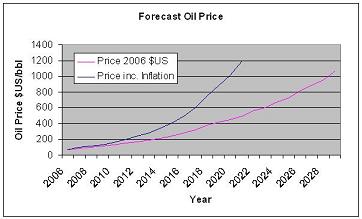
-----
In response to some of the comments and for interest sake I have conducted another run of the model. This time I used a supply curve that reflecting a higher decline rate ie. 4% year on year at 2020. The resulting price graph follows.
A couple of things to note about the effects of this change :
- the normal distribution curve I have now used has a total recoverable reserves at 2006 of slightly less than 700 Billion barrels. I am sure there will be a lot of opinions about the truth here but from what I have studied this number is too low. Oil prices above US$1000 will serve to convert a lot of resources into reserves. I think a figure closer to 900 Billion barrels makes more sense to me.
- the effect of the higher decline rate is not nearly as pronounced as one would expect. Well at least it was not as severe as I expected. This is a result of higher renewables and substitutes mitigating the shortfall. The model now shows 8.2 Mbpd of these on the supply side at 2020.
I thought this may be of further interest to people particularly those who are strong on the conspiracy behind reserve declarations.
Said by Phoenix:
World crude oil production was about 73 Mb/d in 2007 according to figure 2 in Oilwatch Monthly - April 2008. 85 Mb/d is the value for world liquid fuel production in 2007 which includes LNG and ethanol (figure 1).
When the demand on oil decreases the price will lower. Research in ALT powered vehicles like self generating power cells from rare earth magnetic powered generators will be introduce shortly thereby, reducing the demand for fossil fuels.
This is great! Thanks, Phoenix, for putting in all that effort! A comment and a suggestion, though (isn't there always?). First the comment:
From my (admittedly limited) understanding of coupled systems with delay in the feedback loops, it's unlikely that the result will be a monotonic function (smoothly rising with no falls). Oscillation is more usual in such systems. (Unless the drive signal completely overwhelms the system's response.)
So for example the price could be $200 in 2012 and $65 in 2013, then $240 in 2015, etc.
And now the suggestion: Phoenix's approach seems to be broadly in line with the System Dynamics method, which applies engineering concepts and methods to complex systems (such as the market for oil). Much more realistic (and successful) than traditional infinite-world economic models.
It'd be great if Phoenix's spreadsheet model could be converted to a model in one of the more common System Dynamics software packages, say iThink or Vensim. Converting the spreadsheet to a System Dynamics model could be very illuminating.